Army Ants: Social Predation, Nomadism and Tropical Ecology
Army ants are specialised social predators whose colonies hunt collectively, move between temporary nest sites and coordinate reproduction with large-scale foraging. William H. Gotwald Jr.'s 1995 book brought together their classification, colony biology, behaviour, associated organisms and ecological role, giving students a broad introduction to one of the most distinctive forms of social predation.
This explainer revisits that framework using later work on doryline taxonomy, colony cycles, swarm raids, ant-following birds and tropical food webs. It also separates historical classification from current systematics: groups treated in 1995 as Aenictinae, Dorylinae and Ecitoninae are now interpreted within a substantially revised evolutionary framework.
What made Gotwald's book an important synthesis
Gotwald's volume was designed as a primer for students and researchers rather than as a single experimental study. The book's contents show its breadth: introduction, classification and distribution, colony organisation, behaviour, guests and predators, ecosystem roles, and even the myths and metaphors that had grown around army ants.
That breadth matters because army-ant biology is difficult to understand by isolating one behaviour. Collective hunting is linked to colony movement, brood development, queen morphology and the availability of large, patchy prey. The book therefore treated social predation as a whole-colony way of life rather than simply an unusually large ant raid.
The army-ant syndrome links behaviour, reproduction and colony movement
Modern authors often describe an 'army ant syndrome' built around three connected traits: obligate collective foraging, nomadism and highly specialised queens. Workers do not rely on a single scout that finds prey and then recruits nestmates in the usual way. Instead, searching, attacking and retrieving prey are collective processes carried out by moving groups.
Nomadism is equally important. Colonies repeatedly relocate rather than depending on one permanent nest, and reproduction is tied to colony-level changes in brood demand. The queens are wingless and remain with workers when a colony reproduces by fission, so daughter colonies form by splitting an existing workforce rather than by a lone queen flying away to found a nest.
Army-ant predation is not simply many ants hunting together; it is a colony system built around collective movement, feeding and reproduction.
Bivouacs are living nests
Many army ants use temporary nests known as bivouacs. In conspicuous species such as Eciton burchellii, thousands of workers link their bodies together around the queen and brood, often inside a cavity, beneath a log or in another sheltered site. The result is a nest structure made largely from living ants rather than soil walls or a permanent carton nest.
This architecture suits a mobile colony. Workers can assemble and dismantle the bivouac as colony conditions change, allowing the brood and queen to move with the society. Different army-ant lineages use different nesting positions, including subterranean sites, so the exposed Eciton bivouac familiar from documentaries represents one form of a wider biological pattern.
Raids are organised without a central commander
Army-ant raids look highly coordinated, yet no individual directs the entire operation. Workers respond to local contacts, pheromone trails and the movement of nestmates. These simple interactions can generate long columns, branching trails or broad swarm fronts in which thousands of ants search simultaneously.
Experiments on Eciton burchellii show how collective behaviour can improve transport efficiency. Some workers use their own bodies to fill holes in an uneven trail surface, creating a smoother path for the traffic carrying prey back to the bivouac. The behaviour benefits the colony because a small number of stationary workers can increase the speed of many moving foragers.
Swarm raids and column raids are not identical
Army ants differ in how they search. Some species move in relatively narrow columns and specialise strongly on the brood of other ants, whereas species such as Eciton burchellii can develop broad swarm fronts that flush many litter-dwelling animals. That difference in raid architecture affects both prey choice and which other forest animals can exploit the disturbance.
Brood development can switch a colony between statary and nomadic phases
One of the best-known patterns in Eciton is the alternation between a statary phase and a nomadic phase. During the statary phase the colony remains at one bivouac for a prolonged period while the queen lays eggs and much of the brood is in egg or pupal stages. Raids continue, but movement of the whole colony is reduced.
When larvae dominate the brood, food demand rises and the colony enters a nomadic phase. Raiding becomes more intense and emigrations occur repeatedly as the colony follows new foraging opportunities. The cycle therefore links internal brood development with external movement and predation rather than representing random wandering.
Army ants are diverse, and the most visible species are not typical of all of them
Public images of army ants are dominated by large, surface-raiding Eciton or African Dorylus, but many species are smaller, nocturnal or mainly subterranean. That hidden diversity has practical consequences for research because ordinary ground-ant sampling can miss species whose raids occur below the surface or at times when observers are absent.
O'Donnell and colleagues quantified this problem across four Neotropical forests. They recorded 22 army-ant species and found strong differences among sites in species composition, raid activity and daily timing. The result cautions against treating observations from one famous species or one forest as representative of all army-ant communities.
How the scientific picture changed after 1995
Topic | 1995 framework | Later evidence | Current interpretation |
Classification | Army ants discussed across Aenictinae, Dorylinae and Ecitoninae | Molecular work merged several former subfamilies into an expanded Dorylinae | The historical names remain useful for reading older literature but are not the current subfamily-level arrangement |
Evolution of the syndrome | Morphology and behaviour supported broad cross-continental comparison | 2003 work supported one origin; larger 2019 phylogenomic analyses favoured convergent Old- and New-World origins | Evolutionary interpretation changed as molecular datasets and models improved |
Community ecology | Ecological role described from natural history and species accounts | Standardised surveys found strong geographic variation in raid activity and species composition | Army-ant effects differ among forests and lineages |
Associated species | Guests, predators and followers treated as a major part of army-ant biology | Recent reviews document extensive bird and arthropod associations around swarm-raiding species | Army-ant colonies function as moving ecological hubs for many other organisms |
Taxonomy has changed substantially since the book was published
Gotwald's 1995 book treated Aenictinae, Dorylinae and Ecitoninae as separate army-ant subfamilies, reflecting the classification used at the time. Molecular studies later showed that the broader doryline radiation needed major revision. Brady and colleagues in 2014 proposed combining six former dorylomorph subfamilies into a single expanded Dorylinae.
Borowiec's 2016 generic revision then reorganised the subfamily using molecular evidence and morphology, recognising 28 genera, including 27 living genera. This does not make Gotwald's behavioural synthesis obsolete, but readers using the book for identification or higher classification need to translate older names into the modern system.
The evolutionary story also changed more than once
In 2003, a molecular analysis by Brady strongly supported a single origin of the army-ant syndrome. Later, much larger phylogenomic datasets produced a different result. Borowiec's 2019 analysis of 2,166 loci generally supported convergent evolution of the syndrome in Old World and New World doryline lineages, while also showing that some deep relationships remain sensitive to analytical assumptions.
Army ants are top predators, but their ecological effects vary by place
Army ants can exert intense local predation because raids mobilise large numbers of workers over a short period. Many lineages specialise on other social insects, especially ant brood, whereas some conspicuous swarm raiders take a broader range of litter arthropods and other prey.
Yet the ecological effect of an army-ant community cannot be inferred from the presence of one species. O'Donnell and colleagues found that raid activity differed by more than fourfold between the most and least active sites in their four-forest comparison, and the dominant species also changed among sites. Predation pressure is therefore geographically heterogeneous.
Raids create feeding opportunities for other animals
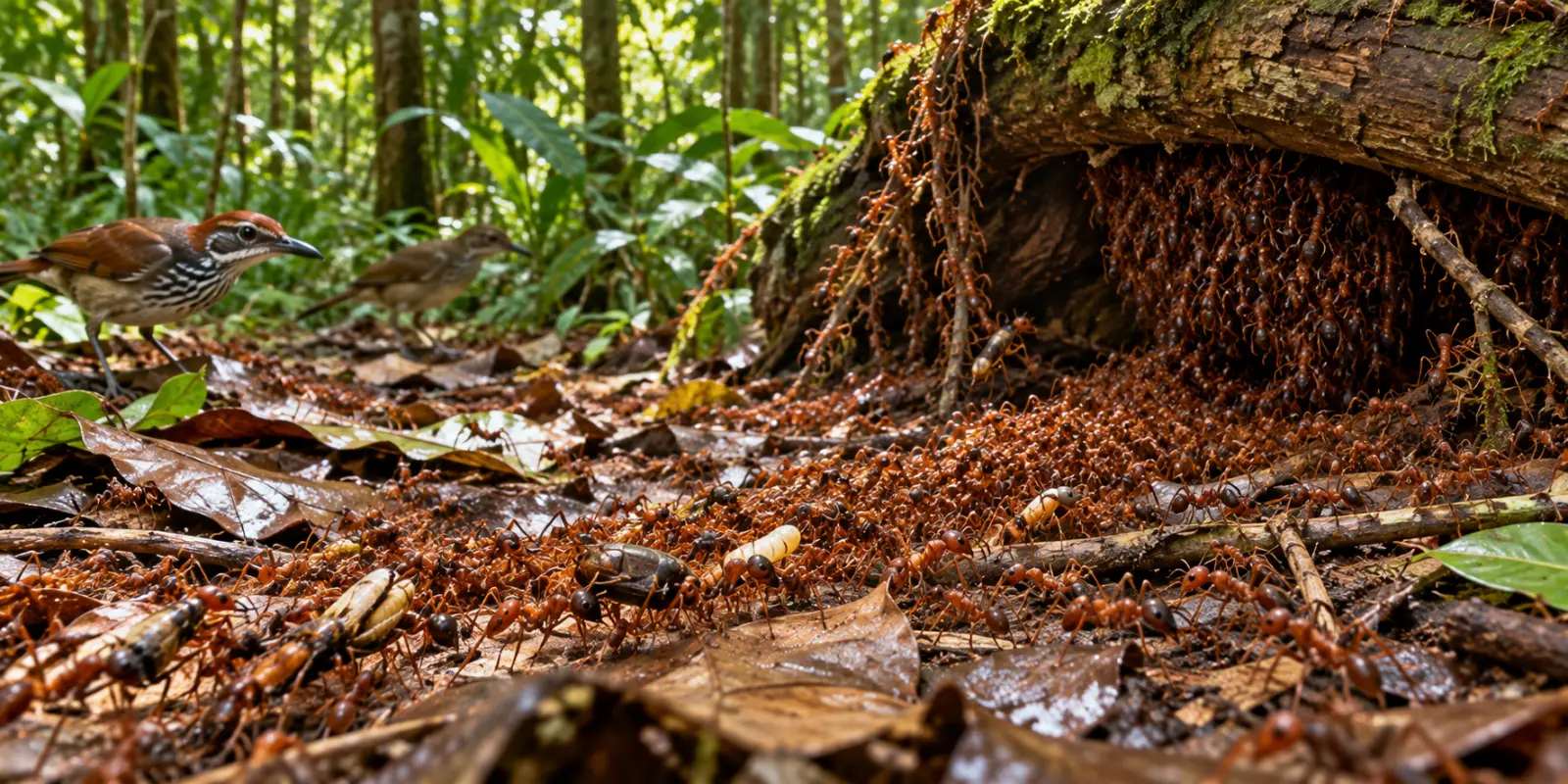
Swarm-raiding ants disturb animals hidden in leaf litter and vegetation. Birds can exploit this by following the advancing ants and capturing insects, spiders and small vertebrates attempting to escape. The birds are not primarily eating the army ants; they are using the raid as a moving source of flushed prey.
A 2021 review described army-ant following as one of the iconic ecological interactions of Neotropical forests. The relationship ranges from opportunistic attendance to specialised species whose foraging ecology is strongly tied to ant swarms. Other attendants include flies, beetles, mites, wasps and butterflies, producing multilayered communities around active colonies.
The ants themselves also have specialised guests, parasites and predators
Gotwald devoted a chapter to 'guests and predators' because an army-ant colony is more than a predator population. Some organisms live in or around bivouacs, travel with emigration columns or exploit material discarded by the colony. Others attack workers, brood or associated animals.
These relationships make army ants useful systems for studying adaptation to a mobile host society. A symbiont that depends on an army-ant colony must cope with frequent nest relocation, dense worker traffic and chemical recognition systems. That creates strong selection for behavioural and morphological specialisation.
Why social predation can support very large colonies
Collective raids give army ants access to prey that would be difficult for solitary workers to subdue or exploit efficiently, including the brood stores of other social insects. Once a prey patch is found, a large workforce can overwhelm defenders, retrieve many prey items and rapidly redirect traffic through trail-based recruitment.
The strategy also carries costs. Large colonies require continual food, and prey patches are temporary. Nomadism, broad searching fronts and repeated relocation reduce dependence on one depleted area. In this sense, the colony's mobility and predatory strategy are functionally linked rather than separate curiosities.
Conservation depends on enough connected forest for a mobile predator
Army ants need space because colonies move repeatedly and forage over substantial areas. Forest fragmentation can therefore affect them directly and can also affect specialised followers that rely on predictable access to swarms.
Recent conservation work has proposed Eciton army ants as useful umbrella organisms for Neotropical forest conservation because protecting the habitat requirements of large, mobile colonies can also protect many associated species. This idea is strongest for specialised swarm-raiding systems and should not be generalised automatically to every army-ant lineage.
What readers should keep from the 1995 synthesis
Gotwald's book remains valuable because it connected classification, behaviour, colony organisation and ecosystem ecology in one account. Modern research has changed the higher taxonomy and revised hypotheses about evolutionary origins, but the central biological insight remains: army ants are best understood as integrated societies rather than ordinary ants that happen to forage in large groups.
A useful modern reading separates:
- the historical taxonomy used in the 1995 book from the current Dorylinae classification;
- well-studied surface-raiding Eciton from the many nocturnal and subterranean army-ant species;
- colony-level mechanisms such as brood cycles and pheromone-guided raids from ecosystem effects measured across forests;
- direct prey capture by ants from the secondary feeding opportunities created for ant-following birds and other associates;
- spectacular natural-history observations from claims that have been tested with modern phylogenetic, behavioural or community data.
Taken together, Gotwald's 1995 synthesis remains a useful foundation for understanding army-ant social predation and colony biology, while modern taxonomy and phylogenetics provide the current framework for interpreting their evolutionary relationships.
Frequently asked questions
What makes an ant an army ant?
Army ants are defined functionally by a combination of obligate collective foraging, frequent colony relocation and specialised reproductive biology. Their workers hunt in coordinated groups rather than relying on solitary foragers. The exact expression of these traits varies among lineages, so the term describes a biological syndrome rather than one simple appearance.
Do army ants build permanent nests?
Many army ants do not rely on permanent built nests. Colonies instead occupy temporary sites and may form bivouacs in which workers link their bodies around the queen and brood. Some species nest below ground or in cavities, so the large exposed bivouacs of Eciton are only one form of temporary nesting.
Why do army ants move so often?
Movement is linked to the colony's feeding strategy and brood cycle. Large larval cohorts create intense food demand, and repeated emigration gives the colony access to new prey patches. In phasic species such as Eciton, nomadic periods alternate with more stationary periods when brood composition and queen reproduction differ.
Do birds that follow army ants eat the ants?
Usually the main attraction is not the ants themselves. Swarm raids flush insects, spiders and small vertebrates from leaf litter and vegetation, creating feeding opportunities for birds. Some bird species attend swarms opportunistically, while others are much more specialised and organise a large part of their foraging around army-ant activity.
Is Gotwald's 1995 classification still current?
Not in full. The book reflects the higher classification used in the early 1990s, including Aenictinae, Dorylinae and Ecitoninae as separate subfamilies. Molecular phylogenetics later reorganised these groups within an expanded Dorylinae, and modern studies have also revised hypotheses about how many times the army-ant syndrome evolved.
Sources
- Gotwald WH Jr. Army Ants: The Biology of Social Predation. Ithaca, NY: Cornell University Press; 1995. 302 pp. ISBN 978-0-8014-2633-9.
- Kronauer DJC. Recent advances in army ant biology (Hymenoptera: Formicidae). Myrmecological News. 2009;12:51–65. doi:10.25849/myrmecol.news_012:051.
- Brady SG. Evolution of the army ant syndrome: the origin and long-term evolutionary stasis of a complex of behavioral and reproductive adaptations. Proceedings of the National Academy of Sciences. 2003;100(11):6575–6579. doi:10.1073/pnas.1137809100.
- Brady SG, Fisher BL, Schultz TR, Ward PS. The rise of army ants and their relatives: diversification of specialized predatory doryline ants. BMC Evolutionary Biology. 2014;14:93. doi:10.1186/1471-2148-14-93.
- Borowiec ML. Generic revision of the ant subfamily Dorylinae (Hymenoptera, Formicidae). ZooKeys. 2016;608:1–280. doi:10.3897/zookeys.608.9427.
- Borowiec ML. Convergent Evolution of the Army Ant Syndrome and Congruence in Big-Data Phylogenetics. Systematic Biology. 2019;68(4):642–656. doi:10.1093/sysbio/syy088.
- O'Donnell S, Lattke J, Powell S, Kaspari M. Army ants in four forests: geographic variation in raid rates and species composition. Journal of Animal Ecology. 2007;76(3):580–589. doi:10.1111/j.1365-2656.2007.01221.x.
- Powell S, Franks NR. How a few help all: living pothole plugs speed prey delivery in the army ant Eciton burchellii. Animal Behaviour. 2007;73(6):1067–1076. doi:10.1016/j.anbehav.2006.11.005.
- Martínez AE, Pollock HS, Rodrigues PF, Touchton JM. Army-ant following in Neotropical birds: A review and prospectus. Ornithology. 2021;138(1):ukaa078. doi:10.1093/ornithology/ukaa078.

Imogen Farrant — author
Imogen Farrant is an animal health and welfare writer with a background in animal science and a particular interest in companion animal welfare. Her work focuses on translating veterinary and animal-welfare research into clear, accessible information for pet o...
Related
Mites That Ride Bark Beetles: Four Species Described in 2000
Florida Camaenid Snails: Introduced Species and Plant Damage
Biting midges: biology, disease transmission and control
Blackflies: biology, life cycle, ecology and disease-vector roles
Insect pheromones and chemical communication in social insects
Stomoxyine Biting Flies: Biology, Livestock Impact and Control