Florida Camaenid Snails: Introduced Species and Plant Damage
The most important agricultural point in the 1993 account is that the two species were not considered equally damaging. Zachrysia provisoria was described as a voracious herbivore that caused significant damage to ornamental plants in southern Florida, whereas the other introduced species was not considered an agricultural pest. The circular records two introduced Florida land snails with different levels of reported plant-pest significance.
What did the 1993 Florida camaenid account examine?
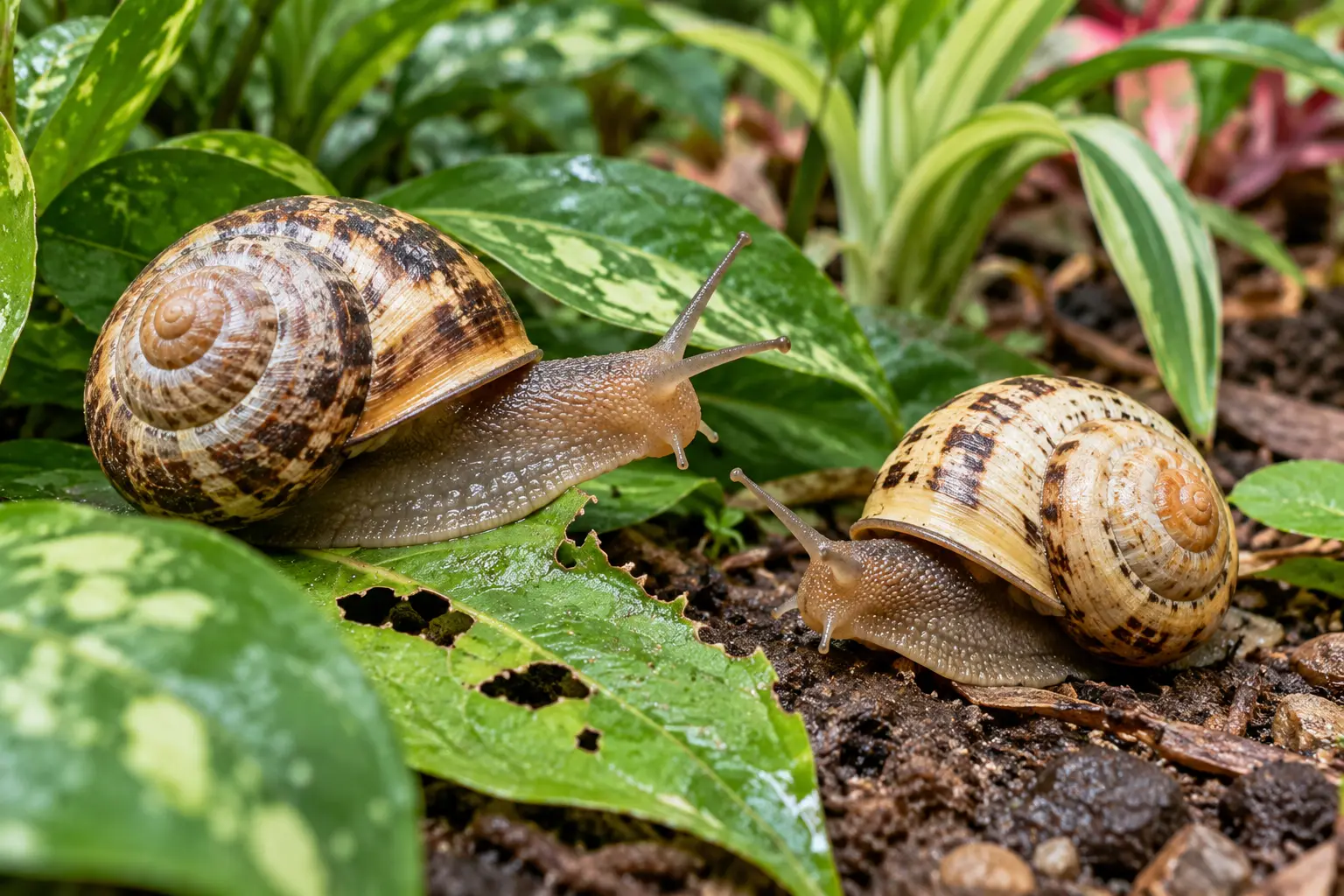
Auffenberg and Stange focused on two introduced terrestrial gastropods recorded in Florida. The 1993 account states that diagnoses were provided for both species, together with notes on habitat and distribution. The circular was therefore designed as a practical identification and occurrence account rather than a long ecological experiment.
The distinction between species occurrence and agricultural importance is central to introduced-species management. Both snails were introduced, but only one was characterized as causing significant damage to ornamental plants. That difference prevents the broad conclusion that every introduced camaenid snail in Florida should be treated as an equivalent plant pest.
Why historical taxonomy needs careful interpretation
The 1993 title uses Camaenidae and the older pulmonate classification that was standard at the time. Later taxonomic treatments place the Florida species discussed in this literature within Pleurodontidae, and modern references may use Caracolus marginella where older literature used Caracolus marginellus. These changes do not invalidate the historical record, but they matter when readers search modern databases or compare older pest literature with current names.
The terminology used in the 1993 publication reflects the classification accepted at that time, while current nomenclature can be identified separately. Keeping historical and current terminology distinct makes it possible to compare the original Florida account with later taxonomic treatments without confusing classifications from different periods.
Which introduced snails were important in the Florida account?
The 1993 account discusses two introduced camaenid gastropods in Florida. Later University of Florida material derived from the same circular identifies the focal species as Zachrysia provisoria and Caracolus marginella, historically also written Caracolus marginellus. Both are terrestrial, air-breathing snails, but their practical significance in Florida was described differently.
Zachrysia provisoria is the species singled out in the 1993 account as a voracious herbivore and a cause of significant damage to ornamental plants in southern Florida. The other species was explicitly described as not being considered an agricultural pest. This contrast is the central management message of the publication.
Why species-level identification matters for pest decisions
A land snail found on vegetation is not automatically evidence of economically important plant damage. Species differ in feeding behaviour, abundance, habitat use and ability to persist around cultivated plants. Identification therefore comes before pest classification.
The 1993 circular supported this process by supplying diagnoses for the two introduced species. A diagnosis highlights characters that help separate one taxon from another, which is particularly useful when superficially similar land snails occur in the same region.
Table 1. Main distinctions emphasized by the 1993 account
Feature | Zachrysia provisoria | Other introduced species in the account |
Status in Florida | Introduced | Introduced |
Feeding significance | Described as a voracious herbivore | Not described as a major plant-feeding pest |
Agricultural relevance | Significant damage to ornamental plants in southern Florida | Not considered an agricultural pest |
Source coverage | Diagnosis, habitat and distribution notes | Diagnosis, habitat and distribution notes |
Why is Zachrysia provisoria important to ornamental plants?
The strongest pest statement in the 1993 account concerns Zachrysia provisoria. Auffenberg and Stange described it as a voracious herbivore and reported significant damage to ornamental plants in southern Florida. The reported damage concerned ornamental vegetation in southern Florida, not all crops throughout the state.
Ornamental landscapes can provide food, moisture and shelter for terrestrial snails. Damage from herbivorous snails may become especially visible on foliage and young plant tissue. The 1993 circular does not quantify percentage yield loss, economic cost or damage thresholds, so its findings establish the presence of ornamental-plant damage without providing a numerical estimate of its economic severity.
What does “significant damage” establish - and what does it not?
In the 1993 account, “significant damage” establishes that the species had practical pest importance for ornamental plants in southern Florida. It does not provide a statewide damage estimate or prove that every population causes the same level of injury. Location, plant species, moisture and snail abundance can all affect the severity observed in a particular setting.
Modern extension material continues to treat Z. provisoria as a plant-feeding snail of concern in Florida, supporting the persistence of the pest interpretation beyond the 1993 circular. That later material represents subsequent evidence rather than information contained in the original two-page publication.
How do habitat and distribution help explain introduced snails?
Auffenberg and Stange included notes on habitat and distribution because occurrence records are essential for understanding introduced terrestrial molluscs. A species may be present in a state yet restricted to particular localities, habitats or human-modified environments. Distribution information helps distinguish an isolated record from a more established pattern.
Terrestrial snails are strongly influenced by moisture, shelter and access to food. Gardens, nurseries and landscaped areas can create favourable microhabitats, especially in warm and humid regions. The brief 1993 account provides habitat and distribution information but does not establish a complete ecological profile for either species. More detailed habitat patterns require evidence from fuller species accounts and subsequent observations.
Ornamental plantings vary considerably between sites, including the amount of irrigation, shade and ground cover. These conditions can influence where land snails remain active and where feeding damage is most likely to be noticed. Observations from one garden or nursery cannot automatically describe every landscape in southern Florida. Local records are most informative when the snail is identified and the affected plants and location are documented together.
Why southern Florida is relevant to the pest record
The 1993 account specifically associates significant ornamental-plant damage by Z. provisoria with southern Florida. That geographic wording is more precise than describing the species as uniformly damaging throughout the entire state.
Florida also has a long history of introduced terrestrial molluscs, and later work has continued to document non-native snails and slugs in the state. These later records provide broader invasion context without changing the narrower claims made in the 1993 account.
How can introduced land snails spread into new areas?
The 1993 account does not identify a specific introduction pathway for the two focal species. It therefore does not establish whether a particular shipment, nursery, vehicle or deliberate release caused their arrival in Florida. Human-assisted transport remains part of the broader context of terrestrial-snail introductions rather than a documented pathway for these particular Florida records.
For terrestrial snails more broadly, movement of plants, soil, containers and other materials can contribute to human-assisted transport. Small snails, juveniles or eggs may be difficult to notice when associated with traded material. Once introduced, suitable climate and habitat determine whether a species can persist and spread.
Why introduction history is often difficult to reconstruct
An introduced species may be discovered only after it has already established a local population. By that point, the original transport event may be impossible to identify. Historical records can therefore document presence and distribution more reliably than the exact route of arrival. Historical records document the presence and distribution of introduced snails, although the original pathways and dates of introduction may remain uncertain.
For a useful identification record, photographs should show the shell from more than one angle and include an indication of scale. Notes about the collection site, date and nearby vegetation help distinguish an incidental sighting from repeated occurrence. Feeding damage should be documented separately from the presence of a snail, since damaged leaves can have several possible causes. A specialist determination can connect the observation to the correct species name and its known biology.
How should Florida land snails be identified?
Identification of terrestrial snails commonly begins with shell form, size, colour pattern, sculpture and aperture characters. Historical field accounts often relied heavily on shell morphology because shells are easy to preserve and compare. The 1993 circular supplied diagnoses intended to distinguish the two introduced species.
Shell appearance can still be useful, but colour and shape may vary within a species. Modern identification may also use anatomical characters and, where needed, molecular evidence. Photographs can support a preliminary identification, but regulatory or management decisions may require confirmation by a specialist.
Why common appearance is not enough for a pest label
Many terrestrial snails share broad features such as rounded shells and plant-associated habitats. Similar appearance does not imply identical feeding behaviour or agricultural importance. The two introduced species differed in their documented pest significance.
A correct name also connects an observation with the appropriate biological literature. Misidentification can lead to the wrong assumptions about diet, distribution or control priorities.
Table 2. Information useful when documenting an introduced land snail
Observation | Why record it | What it cannot prove alone |
Shell photographs | Support later identification and comparison | Pest status or feeding damage |
Location | Documents geographic occurrence | How the snail arrived |
Host or nearby plant | Shows the vegetation where the snail was found | That the snail caused observed injury |
Feeding observation | Provides direct behavioural evidence | Statewide economic importance |
Multiple life stages | May suggest local reproduction | The original date of introduction |
Expert identification | Improves taxonomic confidence | Population size without survey data |
What is the difference between an introduced species and an agricultural pest?
An introduced species occurs outside its native range because of human-associated movement, whether deliberate or accidental. Agricultural pest status is a different concept: it depends on harmful effects on crops, ornamental plants, stored products or other managed resources. A species can therefore be introduced without being an important agricultural pest.
The 1993 circular demonstrates this distinction directly. Both focal gastropods were introduced in Florida, yet the account assigns significant ornamental-plant damage to Z. provisoria while stating that the other species was not considered an agricultural pest.
Why invasion status and damage should not be conflated
Introduced organisms can have ecological, economic or negligible effects depending on species and context. Labeling every non-native snail as a serious pest would erase these differences and could misdirect monitoring resources. Conversely, failing to recognize a damaging herbivore can allow injury to continue in nurseries and landscapes.
Evidence-based management therefore asks separate questions: Is the species native or introduced? Is it established? What does it feed on? What measurable harm does it cause? The answers may differ even among closely related snails.
The historical comparison remains relevant because scientific names and assessments of pest importance answer different questions. A revised family placement changes the taxonomic context but does not itself demonstrate a change in feeding behaviour. Conversely, a historical report of plant injury does not establish how widespread that injury is decades later. Taxonomic references, contemporary occurrence records and documented feeding observations provide distinct kinds of information that should be considered together.
What has changed since the 1993 publication?
The most obvious change is taxonomic terminology. The historical circular used Camaenidae and Pulmonata, whereas later sources commonly treat the focal American taxa within Pleurodontidae. Names and higher classification can change as malacological systematics develops.
The Florida account itself also remained influential. University of Florida extension material subsequently republished and expanded information derived from Entomology Circular 356, keeping the identification and pest relevance of these snails accessible to a wider audience.
How should an older identification source be used today?
Historical sources are valuable for documenting when a species was known, where it had been reported and how specialists described its importance at the time. They are particularly useful for tracing introduced-species history. Current identification, taxonomy and regulatory decisions should nevertheless be checked against modern authoritative sources.
This approach preserves the evidence without treating a 1993 classification as permanently fixed. It also prevents later taxonomic revisions from being incorrectly attributed to Auffenberg and Stange.
What does the 1993 Florida account establish?
The 1993 account documents two introduced camaenid gastropods in Florida and provides diagnoses together with notes on habitat and distribution. Zachrysia provisoria was described as a voracious herbivore associated with significant damage to ornamental plants in southern Florida, whereas the other species was not considered an agricultural pest.
The publication does not provide population estimates, statewide economic losses, experimental feeding rates or a detailed chronology of introduction. It also cannot establish present-day distribution from historical observations alone. Current occurrence patterns require contemporary surveys and species records.
Which conclusions should remain cautious?
The findings do not indicate that all introduced land snails are destructive, that Z. provisoria damages every plant species or that its 1993 distribution remains unchanged today. The circular is a historical diagnostic and pest account rather than a statewide quantitative risk assessment.
The contrast between the two introduced snails connects species identification with plant protection. That distinction remains useful when interpreting introduced terrestrial molluscs today.
Table 3. Evidence documented in the 1993 account and its limits
Documented in the 1993 account | Outside the scope of the 1993 account |
Two introduced camaenid gastropods were discussed from Florida | Current statewide distribution in 2026 |
Diagnoses were provided for both species | A complete molecular identification framework |
Habitat and distribution notes were included | Exact pathway or date of each introduction |
Z. provisoria was described as a voracious herbivore | Equal damage to every ornamental or crop species |
Significant ornamental-plant damage was reported in southern Florida | A statewide economic-loss estimate |
The other species was not considered an agricultural pest | That it can never have any ecological effect |
Practical takeaway: The 1993 Florida account shows why introduced-species identification and pest assessment must be kept separate. Zachrysia provisoria was associated with significant ornamental-plant damage, while the other introduced snail in the account was not considered an agricultural pest; current decisions should combine this historical evidence with modern taxonomy and up-to-date distribution records.
Frequently asked questions
Which introduced land snails are found in Florida?
Auffenberg and Stange described two introduced terrestrial snails in Florida in 1993: Zachrysia provisoria and a species historically named Caracolus marginellus, also treated as Caracolus marginella in later references. The account supplied identification information and habitat and distribution notes. The two species had different reported agricultural significance.
Does Zachrysia provisoria damage ornamental plants in Florida?
Yes. Auffenberg and Stange reported significant damage to ornamental plants in southern Florida and described Zachrysia provisoria as a voracious herbivore. The report did not calculate statewide economic losses or demonstrate equal damage across every plant species. Local conditions, feeding observations and reliable identification remain important when assessing a particular infestation.
Are all introduced land snails agricultural pests?
No. Introduced status concerns a species occurring outside its native range, whereas pest status concerns harmful effects on managed plants or other resources. The 1993 Florida account illustrates this difference: Zachrysia provisoria was associated with significant ornamental-plant damage, but the second introduced snail was not considered an agricultural pest.
Why do Florida land snails have different scientific family names?
Scientific classifications can change as researchers revise relationships among species. Auffenberg and Stange used Camaenidae and Pulmonata in their 1993 publication, while later treatments commonly place the American snails discussed there within Pleurodontidae. Older species spellings may also differ from those in modern taxonomic references, so both the date and the naming system matter.
Sources
- Auffenberg K, Stange LA. The Camaenidae (Mollusca: Pulmonata) of Florida. Entomology Circular (Gainesville). 1993;(356):1–2.
- Auffenberg K, Stange LA, Capinera JL, White J. Pleurodontid snails of Florida: Caracolus marginella, Zachrysia provisoria and Zachrysia trinitaria. University of Florida IFAS Extension. 2011;EENY-118.
- MolluscaBase. Zachrysia provisoria (L. Pfeiffer, 1858). Taxonomic record.
- MolluscaBase. Caracolus marginella (Gmelin, 1791). Taxonomic record.
- Cowie RH, Dillon RT, Robinson DG, Smith JW. Alien non-marine snails and slugs of priority quarantine importance in the United States: A preliminary risk assessment. American Malacological Bulletin. 2009;27(1–2):113–132.
- Florida Museum of Natural History. Invertebrate Zoology collections and terrestrial mollusk research resources.
- Auffenberg K, Stange LA. New records of the Cuban land snail Caracolus marginellus in Dade County, Florida. Malacological Review. 1993;26:95.

Lucas Merritt — author
Lucas writes animal science and zoology explainers. His editorial focus includes animal ecology, terrestrial and aquatic invertebrates, molluscs, invasive species, animal behaviour, species distributions and interactions between animals, agriculture and natura...
Related
Mites That Ride Bark Beetles: Four Species Described in 2000
Army Ants: Social Predation, Nomadism and Tropical Ecology
Biting midges: biology, disease transmission and control
Blackflies: biology, life cycle, ecology and disease-vector roles
Insect pheromones and chemical communication in social insects
Stomoxyine Biting Flies: Biology, Livestock Impact and Control