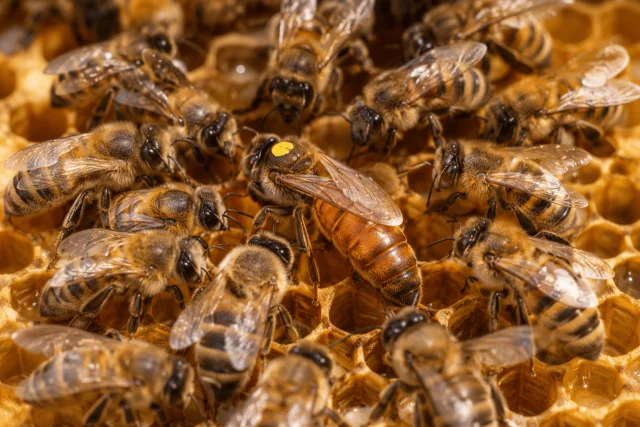















How do bees make honey from nectar inside the hive
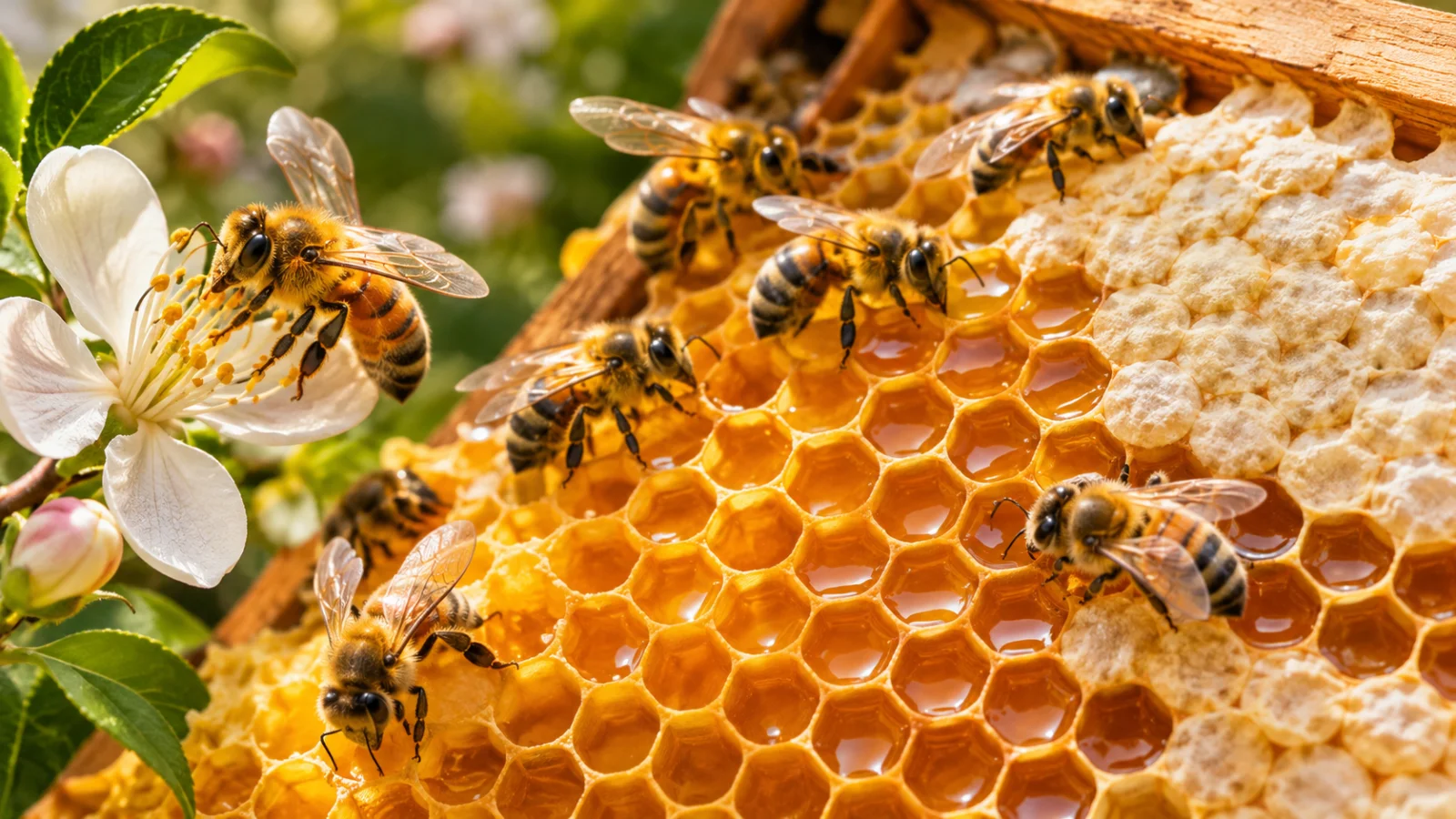
Bees make honey by collecting flower nectar, adding enzymes that split its sucrose into simpler sugars and evaporating most of its water until it becomes highly concentrated, typically reaching around 80% sugar or more as it ripens into honey, before sealing it in wax cells. The work is shared: foragers start drying the nectar on the way home, younger bees inside the hive finish the job, and the whole colony then lives on the stored honey when flowers are scarce.
This explainer follows nectar from the flower to the capped cell, sets out what the enzymes and evaporation each contribute, and explains why honey resists spoiling. It also covers what bees do with their honey once it is made. It draws on field measurements of nectar in foragers’ crops, imaging of storage cells inside living colonies, studies of the enzymes bees add, and research on how colonies use honey for heat and health.
How do bees make honey?
Honey is a concentrated, enzyme-modified form of nectar, the sugary liquid that flowers secrete to attract pollinators. The international Codex Alimentarius standard defines honey as the natural sweet substance produced by honey bees from the nectar of plants, or from certain plant secretions and insect excretions, which bees collect, transform, combine with substances of their own, dehydrate, store and leave in the comb to ripen (Codex Alimentarius Commission, 2001).
That definition already contains the three steps that matter. Bees change the sugars, they remove water, and they store the product in a way that lets it finish maturing. In a review of how honey bees use their stores, Berenbaum and Calla (2021) pointed out that many insects drink nectar, but only a small group of bees and wasps processes and stores it, and the honey bee has taken the practice furthest.
Nectar and honey compared
The difference between the starting material and the product is large. Floral nectar is mostly water. On macadamia trees in South Africa, nectar sampled from flowers contained 20–30% sugar by weight (Nicolson et al., 2022). Honey sits at the other end of the scale: in a survey of 490 samples of American honey, the average water content was 17.2%, with fructose and glucose together making up the large majority of the dry matter (White et al., 1962).
International standards reflect the same picture. Under the Codex Alimentarius Standard for Honey (CXS 12-1981, revised in 2001 and subsequently amended), most honeys must contain no more than 20% water, at least 60 g of fructose and glucose combined per 100 g, and no more than 5 g of sucrose per 100 g. The standard provides exceptions for certain honey types and botanical origins, including heather honey, honeydew honey and some varieties with naturally higher sucrose concentrations. For bees, transforming nectar into honey requires removing much of its water and modifying its sugar composition, processes that take time and energy.
What happens to nectar on the way back to the hive?
A foraging bee sucks nectar into her crop, a stretchy storage sac in front of the true stomach that beekeepers often call the honey stomach. The crop works like a fuel tank and a shopping bag at once: the bee can draw on its contents for her own flight, but most of the load is carried home for the colony.
For a long time, researchers assumed that nectar stayed at its original concentration until it reached the hive. In the study “Honey bees save energy in honey processing by dehydrating nectar before returning to the nest” (2022), Nicolson, Human and Pirk tested this assumption in macadamia orchards in Mpumalanga, South Africa. They captured 30 foragers on flowers of each of four cultivars, plus 30 bees returning to the hive, and measured the sugar concentration of their crop contents.
The results overturned the old picture. Crop nectar of bees still working the flowers was about twice as concentrated as the nectar in the flowers themselves, with 56.5–75.3% of the original water already gone depending on the cultivar. Bees caught at the hive entrance carried nectar averaging 64% sugar, meaning they had lost about 81% of the original water before arriving (Nicolson et al., 2022).
Why drying in flight saves energy
Because the crop is otherwise watertight, the authors concluded that water loss was likely to occur through evaporation from the mouthparts. Using published estimates of flight metabolism and evaporation costs, Nicolson et al (2022) calculated that lighter nectar loads could reduce return-flight energy expenditure by approximately 13–19%.
They also estimated that pre-concentrating nectar spared the colony the evaporation of 16–27 mg of water per forager. On average, the estimated savings in processing energy were about 35 times greater than those in flight energy. These values were calculated rather than directly measured.
How do bees turn nectar into honey inside the hive?
Back at the hive, the forager does not usually deposit nectar herself. She passes it to younger workers who stay inside, and they take over the rest of the process.
Passing nectar mouth to mouth
The transfer happens by trophallaxis, a mouth-to-mouth exchange of liquid food. The forager regurgitates a droplet, a receiver bee draws it up, and the forager returns to the field. This division of labour lets foragers spend their time flying while house bees handle storage, and it relies on constant contact and [chemical signals between nestmates](/animals/pheromones-social-insect-chemical-communication-animals).
The system can adjust to sudden changes in supply. When a strong nectar flow begins, returning foragers may struggle to find a receiver and start a conspicuous signal called the tremble dance.
In the study “The honey bee’s tremble dance stimulates additional bees to function as nectar receivers” (1996), Seeley, Kühnholz and Weidenmüller stimulated tremble dancing and counted receivers before and after. In two trials, the share of the colony acting as nectar receivers rose from 17% to 30–50%. The new receivers were mostly middle-aged bees, with some young ones and no old ones.
Enzymes that change the sugars
As nectar moves from bee to bee, it picks up enzymes. The best known is invertase, which splits sucrose, the main sugar in many nectars, into glucose and fructose. In a study of honey ripening at the Institute of Bee Research in Hohen Neuendorf, Germany, Lichtenberg-Kraag (2014) found a highly significant correlation between invertase activity and sucrose content during ripening, and a feeding experiment with defined sucrose solutions supported the link. The author suggested that very high sucrose concentrations might exhaust the enzyme, a possibility that remains to be confirmed.
Splitting sucrose matters for storage. One sucrose molecule becomes two smaller sugar molecules, so the same amount of sugar exerts more osmotic pressure in solution. This helps explain why ripe honey draws water out of microbes that land in it.
A second enzyme adds a chemical defence. Glucose oxidase converts some of the glucose into gluconic acid and hydrogen peroxide.
Bucekova and colleagues (2014) showed that worker bees produce this enzyme only in their hypopharyngeal glands, in the head. Expression increased with age and was highest in nectar-processing bees and foragers compared with younger workers. Across natural honeys, samples with more glucose oxidase generally produced more hydrogen peroxide, and hydrogen peroxide levels tracked activity against the bacterium Pseudomonas aeruginosa in laboratory tests.
Drying the nectar
House bees continue the drying that foragers began. In a classic description, Park (1925) observed bees repeatedly extending a droplet of nectar on their mouthparts and drawing it back in, which exposes a large surface to the warm air of the hive. This active evaporation is combined with passive evaporation once nectar is spread in the comb.
The hive is kept warm and ventilated for exactly this purpose. Peters, Peleg and Mahadevan (2019) studied colonies of roughly 20,000–40,000 bees and noted that the nest is held at about 35–36 °C. Bees fanning their wings at the entrance generated airflow velocities of up to about 3 m/s.
By comparison, earlier computational models of passive ventilation driven by metabolic heat had predicted airflow velocities of up to approximately 0.03 m/s at the nest entrance (Peters et al., 2019). The fanners organised themselves into groups that separated zones of incoming and outgoing air, which carries moisture out of the nest.
Filling and sealing the cells
The last stage happens inside the comb, and until recently it was hard to observe without disturbing the colony. In the study “A look into the cell: honey storage in honey bees, Apis mellifera” (2016), Eyer, Neumann and Dietemann used computed tomography to scan storage cells in free-flying colonies fed sugar solutions of different strengths. Because sugar concentration changes the density of a solution, the scans showed how concentrated each cell’s contents were over time.
The imaging revealed a messier process than textbook diagrams suggest. Cells fell into two groups with different filling and ripening patterns, and bees often moved contents between cells before final storage, removing less concentrated liquid than they had deposited.
Solutions of different strength mixed within the same cell, so honey in the comb is not uniform. The final stage of ripening continued after bees had started capping cells with wax, which the authors described as a race against water absorption from the humid hive air (Eyer et al., 2016a). A related study by the same group found no clear spatial sorting of cells by sugar concentration during the first three days of storage (Eyer et al., 2016b).
As honey approaches maturity, bees begin sealing storage cells with wax. Capping helps protect the concentrated contents from atmospheric moisture, although measurements show that ripening can continue during the sealing process. Beekeepers commonly use capped comb as an indication of mature honey, but capping is not an absolute guarantee of a particular moisture content (Eyer et al., 2016a).
Stage | Sugar or water content | Source |
Floral nectar (macadamia) | 20–30% sugar | Nicolson et al., 2022 |
Crop of foragers still on flowers | About twice the floral concentration | Nicolson et al., 2022 |
Crop of foragers returning to the hive | 64% sugar on average, about 81% of water removed | Nicolson et al., 2022 |
Typical concentration of ripe honey | Around 80% sugar or higher; actual concentrations vary | Eyer et al., 2016a; Codex Alimentarius Commission, 2001 |
Average ripe honey (490 American samples) | 17.2% water | White et al., 1962 |
International standard for most honeys | No more than 20% water | Codex Alimentarius Commission, 2001 |
Why does honey keep for so long?
The same steps that turn nectar into honey also make it hostile to the yeasts and bacteria that spoil most foods. Several properties act together.
- Low water. With water content around 17% (White et al., 1962), there is too little free water for most microbes to grow.
- High sugar. The concentrated glucose and fructose draw water out of microbial cells by osmosis.
- Acidity. The average pH of the American honeys surveyed was 3.91 (White et al., 1962), partly because glucose oxidase produces gluconic acid.
- Hydrogen peroxide. The same enzyme releases hydrogen peroxide, especially when honey is diluted, and this contributes to antibacterial activity (Bucekova et al., 2014).
Honey still absorbs moisture from humid air, and if its water content rises, yeasts can begin to ferment it. This is why the timing of capping matters to the bees, and why the Codex standard limits water content in commercial honey (Codex Alimentarius Commission, 2001). The Codex standard restricts heating or processing that impairs honey quality. Experimental research has shown that microwave heating can inactivate glucose oxidase and reduce hydrogen peroxide-mediated antibacterial activity (Bucekova et al., 2018).
What do bees do with their honey?
The short answer to why bees make honey is that it is the colony’s food reserve. Nectar is available only while plants flower, but a colony needs energy all year. Honey is a compact, long-lasting way of storing that energy, and the colony draws on it whenever foraging stops.
Fuel for heat in winter
In temperate climates, honey is what carries a colony through winter. Honey bees do not hibernate. Instead, they form a tight cluster and generate heat with their flight muscles.
In the study “Endothermic heat production in honeybee winter clusters” (2003), Stabentheiner and colleagues measured body surface temperatures of bees in broodless winter clusters and found thorax temperatures averaging 30.4 °C in the core and 12.1 °C at the surface, while the air near the cluster was only 0.9–6.3 °C. About 15–16% of bees on the central comb were actively producing heat by shivering their flight muscles.
That heat is paid for with stored honey. Measurements in southwestern Sweden showed how much a colony uses.
Over 140 days in the winter of 2019–2020, colonies lost an average of 0.039 kg per day, a weight loss used as a proxy for consumption of honey and sugar stores. Most colonies lost less than 9 kg over the period, and differences between bee subspecies were marginal (Norrström et al., 2021). That winter was exceptionally mild, with an average temperature of 3.5 °C, so colonies in colder winters can be expected to need more.
More than a source of calories
Honey is not only sugar. Berenbaum and Calla (2021) argued that viewing honey simply as a carbohydrate source for bees is outdated. Its plant-derived compounds, some probably coming from propolis, the resin bees collect to line their nest, appear to help protect bees against microbes, toxins and cold, and to influence development and adult lifespan.
Experimental work supports this view. In the study “Honey constituents up-regulate detoxification and immunity genes in the western honey bee Apis mellifera” (2013), Mao, Schuler and Berenbaum identified three honey constituents that switched on detoxification genes in bees.
One of them, p-coumaric acid, which comes mainly from pollen, up-regulated all classes of detoxification genes and some antimicrobial peptide genes. Adding p-coumaric acid to a sucrose-based diet increased the metabolism of coumaphos, an acaricide used in beehives, in the honey bee midgut by approximately 60% under the experimental conditions (Mao et al., 2013). The authors suggested that replacing honey with simple sugar feeds might reduce bees’ ability to cope with toxins and pathogens, though that link to colony health has not been shown directly.
What is proven about how bees make honey, and what is not
The core sequence is well established. Bees collect nectar, add enzymes that convert sucrose and produce gluconic acid and hydrogen peroxide, evaporate water until the nectar reaches the high sugar concentration characteristic of ripe honey, and seal it in wax cells. Several points are now supported by direct measurement:
- Foragers remove a large share of the water before reaching the hive, about 81% in macadamia orchards (Nicolson et al., 2022).
- Invertase activity is closely linked to the fall in sucrose during ripening (Lichtenberg-Kraag, 2014).
- Glucose oxidase is made in the hypopharyngeal glands of workers and drives hydrogen peroxide production in honey (Bucekova et al., 2014).
- Ripening in the comb is uneven, involves moving nectar between cells and continues after capping begins (Eyer et al., 2016a).
- Colonies rely on stored honey to fuel heat production through winter (Stabentheiner et al., 2003; Norrström et al., 2021).
Honey is nectar that bees have dried, chemically altered and sealed, and the colony stores it as fuel for the months when no flowers bloom.
Some questions remain open. The pre-concentration of nectar in flight has been measured in one crop in one region, so how widespread it is across plants and climates is not yet known. Whether high sucrose levels really exhaust invertase is still a hypothesis.
The functional role of honey’s plant compounds for colony health has been shown at the level of genes and individual bees, but not yet in long-term colony survival. How honey’s properties translate to human health is a separate field, explored in studies such as a small trial of [garlic honey tea and blood pressure](/research/garlic-honey-tea-and-blood-pressure-what-a-small-human-study-found).
For readers interested in [insects and their biology](/animals?sub=entomology), the honey bee offers a clear example of a society that processes food collectively. A single jar of honey represents nectar that has passed through many bees, each removing a little more water and adding a little more enzyme. For anyone curious about [sugars and sweeteners](/nutrition?sub=sugars-sweeteners) in the diet, it also shows why honey’s composition differs from the nectar it started as.
Frequently asked questions
How long does it take bees to make honey?
There is no fixed time. It depends on the concentration of the nectar, weather and colony conditions. In macadamia orchards, returning bees had already removed approximately 81% of the nectar’s original water (Nicolson et al., 2022). Ripening can continue in the comb after the bees start capping the cells (Eyer et al., 2016a).
Is honey just bee vomit?
Not in the usual sense. Nectar is carried in the crop, a storage sac in front of the true stomach, so it is not digested before it is passed on. The crop is otherwise watertight, and water leaves only by evaporation from the mouthparts (Nicolson et al., 2022). Along the way, bees add enzymes that change the sugars.
Do all bees make honey?
No. Many insects drink nectar, but only a small group of bees and wasps processes and stores it, and the honey bee has taken the practice furthest (Berenbaum and Calla, 2021). Other nectar-feeding insects use it mainly as a supplemental food rather than turning it into a stored reserve for the whole colony.
Why do beekeepers wait until honey is capped?
A wax cap usually indicates that honey is approaching maturity, but it does not guarantee a particular moisture content. Honey containing too much water can ferment. The international Codex standard generally limits honey to 20% water (Codex Alimentarius Commission, 2001). Uncapped cells may still contain nectar that has not fully ripened.
Sources
- Nicolson, S.W., Human, H., Pirk, C.W.W. Honey bees save energy in honey processing by dehydrating nectar before returning to the nest. Scientific Reports, 2022, 12, 16224. DOI 10.1038/s41598-022-20626-5
- Eyer, M., Neumann, P., Dietemann, V. A look into the cell: honey storage in honey bees, Apis mellifera. PLoS ONE, 2016, 11(8), e0161059. DOI 10.1371/journal.pone.0161059
- Eyer, M., Greco, M.K., Lang, J., Neumann, P., Dietemann, V. No spatial patterns for early nectar storage in honey bee colonies. Insectes Sociaux, 2016, 63, 51–59. DOI 10.1007/s00040-015-0432-4
- Lichtenberg-Kraag, B. Evidence for correlation between invertase activity and sucrose content during the ripening process of honey. Journal of Apicultural Research, 2014, 53(3), 364–373. DOI 10.3896/IBRA.1.53.3.03
- Bucekova, M., Valachova, I., Kohutova, L., Prochazka, E., Klaudiny, J., Majtan, J. Honeybee glucose oxidase: its expression in honeybee workers and comparative analyses of its content and H2O2-mediated antibacterial activity in natural honeys. Naturwissenschaften, 2014, 101(8), 661–670. DOI 10.1007/s00114-014-1205-z
- Seeley, T.D., Kühnholz, S., Weidenmüller, A. The honey bee’s tremble dance stimulates additional bees to function as nectar receivers. Behavioral Ecology and Sociobiology, 1996, 39(6), 419–427. DOI 10.1007/s002650050309
- Park, O.W. The storing and ripening of honey by honeybees. Journal of Economic Entomology, 1925, 18(2), 405–410. DOI 10.1093/jee/18.2.405
- Peters, J.M., Peleg, O., Mahadevan, L. Collective ventilation in honeybee nests. Journal of the Royal Society Interface, 2019, 16, 20180561. DOI 10.1098/rsif.2018.0561
- White, J.W., Riethof, M.L., Subers, M.H., Kushnir, I. Composition of American honeys. Technical Bulletin 1261. United States Department of Agriculture, Agricultural Research Service, Washington DC, 1962.
- Codex Alimentarius Commission. Standard for Honey, CXS 12-1981, revised 2001. Food and Agriculture Organization of the United Nations and World Health Organization, Rome, 2001.
- Berenbaum, M.R., Calla, B. Honey as a functional food for Apis mellifera. Annual Review of Entomology, 2021, 66, 185–208. DOI 10.1146/annurev-ento-040320-074933
- Mao, W., Schuler, M.A., Berenbaum, M.R. Honey constituents up-regulate detoxification and immunity genes in the western honey bee Apis mellifera. Proceedings of the National Academy of Sciences of the USA, 2013, 110(22), 8842–8846. DOI 10.1073/pnas.1303884110
- Stabentheiner, A., Pressl, H., Papst, T., Hrassnigg, N., Crailsheim, K. Endothermic heat production in honeybee winter clusters. Journal of Experimental Biology, 2003, 206, 353–358. DOI 10.1242/jeb.00082
- Norrström, N., Niklasson, M., Leidenberger, S. Winter weight loss of different subspecies of honey bee Apis mellifera colonies (Linnaeus, 1758) in southwestern Sweden. PLoS ONE, 2021, 16(10), e0258398. DOI 10.1371/journal.pone.0258398
- Bucekova, M., Juricova, V., Monton, E., Martinotti, S., Ranzato, E., Majtan, J. Microwave processing of honey negatively affects honey antibacterial activity by inactivation of bee-derived glucose oxidase and defensin-1. Food Chemistry, 2018, 240, 1131–1136. DOI 10.1016/j.foodchem.2017.08.054.

Imogen Farrant — author
Imogen Farrant is an animal health and welfare writer with a background in animal science and a particular interest in companion animal welfare. Her work focuses on translating veterinary and animal-welfare research into clear, accessible information for pet o...
Related
Insect pheromones and chemical communication in social insects
Army Ants: Social Predation, Nomadism and Tropical Ecology
Mites That Ride Bark Beetles: Four Species Described in 2000
Biting midges: biology, disease transmission and control
Blackflies: biology, life cycle, ecology and disease-vector roles
Garlic Honey Tea and Blood Pressure: What the Study Found
Monarch butterfly migration and how monarchs find their way