















Monarch butterfly migration and how monarchs find their way
Each autumn, monarchs born across the eastern half of North America fly up to roughly 4,000 km to central Mexico, finding their way with a time-compensated sun compass whose timing depends partly on clocks in their antennae (Flockhart et al., 2017; Merlin et al., 2009). The northward return is completed across several successive generations rather than by the overwintering migrants alone (Flockhart et al., 2013).
The sections below trace the route, explain how one round trip is split between several generations, describe the navigation equipment that experiments have uncovered and look at the evidence behind the fall in monarch numbers. The account rests on tethered-flight tests with wild-caught migrants, chemical tracing of the places where wintering butterflies hatched, decades of colony measurements in Mexico and risk assessments by US researchers and wildlife officials.
What is the monarch butterfly migration?
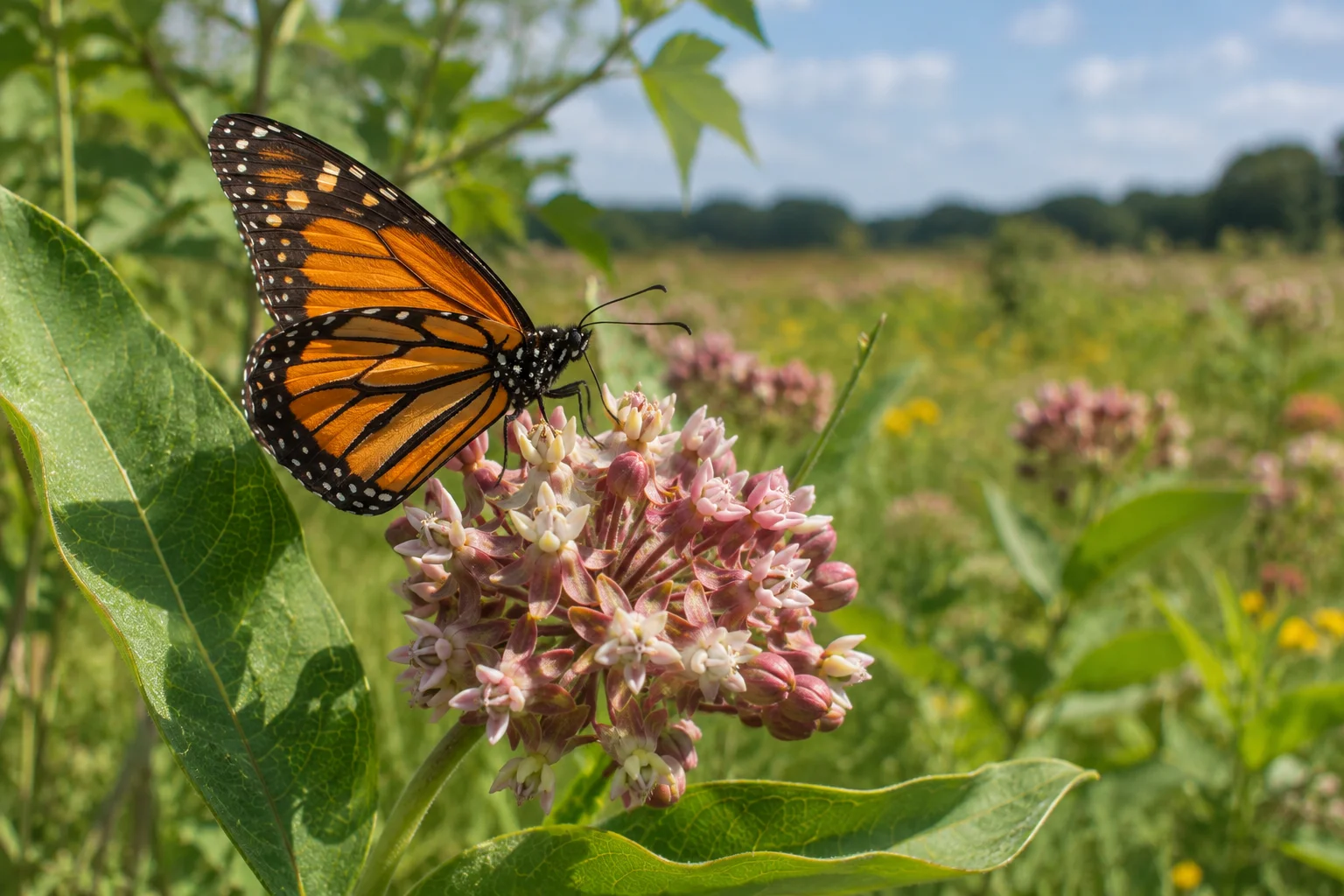
Plenty of insects drift with the seasons, but very few fly a fixed outbound leg and a return leg every year on a continental scale. Danaus plexippus is the famous exception. Monarchs that spend the summer from the Great Plains to the Atlantic coast and up into Canada funnel south in autumn towards a remarkably small target, with some covering close to 4,000 km on the way (Merlin et al., 2009).
That target is a set of cool conifer stands high in the Transvolcanic ranges of central Mexico. Butterflies start arriving at about the turn of November and stay until around the middle of March (Guerra and Reppert, 2013). Millions of them hang in clumps from branches and trunks. The forest canopy and dense clusters help buffer temperature extremes and reduce the risk of freezing while keeping the butterflies cool and relatively inactive.
West of the Rockies, a separate and much smaller group takes a shorter route to wintering groves on the Pacific coast. When US federal wildlife officials drew up proposed protections in 2024, the sites they singled out for this western group lay in seven Californian counties (US Fish and Wildlife Service, 2024b).
Distances flown by individual butterflies
Not every migrant faces the same journey, since the starting points are scattered over a huge breeding area. Flockhart and colleagues worked out how far individual butterflies had come in the study “Migration distance as a selective episode for wing morphology in a migratory insect” (2017). They examined 613 specimens gathered at the Sierra Chincua sanctuary over nearly four decades and used chemical markers locked into wing tissue to estimate each one's birthplace. The implied flights ranged from 774 km to 4,430 km.
Wings appeared to carry a trace of that effort. Butterflies with the longest estimated journeys tended to have bigger, longer forewings, whereas measures of shape, such as roundness, did not change with distance. The team was careful to call this a correlation: long flights might weed out small-winged individuals, but constant mixing of butterflies from different regions blurs any such pressure (Flockhart et al., 2017).
How many generations does the monarch migration take?
A useful way to picture the cycle is as a relay in which only one runner covers the long stretch. Adults hatched in midsummer usually survive just a few weeks, yet the autumn cohort can last for months (Reppert, 2006). That long-lived cohort makes the whole southward run and the first part of the return, after which shorter-lived descendants carry the population back across the continent. Every butterfly that reaches Mexico is therefore making its first and only visit.
In outline, a year looks like this:
- Butterflies that emerge at the end of summer hold off breeding and head for Mexico.
- After the winter, those same individuals leave the mountains, cross into the southern United States and lay eggs on fresh spring milkweed (Reppert, 2006).
- The young they produce push further north, and two or three brief summer generations follow one another across the breeding range (Reppert, 2006).
- The final summer brood switches into migrant mode, and the loop closes.
Following the northward relay
Chemical fingerprints have helped map the spring leg. For the study “Tracking multi-generational colonization of the breeding grounds by monarch butterflies in eastern North America” (2013), Flockhart and colleagues caught upwards of 800 butterflies at sites spread over the breeding range. Their analysis placed the birth of the first spring brood chiefly in Texas and Oklahoma, with subsequent broods hatching progressively further north and the Midwest standing out as a core nursery (Flockhart et al., 2013).
How a migrant differs from a summer butterfly
The long-distance cohort is built differently. Its members put reproduction on hold, a state known as reproductive diapause that persists through the winter. They lay down fat in the abdomen, cope better with cold and feel a powerful pull southward. Shortening day length is an important cue that acts together with fluctuating temperatures and, potentially, host-plant condition to promote reproductive diapause, while low levels of juvenile hormone are associated with suppressed reproduction and extended lifespan (Goehring and Oberhauser, 2002; Reppert, 2006).
Heading home needs a different cue. Guerra and Reppert set out to find it in the study “Coldness triggers northward flight in remigrant monarch butterflies” (2013). They held autumn migrants for 24 days under a simulated Mexican winter, at 11 °C by day and 4 °C at night, then tested them in a flight arena; the butterflies now aimed north.
Comparison groups that never experienced the chill kept flying southwest, and so did butterflies left under autumn settings all the way from October to mid-March. Months passing on the calendar were not enough. A spell of cold was what turned them around.
How do monarch butterflies find their way?
A first-time traveller aiming for a few hillsides in another country needs dependable directions. Most of what is known about the monarch’s guidance system comes from a simple set-up: a butterfly glued to a thin rod flies on the spot inside an open cylinder, and a sensor logs which way it tries to go.
Reading the sun with an internal timer
The sun makes a fine landmark only if its daily movement is taken into account. A butterfly heading south at 9 am and at 3 pm must hold the sun at quite different angles, so it needs some sense of the hour.
Mouritsen and Frost tested this in the study “Virtual migration in tethered flying monarch butterflies reveals their orientation mechanisms” (2002), using migrants caught by Lake Ontario. Insects whose daily rhythm matched local time aimed roughly southwest. Insects whose rhythm had been moved 6 hours ahead aimed southeast, and those moved 6 hours back aimed northwest.
Put simply, a butterfly fooled about the time of day misjudges where the sun ought to be, and its heading swings by a matching amount. That pattern is the signature of a sun compass with built-in time correction (Mouritsen and Frost, 2002).
Other insects use different navigational cues. For example, [chemical communication in social insects](/animals/pheromones-social-insect-chemical-communication-animals) can help coordinate movement and guide nestmates towards food, whereas the monarch experiments described here examine orientation using sunlight and internal timing.
Why the antennae matter
Most researchers expected the relevant timer to sit in the brain. Merlin, Gegear and Reppert put that assumption to the test in the study “Antennal circadian clocks coordinate sun compass orientation in migratory monarch butterflies” (2009), comparing migrants that still had their antennae with migrants that did not.
Butterflies with intact antennae maintained a consistent flight direction. In the clear-painted controls, a six-hour delay in the light-dark schedule shifted mean orientation clockwise by 107°, the direction and magnitude expected for a time-compensated sun compass (Merlin et al., 2009). Without antennae, the insects scattered in every direction, even though nearly all of them could still fly properly and the daily rhythm inside their brains carried on as usual (Merlin et al., 2009). Whatever was missing, it was not flying ability and not the brain’s timekeeping.
Looking at the antennae themselves, the researchers detected genes known to run daily cycles, among them per and tim, switching on and off over 24 hours (Merlin et al., 2009). A neat follow-up separated light from everything else.
Some butterflies had their antennae coated in opaque black paint, others in transparent paint. The transparent group behaved like normal migrants. The blacked-out group settled on a heading 182° away from them, and that heading crept round from day to day at a rate pointing to an antennal rhythm of about 23.3 hours instead of a full day (Merlin et al., 2009). Light reaching the antennae, in other words, keeps their timers in step with the real day, and the compass relies on those timers.
The same organs help on the way back. When Guerra and Reppert (2013) tested spring travellers, butterflies missing both antennae lost their northward bearing, while those missing only one kept it.
The magnetic field: help on cloudy days?
Grey skies hide the sun, yet migration does not stop. Whether monarchs fall back on the planet’s magnetic field has been argued over. In the 2002 tests, butterflies flown beneath an artificial overcast showed no preferred direction, and turning the magnetic field around had no effect on them (Mouritsen and Frost, 2002).
Twelve years later, a different set-up produced a different answer. Guerra, Gegear and Reppert (2014) found evidence of an inclination compass, a sense that responds to how steeply field lines dip towards the ground rather than to magnetic north or south, steering autumn flight towards the equator. It operated only when the butterflies received ultraviolet-A or blue light in the 380–420 nm band. The authors proposed that it serves mainly when the sky gives no usable directional light and works alongside the sun compass rather than in its place.
Study | What was changed | Result |
Mouritsen and Frost, 2002 | Body clock shifted 6 hours earlier or later | Heading shifted to southeast or northwest, showing a time-compensated sun compass |
Mouritsen and Frost, 2002 | Simulated overcast, magnetic field rotated | Random orientation; no magnetic compass detected |
Merlin et al., 2009 | Antennae removed | Random orientation, although brain clock kept running |
Merlin et al., 2009 | Antennae painted black to block light | Heading shifted by 182° compared with clear paint |
Guerra and Reppert, 2013 | 24 days of winter-like cold | Autumn migrants reversed to fly north |
Guerra et al., 2014 | Magnetic field tested under UV-A and blue light | Inclination magnetic compass detected |
Why are monarch butterfly numbers falling?
Because the eastern population packs into a few forest stands for the winter, the area those colonies cover is used as an annual index of its size. Surveys led by WWF-México with Mexican partners have recorded a maximum of 18.19 ha of occupied forest in the winter of 1996–97 and a minimum of 0.67 ha in 2013–14 (WWF-México, 2023).
In 2022–23, colonies covered 2.21 ha across 11 sites, 22% less than the year before (WWF-México, 2023). More recent monitoring recorded 1.79 ha in 2024–25 and 2.93 ha in 2025–26, a 64% year-on-year increase. Despite this recovery, the occupied area remains far below the historical maximum, highlighting substantial long-term population fluctuations (WWF-México, 2026).
Population models have turned these figures into estimates of risk. In the study “Quasi-extinction risk and population targets for the eastern, migratory population of monarch butterflies” (2016), Semmens and colleagues estimated that the eastern population had declined by about 80% over the previous decade. They estimated an 11–57% probability of quasi-extinction over 20 years, depending on the population threshold used in the model.
Quasi-extinction refers to falling below a defined population threshold rather than necessarily disappearing completely. The researchers also estimated that an approximately fivefold increase relative to the winter of 2014–15 would halve the modelled risk across the thresholds considered (Semmens et al., 2016).
The western migratory population has also undergone a substantial long-term decline. The US Fish and Wildlife Service estimated that the western population had a 99% probability of reaching an extinction threshold within 60 years under current conditions, while the eastern population faced a 56–74% probability under projected future conditions (US Fish and Wildlife Service, 2024a). These figures are model-based risk estimates rather than predictions of certain extinction, and the assessment acknowledges uncertainty about future environmental conditions (US Fish and Wildlife Service, 2024a).
Loss of milkweed
Monarch caterpillars feed only on milkweed, so the plant’s availability limits how many butterflies each summer produces. Pleasants and Oberhauser (2013) estimated that milkweed in the US Midwest declined by 58% between 1999 and 2010, and that monarch production in the region fell by 81% over the same period. The loss was concentrated in agricultural fields and coincided with wider use of glyphosate and crops engineered to tolerate it. Midwest production each year correlated with the size of the following winter’s colonies in Mexico, and the authors concluded that lost agricultural milkweed was a major contributor to the decline.
Other pressures
Milkweed is not the only factor. The Fish and Wildlife Service listed habitat loss and degradation across breeding, migratory and overwintering areas, exposure to insecticides and climate change as the main threats (US Fish and Wildlife Service, 2024b). The WWF-México surveys name forest degradation in Mexico alongside milkweed loss and climate change (WWF-México, 2023). Similar combinations of host plant loss and changing landscapes have been linked to declines in other North American Lepidoptera, such as the [imperial moth in New England](/environment/imperial-moth-new-england-decline-host-ecology-environment).
What is proven about monarch migration, and what is not
The broad pattern of the migration is well documented, and several of its mechanisms have been demonstrated experimentally:
- Eastern monarchs travel between the breeding range and a small group of forests in central Mexico, with individual journeys estimated at 774–4,430 km (Flockhart et al., 2017).
- The cycle spans several generations, with only the autumn migrants making the long journey south and surviving the winter (Reppert, 2006; Flockhart et al., 2013).
- Monarchs use a time-compensated sun compass (Mouritsen and Frost, 2002), and light-sensitive clocks in the antennae are necessary for it to work (Merlin et al., 2009).
- Experiments showed that exposure to overwintering-like cold conditions can trigger a switch from southward to northward flight orientation, while the passage of time alone did not produce this change under the tested conditions (Guerra and Reppert, 2013).
- Both populations have declined sharply, and the loss of Midwest milkweed is closely tied to the eastern decline (Pleasants and Oberhauser, 2013; Semmens et al., 2016).
Monarchs use a time-compensated sun compass, with circadian clocks in the antennae contributing to orientation, but how they pinpoint their specific overwintering forests remains unresolved (Merlin et al., 2009; Mouritsen et al., 2013).
Several questions remain open. The two flight simulator studies on magnetic orientation reached different conclusions, so how much monarchs rely on a magnetic compass in the wild is unsettled. How the sun compass and the antennal clocks are integrated in the brain is still being worked out. The relative weight of milkweed loss, overwintering forest condition, insecticides and weather in driving the decline is debated, and the overwintering area itself is an index that converts only roughly into butterfly numbers.
For readers following [biodiversity research](/environment?sub=biodiversity), the monarch shows how one species can depend on habitats spread across three countries. For those interested in [insect biology and behaviour](/animals?sub=entomology), it remains one of the clearest examples of an insect navigating with precision over a journey that no individual completes alone.
Frequently asked questions
How long do monarch butterflies live?
It depends on the generation. Summer monarchs live only a few weeks as adults, while the autumn migrants live for several months, long enough to fly south, overwinter in Mexico and begin the return in spring (Reppert, 2006). Their longer life is linked to reproductive diapause and low levels of juvenile hormone.
What triggers monarchs to start migrating?
Shortening days in late summer are an important seasonal cue, but photoperiod acts together with temperature and other environmental signals in promoting reproductive diapause (Goehring and Oberhauser, 2002). The final summer generation also builds fat reserves and delays reproduction before flying south, while winter-like cold later helps switch returning monarchs towards northward orientation (Guerra and Reppert, 2013).
Do monarchs return to the same overwintering trees?
No individual makes the trip twice, because the butterflies arriving in Mexico each autumn are the descendants of the previous year’s migrants. Even so, the eastern population gathers in the same small region of mountain forest every winter, and surveys have tracked its colonies there across decades (WWF-México, 2023).
Is the monarch butterfly endangered?
In December 2024, the US Fish and Wildlife Service proposed listing the monarch as threatened under the Endangered Species Act. The agency reported that the eastern migratory population was estimated to have declined by about 80%, while the western migratory population had declined by more than 95% since the 1980s (US Fish and Wildlife Service, 2024b).
Sources
- Merlin, C., Gegear, R.J., Reppert, S.M. Antennal circadian clocks coordinate sun compass orientation in migratory monarch butterflies. Science, 2009, 325(5948), 1700–1704. DOI 10.1126/science.1176221
- Mouritsen, H., Frost, B.J. Virtual migration in tethered flying monarch butterflies reveals their orientation mechanisms. Proceedings of the National Academy of Sciences of the USA, 2002, 99(15), 10162–10166. DOI 10.1073/pnas.152137299
- Guerra, P.A., Gegear, R.J., Reppert, S.M. A magnetic compass aids monarch butterfly migration. Nature Communications, 2014, 5, 4164. DOI 10.1038/ncomms5164
- Guerra, P.A., Reppert, S.M. Coldness triggers northward flight in remigrant monarch butterflies. Current Biology, 2013, 23(5), 419–423. DOI 10.1016/j.cub.2013.01.052
- Reppert, S.M. A colorful model of the circadian clock. Cell, 2006, 124(2), 233–236. DOI 10.1016/j.cell.2006.01.009
- Flockhart, D.T.T., Wassenaar, L.I., Martin, T.G., Hobson, K.A., Wunder, M.B., Norris, D.R. Tracking multi-generational colonization of the breeding grounds by monarch butterflies in eastern North America. Proceedings of the Royal Society B, 2013, 280(1768), 20131087. DOI 10.1098/rspb.2013.1087
- Flockhart, D.T.T., Fitz-gerald, B., Brower, L.P., Derbyshire, R., Altizer, S., Hobson, K.A., Wassenaar, L.I., Norris, D.R. Migration distance as a selective episode for wing morphology in a migratory insect. Movement Ecology, 2017, 5, 7. DOI 10.1186/s40462-017-0098-9
- Pleasants, J.M., Oberhauser, K.S. Milkweed loss in agricultural fields because of herbicide use: effect on the monarch butterfly population. Insect Conservation and Diversity, 2013, 6(2), 135–144. DOI 10.1111/j.1752-4598.2012.00196.x
- Semmens, B.X., Semmens, D.J., Thogmartin, W.E., Wiederholt, R., Lopez-Hoffman, L., Diffendorfer, J.E., Pleasants, J.M., Oberhauser, K.S., Taylor, O.R. Quasi-extinction risk and population targets for the eastern, migratory population of monarch butterflies (Danaus plexippus). Scientific Reports, 2016, 6, 23265. DOI 10.1038/srep23265
- WWF-México. Area of forest occupied by the colonies of monarch butterflies in Mexico during the 2022–2023 overwintering period. WWF-México, 21 March 2023. https://www.worldwildlife.org/publications/area-of-forest-occupied-by-the-colonies-of-monarch-butterflies-in-mexico-during-the-2022-2023-overwintering-period/
- U.S. Fish and Wildlife Service. Monarch Butterfly (Danaus plexippus) Species Status Assessment Report. Version 2.3. Midwest Regional Office; December 2024a. https://www.fws.gov/media/monarch-butterfly-danaus-plexippus-species-status-assessment-report-version-23
- U.S. Fish and Wildlife Service. Endangered and Threatened Wildlife and Plants; Threatened Species Status With Section 4(d) Rule for Monarch Butterfly and Designation of Critical Habitat. Federal Register. 2024b;89(239):100662–100716. Document 2024-28855.
- WWF-México. Area of Forest Occupied by the Colonies of Monarch Butterflies in Mexico, During the Overwintering Period 2025–2026. WWF-México, 17 March 2026. https://www.worldwildlife.org/publications/area-of-forest-occupied-by-the-colonies-of-monarch-butterflies-in-mexico-during-the-overwintering-period-2025-2026/
- Goehring, L., Oberhauser, K.S. Effects of photoperiod, temperature, and host plant age on induction of reproductive diapause and development time in Danaus plexippus. Ecological Entomology, 2002, 27(6), 674–685. DOI 10.1046/j.1365-2311.2002.00454.x
- Mouritsen, H., Derbyshire, R., Stalleicken, J., Mouritsen, O.Ø., Frost, B.J., Norris, D.R. An experimental displacement and over 50 years of tag-recoveries show that monarch butterflies are not true navigators. Proceedings of the National Academy of Sciences of the USA, 2013, 110(18), 7348–7353. DOI 10.1073/pnas.1221701110

Rhys Penwarden — author
Rhys Penwarden is an Animal Science graduate with postgraduate training in Livestock Production. His previous work focused on preparing technical materials on feeding and herd management for dairy and beef farming operations. At Cabdirect, Rhys covers dairy an...
Related
Imperial moth decline and host ecology on Martha's Vineyard
Insect pheromones and chemical communication in social insects
Animal Translocation Stress: Conservation Risks and Management
Army Ants: Social Predation, Nomadism and Tropical Ecology
Blackflies: biology, life cycle, ecology and disease-vector roles
How long do bees live: workers, drones and queens compared
Mosquito life cycle from egg to adult and why water matters