How maternal investment and play relate to foal condition
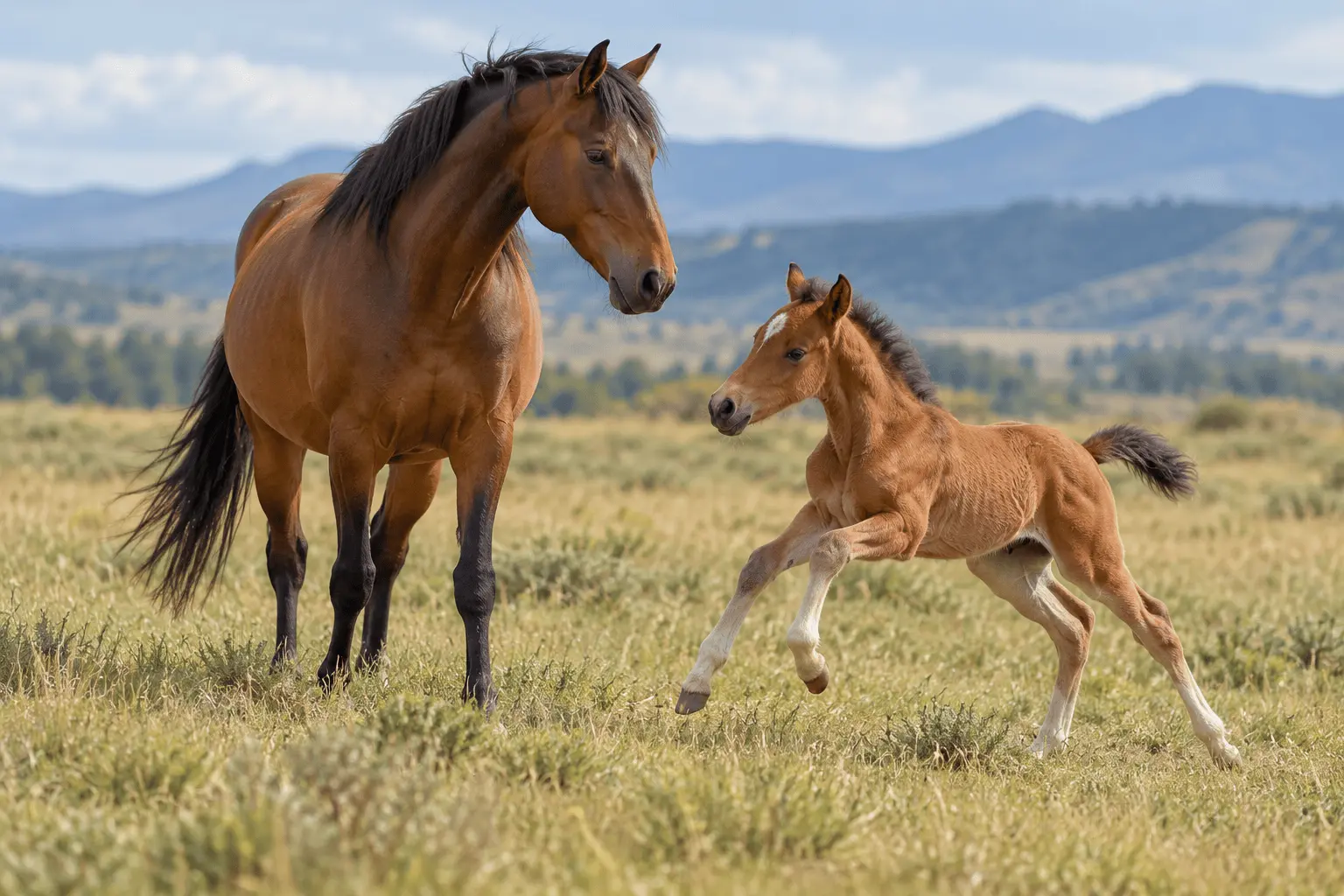
A 2008 field study of Kaimanawa feral horses found that foals that played more had higher survival and better body condition as yearlings despite earlier weaning. Play was also associated with maternal investment, although patterns differed between sons and daughters.
Because the study was observational, it could not establish whether play itself caused better outcomes. Its findings instead suggest a possible developmental link between maternal resources, juvenile behaviour and later condition.

What the study asked
Play is common in young mammals, but its developmental value remains difficult to isolate from health, maternal care and environmental influences. Cameron and colleagues investigated whether maternal investment was associated with foal play and whether greater play predicted later physical advantages.
The researchers observed free-ranging Kaimanawa horses in New Zealand, examining three relationships:
Differences in play between male and female foals.
Associations between maternal condition, investment and play.
Relationships between play, survival, weaning and yearling condition.
The natural setting provided behavioural evidence without experimentally manipulating maternal investment or activity.
How the horses were observed
The broader Kaimanawa dataset included 55 mares and 98 foals across three breeding seasons. Researchers measured play in seconds per hour, including locomotor activity, and compared behaviour with maternal condition and later outcomes.
Comparisons of sons and daughters born to the same mother helped examine sex-specific investment patterns while reducing some differences between mares.
Although longitudinal observations connected early behaviour with subsequent condition, the design could not determine whether play independently produced those outcomes.
What the numerical play data showed
Foals averaged 23.63 ± 2.01 seconds of play per hour. Females averaged 21.23 ± 2.69 seconds and males 26.13 ± 2.99 seconds. The difference was not statistically significant.
Measure | Female foals | Male foals | Comparison |
Overall play | 21.23 ± 2.69 s/h | 26.13 ± 2.99 s/h | t96 = 1.22; P = 0.23 |
Locomotor play | 5.45 ± 1.37 s/h | 7.49 ± 1.04 s/h | t96 = 1.18; P = 0.24 |
Values are mean ± SE. Neither sex comparison was statistically significant.
Males nevertheless initiated more play bouts, indicating that play initiation differed even when overall activity levels were similar.
Maternal condition, investment and later foal outcomes
Maternal condition was associated with play differently according to offspring sex. Sons of mares in better condition played more. Within-mother comparisons showed greater play among daughters when maternal condition was poorer and among sons when it was better.
Mares whose foals played more also lost more body condition, suggesting a maternal investment cost.
Foals that played more subsequently had higher survival and better yearling body condition despite earlier weaning. These associations supported the authors' proposal that play may reflect resources available for development.
What the findings mean—and what they do not
The findings connect maternal investment, juvenile play and subsequent condition within one feral-horse population.
They do not establish that increasing play independently improves survival or physical development. Maternal resources, health and social opportunities could influence both activity and later outcomes.
A 2019 review discussed locomotor play as a potential stimulus for musculoskeletal development. A 2022 horse-welfare review also referenced the study's survival and body-condition findings.
Neither review directly replicated the original relationships.
How to use the result in a welfare context
Juvenile play may reflect maternal resources, health or developmental benefits. However, this study establishes neither recommended play durations nor equivalent outcomes in domestic foals. Welfare assessment requires behavioural and veterinary evidence.
Frequently asked questions
Did male foals play more than female foals?
Not overall. Males averaged more seconds of play per hour than females, but the difference was not statistically significant. The study did report that males initiated more play bouts, so sex differences appeared more clearly in how play was expressed than in the total amount of time spent playing.
How was maternal condition related to foal play?
Maternal condition was related to play differently for sons and daughters. Sons of mares in good condition played more. In within-mother comparisons, daughters played more when their mother was in poor condition, whereas sons played more when their mother was in good condition, suggesting variation in maternal investment.
Did play cause better body condition in yearlings?
The study cannot establish that conclusion. Foals that played more later showed better survival and better body condition as yearlings, but the research was observational. Health, maternal resources, social environment or other factors could influence both play and later condition, so the result is an association rather than proof of causation.
Why is the study still relevant to horse welfare research?
Later reviews continue to cite the work because it connects spontaneous juvenile play with maternal investment, survival and later condition in a free-ranging horse population. It also provides field evidence that complements research on exercise and musculoskeletal development, while leaving open important questions about mechanism and applicability to domestic horses.
What should horse owners take from these findings?
The study supports treating juvenile play as biologically meaningful behaviour, not as a trivial extra. It does not provide a target number of minutes or justify forcing exercise. Management decisions for domestic foals should rely on broader welfare and veterinary evidence, with space, social contact and safe opportunities for voluntary movement considered together.
Sources
- Cameron, E. Z., Linklater, W. L., Stafford, K. J., & Minot, E. O. (2008). Maternal investment results in better foal condition through increased play behaviour in horses. Animal Behaviour, 76(5), 1511–1518. DOI: 10.1016/j.anbehav.2008.07.009
- Cameron, E. Z. (1998). Maternal investment in Kaimanawa horses. PhD thesis, Massey University, Palmerston North, New Zealand.
- Cameron, E. Z., & Linklater, W. L. (2000). Individual mares bias investment in sons and daughters in relation to their condition. Animal Behaviour, 60(3), 359–367. DOI: 10.1006/anbe.2000.1480
- Cameron, E. Z., Stafford, K. J., Linklater, W. L., & Veltman, C. J. (1999). Suckling behaviour does not measure milk intake in horses, Equus caballus. Animal Behaviour, 57(3), 673–678. DOI: 10.1006/anbe.1998.0997
- Cameron, E. Z., Linklater, W. L., Stafford, K. J., & Minot, E. O. (2003). Social grouping and maternal behaviour in feral horses (Equus caballus): the influence of males on maternal protectiveness. Behavioral Ecology and Sociobiology, 53(2), 92–101. DOI: 10.1007/s00265-002-0556-1
- Linklater, W. L., Cameron, E. Z., Minot, E. O., & Stafford, K. J. (2004). Feral horse demography and population growth in the Kaimanawa Ranges, New Zealand. Wildlife Research, 31(2), 119–128. DOI: 10.1071/WR02067
- Rogers, C. W., Bolwell, C. F., Tanner, J. C., & van Weeren, P. R. (2012). Early exercise in the horse. Journal of Veterinary Behavior, 7, 375–379. DOI: 10.1016/j.jveb.2012.01.003
Related
How hormones time seasonal reproduction in temperate-zone birds
Chicken cognition: learning, memory, social behaviour, navigation

American zoos: how cages gave way to habitat design
Behavioural Problems of Farm Animals: What the 1977 Review Covered

Animal Translocation Stress: Conservation Risks and Management
Mites That Ride Bark Beetles: Four Species Described in 2000