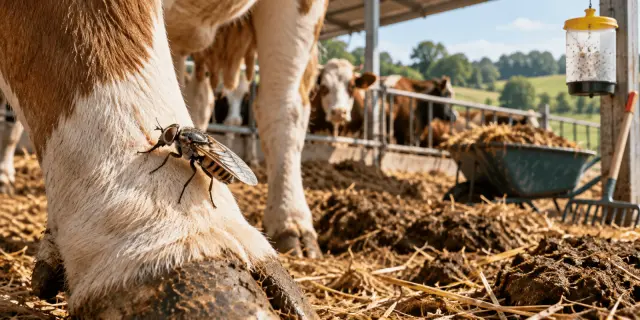
Behavioural Problems of Farm Animals: What the 1977 Review Covered
Marthe Kiley-Worthington’s 1977 book examined behavioural problems in farm animals through social conditions, housing, handling, reproduction, feeding and livestock management. It was a narrative synthesis rather than a single experiment, with no fixed sample size or intervention.
Its themes include stress, aggression, confinement, dominance, stereotypic behaviour, grazing and stockmanship. The book remains relevant to the history of applied ethology, although modern welfare assessment uses more specific methods and evidence.
Why the 1977 review mattered
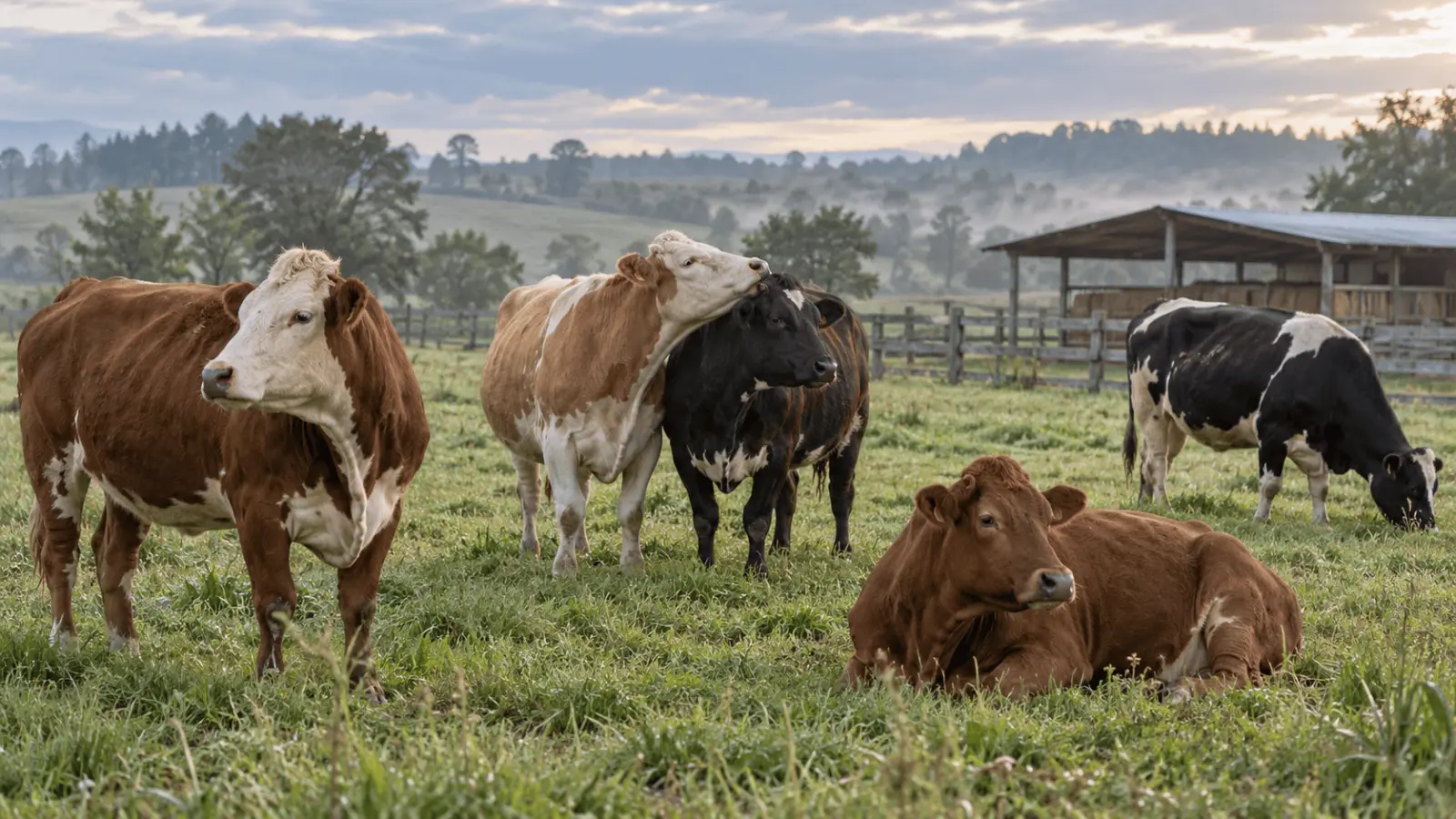
The book appeared as applied animal behaviour became increasingly important to livestock management. It brought together stress, aggression, crowding, dominance, isolation, reproduction, learning, stereotypies, grazing and housing within one framework.
Rather than treating behaviour as secondary to production, Kiley-Worthington examined how animals respond to their surroundings and management.
This approach anticipated later welfare research. Modern frameworks, including the Five Domains Model, consider behavioural interactions alongside health, environmental conditions and mental state when evaluating animal welfare.
What the book covered
Kiley-Worthington reviewed behavioural mechanisms such as stress, aggression, dominance, isolation, learning and stereotypies. She also examined practical farming concerns, including reproduction, maternal behaviour, grazing, feeding, stockmanship and housing.
The following comparison illustrates how these historical themes relate to later welfare-science approaches.
Theme | 1977 review scope | Later welfare-science framing |
Social environment | Aggression, dominance, group size, isolation | Social stress, competition, affiliation and social bonds |
Housing and environment | Crowding, confinement, complexity, housing effects | Environmental fit, enrichment and multiple animal-based indicators |
Abnormal behaviour | Stereotypies and repetitive purposeless behaviour | Potential welfare indicator that requires contextual interpretation |
Human–animal relationship | Stockmanship and effects on production | Positive and negative human–animal interactions within welfare assessment |
Feeding and grazing | Food intake control and grazing behaviour | Behavioural opportunities, resource access and species-specific management |
How later research changed the interpretation
Several themes remain important, although modern evidence offers more nuanced interpretations.
Stereotypies, for example, may be associated with environmental restriction, frustration or previous adverse conditions. Research by Dantzer and Mason helped establish their importance, but repetitive behaviour alone cannot determine an animal's overall welfare.
Social behaviour research now examines aggression and competition alongside positive relationships, affiliation and social bonds. Group composition, access to resources and environmental conditions influence behavioural outcomes.
Stockmanship has also become part of broader welfare assessment. The 2020 Five Domains update explicitly considers human–animal interactions and their potential effects on animals' experiences.
Together, these developments extend the book's historical approach through more detailed behavioural evidence and validated assessment methods.
Practical lessons and limits
The central lesson is that animal behaviour must be interpreted within its environmental and biological context.
Changes in feeding, activity, social contact or repetitive behaviour may indicate welfare concerns, but their meaning depends on species, health, housing, previous experience and available resources.
Modern assessments therefore combine behavioural observations with additional animal-based measures.
The 1977 book also has methodological limitations. It is not a systematic review or controlled experiment, and it predates contemporary welfare-assessment frameworks.
Its discussions of drugs, hormones and surgical interventions represent historical approaches rather than current veterinary recommendations.
Why the archive record remains useful
PAN 19770131707 documents an influential early synthesis of livestock behavioural research.
It shows that environmental restriction, social stress, abnormal behaviour, maternal relationships, grazing and human handling were already important research questions during the 1970s.
Later animal-welfare science has refined these questions through validated indicators, greater attention to affective states and more comprehensive assessment frameworks.
The book therefore provides historical context for understanding the development of applied ethology without replacing modern species-specific evidence.
Sources
Kiley-Worthington, M. Behavioural Problems of Farm Animals. Oriel Press, Stocksfield, 1977. ISBN 0853621632.
Dantzer, R. Behavioral, physiological and functional aspects of stereotyped behavior: a review and a re-interpretation. Journal of Animal Science. 1986;62(6):1776–1786. doi:10.2527/jas1986.6261776x.
Broom, D.M. Animal welfare: concepts and measurement. Journal of Animal Science. 1991;69(10):4167–4175. doi:10.2527/1991.69104167x.
Mason, G.J. Stereotypies: a critical review. Animal Behaviour. 1991;41(6):1015–1037. doi:10.1016/S0003-3472(05)80640-2.
Düpjan, S.; Puppe, B. Abnormales Verhalten mit dem Schwerpunkt Stereotypien—Indikator für Leiden und beeinträchtigtes Wohlbefinden? Berliner und Münchener tierärztliche Wochenschrift. 2016;129(3–4):93–102.
Mellor, D.J.; Beausoleil, N.J.; Littlewood, K.E.; et al. The 2020 Five Domains Model: Including Human–Animal Interactions in Assessments of Animal Welfare. Animals. 2020;10(10):1870. doi:10.3390/ani10101870.
Orihuela, A. Review: Management of livestock behavior to improve welfare and production. Animal. 2021;15(Suppl 1):100290. doi:10.1016/j.animal.2021.100290.
Lee, V.E.; Arnott, G.; Turner, S.P. Social behavior in farm animals: Applying fundamental theory to improve animal welfare. Frontiers in Veterinary Science. 2022;9:932217. doi:10.3389/fvets.2022.932217.
Huber, K. Review: Welfare in farm animals from an animal-centred point of view. Animal. 2024;18(10):101311. doi:10.1016/j.animal.2024.101311.
Li, C.; Gao, J.; Shu, H.; Zhao, G.; Gu, X. Stereotypic behaviors across species: From neurobiological mechanisms to farm animal welfare. Neuroscience & Biobehavioral Reviews. 2026;185:106637. doi:10.1016/j.neubiorev.2026.106637.
FAQ
Who wrote Behavioural Problems of Farm Animals?
Behavioural Problems of Farm Animals was written by Marthe Kiley-Worthington and published by Oriel Press in 1977. The book examines livestock behaviour, including stress, aggression, grazing, reproduction, housing and stockmanship. It combines research and observations across farm-animal species and contributed to early discussions of applied animal behaviour and welfare.
What is Behavioural Problems of Farm Animals about?
The 1977 book explores how environmental conditions, social relationships and farming practices influence livestock behaviour. It examines stress, aggression, learning, reproductive behaviour, feeding, grazing and repetitive stereotypies. Rather than presenting one controlled experiment, it synthesizes observations and research across different species and agricultural production settings.
Why are stereotypies important in farm-animal welfare?
Stereotypies are repetitive, relatively invariant behaviours that may develop under restrictive or challenging environmental conditions. They can indicate previous or ongoing welfare problems, including frustration or limited behavioural opportunities. However, their presence does not establish a complete welfare diagnosis, so researchers interpret them alongside health, housing and other behavioural indicators.
How does stockmanship affect animal behaviour?
Stockmanship influences how farm animals experience handling, human contact and routine management. Calm, predictable interactions may reduce fear, while rough or inconsistent handling can increase stress and avoidance responses. Modern welfare frameworks assess these relationships through observed animal responses and broader evidence about handling conditions and management practices.
What are the main principles of modern farm-animal welfare assessment?
Modern farm-animal welfare assessment combines behavioural observations with health, physiological and environmental information. Researchers consider social interactions, movement, feeding, resting and responses to handling, alongside species-specific needs. Frameworks such as the Five Domains also address animals' mental experiences, helping distinguish physical conditions from broader welfare outcomes.
Related

Hereditary dwarfism in beef cattle: genetics and calf outcomes

Biting midges: biology, disease transmission and control

Blackflies: biology, life cycle, ecology and disease-vector roles

Insect pheromones and chemical communication in social insects

Animal Translocation Stress: Conservation Risks and Management

Skin tumours in dogs and cats: what pathology data show