
















Why do dogs eat grass and what veterinary research has found
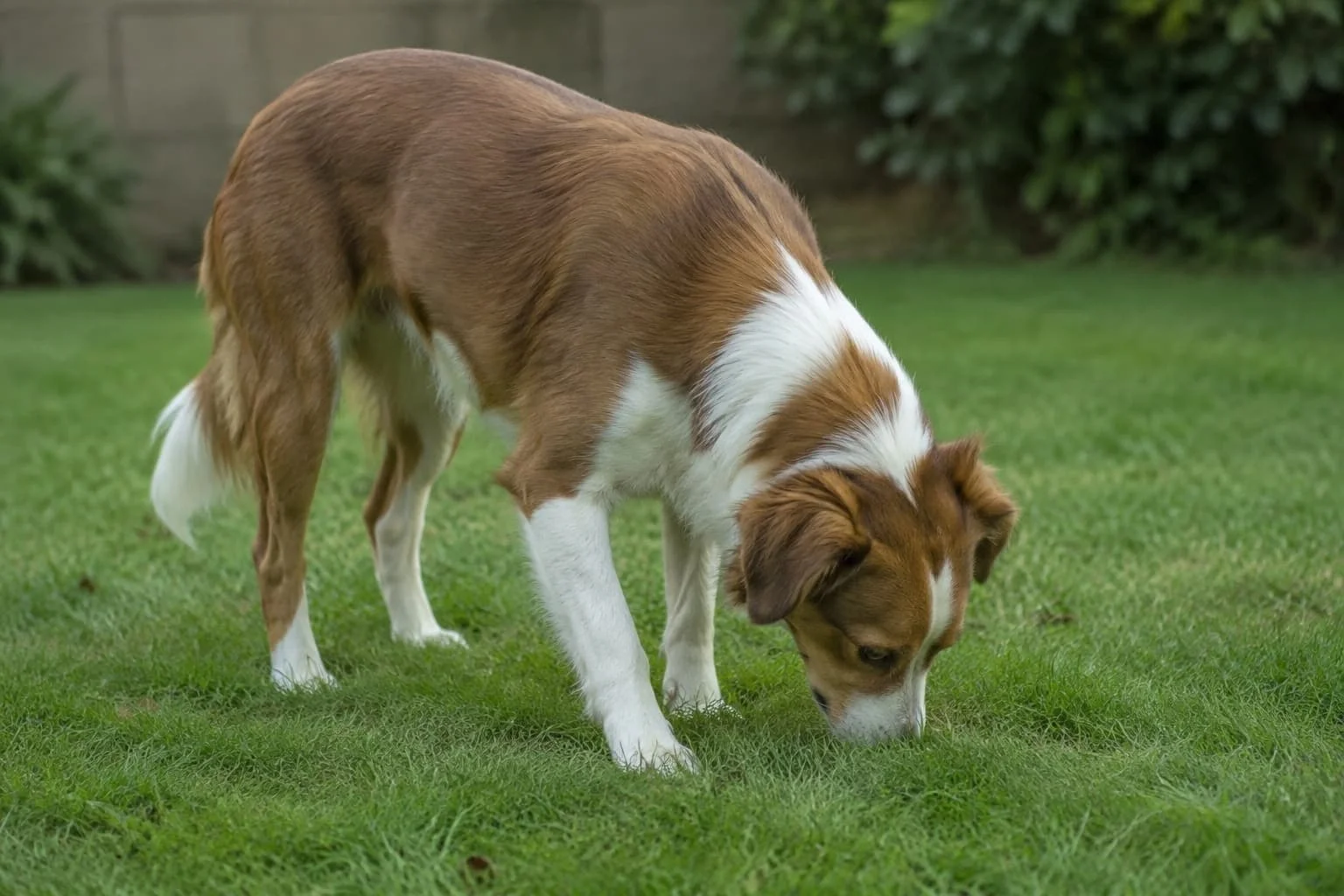
Dogs eat grass as ordinary behaviour rather than as a response to feeling unwell, and that is where the veterinary research points: the sick-dog explanation is the part the evidence fits worst. In a survey of 1,571 owners of plant-eating dogs, only 9 per cent of dogs were reported to frequently appear ill before eating plants and only 22 per cent to frequently vomit afterwards, while 68 per cent ate plants daily or weekly (Sueda et al., 2008).
This explainer sets out what has actually been measured: how common the behaviour is, what happened when researchers deliberately upset dogs' digestion, where the sick-dog story came from, and which questions the studies leave open. Wider coverage of the subject area sits in the animals section.
Where the sick-dog explanation comes from
The idea is old enough to predate veterinary science. A survey study of plant eating in cats traces it to Aristotle, who held that dogs eat grass only when they are sick, to bring on vomiting and purge themselves (Hart et al., 2021). The explanation has an obvious appeal: it is tidy, it gives the behaviour a purpose, and most owners have at some point seen a dog eat grass and then be sick.
It also survives for a reason that has nothing to do with dogs. An owner who sees a dog eat grass and then be sick remembers the pairing; the far commoner sequence, grass with nothing following, is unremarkable and leaves no trace. Any explanation built on what people notice will favour the dramatic version of events.
What it lacked for most of its history was any measurement. Plant eating in dogs received little attention in the scientific literature, and the first attempts to put numbers on it are recent (Sueda et al., 2008). That is the gap worth keeping in mind: the explanation is ancient, the data are not.
How common the behaviour actually is
The first measurement was small and deliberately unselective. Owners of healthy dogs attending a veterinary teaching hospital for routine appointments were surveyed, and of 47 whose dogs had daily access to plants, 79 per cent said the dog had eaten grass or other plants (Sueda et al., 2008). Whatever grass eating is, it is not a rarity.
The larger survey targeted owners of plant-eating dogs specifically. Of 3,340 returns, 1,571 met the enrolment criteria. Sixty-eight per cent of those dogs ate plants daily or weekly, with the rest doing so monthly or less, and grass was the most frequently eaten plant for 79 per cent of them (Sueda et al., 2008).
The two numbers that matter for the sick-dog story came from the same survey. Only 9 per cent of dogs were reported to frequently appear ill before eating plants, and only 22 per cent to frequently vomit afterwards. The authors concluded that plant eating is a normal behaviour of domestic dogs (Sueda et al., 2008).
What owners reported | Share of dogs | Source |
Ate plants daily or weekly | 68 per cent | Sueda et al., 2008 |
Grass as the most frequently eaten plant | 79 per cent | Sueda et al., 2008 |
Frequently appeared ill before eating plants | 9 per cent | Sueda et al., 2008 |
Frequently vomited after eating plants | 22 per cent | Sueda et al., 2008 |
Note: these are owner reports from a survey of dogs already known to eat plants, not observations made by researchers, and not a sample of all dogs. They describe how often owners noticed something, which is not the same as how often it happened.
What happened when researchers upset the dogs' digestion
A survey cannot test cause and effect, so the question was taken into a controlled setting. Twelve beagles were fed their standard diet and then the same diet supplemented with a fructo-oligosaccharide, which temporarily produced loose, watery stools: a mild gastrointestinal disturbance on demand. Grass was available throughout (McKenzie et al., 2010). Controlled feeding studies of this kind also underpin work on dairy cow welfare.
If the sick-dog explanation held, grass eating should have risen during the loose-stool phase. It fell. Dogs spent significantly more time eating grass on the standard diet with normal stools than on the supplemented diet, and the authors concluded that dogs do not appear to use grass to self-medicate diarrhoea (McKenzie et al., 2010).
The design has limits worth stating. A fructo-oligosaccharide supplement produces loose stools, which is one kind of digestive upset and not the same thing as nausea, and the authors themselves suggested that future work look at other disturbances such as constipation or nausea (McKenzie et al., 2010). What the study rules out is the diarrhoea version of the folk explanation, not every version.
The prediction was clear enough to fail, and it failed in the opposite direction to the one the folk explanation requires.
The emetic claim fared no better in the same study. Across 374 recorded grass-eating events there were two vomiting events (McKenzie et al., 2010). Whatever the dogs were doing, being sick was not the reliable consequence.
What the behaviour does track
An earlier controlled study by the same group looked at when grass eating happens rather than why. Twelve dogs were offered kikuyu and couch grass three times a day for six days, and the pattern that emerged was tied to satiety and time of day: dogs spent more time eating grass before their kibble meal than after it, and showed no clear preference between the two grasses (Bjone et al., 2007).
That is a modest finding, and it points somewhere specific. A behaviour that falls away once the animal has eaten behaves like feeding, not like treatment. The same study concluded that grass eating is normal and common in healthy dogs rather than a sign of illness (Bjone et al., 2007).
The two controlled studies disagree on one small point, which is worth recording rather than smoothing over. The earlier one found no clear preference between kikuyu and couch grass, while the later one found kikuyu preferred on both diets (Bjone et al., 2007; McKenzie et al., 2010). With twelve dogs in each, neither result settles what dogs look for in a plant.
Age is the other consistent pattern. Younger dogs ate plants more often, ate more non-grass plants, and were less likely to show signs of illness beforehand or to vomit afterwards (Sueda et al., 2008). An explanation resting on sickness has to account for the youngest and healthiest animals doing it most.
The inherited-behaviour idea and what supports it
Before the alternative, it is worth naming what a good explanation would have to do. It has to fit a behaviour that is common rather than rare, that appears in healthy animals, that is most frequent in the youngest of them, and that does not increase when digestion is upset. The sickness story fails on all four counts as a general explanation, although the authors leave nausea and constipation open as questions for further work.
The alternative on offer is that plant eating is an inherited predisposition rather than a response to feeling unwell. One version proposes that in wild ancestors, plant material passing through the gut increased motility and helped carry intestinal worms out, so the behaviour persisted whether or not any given animal was infected (Hart, 2011).
The comparison usually drawn is with primates. Chimpanzees, bonobos and gorillas swallow leaves whole and pass them intact, and this has been shown to work as a physical means of purging intestinal parasites (Huffman, 2003). A review of how mammals deal with parasites and pathogens places such plant use alongside grooming and avoidance of sleeping areas as one of several evolved strategies (Hart & Hart, 2018).
The honest status of the dog version is that it is a hypothesis with a plausible mechanism and no direct test. Nothing in the surveys or the feeding trials measures worm burdens, and the parasite account is put forward as needing further study rather than as an established finding (Hart, 2011).
Testing it properly would mean something the published work has not attempted: measuring parasite burdens in dogs alongside how much grass they eat, in animals whose worming history is known. No published study compares grass eating in dogs carrying worms with dogs that have been de-wormed, which leaves the parasite account untested rather than supported.
What wild canids show, and what they do not
If plant eating were inherited, it should show up in wolves. It does, in the sense that plant material turns up in wolf droppings, but the published figures are harder to use than they look. A study of 221 wolf scats from the Bieszczady Mountains in Poland states plainly that grass, leaves and needles were not counted as food in the analysis, since wolves cannot digest them, while noting that grass at least may be ingested intentionally (Śmietana & Klimek, 1993).
That sentence is the whole problem in miniature. Diet studies are built to measure what an animal gets nutrition from, so the one category relevant here is routinely set aside, and the published figures understate how often plant material is taken.
How a behaviour is compared across species is a recurring difficulty in this literature, as the account of farm animal behaviour problems and how they were classified also shows. The categories used to record behaviour decide in advance what the data can answer.
There is a second reason the wolf comparison carries less than it seems to. Scat analysis records what survives digestion, so an indigestible plant is over-represented relative to how much was eaten, while anything fully digested disappears. The method answers a different question from the one asked here (Śmietana & Klimek, 1993).
The same team ran the equivalent surveys on cats, and the pattern is similar without being identical. Two surveys of cat owners found that very few cats showed signs of illness before eating plants, while 27 to 37 per cent frequently vomited afterwards, which the authors read as gastrointestinal disturbance being related to vomiting in some cats (Hart et al., 2021).
One subsidiary result is worth recording because it kills a neighbouring myth. Short-haired cats ate plants as often as long-haired cats, which argues against the idea that plant eating serves to expel hairballs (Hart et al., 2021). Young cats, as with dogs, ate plants more often and vomited less in connection with it.
A general caution applies to all of the survey evidence. Owner reports record what someone happened to see and remember, over a period they are asked to summarise from memory, and the dogs enrolled were ones already known to eat plants. Figures like 22 per cent describe reported impressions, not counted events (Sueda et al., 2008).
What the evidence supports and what it does not
Supported: plant eating is common in healthy dogs, grass is the usual plant, and most dogs are reported neither as looking ill beforehand nor as vomiting afterwards (Sueda et al., 2008). The behaviour also falls rather than rises when digestion is deliberately upset (McKenzie et al., 2010).
Not supported: the claim that a dog eats grass in order to be sick. Two vomiting events across 374 grass-eating events is not a mechanism, and the one experimental test of the digestive-upset version went the wrong way (McKenzie et al., 2010).
Unsettled: what the behaviour is for. The inherited-predisposition account fits the age pattern and the comparison with other mammals, but it has not been tested directly in dogs, and the controlled studies that exist are small (Bjone et al., 2007; Hart, 2011). Development and early life shape a great deal of animal behaviour, as the account of maternal investment and play in foals describes, and that side of grass eating has barely been looked at.
What a reader can take from this is narrower than the headlines usually allow. The research says that a dog eating grass is doing something ordinary, and that no study has shown the behaviour on its own to be a reliable sign of illness. It does not say that grass is good for dogs, and it does not say that a dog which eats grass is well.
One point sits outside the research. These studies describe behaviour in healthy animals and do not examine dogs that seem unwell, vomit repeatedly or change their habits, so survey percentages say nothing about those cases.
Frequently asked questions
Do dogs eat grass to make themselves sick?
The measured answer is mostly no. In the largest survey, 22 per cent of plant-eating dogs were reported to frequently vomit afterwards, and in a controlled study there were two vomiting events across 374 grass-eating events. Vomiting looks incidental rather than the point. (Sueda et al., 2008; McKenzie et al., 2010)
Does grass eating mean a dog has an upset stomach?
A feeding trial tested exactly that. When a supplement gave twelve dogs loose stools, they spent less time eating grass, not more. In the survey work, 9 per cent of dogs were reported to frequently appear ill before eating plants. (McKenzie et al., 2010; Sueda et al., 2008)
How many dogs eat grass?
Among owners of plant-eating dogs, 68 per cent reported daily or weekly plant eating, and grass was the most frequently eaten plant for 79 per cent. In a separate sample of healthy dogs with daily access to plants, 79 per cent of owners had seen it. (Sueda et al., 2008)
Why do puppies and young dogs eat more grass?
The age pattern is consistent across the surveys: younger dogs ate plants more frequently, ate more non-grass plants, and were less likely to appear ill or vomit in connection with it. The same held in the equivalent surveys of cats. Why that is has not been established.
Is eating grass something to be concerned about?
The published work treats it as a normal behaviour of healthy dogs rather than a problem in itself. The studies did not examine dogs that seem unwell before or after eating plants or that vomit persistently, so their findings do not describe those cases.
Sources
- Sueda KLC, Hart BL, Cliff KD. Characterisation of plant eating in dogs. Applied Animal Behaviour Science. 2008;111(1–2):120–132. DOI 10.1016/j.applanim.2007.05.018.
- McKenzie SJ, Brown WY, Price IR. Reduction in grass eating behaviours in the domestic dog, Canis familiaris, in response to a mild gastrointestinal disturbance. Applied Animal Behaviour Science. 2010;123(1–2):51–55. DOI 10.1016/j.applanim.2009.12.003.
- Bjone S, Brown W, Price I. Grass eating patterns in the domestic dog, Canis familiaris. Recent Advances in Animal Nutrition in Australia. 2007;16:45–49. University of New England, Armidale.
- Hart BL, Hart LA, Thigpen AP, Willits NH. Characteristics of plant eating in domestic cats. Animals. 2021;11(7):1853. DOI 10.3390/ani11071853.
- Hart BL. Behavioural defences in animals against pathogens and parasites: parallels with the pillars of medicine in humans. Philosophical Transactions of the Royal Society B. 2011;366(1583):3406–3417. DOI 10.1098/rstb.2011.0092.
- Hart BL, Hart LA. How mammals stay healthy in nature: the evolution of behaviours to avoid parasites and pathogens. Philosophical Transactions of the Royal Society B. 2018;373(1751):20170205. DOI 10.1098/rstb.2017.0205.
- Huffman MA. Animal self-medication and ethno-medicine: exploration and exploitation of the medicinal properties of plants. Proceedings of the Nutrition Society. 2003;62(2):371–381. DOI 10.1079/PNS2003257.
- Śmietana W, Klimek A. Diet of wolves in the Bieszczady Mountains, Poland. Acta Theriologica. 1993;38(3):245–251. DOI 10.4098/AT.arch.93-20.

Lena Okonjo — author
Lena Okonjo is a Zoology graduate with a master’s-level specialization in Animal Behaviour. Her earlier work involved preparing summaries of field studies on animal behaviour and insects for general audiences. At Cabdirect, Lena covers animal behaviour, insect...
Related

Behavioural Problems of Farm Animals: What the 1977 Review Covered
How maternal investment and play relate to foal condition
Overstocking and Dairy Cows: Lessons from a 2012 Review

Why do cats knead and make biscuits on blankets and people

Why do cats purr and how the larynx makes the sound

How hormones time seasonal reproduction in temperate-zone birds
Chicken cognition: learning, memory, social behaviour, navigation