Overstocking and Dairy Cows: Lessons from a 2012 Review
Overstocking takes rest away from dairy cows: in a study summarised by a 2012 review, cows lay down 1.7 hours a day less at 1.5 cows per stall than at one cow per stall (Huzzey et al., 2012a). The review, by researchers at the University of British Columbia and Cornell University, also reported more displacements at crowded feed bunks, with subordinate cows most affected (Huzzey et al., 2012a). A Cornell trial it described found small shifts in energy metabolism in dry cows housed two to a stall (Huzzey et al., 2012a; Huzzey et al., 2012b). Later trials in dry and close-up cows mostly did not find harmful metabolic effects (Miltenburg et al., 2018; Fujiwara et al., 2019).
Below, we explain what overstocking means in stalls and centimetres of feed face, what the review’s behavioural and physiological evidence showed and how far it reaches. We then set that evidence against later trials, against current Canadian, US and UK standards on space and against EFSA’s advice to the European Commission. We do not cover pasture-based systems or give housing advice for individual farms. The original study is summarised in Cabdirect archive record 20143159639.
What Counts as Overstocking on a Dairy Farm?
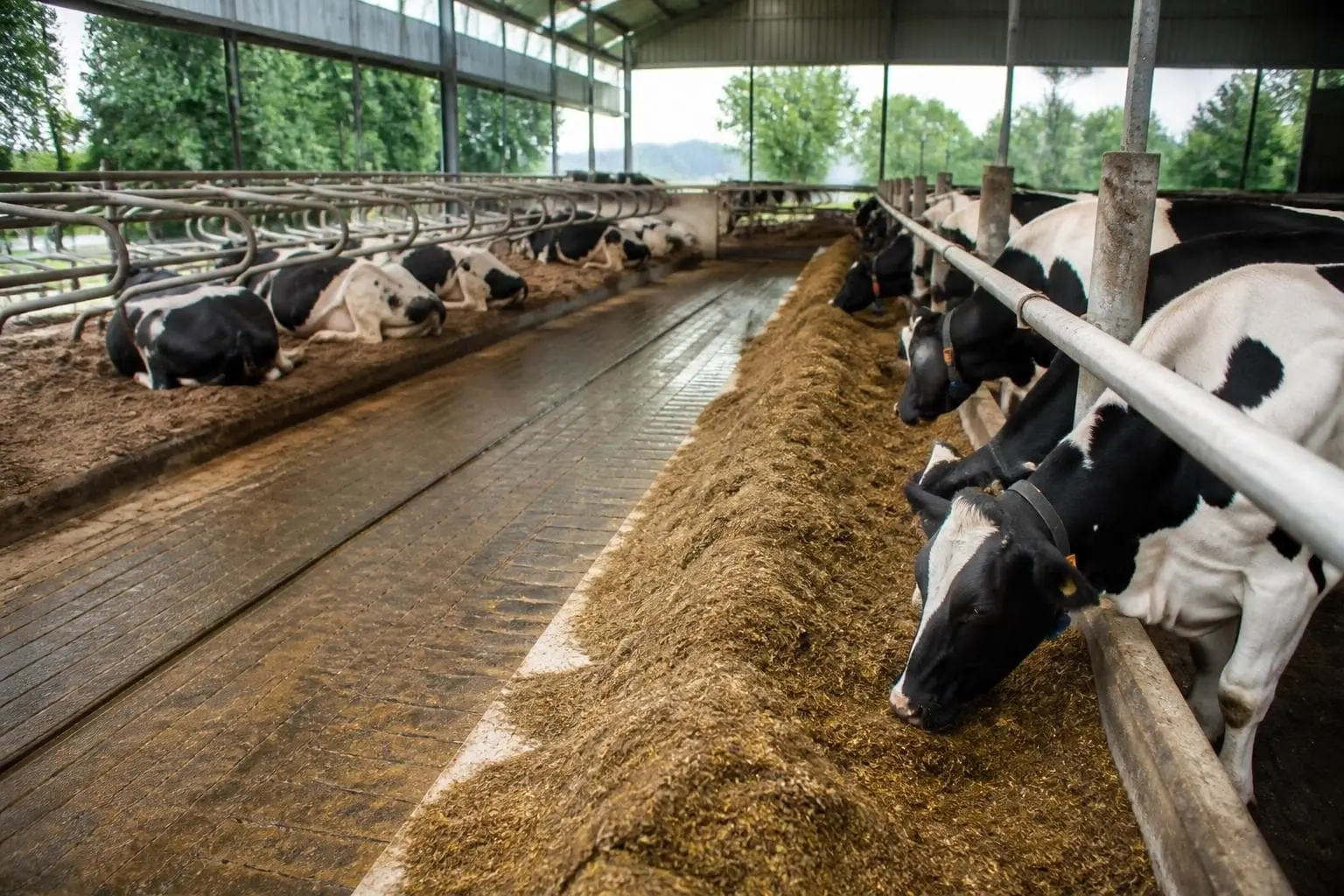
A pen is overstocked when it holds more cows than it has lying stalls or places at the feed bunk, and researchers express the ratio as a percentage (Huzzey et al., 2012a). At 100% there is one stall or one headlock per cow. At 150% there are 1.5 cows for every stall, and at 200% two cows share each one (Huzzey et al., 2012a; Huzzey et al., 2012b).
Feed space is also measured as a length of feed barrier per cow. The 2012 review by Julie Huzzey, Marina von Keyserlingk and Thomas Overton took its benchmark from Canada’s dairy code of the time. That code, the review said, suggested one lying stall for every lactating cow and 60 cm (24 in) of linear bunk space (Huzzey et al., 2012a). The review’s own closing advice repeats both numbers as the aim for every producer (Huzzey et al., 2012a).
Overstocking rarely begins as a plan: the review names busy calving months, surplus replacement heifers and herds that grow before their barns do (Huzzey et al., 2012a). Crowding can also pay on paper, as a 2016 US simulation put the most profitable stall stocking at 120% on average, while calling the performance evidence weak (De Vries et al., 2016).
How common crowded pens are
The most recent national US figures come from the USDA’s Dairy 2007 study, published in 2010: 57.1% of freestall operations gave cows less than 60 cm (24 in) of bunk space, and 30.4% housed 1.10 or more cows per stall (USDA APHIS VS CEAH, 2010).
Newer data are regional. In 78 Canadian herds assessed in 2014–2018, mostly in Ontario, 41% of far-off dry pens and about half of close-up and fresh-cow pens were overstocked, although the visits were not a national sample (Couto Serrenho et al., 2022).
How Does Crowding Change Feeding and Lying?
Crowding changes when cows eat and how long they rest (Huzzey et al., 2012a). In one feeding study cited by the review, cows fed more when they had 1.0 m of bunk each than when they had 0.5 m (Huzzey et al., 2012a). The gap was widest in the 90 minutes after fresh feed arrived (Huzzey et al., 2012a).
That window matters because fresh feed is then at its best and cows are keen to reach it (Huzzey et al., 2012a). In a follow-up study, crowding at the bunk cut the share of cows feeding after delivery, whether the barrier was a post-rail or headlocks. The cows did not catch up overnight. They spent longer standing idle instead, apparently waiting for a place (Huzzey et al., 2012a).
Less feeding time does not always mean less feed, as crowded cows eat faster, and in one study multiparous cows crowded before calving tended to eat nearly 2 kg less dry matter a day (Huzzey et al., 2012a).
Lost lying time
Stalls matter even more to cows than feed places, and when both are scarce cows give up feeding time to lie down (Huzzey et al., 2012a). In one experiment, groups of 12 cows were given between 12 and 8 stalls, a range of 100% to 150% stocking (Fregonesi et al., 2007). The review reports that at 150% cows lay down 1.7 hours a day less. They also lay down 13 minutes sooner after milking, as if racing for a free stall (Huzzey et al., 2012a).
The losses were greatest at the usual peak resting times, overnight and around midday (Huzzey et al., 2012a). Time not spent lying is spent standing, often on concrete alleys. The review flagged long standing on hard floors as a known risk factor for lameness, although it did not measure lameness itself (Huzzey et al., 2012a).
What Did the Cornell Experiment Show About Stress and Metabolism?
The Cornell experiment showed that crowding can shift energy metabolism, though the shifts were small and the cortisol results mixed (Huzzey et al., 2012a; Huzzey et al., 2012b). Before it, very little work had looked at physiology. Studies from the 1970s had found a stronger cortisol response to an ACTH challenge in cows regrouped into pens with 25 cm of bunk per cow and one stall for every two cows (Huzzey et al., 2012a).
The trial used 40 pregnant, non-lactating Holstein cows, 16 heifers and 24 older cows, in groups of 10 at Cornell University (Huzzey et al., 2012a). Each group spent 14 days at 100% stocking and 14 days at 200%, with two cows per stall and half the bunk space, ending each period with a glucose tolerance test and an ACTH challenge (Huzzey et al., 2012a; Huzzey et al., 2012b).
When crowded, cows ate about 1 kg more dry matter a day, 15.9 against 14.9 kg, without spending longer at the bunk, so they ate faster (Huzzey et al., 2012b). Plasma NEFA and glucose were nonetheless higher, which the authors thought might reflect greater mobilisation of body reserves (Huzzey et al., 2012a; Huzzey et al., 2012b). In the glucose tolerance test, glucose cleared slightly more slowly and the insulin response was smaller (Huzzey et al., 2012b).
Cortisol gave a weaker signal. The adrenal response to ACTH did not change, and the faecal cortisol metabolite only tended to be higher during crowding (Huzzey et al., 2012b). The authors called their results the first evidence that overstocking can alter energy metabolism. They added that more work was needed before long-term effects could be judged (Huzzey et al., 2012a).
What Do Welfare Codes Require Today?
Most current codes and schemes now expect at least one stall or cubicle per cow, though only some put a number on feed space (National Farm Animal Care Council, 2023; EFSA Panel on Animal Health and Animal Welfare (AHAW) et al., 2023; Department for Environment, Food & Rural Affairs, 2003; Red Tractor, 2025; RSPCA, 2026). The main US programme sets no numeric ratio at all (National Dairy FARM Program, 2024).
Canada and the United States
Canada’s Code of Practice for the Care and Handling of Dairy Cattle has been in force since 1 April 2024. It caps free-stall density at 1.2 cows per stall (National Farm Animal Care Council, 2023). From 1 April 2027 density must not normally exceed 1.1 cows per stall, and from 1 April 2031 one cow per stall (National Farm Animal Care Council, 2023). Code requirements are an industry standard that may be enforceable under legislation, not a statute (National Farm Animal Care Council, 2023).
The code recommends 0.9 cows per stall and at least 60 cm of bunk per lactating cow and 76 cm per transition cow (National Farm Animal Care Council, 2023). In the United States, the National Dairy FARM Program asks only that animals have access to sufficient feed (National Dairy FARM Program, 2024).
England, the UK schemes and the EU
In England, Defra’s cattle welfare code, issued in April 2003, recommends at least one cubicle per cow and about 5% more cubicles than cows (Department for Environment, Food & Rural Affairs, 2003). Where feed is not available at all times, all animals in a pen should be able to eat at once (Department for Environment, Food & Rural Affairs, 2003). Red Tractor’s February 2025 dairy standards require at least one cubicle per animal and feeding space suited to the feeding system (Red Tractor, 2025).
RSPCA Assured goes further. Its April 2026 standards require at least 5% more cubicles than cows and strongly recommend 10–20% extra (RSPCA, 2026). Feed space must be 750 mm per head in buildings built from July 2020 and 600 mm in older ones, with 100 cm per transition cow and at least 15% spare cubicles for them (RSPCA, 2026).
The European Food Safety Authority’s 2023 scientific opinion concluded with 90% certainty that cows need at least one cubicle each, and with 66% certainty that they benefit from more cubicles than cows (EFSA Panel on Animal Health and Animal Welfare (AHAW) et al., 2023). It is advice to the European Commission, not law (EFSA Panel on Animal Health and Animal Welfare (AHAW) et al., 2023).
How Strong Is the Evidence?
The behavioural evidence is the strongest: later trials agree that crowding increases competition at the feed face (Huzzey et al., 2012a; Miltenburg et al., 2018; Fujiwara et al., 2019). The evidence on metabolism, health and milk yield is weaker and mixed, and the review’s new physiological data come from one crossover trial of 40 dry cows (Huzzey et al., 2012a; Huzzey et al., 2012b).
Some details in the review need care: it states that 43% of US freestall farms provided too few stalls (Huzzey et al., 2012a), while the USDA table shows about 43% stayed below one cow per stall (USDA APHIS VS CEAH, 2010).
What later trials found
Later trials have not reproduced the metabolic signal consistently. In a UK study of 48 dry cows, high stocking density increased competition at the feed face but did not affect stress responses, energy metabolism or later milk yield (Fujiwara et al., 2019). Close-up cows given 120% stall stocking and 45 cm of bunk lay 12.8 hours a day, against 14.8 hours at 80% and 90 cm (Miltenburg et al., 2018). Yet most of the expected harm to metabolic and immune markers did not appear (Miltenburg et al., 2018).
Counting cows against stalls and centimetres of feed face is simple arithmetic, yet it decides how much rest the lowest-ranking cow in the pen can get.
Behaviour is therefore the more direct measure. EFSA treats lying for less than 10–12 hours a day in cubicle housing as a sign of high welfare risk, to be read in context (EFSA Panel on Animal Health and Animal Welfare (AHAW) et al., 2023). By that yardstick, the lost lying time is the best-supported cost of overstocking, while effects on disease remain uncertain (Huzzey et al., 2012a; EFSA Panel on Animal Health and Animal Welfare (AHAW) et al., 2023; Miltenburg et al., 2018).
Frequently asked questions
How many stalls should a dairy cow have?
At least one each is the common benchmark. EFSA’s experts concluded with 90% certainty that cows need at least one cubicle per cow (EFSA Panel on Animal Health and Animal Welfare (AHAW) et al., 2023). Canada’s code recommends 0.9 cows per stall (National Farm Animal Care Council, 2023), and RSPCA Assured requires at least 5% spare cubicles (RSPCA, 2026).
How much feed bunk space does a dairy cow need?
The 2012 review set 60 cm (24 in) per cow as the aim (Huzzey et al., 2012a). Canada’s code recommends at least 60 cm for lactating and 76 cm for transition cows (National Farm Animal Care Council, 2023), and RSPCA Assured requires 750 mm per head in newer buildings (RSPCA, 2026).
How long should dairy cows lie down each day?
There is no single agreed target. EFSA treats lying for less than 10–12 hours a day in cubicle housing as a sign of high welfare risk (EFSA Panel on Animal Health and Animal Welfare (AHAW) et al., 2023). In one experiment cited by the 2012 review, 150% stall stocking cut lying by 1.7 hours a day (Huzzey et al., 2012a).
Is overstocking worse around calving?
It is thought to be, but the evidence is mixed. Canada’s code says overstocking hits transition cows hardest (National Farm Animal Care Council, 2023), yet a trial in close-up cows found shorter lying times without most of the expected metabolic or immune harm (Miltenburg et al., 2018).
Why do farms overstock if it can harm cows?
Space is expensive, and crowding can pay. The 2012 review lists busy calving months, surplus heifers and herd growth ahead of barn building as causes (Huzzey et al., 2012a). A US simulation put the most profitable stall stocking at 120% on average, while calling the performance data weak and acknowledging a welfare trade-off (De Vries et al., 2016).
Sources
- Huzzey, J. M., von Keyserlingk, M. A. G., & Overton, T. R. (2012). The behavioral and physiological consequences of overstocking dairy cattle. American Association of Bovine Practitioners Conference Proceedings, 45, 92–97. – Cabdirect archive record 20143159639
- Huzzey, J. M., Nydam, D. V., Grant, R. J., & Overton, T. R. (2012). The effects of overstocking Holstein dairy cattle during the dry period on cortisol secretion and energy metabolism. Journal of Dairy Science, 95(8), 4421–4433.
- Fregonesi, J. A., Tucker, C. B., & Weary, D. M. (2007). Overstocking reduces lying time in dairy cows. Journal of Dairy Science, 90(7), 3349–3354.
- USDA APHIS VS CEAH. (2010). Dairy 2007: Facility characteristics and cow comfort on U.S. dairy operations, 2007. United States Department of Agriculture.
- National Farm Animal Care Council. (2023). Code of practice for the care and handling of dairy cattle. Dairy Farmers of Canada and NFACC.
- EFSA Panel on Animal Health and Animal Welfare (AHAW), Nielsen, S. S., Alvarez, J., Bicout, D. J., et al. (2023). Welfare of dairy cows. EFSA Journal, 21(5), e07993.
- Department for Environment, Food & Rural Affairs. (2003). Code of recommendations for the welfare of livestock: Cattle. GOV.UK.
- Red Tractor. (2025). Dairy standards: Standards manual, 1 February 2025, version 5 (modified). Assured Food Standards.
- RSPCA. (2026). RSPCA welfare standards for dairy cattle (April 2026).
- National Dairy FARM Program. (2024). Animal Care Reference Manual, version 5 (July 2024 – June 2027). Archived copy, 1 April 2026.
- De Vries, A., Dechassa, H., & Hogeveen, H. (2016). Economic evaluation of stall stocking density of lactating dairy cows. Journal of Dairy Science, 99(5), 3848–3857.
- Couto Serrenho, R., Church, C., McGee, D., & Duffield, T. F. (2022). Environment, nutrition, and management practices for far-off, close-up, and fresh cows on Canadian dairy farms: A retrospective descriptive study. Journal of Dairy Science, 105(2), 1797–1814.
- Miltenburg, C. L., Duffield, T. F., Bienzle, D., Scholtz, E. L., & LeBlanc, S. J. (2018). The effect of prepartum feeding and lying space on metabolic health and immune function. Journal of Dairy Science, 101(6), 5294–5306.
- Fujiwara, M., Haskell, M., Macrae, A., & Rutherford, K. (2019). Effects of stocking density during the dry period on dairy cow physiology, metabolism and behaviour. Journal of Dairy Research, 86(3), 283–290.
Rhys Penwarden — author
Rhys Penwarden is an Animal Science graduate with postgraduate training in Livestock Production. His previous work focused on preparing technical materials on feeding and herd management for dairy and beef farming operations. At Cabdirect, Rhys covers dairy an...
Related
Eastern Europe's native poultry genetic resources in 1996
Teart Pastures in Somerset: Molybdenum and Cattle Scouring

Hereditary dwarfism in beef cattle: genetics and calf outcomes

Mites That Ride Bark Beetles: Four Species Described in 2000

How maternal investment and play relate to foal condition

Army Ants: Social Predation, Nomadism and Tropical Ecology