Koshihikari rice: marker-assisted heading-date gene transfer
Marker-assisted backcrossing was used to transfer heading-date alleles at Hd1, Hd6 and Ehd1 from the photoperiod-insensitive cultivar Tainung 67 into Koshihikari while recovering most of the Koshihikari genetic background. In the 2010 study, three BC4F1 candidates carried 94.05%, 97.49% and 97.08% of the recurrent-parent genome, demonstrating a high level of genetic background recovery through the breeding process.
Heading date is a key adaptation trait in rice because it determines how flowering aligns with local day length and growing conditions. In this breeding program, Hd1, Hd6 and Ehd1 were transferred from Tainung 67 into Koshihikari through four backcross generations, with foreground markers used to retain the target alleles and background markers used to recover the Koshihikari genome. The reported BC4F1 genome-recovery values show how effectively the recurrent-parent background was restored while the selected heading-date alleles were maintained.
Why Koshihikari headed too early in Taiwan
Koshihikari is a japonica rice cultivar valued for grain and eating quality, but its performance depends on the environment in which its developmental schedule unfolds. The 2010 breeding study started from a specific adaptation problem: Koshihikari tended to head too early when grown in Taiwan. Earlier heading shortens the vegetative period available for canopy development and biomass accumulation, and it can shift flowering and grain filling into environmental conditions that are less favorable for yield or grain quality. The study therefore treated heading date not as a cosmetic trait, but as a timing mechanism that could determine whether an elite cultivar remained agronomically useful after transfer to a different latitude and production system (Chen et al., 2010).
Rice is generally described as a facultative short-day plant, meaning that day length is a major environmental signal in the transition from vegetative growth to reproductive development. Modern work shows that this response is controlled by a network rather than a single switch. Genes such as Hd1 and Ehd1 help translate light and circadian information into the expression of florigen genes, while other loci modify the strength and direction of that response (Zhou et al., 2021). Because natural alleles differ among cultivars, two varieties grown under the same day length can reach heading at substantially different times.
Tainung 67 offered a useful contrast to Koshihikari because it was described as photoperiod insensitive and was already used as breeding germplasm in Taiwan. Sequence comparisons between the two cultivars identified functional differences at three heading-date genes: Hd1, Hd6 and Ehd1. The breeding objective was narrowly defined: introduce the Tainung 67 alleles at those loci into a genetic background that remained as close as possible to Koshihikari, then use the resulting near-isogenic material to test whether heading date could be adjusted while retaining the cultivar’s desirable characteristics (Chen et al., 2010).
What Hd1, Hd6 and Ehd1 do in the flowering network
Hd1 is one of the best-studied photoperiod-sensitivity loci in rice. It is related to the Arabidopsis CONSTANS flowering-time gene, but its effect in rice changes with day length. Under short-day conditions, Hd1 can promote flowering by increasing expression of the florigen gene Hd3a; under long-day conditions, the same regulatory system can repress florigen expression and delay heading (Yano et al., 2000; Kojima et al., 2002). This dual behavior helps explain why an Hd1 allele that works well in one seasonal or latitudinal setting may contribute to a differently timed heading response in another.
Hd6 acts through a different molecular component. Fine mapping identified Hd6 as a gene encoding the alpha subunit of protein kinase CK2. Functional variation at this locus changes photoperiod sensitivity, and the functional allele increased days to heading under conditions in which the locus was expressed as a delaying factor (Takahashi et al., 2001). Hd6 therefore does not duplicate Hd1; it modifies the timing network through another regulatory layer.
Ehd1 adds a third route. It encodes a B-type response regulator and can promote heading independently of Hd1 by activating FT-like florigen genes, especially under short-day conditions (Doi et al., 2004). Downstream of these upstream regulators, Hd3a and RFT1 act as major floral activators. Experiments have shown that Hd3a functions prominently under short days, whereas RFT1 becomes especially important in long-day flowering networks (Kojima et al., 2002; Komiya et al., 2008; Komiya et al., 2009). The three target genes in the Koshihikari project therefore represented distinct entry points into a connected flowering-control system.
That network perspective is important when interpreting an introgression experiment. Heading date emerges from gene-by-gene and gene-by-environment interactions, and the effects of a locus can depend on day length, temperature and the alleles present elsewhere in the genome. The study created genetic materials in which these effects could be evaluated against a largely Koshihikari background and compared under relevant growing conditions.
How marker-assisted backcrossing was used
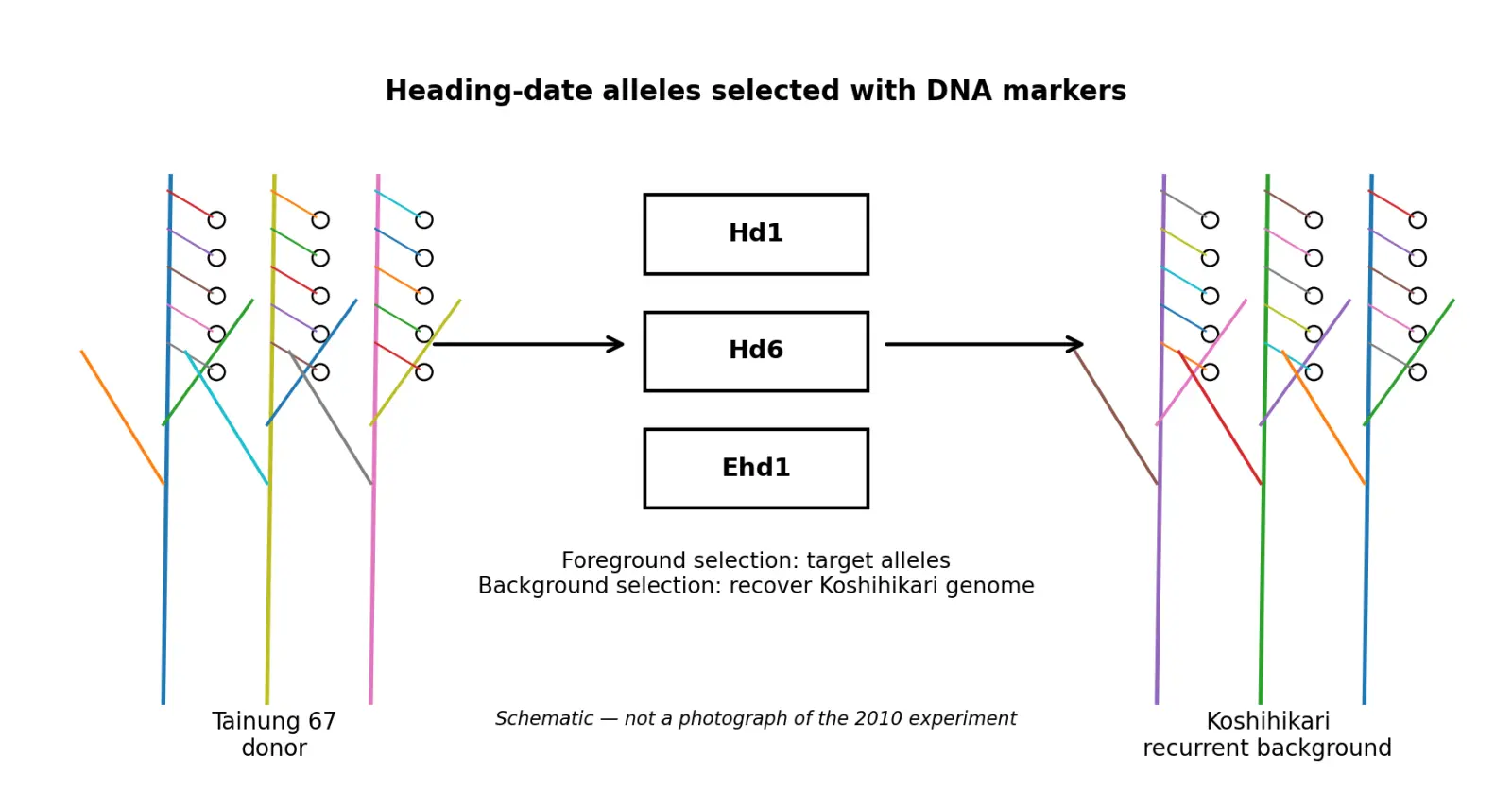
Conventional backcrossing repeatedly crosses progeny carrying a desired donor trait back to an elite recurrent parent. Each cycle increases the expected proportion of the recurrent-parent genome. Marker-assisted backcrossing adds DNA markers so breeders can track the target allele and, separately, estimate how much of the recurrent genetic background has been recovered. Rice breeding methods describe these as foreground selection and background selection, with recombinant selection also used to reduce donor DNA closely linked to the target locus (Hasan et al., 2015).
Foreground selection kept the three target loci
The Koshihikari study converted sequence differences at the three target genes into functional markers: an insertion/deletion marker for Hd1, a CAPS marker for Hd6 and a dCAPS marker for Ehd1. In each backcross generation, these markers were used first to identify plants that still carried the desired donor alleles at the target loci. This was the foreground step: the breeder identified which plants had the required genotype to continue the crossing scheme (Chen et al., 2010).
Background selection recovered the Koshihikari genome
After foreground selection, the study used polymorphic markers distributed across the genome to favor plants with more Koshihikari DNA outside the target regions. The study reports 87 polymorphic markers, with an average spacing of 17.3 cM in the final marker set. That genome-wide screen served a different purpose from the functional markers: it helped remove unnecessary donor segments while retaining the three selected heading-date alleles. This distinction is central to marker-assisted recurrent selection because target-gene retention and recurrent-genome recovery are separate selection problems.
- Foreground selection tracked the Tainung 67 alleles at Hd1, Hd6 and Ehd1.
- Background selection favored plants carrying more Koshihikari alleles across the 87 polymorphic markers.
- Selfing selected BC4F1 plants produced BC4F2 material for agronomic and quality evaluation.
The population sizes also show why DNA markers were useful. Hundreds of plants could carry different combinations of target alleles and recurrent-parent segments even when they looked similar. The 2010 work reported that 283 BC1F1 plants yielded two selected parents, 64 BC2F1 plants yielded five, and 147 BC3F1 plants yielded three. A later BC4F1 population contained 186 plants from which three named candidates were selected. The marker data therefore acted as a filter across several generations rather than as a one-time test.
Backcross generation | Plants screened | Selected for next stage |
BC1F1 | 283 | 2 |
BC2F1 | 64 | 5 |
BC3F1 | 147 | 3 |
BC4F1 | 186 | 3 candidates highlighted |
Selection counts reported for the 2010 breeding program.
What the genome-recovery results showed
The three highlighted BC4F1 plants were #286-14-A23-5, #286-85-A4-121 and #286-85-A27-55. Their estimated Koshihikari genome proportions were 94.05%, 97.49% and 97.08%, respectively. The highest value, 97.49%, showed that the marker profile of that plant was very close to the recurrent parent across the loci examined and represented a high level of Koshihikari genome recovery.
BC4F1 candidate | Estimated Koshihikari genome |
#286-14-A23-5 | 94.05% |
#286-85-A4-121 | 97.49% |
#286-85-A27-55 | 97.08% |
Recurrent-parent genome recovery among the three selected BC4F1 plants.
Background selection efficiency varied among backcross generations, and linkage drag was an important consideration. Linkage drag occurs when DNA physically close to a desired donor allele is inherited along with it because recombination has not separated the segments. This is particularly relevant in near-isogenic-line development: breeders want the donor allele while retaining as much of the recurrent-parent background as possible. Marker density and recombination around the target region therefore influence how precisely the recurrent background can be reconstructed (Hasan et al., 2015).
A high percentage of recurrent-parent genome recovery provides a strong measure of genetic similarity to the recurrent parent.
The selected BC4F1 plants were self-pollinated to produce BC4F2 material for subsequent evaluation. This phase focused on the biological breeding targets, including photoperiod sensitivity, heading date, yield potential, grain appearance and eating quality. The 2010 study established an effective route for creating near-isogenic Koshihikari lines carrying alternative heading-date alleles and prepared these materials for agronomic and quality assessment.
Why phenotype testing mattered
Marker-assisted selection is particularly useful when the marker-to-gene relationship is known and the target allele has a predictable effect, while complex agronomic traits also depend on the whole plant and its environment. Heading date can alter the duration of vegetative growth and the timing of grain filling; those shifts can in turn affect yield components and grain quality. A useful breeding line must head at an appropriate time for the local cropping system and perform well for plant height, panicle traits, maturity, disease exposure and quality.
The same principle applies to eating quality. Koshihikari’s value as a recurrent parent came from a package of desirable traits rather than from a single locus. Recovering more than 97% of the Koshihikari marker background supported the goal of retaining those characteristics while modifying heading behavior. Grain-quality and sensory-related measurements formed part of the evaluation of the derived material.
This separation between genotype and performance is also why modern rice breeding continues to combine DNA markers with field selection rather than treating molecular data as a replacement for agronomy. A 2026 review of Japanese rice breeding describes marker-assisted selection as a practical tool for tracking genes and combining traits efficiently, while final line development integrates generation advancement with evaluation of agronomic performance (Goto et al., 2026). The Koshihikari project is an early example of that integrated logic.
How to interpret the study in today’s breeding context
The tools available to rice breeders have changed substantially since 2010, but the logic of the experiment remains recognizable. High-throughput genotyping and whole-genome sequence data can now provide denser information than a panel of several dozen markers, yet breeders still distinguish the gene or chromosome segment they want from the surrounding donor genome. The 87-marker background panel was therefore a practical implementation of a principle that remains current: selection should be informed not only by the presence of the target allele but also by the genetic context in which that allele is carried. Modern breeding methods continue to use DNA markers for stacking genes, shortening selection cycles and supporting the improvement of established rice cultivars (Goto et al., 2026).
The study also illustrates how genome-recovery percentages can be used as practical marker-based estimates of recurrent-parent similarity. Marker panels provide information across selected genome positions and help breeders identify plants with highly recovered recurrent-parent backgrounds. Plants with similar recovery percentages can still carry different arrangements of donor and recurrent-parent segments, particularly around selected loci where recombination patterns influence inheritance. Denser genotyping can provide increasingly detailed information, while field evaluation shows how these genetic combinations perform under agricultural conditions. For practical breeding, genomic similarity is a tool for preserving the recurrent parent’s characteristics while introducing targeted genetic changes.
What this study contributes to rice breeding
The most useful contribution of the 2010 work is methodological. It showed how functional markers for three heading-date genes could be combined with genome-wide background markers in a recurrent backcross program. Instead of selecting only for one visible trait, the breeding program simultaneously tracked the target alleles and the recovery of an elite cultivar’s genome. That approach is particularly suited to modifying a well-liked cultivar when the goal is to change a narrow adaptation trait while preserving as much of the original genetic package as possible.
The experiment also illustrates the value of near-isogenic lines for research. When lines differ mainly at defined target regions, comparisons among them can help separate the effects of particular alleles from the many background differences that complicate comparisons between unrelated cultivars. In the context of flowering, such lines are useful for examining how Hd1, Hd6 and Ehd1 interact under local day lengths and seasons. They can therefore serve both breeding and biological research.
The 2010 breeding program successfully introduced the selected heading-date alleles from Tainung 67 into Koshihikari-derived material while achieving substantial recovery of the recurrent-parent genome. The resulting near-isogenic lines provided a focused genetic basis for evaluating heading behavior, adaptation, agronomic performance and grain-quality characteristics under Taiwanese growing conditions.
Frequently asked questions
Why was Koshihikari crossed with Tainung 67?
Koshihikari headed too early under Taiwanese growing conditions in the study, whereas Tainung 67 was described as photoperiod insensitive. The breeding program used Tainung 67 as the donor of alternative Hd1, Hd6 and Ehd1 alleles while repeatedly backcrossing to Koshihikari to retain its broader genetic background and quality traits.
What is marker-assisted backcrossing?
Marker-assisted backcrossing combines repeated crosses to an elite recurrent parent with DNA-marker selection. Foreground markers track the desired donor alleles, while background markers favor progeny carrying more of the recurrent-parent genome. The method can speed recovery of an elite genetic background and reduce unwanted donor DNA compared with phenotype-only selection.
Did the study prove that the new rice lines had higher yield?
No. The 2010 work showed successful introgression of the target heading-date alleles and high recovery of the Koshihikari marker background. The selected BC4F1 plants were selfed for later evaluation. Yield, grain quality, eating quality and the practical value of altered heading dates required separate field and quality testing.
Why were three genes targeted instead of one?
Hd1, Hd6 and Ehd1 influence rice heading through different parts of the photoperiodic flowering network. Their combined allelic state can therefore shape heading behavior more effectively than considering one locus in isolation. The study used functional markers for all three so breeders could preserve the intended combination through successive backcross generations.
What does 97.49% Koshihikari genome recovery mean?
It means that, at the background markers used in the breeding program, one BC4F1 candidate was estimated to carry 97.49% of the Koshihikari recurrent-parent genome. It does not mean every trait was 97.49% identical, nor does it guarantee that all unmeasured donor DNA or linked segments had been removed.
Sources
- Chen CS, Chen RK, Chin HH, Lin YR. (2010). Introgression of three heading date genes, hd1, Hd6, and ehd1, to Oryza sativa L. japonica cv. Koshihikari by marker-assisted selection. Crop, Environment & Bioinformatics, 7(1), 1–20.
- Yano, M., Katayose, Y., Ashikari, M., et al. (2000). Hd1, a major photoperiod sensitivity quantitative trait locus in rice, is closely related to the Arabidopsis flowering time gene CONSTANS. The Plant Cell, 12(12), 2473–2483.
- Takahashi, Y., Shomura, A., Sasaki, T., & Yano, M. (2001). Hd6, a rice quantitative trait locus involved in photoperiod sensitivity, encodes the alpha subunit of protein kinase CK2. Proceedings of the National Academy of Sciences, 98(14), 7922–7927.
- Doi, K., Izawa, T., Fuse, T., et al. (2004). Ehd1, a B-type response regulator in rice, confers short-day promotion of flowering and controls FT-like gene expression independently of Hd1. Genes & Development, 18(8), 926–936.
- Kojima, S., Takahashi, Y., Kobayashi, Y., et al. (2002). Hd3a, a rice ortholog of the Arabidopsis FT gene, promotes transition to flowering downstream of Hd1 under short-day conditions. Plant and Cell Physiology, 43(10), 1096–1105.
- Komiya, R., Ikegami, A., Tamaki, S., Yokoi, S., & Shimamoto, K. (2008). Hd3a and RFT1 are essential for flowering in rice. Development, 135(4), 767–774.
- Komiya, R., Yokoi, S., & Shimamoto, K. (2009). A gene network for long-day flowering activates RFT1 encoding a mobile flowering signal in rice. Development, 136(20), 3443–3450.
- Zhou, S., Zhu, S., Cui, S., et al. (2021). Transcriptional and post-transcriptional regulation of heading date in rice. New Phytologist, 230(3), 943–956.
- Hasan, M. M., Rafii, M. Y., Ismail, M. R., et al. (2015). Marker-assisted backcrossing: a useful method for rice improvement. Biotechnology & Biotechnological Equipment, 29(2), 237–254.
- Goto, A., Matsushita, K., & Yamanouchi, U. (2026). The current state of the use of DNA markers for improving the efficiency of rice breeding in Japan. Breeding Science, 76(1), 3–26.
Sophie Bennett — author
Sophie writes the health and nutrition explainers. Her editorial focus includes nutrients, dietary patterns, energy metabolism, hydration, supplements, sports nutrition and the interpretation of health research for general readers. She approaches health conten...
Related

Wild fruit diversity and the origins of cultivated trees

How vermicompost affects growth and flowering in Liatris spicata
Sugar components of coconut sugar in Indonesia: study digest
Can Alsike Clover Be Bred for Bulgaria’s Lowland Pastures?
How Tunisian Date Palm Seeds Differ in Chemistry and Bioactivity
Coffee, Cocoa and Tea: Cultivation, Management and Production