How Tunisian Date Palm Seeds Differ in Chemistry and Bioactivity
Mounira Metoui and colleagues compared seeds from 11 common date palm cultivars from the coastal oasis of Gabès with Deglet Nour from Kébili. The study measured proximate and mineral composition, phenolics, flavonoids, anthocyanins, DPPH radical-scavenging activity and antibacterial effects.
The results showed strong cultivar-to-cultivar variation. Khadhouri was among the strongest entries for phenolics and antioxidant activity, while methanol extracts generally produced the greatest antibacterial inhibition. Principal component analysis separated the 12 cultivars into four groups.
Why Tunisian Date Palm Seeds Were Examined as a Valuable By-Product
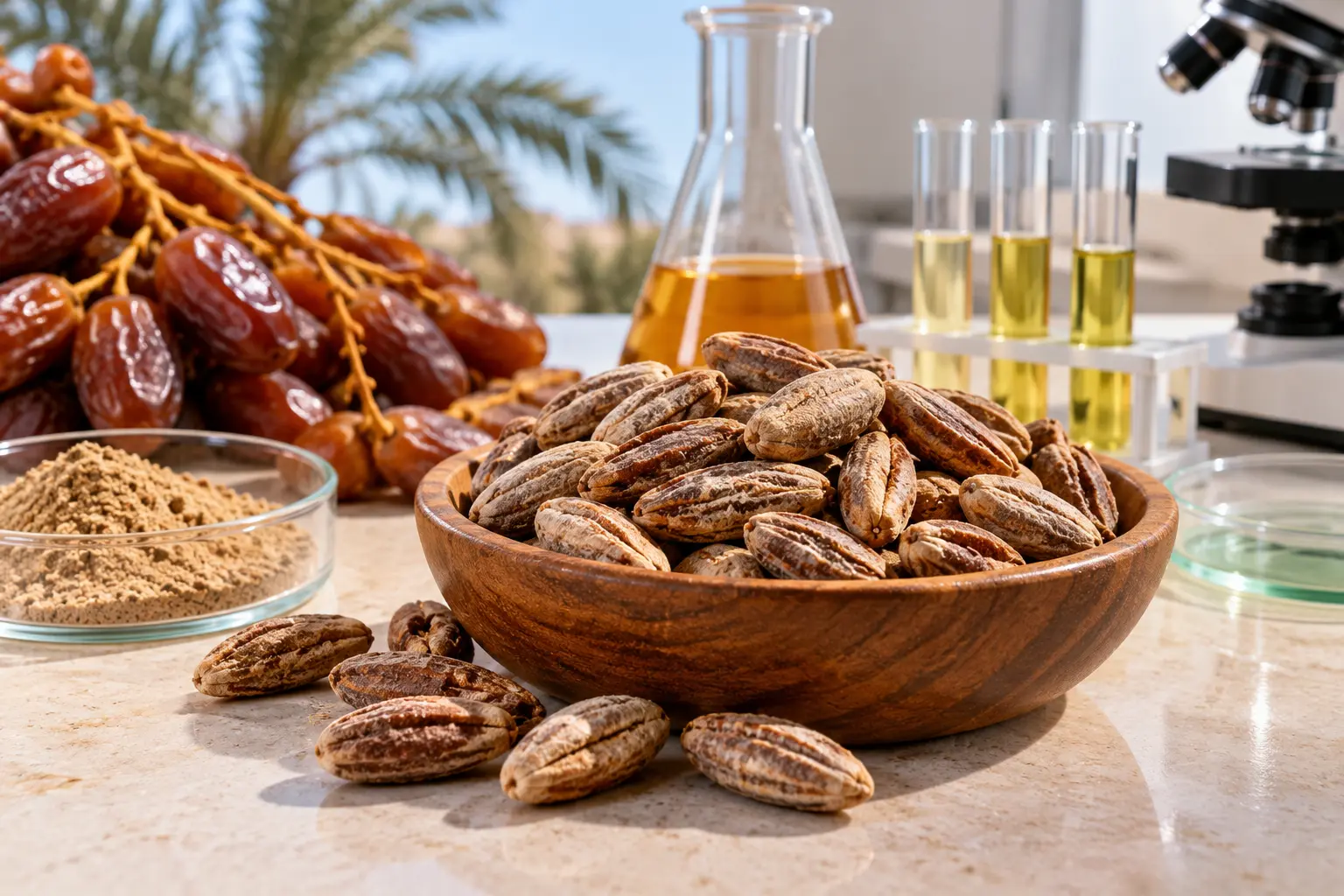
Date seeds typically represent a substantial fraction of the fruit and are often discarded or directed to animal feed. The authors approached them instead as a possible source of recoverable compounds with value for food, technological and other applications. The study focused on 11 cultivars collected in the coastal oasis of Gabès and the well-known Deglet Nour cultivar from Kébili. Seeds were separated from fruits, washed, air-dried, ground into powder and stored at -20°C before analysis.
The Research Combined Nutritional Composition With Bioactivity Testing
The experimental programme was broader than a single antioxidant assay. It included protein, fat, moisture, dietary fibre, sugars, ash and minerals, together with phenolic, flavonoid and anthocyanin measurements. The researchers then tested DPPH radical-scavenging activity and antibacterial activity against five bacterial strains. This design allowed chemical differences among cultivars to be considered alongside functional laboratory measurements. By combining these analyses, the researchers could examine whether cultivars with similar basic nutritional profiles also displayed comparable antioxidant and antibacterial properties. The approach provided a broader picture of date seed characteristics and highlighted the importance of evaluating several indicators rather than relying on a single measurement.
How the Twelve Date Seed Cultivars Differed in Basic Composition
The proximate analysis showed substantial variation among cultivars. Protein values in the published table ranged from 5.23% in Baht to about 7% in several entries, while fat ranged from 4.88% in Matata to 7.81% in Halwaya. Sugar content ranged from 1.21% in Bouhattam to 3.81% in Khadhouri in the full paper's table. The article attributes differences among cultivars to factors that can include cultivar identity, maturity, environmental conditions, processing and storage. These differences indicate that date seeds should not be treated as a chemically uniform by-product, even when they originate from the same geographical region. The variation in protein, fat and sugar content may also influence which cultivars are considered for further research into food ingredients, seed oils and other potential applications.
Dietary Fibre Was a Major Component of the Date Seeds
Dietary fibre was abundant across all 12 cultivars, ranging from 73.83% in Amari to 82.37% in Khadhouri according to the numerical table. However, the accompanying narrative identifies Deglet Nour as having the highest fibre content. This discrepancy should be considered when comparing individual cultivars. Despite the inconsistency in identifying the highest-ranking cultivar, the reported measurements consistently show that fibre represented a substantial proportion of the analysed seed material. The findings help explain why date palm seeds have attracted interest as a possible source of fibre-rich ingredients, although their suitability for particular products would require additional processing and functional assessments.
Table 1. Selected Proximate Composition Values From the Twelve Date Seed Cultivars
Measure | Lowest reported value | Highest reported value |
Protein | Baht: 5.23% | Halwaya: 7.02% |
Fat | Matata: 4.88% | Halwaya: 7.81% |
Sugar | Bouhattam: 1.21% | Khadhouri: 3.81% |
Dietary fibre | Amari: 73.83% | Khadhouri: 82.37% |
Table note: Values are taken from Table 1 of the full article. The reported fibre maximum differs between the numerical table and the accompanying discussion.
What the Mineral Analysis Showed Across Tunisian Cultivars
Potassium was the most abundant of the three minerals reported in the mineral table, followed by phosphorus and sodium. Rochdi had the highest listed potassium value at 300 mg/100 g dry weight and the highest phosphorus value at 124 mg/100 g dry weight. Sodium was much lower than potassium. The paper reports a range extending to 17.83 mg/100 g dry weight in Rochdi, while Baht was among the lowest entries at 11.22 mg/100 g dry weight.
Potassium, Phosphorus and Sodium Were Strongly Correlated
The authors reported correlations of 0.94 between phosphorus and potassium, 0.87 between potassium and sodium, and 0.85 between phosphorus and sodium. These measurements add a mineral-composition dimension to the cultivar comparison, but the paper's main bioactivity discussion centres on phenolic compounds, antioxidant activity and antibacterial inhibition.
How Phenolics, Flavonoids and Anthocyanins Varied Among Seeds
Total phenolic content differed significantly among the studied cultivars. The full paper's table places Khadhouri at 9.53 g GAE/100 g dry weight, Eguiwa at 9.48 and Korkobi at 9.41, while the lowest values were found in Lemsi and Baht. Flavonoid content also differed significantly. Table 3 reports Korkobi at 3.83 g CAE/100 g dry weight, followed by Khadhouri at 3.68 and Eguiwa at 3.61. These results indicate that cultivars with relatively high phenolic concentrations also tended to show substantial flavonoid levels, although their rankings were not identical. The differences are relevant to evaluating date seeds as potential sources of bioactive compounds, particularly because extraction methods and analytical conditions can influence the quantities measured. Comparing several cultivars therefore provides a more informative assessment than relying on the chemical profile of a single seed variety.
Deglet Nour had the highest reported anthocyanin value
Anthocyanin values ranged from 0.20 mg cyanidin-3-glucoside equivalents per gram dry weight in Baht to 0.61 mg/g in Deglet Nour. The article emphasizes that cultivar, growing and processing conditions can influence these measurements. The biochemical profile therefore should not be treated as a fixed characteristic independent of environment and methodology. Unlike the phenolic and flavonoid results, where Khadhouri and Korkobi ranked highly, Deglet Nour stood out for its reported anthocyanin concentration. This distinction illustrates why different groups of bioactive compounds need to be assessed separately when comparing date palm cultivars. Higher anthocyanin content in one cultivar does not necessarily indicate stronger overall antioxidant or antibacterial activity, since these properties depend on multiple compounds and their interactions under the tested conditions.
Table 2. Selected Bioactive Compound Extremes Reported in Table 3
Measure | Lower end | Higher end |
Total phenolics | Lemsi: 5.13 g GAE/100 g DW | Khadhouri: 9.53 g GAE/100 g DW |
Total flavonoids | Lemsi: 1.43 g CAE/100 g DW | Korkobi: 3.83 g CAE/100 g DW |
Anthocyanins | Baht: 0.20 mg CGE/g DW | Deglet Nour: 0.61 mg CGE/g DW |
DPPH inhibition | Lemsi: 33.12% | Korkobi: 55.47% |
Table note: The abstract identifies Khadhouri as having the highest DPPH activity and flavonoid content, whereas the numerical table assigns these maxima to Korkobi.
What the DPPH Test Revealed About Antioxidant Activity
The DPPH assay revealed significant differences in radical-scavenging activity among the cultivars. The numerical results in Table 3 identify Korkobi as having the highest value at 55.47%, followed by Khadhouri at 54.58% and Eguiwa at 51.52%. However, the abstract attributes the maximum value of 55.47% to Khadhouri. This discrepancy should be considered when identifying the cultivar with the strongest antioxidant activity.
Antioxidant Activity Tracked Phenolic and Flavonoid Content Closely
The paper reports a correlation of r = 0.96 between DPPH activity and phenolic content and the same r = 0.96 correlation with flavonoids. The correlation with anthocyanins was much lower at r = 0.42. These associations support the authors' interpretation that phenolic and flavonoid compounds contributed strongly to the measured radical-scavenging capacity. Correlation, however, does not isolate which individual compounds were responsible.
How Antibacterial Activity Was Tested in Date Seed Extracts
The researchers prepared seed extracts in water, methanol and acetone and used a disc-diffusion method. The tested organisms were Escherichia coli, Salmonella Typhimurium, Enterococcus faecalis, Staphylococcus aureus and Staphylococcus epidermidis. Paper discs were impregnated with extract and placed on inoculated Mueller-Hinton agar. After incubation, antibacterial activity was evaluated by measuring inhibition zones.
Methanol Extracts Were Generally the Most Effective
The study reports that methanol extracts were the most effective overall, followed by acetone extracts, whereas aqueous extracts had relatively little effect. None of the extracts showed antibacterial activity against Enterococcus faecalis. For individual methanol extracts, notable inhibition zones included 27.87 mm for Korkobi against E. coli, 22.43 mm for Bouhattam against S. aureus, 21.70 mm for Matata against S. epidermidis and 19.43 mm for Bouhattam against S. Typhimurium.
Table 3. Selected Maximum Methanol-Extract Inhibition Zones Reported
Test bacterium | Cultivar highlighted in article | Inhibition zone |
Escherichia coli | Korkobi | 27.87 mm |
Staphylococcus aureus | Bouhattam | 22.43 mm |
Staphylococcus epidermidis | Matata | 21.70 mm |
Salmonella Typhimurium | Bouhattam | 19.43 mm |
Enterococcus faecalis | No active extract reported | No inhibition |
Table note: The paper reports methanol extracts as most effective overall, followed by acetone and aqueous extracts.
What PCA Revealed About Relationships Among the Twelve Cultivars
The authors used principal component analysis on the measured composition and bioactivity variables. The first two principal components together explained 54.23% of total variation: PC1 accounted for 35.11% and PC2 for 19.12%. The two components separated the cultivars into four groups. Khadhouri formed one group and Korkobi another, indicating distinctive multivariate profiles relative to the remaining entries.
The Remaining Cultivars Formed Two Larger PCA Groups
A third group contained Amari, Deglet Nour, Rochdi, Hammouri, Halwaya and Eguiwa. The fourth contained Baht, Bouhattam, Lemsi and Matata. PCA summarizes similarities across many measurements at once. It does not by itself establish why the cultivars differ, but it helps show that the biochemical and antibacterial data were structured rather than uniform.
Why Date Seeds May Have Potential Beyond Processing Waste
The authors conclude that date seeds could be considered a useful by-product rather than simply a processing residue. Their argument rests on the combination of high fibre, measurable oil and minerals, substantial phenolic content, antioxidant capacity and antibacterial activity in laboratory extracts. The paper discusses possible food, pharmaceutical and cosmetic uses and notes the potential value of seed oil. These are proposed applications based on composition and in-vitro properties, not demonstrations of clinical effectiveness or commercial performance.
Laboratory Bioactivity Does Not Equal a Proven Medicinal Effect
Disc-diffusion inhibition and DPPH radical scavenging are laboratory endpoints. They can identify promising material for further study, but the study did not evaluate human efficacy, safety, dosing or bioavailability. Tunisian date seeds contain potentially useful compounds and exhibit in-vitro antioxidant and antibacterial activities, supporting further food-technology, microbiological and product-development research.
What the Study Supports and Where Its Limits Matter
The work has several strengths for cultivar screening: 12 named date seed sources were compared, analytical determinations were performed in triplicate, and the study combined compositional, antioxidant, antibacterial and multivariate analyses. At the same time, the article contains internal inconsistencies between the abstract, narrative text and tables. Examples include the identity of the cultivar with the highest DPPH activity and differences in reported flavonoid or fibre maxima.
The Numerical Tables Are Important When Claims Conflict
Differences between the numerical tables and accompanying descriptions affect the identification of cultivars with the highest measured values. This is especially important because small differences can change which cultivar is described as the highest. The findings demonstrate substantial variation in seed composition and laboratory bioactivity among the 12 Tunisian date palm cultivars, although inconsistencies in the reported maxima limit some cultivar-level comparisons.
Practical takeaway: Metoui and colleagues found substantial chemical and functional variation among Tunisian date palm seed cultivars. No single cultivar showed the highest values across all measured characteristics. Date seeds contained fibre, oil, minerals and phenolic compounds and demonstrated antioxidant and antibacterial activity in laboratory assays. These findings support further research into potential applications of date palm seeds, although the observed bioactivity has not been established in humans.
Frequently asked questions
How many Tunisian date palm cultivars were analysed for seed composition?
The researchers compared seeds from 12 Tunisian date palm cultivars. Eleven common cultivars originated in the coastal oasis of Gabès, while Deglet Nour came from Kébili. Their seeds were examined for basic composition, minerals, phenolic compounds, antioxidant activity and antibacterial effects. The comparison revealed substantial differences across cultivars rather than one uniform chemical profile.
Which Tunisian date palm seed cultivar contains the most phenolics?
The numerical results identify Khadhouri as having the highest total phenolic content, at 9.53 g gallic acid equivalents per 100 g dry weight. Eguiwa and Korkobi followed closely, with values of 9.48 and 9.41, respectively. These are measurements for the samples and analytical conditions reported, not fixed values for every harvest.
Which Tunisian date palm seeds showed the strongest DPPH antioxidant activity?
The numerical table lists Korkobi as having the highest DPPH inhibition, at 55.47%, followed by Khadhouri at 54.58%. However, the publication’s abstract attributes the maximum value of 55.47% to Khadhouri. Because those statements conflict, the leading cultivar cannot be reported unambiguously without specifying whether the table or abstract is being used.
Which solvent gave the strongest antibacterial activity in date seed extracts?
Methanol extracts generally produced the strongest antibacterial inhibition in the laboratory tests, followed by acetone extracts. Water-based extracts showed comparatively little activity. The researchers tested five bacterial strains, and none of the extracts inhibited Enterococcus faecalis. These disc-diffusion findings concern prepared seed extracts under experimental conditions and do not demonstrate antibacterial benefits in humans.
Sources
- Metoui M, Essid A, Bouzoumita A, Ferchichi A. Chemical composition, antioxidant and antibacterial activity of Tunisian date palm seed. Polish Journal of Environmental Studies. 2019;28(1):267–274.
- Al-Farsi MA, Lee CY. Optimization of phenolics and dietary fibre extraction from date seeds. Food Chemistry. 2008;108(3):977–985.
- Besbes S, Blecker C, Deroanne C, Drira N-E, Attia H. Date seeds: chemical composition and characteristic profiles of the lipid fraction. Food Chemistry. 2004;84(4):577–584.
- Mrabet A, Jiménez-Araujo A, Guillén-Bejarano R, Rodríguez-Arcos R, Sindic M. Date seeds: a promising source of oil with functional properties. Foods. 2020;9(6):787.
- Al Juhaimi F, Ghafoor K, Özcan MM. Physical and chemical properties, antioxidant activity, total phenol and mineral profile of seeds of seven different date fruit varieties. International Journal of Food Sciences and Nutrition. 2012;63(1):84–89.
- Djaoudene O, López V, Cásedas G, et al. Phoenix dactylifera L. seeds: a by-product as a source of bioactive compounds with antioxidant and enzyme inhibitory properties. Food & Function. 2019;10:4953–4965.
- Alkhoori MA, Kong AS-Y, Aljaafari MN, et al. Biochemical composition and biological activities of date palm (Phoenix dactylifera L.) seeds: a review. Biomolecules. 2022;12(11):1626.
- Olaniyi OO, Samuel IA, Igbe FO. Phytochemical content, antioxidant properties and antibacterial activities of date (Phoenix dactylifera L.) seed extracts. Journal of Food Safety and Hygiene. 2022;8(2).

Maya Hartwell — author
Maya writes environment and plant science explainers, with an editorial focus on biodiversity, ecosystems, water quality, environmental pollution, plant biology, invasive plants, natural materials and the use of biological resources in environmental technologi...
Related
Koshihikari rice: marker-assisted heading-date gene transfer

Wild fruit diversity and the origins of cultivated trees
How vermicompost affects growth and flowering in Liatris spicata
Sugar components of coconut sugar in Indonesia: study digest
Can Alsike Clover Be Bred for Bulgaria’s Lowland Pastures?
Coffee, Cocoa and Tea: Cultivation, Management and Production