Keystone species and how one animal can hold an ecosystem together
A keystone species has an ecological influence disproportionately large relative to its abundance, sometimes maintaining a community that would change sharply without it (Power et al., 1996). Predators can prevent a competitor from monopolising habitat, while other species transform the physical environment (Paine, 1966; Jones et al., 1994). The effect depends on the community being examined.
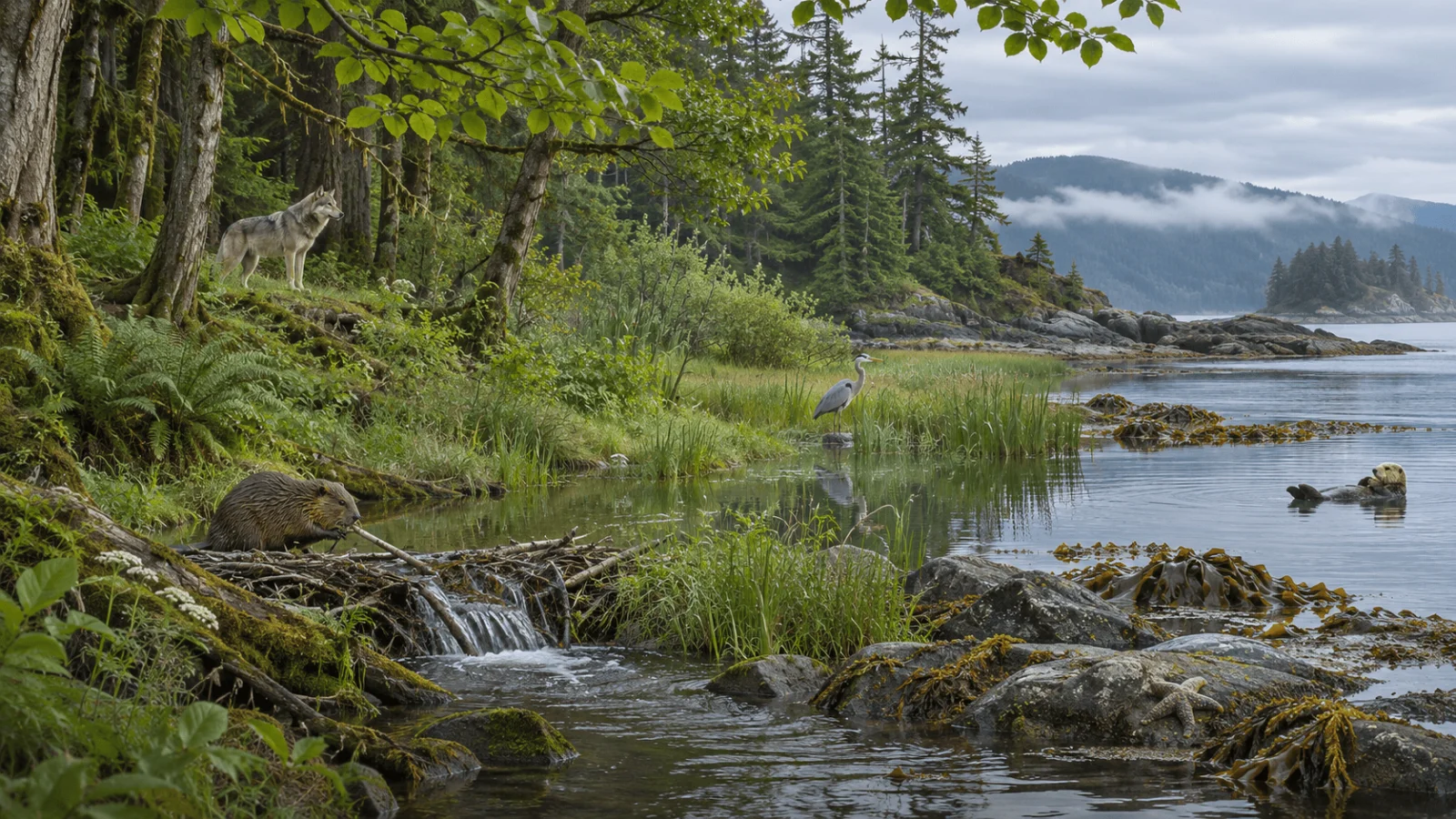
Sea stars, sea otters, wolves and beavers reveal different ways that species influence other organisms. Removal experiments, island comparisons and long field studies show which relationships can be measured directly. The evidence also exposes a distinction between a convincing local cascade and a claim that restoring an animal will restore an entire ecosystem.
What a keystone species is and why it matters
The term keystone species describes ecological influence in relation to abundance. Power and colleagues (1996) distinguished such species from dominants, which occupy more of a community's biomass or space and can therefore exert large effects simply through their presence. A species need not be numerous to change which neighbours survive. Its influence is measured through the responses of other organisms, not through its rarity or public prominence.
Mills, Soulé and Doak (1993) identified two hallmarks in the original idea: the species helps maintain community organisation and diversity, and its importance is exceptional relative to other members. The authors traced that understanding to rocky-shore predator experiments and warned against treating every ecological relationship as belonging to a single category. The concept grew beyond conspicuous carnivores. Plants can qualify too.
The keystone label has no universally simple threshold. Power and colleagues (1996) described disputes arising from ambiguity in the term and the absence of an agreed operational definition. A claim about a keystone needs a named system, a measured response and a comparison, because the same species may be influential in one interaction yet remain difficult to classify without evidence from that community.
The contrast with dominant species also shapes conservation interpretation. Power and colleagues (1996) observed that dominant species often supply much of the energy flow and three-dimensional shelter on which communities depend. Although those roles can be necessary for the community without meeting the criterion of disproportionate impact per unit abundance, the ecological question concerns what changes when the species changes and how much can be attributed to it.
How keystone species shape food webs and habitats
Keystone effects move through ecological relationships in several ways. Predation can change the pressure on competitors or herbivores, while physical modification changes which habitats remain available (Paine, 1966; Jones et al., 1994). Mutualism offers another route. The mechanisms overlap, but the evidence needed to establish each one differs.
Predators and trophic cascades
A trophic cascade occurs when a predator changes herbivore abundance or foraging behaviour and thereby affects plants. Hobbs and colleagues (2024) used that definition to examine Yellowstone's links among carnivores, ungulates and woody vegetation. The indirect plant response is central to the term. A predator's presence, taken alone, cannot measure how strongly the cascade operates.
Rocky-shore food webs provide another route. In Paine's removal experiment, a predator limited the spread of organisms competing for attachment space; species not eaten by that predator were affected indirectly (Paine, 1966). The mechanism differs from a simple predator-herbivore-plant chain. Here the crucial resource was space on the rock, and dominance by mussels constrained other organisms.
Ecosystem engineers
Jones, Lawton and Shachak (1994) defined ecosystem engineers by their ability to modify the physical state of living or non-living material, changing resource availability for other species. Their examples distinguish corals and trees, which create structure through their own tissues, from beavers and woodpeckers, which transform external materials. The label describes how habitat changes. It does not, by itself, establish that the engineer has a disproportionate effect relative to abundance.
Beavers offer a visible example of such physical work. Their tree cutting and dam construction alter water movement and produce wetlands, according to Jones and colleagues (1994). Changed hydrology can create a different setting for organisms without passing through a predator-prey link. The duration and area of a structure also matter when comparing the effects of engineers (Jones et al., 1994).
Mutualists and other roles
Stachowicz (2001) described facilitation as an interaction benefiting at least one species while harming neither; mutualism is the case in which both partners benefit. The same pair of species can shift among positive interactions under changing environmental conditions, as Stachowicz (2001) noted.
Mills and colleagues (1993) treated keystone effects as a varied set of ecological interactions rather than mutually exclusive groups. Pollination and the modification of plant growth illustrate why categories can meet. Jones and colleagues (1994) noted that pollinators affect plant tissue and resources available to seed predators, complicating the boundary around engineering. The decisive test remains the wider community response.
How Paine's sea star experiment revealed keystone effects
Robert Paine's rocky-intertidal study supplied experimental evidence that removing a predator could alter an assemblage far beyond its direct prey (Paine, 1966). The study took place on a Washington shoreline where barnacles, mussels and other attached organisms competed for limited rock space, with its evidence resting on controlled manipulation and the changes counted within that particular place.
Sea star removal and mussel dominance
At Mukkaw Bay, Paine (1966) kept a shoreline section approximately eight metres long and two metres high free of the predatory sea star Pisaster, beginning in June 1963. An adjacent area was left undisturbed as a control. The comparison separated changes following removal from the continuing presence of the animal nearby, because this was a field manipulation of a defined section of shore rather than removal across an entire coastline.
Barnacles initially colonised the space after the sea stars were removed. Paine (1966) reported that Balanus glandula occupied 60 to 80% of the available space by September, before growing mussels crowded the barnacles in the following June. Dominance developed in stages. Release from predation was followed by competition among the remaining attached organisms.
Changes in species diversity
Paine (1966) counted a decline from 15 species to eight species in the experimental area after Pisaster removal. The measurement included species the sea stars did not consume, identifying effects mediated through neighbouring organisms and competition for rock. The sponge-nudibranch food chain was displaced, while anemones became less dense, despite neither the sponge nor the named carnivores being eaten by Pisaster.
Mills and colleagues (1993) later used this predator-removal result to explain the concept's origin. It showed how suppressing a strong space competitor could permit several food-chain connections to coexist. Paine (1966) also considered environmental heterogeneity as another influence on local diversity, so the experiment did not isolate every possible driver of rocky-shore communities. The causal evidence remains local.
Keystone species examples from wolves to beavers
Mechanisms differ across species. Sea otters change grazing pressure in marine habitats, wolves may affect herbivore numbers and browsing, and beavers redirect water and create habitat (Estes et al., 1978; Hobbs et al., 2024; Jones et al., 1994). Similar labels can therefore conceal distinct measurements. Their effects are best compared at the scale used in each study.
Yellowstone wolves and elk
Wolves are frequently associated with a Yellowstone trophic cascade involving elk and aspen or willow. The mechanism would involve carnivores changing elk abundance or foraging, followed by reduced browsing on woody plants (Hobbs et al., 2024). Vegetation recovery requires a separate measurement. The experimental evidence for willow recovery in the northern range also includes hydrology and browsing controls (Hobbs et al., 2024).
In 2010, Kauffman, Brodie and Jules examined aspen tree rings and monitored browsing in experimental elk exclosures arranged across different levels of predation risk. They found no reduction in elk browsing impacts at sites where elk faced higher risk from wolves. Their assessment also reported that young browsable aspen were not recovering in its sampled setting at that time.
A later field experiment reached a different but equally conditional conclusion about willows. Hobbs and colleagues (2024) crossed browsing exclusion with simulated beaver dams across 20 years and found willow growth to expected restoration heights only where dams and reduced browsing occurred together. Predator restoration alone had not restored the riparian plant communities examined on Yellowstone's northern range. Both constraints mattered.
Sea otters and kelp forests
Sea otters have an especially direct relationship with grazing invertebrates. The 1974 report by Estes and Palmisano compared western Aleutian islands with and without otter populations and connected otter presence to control of herbivorous invertebrates. They reported increased grazing and loss of macrophyte associations where otters were removed.
The 1978 Aleutian research by Estes, Smith and Palmisano described small, scarce sea urchins in shallow water where otters were abundant, alongside flourishing macroalgae. At islands lacking otters, urchins were larger and more abundant, and fleshy macroalgae had been eliminated. These observations support a predator-urchin-algae cascade. They do not, by themselves, measure how every kelp forest would respond to reintroduction.
Beavers and wetland habitats
Beavers affect ecosystems through habitat construction. Jones and colleagues (1994) described dam building as a physical change to hydrology that can create wetlands. The consequences can be studied in organisms living in those altered waters and adjacent habitats, beyond the beavers' own food relationships. The structure they leave is an ecological variable in its own right.
Law and colleagues (2026) compared nine beaver-created wetlands with nine wetlands unmodified by beavers in Evo, Finland. At sample and site scales, taxon numbers were mostly similar, with exceptions for particular groups, whereas beaver wetlands enlarged the landscape taxon pool by an average of 19%, with a reported range of 0–40%. They also measured plant functional diversity 55% higher in beaver wetlands than in controls. Scale changes the result.
How scientists identify and test keystone species
Identification begins with a proposed mechanism and a measurable community response. Power and colleagues (1996) noted that a species must have effects unexpectedly large for its abundance, yet operational definitions have been contested. Researchers can alter a species' presence, compare sites where it occurs naturally, or examine responses through time.
Removal experiments and field observations
Paine's experiment deliberately changed the presence of Pisaster while retaining an adjacent control (Paine, 1966). His subsequent species counts supplied a local causal test of removal. The 1978 investigation by Estes and colleagues compared Aleutian islands with different otter populations, connecting grazing and macroalgal differences without an equivalent assigned removal. Experimental control and geographic breadth are different strengths.
In Yellowstone, Kauffman and colleagues (2010) added exclosures and tree-ring evidence to observations along wolf-predation risk gradients. The experimental browsing comparison did not support the proposed fear-mediated mechanism at its sites. Hobbs and colleagues (2024) tested another possible constraint by crossing browsing exclusion with simulated dams. Manipulation separated the constraints.
Evidence that depends on context
Measurements must match the ecological claim. Power and colleagues (1996) warned that loosely using the term keystone obscures which impacts are disproportionate to abundance. An increase in tall saplings, a change in species richness and the creation of wetland habitat are separate outcomes. They cannot be treated as interchangeable measures of one generic force.
Northern Yellowstone aspen studies provide a current dispute about effect size. A 2025 survey by Painter and colleagues examined 87 stands and described a new cohort of small trees in forty-three percent of them. The original researchers described 30% of stands as having saplings throughout, 32% as patchy, and 38% as having few or none. MacNulty and colleagues (2026) then identified an error in the baseline used to calculate a reported increase, together with problems treating repeated stand observations as independent.
The 2026 response by Painter and colleagues acknowledged the baseline calculation error while maintaining that an ecologically significant cascade had occurred. The disagreement concerns the strength of the effect and its interpretation across the landscape, rather than the mere presence of some taller aspen. The spatially uneven observations remained in both accounts. The reported original multiplier should not be repeated as an established ecological effect.
Selected research findings
The selected studies answer different questions about keystone effects and restoration. In Paine's experiment, predator presence was manipulated directly, whereas the beaver study compared existing wetlands and the Yellowstone willow study manipulated browsing and water conditions (Paine, 1966; Law et al., 2026; Hobbs et al., 2024). None supplies a universal numerical effect for all keystone species.
Study | Setting and design | Reported finding | Interpretation |
Paine, 1966 | Sea star removal and adjacent control | Local species count fell from 15 to eight | Predator removal altered rocky-shore diversity |
Estes et al., 1978 | Aleutian islands with and without otters | Urchins scarce in shallow otter sites; macroalgae abundant | Marine grazing relationship |
Kauffman et al., 2010 | Yellowstone aspen, tree rings and exclosures | Higher wolf risk did not diminish elk browsing impact | Proposed behavioural route not supported at study sites |
Hobbs et al., 2024 | Yellowstone 20-year factorial willow study | Restoration-height willow growth required dams and reduced browsing | Joint constraints on recovery |
Law et al., 2026 | Nine Finnish beaver wetlands and nine controls | Landscape taxon pool averaged 19% higher, range 0–40% | Habitat effects depended on scale |
Interpretation also differs between measures within one study. Law and colleagues (2026) reported broadly similar local taxon numbers while finding additions to the landscape pool in beaver wetlands. An average at the sample level can miss taxa occurring in particular habitats, so a measure of ecological influence must identify both the organisms counted and the spatial scale at which observations were made.
What happens when a keystone species disappears
The consequences of a disappearance depend on the function formerly performed. In Paine's removal area, the absence of a sea star changed competition for rock and indirectly reduced organisms that the predator had not eaten (Paine, 1966). The food web changed through spatial competition. Loss of one predator affected several relationships at once.
Changes in food webs
Without otters on some western Aleutian islands, large and abundant sea urchins had eliminated fleshy macroalgae, as observed in the 1978 Aleutian research by Estes and colleagues. The 1974 report by Estes and Palmisano connected the removal of otters with greater herbivory and destruction of macrophyte associations. The pathway involves the prey population and the plants it consumes, while associated animals may be influenced by changes in primary productivity.
The outcome is not confined to species consumed directly. Paine (1966) observed effects on a sponge-nudibranch food chain and on anemones despite the relevant organisms not being eaten by Pisaster. Indirect effects extend beyond prey. The community response emerges from linked competition and feeding relationships.
Habitat loss and local context
A missing engineer changes the physical system. Jones and colleagues (1994) linked beaver dams to modified water flow and wetland formation, while describing structures whose ecological effects depend on density, area and persistence. Removing an animal does not specify the immediate fate of its dams or wetlands, because the duration of those physical structures constitutes a separate part of the ecological response.
Hobbs and colleagues (2024) found that bringing large carnivores back had not restored northern Yellowstone's studied riparian plant communities. Willow growth required reduced browsing in combination with simulated dams, implying that the earlier loss of ecosystem components had left more than one constraint on recovery. The loss of a keystone interaction can therefore leave conditions that predator return alone does not reverse.
Habitat also links keystone discussion with other biodiversity pressures. [Research on biodiversity and biological pest control](/environment/biodiversity-insect-pest-management-agroecosystems-environment) considers interactions among natural enemies and their habitat in farmland. Paine and Jones examined how species influence other organisms through changes in access to space and physical habitat.
What is proven about keystone species and what is not
A keystone effect is a defensible ecological claim when a species has a disproportionate influence on a defined community. Power and colleagues (1996) articulated the relative-abundance criterion, while Paine's manipulation demonstrated one such pathway on a rocky shore. Findings concern named species and places, so the keystone label cannot itself guarantee ecosystem stability.
A keystone species can influence community organisation through predation or habitat change, while restoration depends on the specific system and its constraints.
Paine's removal results support a direct link between Pisaster and local rocky-shore diversity. The 1978 otter comparisons by Estes and colleagues describe a related but observational route through sea urchin grazing and macroalgae. Jones and colleagues (1994) showed why physical engineering is a different mechanism, with dams and reefs changing resources without following the same predator chain. These lines of evidence should retain their different designs.
Restoration is an additional claim. Hobbs and colleagues (2024) found that browsing reduction and dam effects had to coincide for Yellowstone willows to reach expected restored heights. The 2025 aspen survey by Painter and colleagues recorded recovery in some stands and little or none in others. The researchers' subsequent 2026 exchange with MacNulty and colleagues exposed an acknowledged baseline error and disagreement over the strength of the reported cascade.
The distinction between a keystone and a foundation species also remains useful. Stachowicz (2001) described foundation species as habitat-forming organisms on which other community members depend, while Power and colleagues (1996) made disproportionate impact relative to abundance central to the keystone concept. A dominant reef-building coral may supply extensive structure; that fact alone does not give a numerical test of its per-capita importance. The categories describe different features of ecological influence.
Restoration is conditional. Yellowstone's willow experiments show that restored carnivores coexisted with conditions that still limited riparian recovery (Hobbs et al., 2024). Long-term studies that separately measure predation, habitat engineering and environmental conditions could identify which mechanisms persist after species return, since the observed interactions have so far been documented in particular ecological systems.
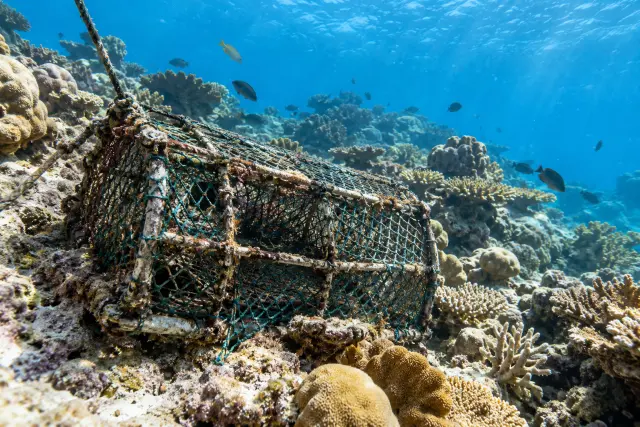
A parallel issue arises where ecological interactions are lost without a keystone removal experiment. [Research on coral reef disturbance from lobster traps](/environment/lobster-trap-impact-on-coral-reefs-environment) documents a separate physical disturbance to habitat-forming organisms. The linked study concerns physical habitat damage. Jones and colleagues (1994) distinguished the physical creation of habitat from direct feeding relationships.
Frequently asked questions
Can plants be keystone species?
Yes. The keystone concept concerns the size of an organism's ecological influence relative to its abundance, not whether it is a predator (Power et al., 1996). Mills and colleagues (1993) described a variety of keystone relationships, and habitat-forming plants can change the conditions available to other species. A plant still requires evidence of a disproportionate community effect.
Are all top predators keystone species?
No. A top predator occupies a position in a food web; a keystone species must also have an effect unexpectedly large for its abundance (Power et al., 1996). Yellowstone illustrates why the distinction matters. Kauffman and colleagues (2010) found that wolf-predation risk did not reduce elk browsing impacts in their sampled aspen stands.
Can an ecosystem have several keystone species?
Yes, ecological effects can operate through different interactions in the same community. Mills and colleagues (1993) considered keystone categories neither mutually exclusive nor exhaustive. Predators can influence herbivores, while engineers change physical habitat and mutualists alter the benefits organisms obtain from one another (Hobbs et al., 2024; Jones et al., 1994; Stachowicz, 2001).
How is a keystone species different from a foundation species?
Keystone status describes disproportionate ecological influence relative to abundance (Power et al., 1996). Foundation species, as discussed by Stachowicz (2001), create the habitat structure on which much of a community depends. A large, abundant habitat-former can be a foundation species without demonstrating the abundance-adjusted effect required by the keystone definition.
Does a keystone species have to be endangered?
No. Endangerment is not part of the definition used by Power and colleagues (1996), which focuses on effects relative to abundance. Paine (1966) demonstrated the ecological role of Pisaster by removing it from a confined shore section, without needing to establish a threatened population. Conservation status and community influence are separate questions.
Sources
- Paine RT. Food Web Complexity and Species Diversity. The American Naturalist. 1966;100(910):65–75. DOI 10.1086/282400.
- Jones CG, Lawton JH, Shachak M. Organisms as ecosystem engineers. Oikos. 1994;69(3):373–386. DOI 10.2307/3545850.
- Power ME, Tilman D, Estes JA, et al. Challenges in the quest for keystones. BioScience. 1996;46(8):609–620. DOI 10.2307/1312990.
- Kauffman MJ, Brodie JF, Jules ES. Are wolves saving Yellowstone’s aspen? A landscape-level test of a behaviorally mediated trophic cascade. Ecology. 2010;91(9):2742–2755. DOI 10.1890/09-1949.1.
- Mills LS, Soulé ME, Doak DF. The keystone-species concept in ecology and conservation. BioScience. 1993;43(4):219–224. DOI 10.2307/1312122.
- Hobbs NT, Johnston DB, Marshall KN, et al. Does restoring apex predators to food webs restore ecosystems? Large carnivores in Yellowstone as a model system. Ecological Monographs. 2024;94(2):e1598. DOI 10.1002/ecm.1598.
- Painter LE, Beschta RL, Ripple WJ. Changing aspen stand structure following large carnivore restoration in Yellowstone. Forest Ecology and Management. 2025;594:122941. DOI 10.1016/j.foreco.2025.122941.
- MacNulty DR, Brice EM, Bergeron NJ, Larsen EJ. Overstating trophic cascade strength following large carnivore restoration in Yellowstone: A comment on Painter et al. (2025). Forest Ecology and Management. 2026;605:123448. DOI 10.1016/j.foreco.2025.123448.
- Estes JA, Smith NS, Palmisano JF. Sea Otter Predation and Community Organization in the Western Aleutian Islands, Alaska. Ecology. 1978;59(4):822–833. DOI 10.2307/1938786.
- Stachowicz JJ. Mutualism, Facilitation, and the Structure of Ecological Communities. BioScience. 2001;51(3):235–246. DOI 10.1641/0006-3568(2001)051[0235:MFATSO]2.0.CO;2.
- Painter LE, Beschta RL, Ripple WJ. An ecologically significant trophic cascade in Yellowstone: Response to MacNulty, et al. (2026). Forest Ecology and Management. 2026;605:123449. DOI 10.1016/j.foreco.2025.123449.
- Law A, Willby NJ, Spencer T, et al. Wetland landscape transformation by beavers: responses of biodiversity and functional indicators at multiple scales. Landscape Ecology. 2026;41(6):93. DOI 10.1007/s10980-026-02303-4.
- Estes JA, Palmisano JF. Sea otters: Their role in structuring nearshore communities. Science. 1974;185(4156):1058–1060. DOI 10.1126/science.185.4156.1058.

Daniel Brooks — author
Daniel Brooks is a contributor to Cabdirect’s Environment & Climate content. He holds an MSc in Climate Science and a BSc in Environmental Geography and is affiliated with Northfield Climate Evidence Lab, a research and communication organisation. His backgrou...
Related
Biodiversity for Better Insect Pest Control in Agroecosystems
Army Ants: Social Predation, Nomadism and Tropical Ecology
How wind-driven lobster traps damage Florida Keys coral reefs

What is biodiversity and why it matters for food and farming
Invasive species and why some newcomers take over ecosystems

How consumerism affects the pursuit of sustainable tourism
Acacia Invasion and Cork Oaks in Algeria: Evidence from El Kala