How fertiliser types affect rice yield and soil under SRI
Under the System of Rice Intensification (SRI), fertilizer type can change both rice performance and soil condition even when similar amounts of nitrogen, phosphorus and potassium are supplied. The 2005 study reported that combining chemical and organic fertilizer promoted plant development, increased grain yield, improved soil physical and chemical properties, and raised fertilizer-use efficiency compared with other fertilizer-source treatments under SRI.
This explainer places that finding within the wider evidence on nutrient management in SRI and paddy rice. It examines why organic and mineral nutrient sources can behave differently, how different fertilizer strategies affect yield and soil properties, where purely organic nutrition may perform less effectively, and why local soil fertility, water management, amendment type and application rate influence the effectiveness of an integrated nutrient-management program.
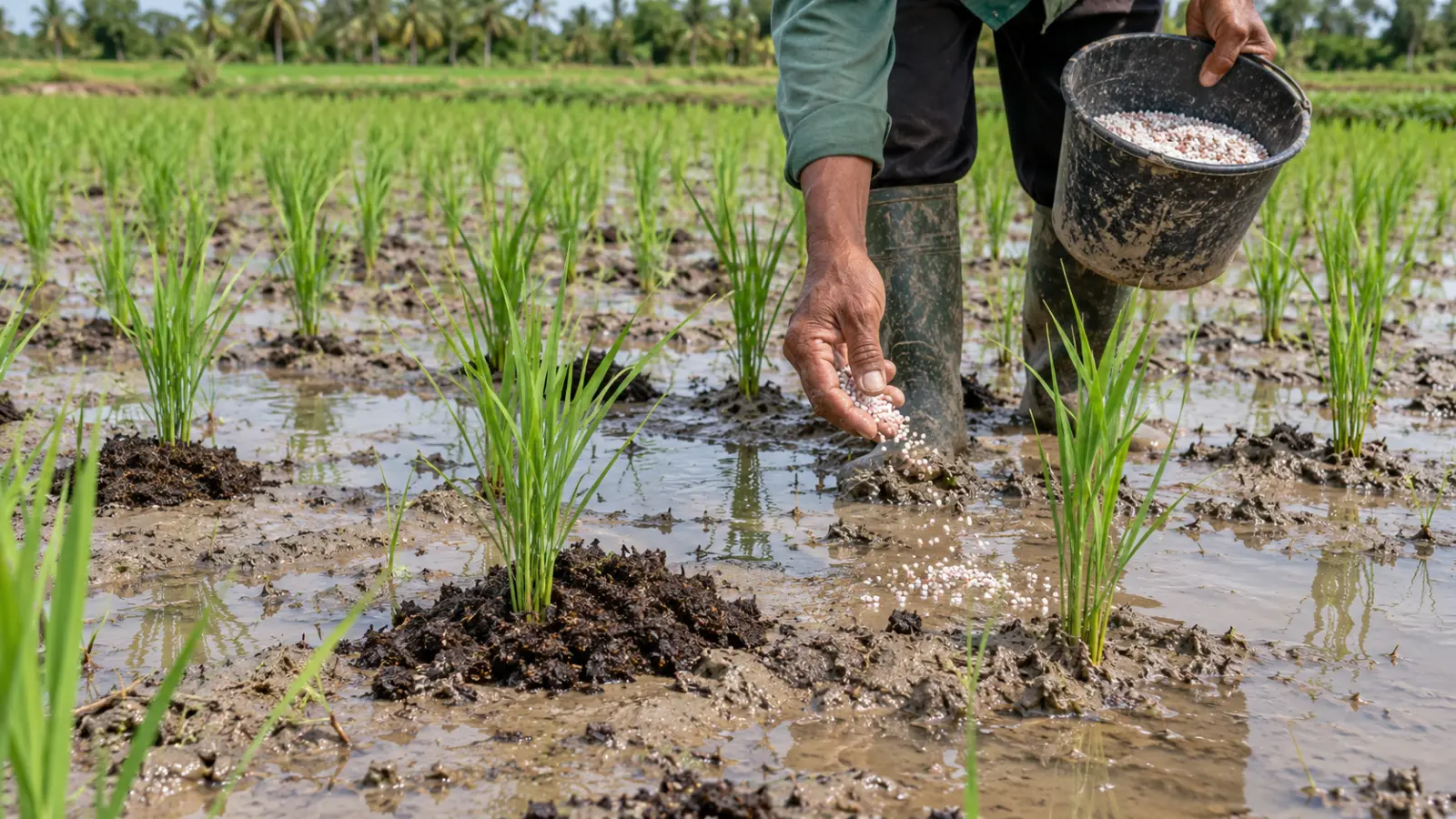
What fertilizer type changes under SRI
SRI is a crop-management system rather than a fertilizer recipe. Its core practices usually change seedling age, plant spacing, soil aeration, irrigation and weed management, so the root zone in an SRI field can differ substantially from a continuously flooded, densely planted rice field. Nutrient supply therefore interacts with a management environment in which roots may explore a larger volume of soil and alternate wetting can change oxygen availability, nutrient transformations and microbial activity. Fertilizer performance can consequently vary according to field conditions, nutrient sources and the wider management system.
The 2005 study compared fertilizer sources while maintaining equivalent nominal quantities of nitrogen, phosphorus as P2O5 and potassium as K2O. This design addressed whether the form in which nutrients are supplied can alter crop and soil responses. Coordinated chemical and organic fertilization promoted plant development and grain yield, improved physical and chemical soil status, and increased fertilizer-use efficiency. The results support the role of fertilizer source as an important component of nutrient management under SRI.
Mineral fertilizers and organic materials deliver nutrients through different pathways. Soluble mineral sources can provide nitrogen, phosphorus and potassium quickly and predictably, which is valuable when crop demand rises rapidly. Organic inputs such as manure, compost, crop residues or vermicompost contain carbon and nutrients that become available as they decompose. They can also influence aggregation, water retention, cation exchange, pH and microbial activity. The practical advantage of an integrated program is that different nutrient-release patterns and soil effects can complement one another under suitable field conditions.
What field trials say about grain yield
Integrated programs can match or exceed mineral-only treatments
A two-season SRI field experiment at Varanasi, India, tested 50%, 75% and 100% of the recommended fertilizer dose together with nitrogen supplied through farmyard manure or vermicompost. Srivastava et al. (2014) reported that 100% of the recommended fertilizer dose increased grain yield by 19.0% over the 50% dose. Increasing organic-source nitrogen to 45 kg N/ha also improved yield components and grain yield relative to lower organic-N rates. Importantly, 75% of the recommended fertilizer dose plus 45 kg N/ha through vermicompost produced a markedly high grain yield that was statistically at par with several treatments combining the full recommended fertilizer dose with farmyard manure or vermicompost.
Purely organic nutrition is not automatically sufficient
Reddy et al. (2013) reported a mean grain yield of 76.56 q/ha under SRI with 100% NPK compared with 64.76 q/ha under the traditional method, while purely organic nutrient management under SRI did not produce the highest grain yield. In Japan, Chapagain and Yamaji (2011) found that SRI changed several plant traits, but overall grain yield did not differ from conventional management; conventional-inorganic management produced comparatively high grain yield, while some SRI-organic combinations improved other plant characteristics and economic returns. These studies show that SRI can continue to benefit from readily available nutrients depending on soil and crop conditions.
How fertilizer source changes soil properties
Soil responses are one of the strongest reasons to compare fertilizer sources over more than a single harvest. In a four-year paddy experiment, Mi et al. (2018) found that adding cattle manure to NPK increased 2014 rice grain yield by 11.4% relative to NPK alone, while adding rice straw increased yield by 9.3%. The cattle-manure treatment also raised soil pH by 0.16 to 0.29 units and cation exchange capacity by 17.4% to 21.9%, and it produced the highest available phosphorus concentration in the surface layer. Other organic amendments in the same study produced different pH responses, demonstrating that organic amendments can affect soil properties in distinct ways.
Chesti et al. (2015) reported that 100% NPK plus 10 t/ha of farmyard manure increased grain yield to 5.36 t/ha, compared with 4.96 t/ha under 100% NPK alone, while also increasing soil organic carbon and available nitrogen, phosphorus and potassium. Long-term rainfed-lowland work by Banik et al. (2006) adds an important qualification: the highest mean yield was 3.53 t/ha with inorganic fertilizer and 3.47 t/ha with cow dung, a difference that was not statistically significant, yet several soil-quality indicators were highest under cow dung. Yield and soil quality can therefore move together, but they do not have to rank treatments in the same order.
Selected results from rice fertilizer studies
Study | Setting | Fertilizer comparison | Grain-yield result | Soil result |
Effect of different kinds of fertilizer on the yield and physical and chemical status of soil in SRI (2005) | SRI; equal N, P2O5 and K2O | Different fertilizer sources, including combined organic + chemical | Combined treatment reported higher grain yield | Improved physical and chemical status; higher fertilizer-use efficiency reported |
Srivastava et al. 2014 | Two-season SRI field trial, India | 50–100% RDF plus FYM or vermicompost N | 100% RDF: +19.0% vs 50% RDF; integrated 75% RDF + 45 kg N/ha VC performed strongly | Higher organic C and available N, P, K at stronger nutrient inputs |
Mi et al. 2018 | Four-year paddy field, China | NPK alone vs NPK + organic amendments | Cattle manure +11.4%; rice straw +9.3% vs NPK alone in 2014 | Cattle manure raised pH 0.16–0.29 and CEC 17.4–21.9% |
Chesti et al. 2015 | Three-year rice field, India | 100% NPK vs 100% NPK + 10 t/ha FYM | 5.36 vs 4.96 t/ha | Higher organic C and available N, P, K with FYM + NPK |
Li et al. 2024 | Greenhouse; two irrigation regimes | Equal N; different organic:inorganic ratios | High-organic ratio +2.7% vs chemical-only; +22% vs unfertilized | Fertilizer ratio and irrigation changed pH, EC, N and other soil factors |
Banik et al. 2006 | Rainfed lowland rice, India, 1997–2002 | Organic nutrient sources vs inorganic fertilizer | 3.47 t/ha cow dung vs 3.53 t/ha inorganic; not significantly different | Several soil-quality indicators were highest under cow dung |
Why results vary across sites and water regimes
The response to fertilizer is filtered through the soil. A review by Turmel et al. (2011) found that SRI yield responses differed with soil fertility and soil type: yield advantages were more apparent on highly weathered, infertile Acrisols and Ferralsols, while differences were not evident on more fertile Gleysols, Luvisols and Fluvisols in the studies analyzed. This pattern shows that the baseline soil environment can determine how strongly a management change affects nutrient capture and crop performance.
Water management is another part of the interaction. Li et al. (2024) compared different organic-to-inorganic fertilizer ratios under conventional and controlled irrigation. With equal nitrogen application, the treatment with the highest organic fertilizer ratio yielded 2.7% more rice than chemical fertilizer alone and 22% more than the unfertilized control. Controlled irrigation increased yield by 6% compared with conventional irrigation and also changed soil temperature, electrical conductivity, nitrogen and pH. The experiment demonstrates that fertilizer-source effects can change when the water regime changes.
Broader evidence also reveals environmental trade-offs. A 2024 global meta-analysis of 211 papers and 852 observations found that replacing part of inorganic fertilizer with organic substrate increased crop productivity by 3.04% on average and improved several biological soil-fertility indicators. It also reduced several nitrogen-loss pathways, but paddy-field methane emissions increased by 41.2%. These findings show that higher productivity and improvements in soil characteristics can occur alongside changes in greenhouse-gas emissions. Fertilizer strategy can therefore be evaluated across crop performance, soil quality and environmental outcomes.
Equal NPK does not mean equal nutrient availability
One of the easiest mistakes in fertilizer comparisons is to assume that equal total N, P and K means equal nutrition for the crop. Total nutrient content describes what is present in the material, not when it becomes available to roots. Mineral nitrogen can be immediately soluble, while organic nitrogen must be mineralized. Phosphorus availability depends strongly on soil chemistry, and potassium may be released at different rates from residues, manures and mineral salts. Two treatments can therefore contain the same nominal nutrient amount yet produce different nutrient concentrations in soil solution during critical growth stages.
Organic materials also bring non-nutrient properties into the comparison. Carbon inputs can support microbial biomass and contribute to aggregation; some manures can buffer acidity and increase cation exchange; residues with high carbon-to-nitrogen ratios can temporarily immobilize nitrogen. Compost maturity, moisture, storage losses and nutrient analysis all matter. Different organic materials can therefore produce different soil and yield responses even when they are applied alongside the same mineral fertilizer program. The four-year paddy study illustrates the point: cattle manure, rice straw, green manure and spent mushroom compost produced different soil and yield responses despite all being organic additions to NPK.
The same logic applies to fertilizer-use efficiency. A higher efficiency value may reflect better synchronization between nutrient release and crop uptake, a stronger root system, less nutrient loss from the soil, or a lower nutrient input used to produce a similar yield. The 2005 study reported that coordinated organic and chemical nutrient supply increased fertilizer-use efficiency, supporting the role of integrated management in improving nutrient use under the tested conditions.
The evidence does not show that organic or mineral fertilizer wins everywhere; it shows that nutrient source, dose, soil and water management interact.
How to read an SRI fertilizer study
A fertilizer trial becomes much more informative when the treatment labels are translated into actual field conditions. This is especially important in SRI, because changes in planting density, irrigation, weeding and root-zone aeration may occur at the same time as changes in fertilizer. When comparing studies or deciding whether a result is transferable, the following variables are particularly important:
- Starting soil fertility, pH, texture and organic matter, because these determine how strongly a field may respond to added nutrients or carbon.
- Actual N, P and K rates and whether equal nutrients refers to total nutrient content or estimated plant-available amounts.
- Organic input type, maturity, nutrient analysis and application timing, including whether manure, compost, residues or vermicompost were used.
- Water regime, seedling age, spacing and other SRI practices that can alter root growth, aeration and nutrient transformations.
- Trial duration and whether soil measurements represent a one-season response or changes accumulated over several crop cycles.
These variables explain why coordinated organic and chemical fertilization can perform well under SRI conditions while producing different responses across environments. Research across multiple rice-production systems supports integrated nutrient management while also demonstrating that outcomes vary according to site, amendment type, fertilizer rate and water regime.
What the evidence supports for nutrient planning
Across the evidence reviewed here, integrated nutrient management is a credible option for rice systems because it can combine the rapid nutrient availability of mineral fertilizers with the longer-term soil effects of organic materials. Several field studies found higher grain yield or improved soil nutrient status when manure or vermicompost was combined with mineral fertilizer. At the same time, other experiments found comparable yields between organic and mineral programs or comparatively high yields under mineral-only management. The supported conclusion is therefore conditional: integrated programs can work well, but the best balance is site-specific rather than fixed by the SRI label.
The 2005 study fits that broader picture: fertilizer source affected both crop and soil outcomes under SRI, and the combined organic-plus-chemical treatment was reported as the strongest overall option. More recent research supports the same mechanism and shows multiple cases where integration improved yield or soil properties, while also demonstrating variation among sites and management systems. For practical nutrient management, the main takeaway is to adjust the organic-mineral balance according to local soil, water and crop responses rather than treating either fertilizer category as universally superior.
Frequently asked questions
Is organic fertilizer always better for rice under SRI?
No. Organic inputs can improve soil carbon, nutrient status and other soil properties, but they do not always produce the highest grain yield. Outcomes depend on nutrient rate, amendment quality, release timing, soil fertility and water management. Some SRI studies have performed best with integrated or mineral-supported nutrient programs.
Can combined fertilizer improve soil properties?
Yes, in some trials. Combining mineral NPK with farmyard manure, cattle manure or vermicompost has increased soil organic carbon, available nutrients, pH or cation exchange capacity. The response is amendment-specific, however; different organic materials can behave differently, and improvements may require several seasons to become measurable.
Does equal NPK mean treatments are nutritionally equivalent?
Not necessarily. Equal total nitrogen, phosphorus and potassium does not guarantee that roots receive those nutrients at the same time or in the same chemical form. Mineral fertilizers are often rapidly available, while organic nutrients depend on decomposition, soil temperature, moisture, microbial activity and the composition of the amendment.
Can mineral fertilizer rates be reduced when using organic inputs?
Sometimes, but the reduction should be based on the measured nutrient contribution of the organic material and field response. In one SRI trial, 75% of the recommended fertilizer dose plus a high vermicompost-N rate performed comparably with several full-rate combinations. That result should not be copied without local nutrient accounting.
What should be measured besides grain yield?
Useful measurements include soil organic carbon, pH, available nitrogen, phosphorus and potassium, electrical conductivity, physical condition and nutrient-use efficiency. Multi-season studies are especially valuable because soil changes can accumulate slowly. Costs, labor, input availability and environmental losses should also be tracked when comparing fertilizer strategies.
Sources
- He Yang-Dong; Ma Jun. Effect of different kinds of fertilizer on the yield and physical and chemical status of soil in SRI. Southwest China Journal of Agricultural Sciences. 2005;18(3):315–320.
- Srivastava VK, Singh JK, Bohra JS, Singh SP. Effect of fertilizer levels and organic sources of nitrogen on production potential of hybrid rice and soil properties under system of rice intensification. Indian Journal of Agronomy. 2014;59(4):607–612.
- Reddy BGM, Ravishankar R, Balaganhvi S, Joshi VR. Nutrient management of rice (Oryza sativa) under system of rice intensification (SRI). The Indian Journal of Agricultural Sciences. 2013;83(6).
- Chapagain T, Yamaji E. Assessment of System of Rice Intensification (SRI) and conventional practices under organic and inorganic management in Japan. Rice Science. 2011;18(4):311–320.
- Turmel M-S, Turner BL, Whalen JK. Soil fertility and the yield response to the System of Rice Intensification. Renewable Agriculture and Food Systems. 2011;26(3):185–192.
- Mi W, Sun Y, Xia S, et al. Effect of inorganic fertilizers with organic amendments on soil chemical properties and rice yield in a low-productivity paddy soil. Geoderma. 2018;320:23–29.
- Chesti MH, Kohli A, Mujtaba A, et al. Effect of integrated application of inorganic and organic sources on soil properties, yield and nutrient uptake by rice in the intermediate zone of Jammu and Kashmir. Journal of the Indian Society of Soil Science. 2015;63(1).
- Banik P, Ghosal PK, Sasmal TK, et al. Effect of organic and inorganic nutrients for soil quality conservation and yield of rainfed low land rice in sub-tropical plateau region. Journal of Agronomy and Crop Science. 2006;192:331–343.
- Li Y, He P, Leghari SJ, Li Y, Gao S, Li D. Effects of different ratios of organic and inorganic fertilizer on rice yield and soil physicochemical properties under conventional and controlled irrigation conditions. Irrigation and Drainage. 2024;73(1):102–118.
- Wang X, Liu M, Ciampitti IA, et al. Benefits and trade-offs of replacing inorganic fertilizer by organic substrate in crop production: a global meta-analysis. Science of the Total Environment. 2024;925:171781.
- Berkhout ED, Glover DBA, Kuyvenhoven A. On-farm impact of the System of Rice Intensification (SRI): evidence and knowledge gaps. Agricultural Systems. 2015;132:157–166.

Callum Hebden — author
Callum Hebden is an editorial byline of the CAB Direct Editorial Team for agriculture explainers. At CAB Direct, Callum covers agricultural markets and prices, farm subsidies and support schemes, land use, and the regulation and farm-level economics of GM and...
Related

Calendula, crotalaria and oats for root-knot nematodes in naranjilla

Why breadfruit mealybug control failed to last on Pacific atolls

Organic vs Conventional Farming: Economics and Ecology
How Orchard Age and Herbicides Shift Soil Nitrogen and N2O

Glyphosate’s Rise to Top Weedkiller: A 1997 Account
Why Punjab Farmers Burn Stubble and What Fire Counts Show