














Integrated pest management and how thresholds replace spraying
Integrated pest management swaps spraying by the calendar for a series of decisions based on prevention, field monitoring, thresholds and a mix of control methods. Rather than trying to remove every pest, it keeps damage below the point where action pays off, using pesticides only where they are needed and sparing the beneficial organisms that help keep pests in check.
The sections below trace how this decision process works, why economic and action thresholds sit at its centre, how biological, mechanical and agronomic controls fit together, and how far IPM cuts pesticide use in practice. It draws on the original threshold studies, later reviews of IPM principles, evidence from farms and field projects, and current guidance from public agencies.
What is integrated pest management
Integrated pest management, or IPM, is a way of managing pests as part of an [agroecosystem](/environment/biodiversity-insect-pest-management-agroecosystems-environment) rather than treating every pest sighting as a signal to spray. The Food and Agriculture Organization describes IPM as the careful consideration of all available control techniques and their integration so that pest populations are discouraged, interventions remain economically justified, and risks to people and the environment are reduced (FAO, accessed 2026). The US Environmental Protection Agency likewise defines IPM as a decision process that combines information about pest life cycles, environmental conditions and available controls rather than as one pesticide or one non-chemical technique (US EPA, 2026).
At the root of IPM lies the idea of a threshold. A 1959 study of the spotted alfalfa aphid separated two levels: the economic injury level, where the expected loss of crop is worth as much as the cost of controlling the pest, and the economic threshold, a lower density at which action starts so that the injury level is never reached (Stern et al., 1959). The same work paired natural enemies with carefully chosen insecticide use, and timed treatment by what growers saw in the field instead of by dates on a calendar.
Over the following decades the approach spread from insects to plant diseases, weeds and other pests, and grew well beyond a simple mix of biological and chemical tools. A historical review traced how IPM developed along several routes into an applied ecological framework that took in wider crop and ecosystem management (Kogan, 1998). Because the term has gathered so many definitions, two programmes can both carry the IPM name yet lean on prevention, monitoring, natural enemies and pesticides in very different proportions (Ehler, 2006).
With so many versions in use, defining IPM through thresholds helps. The approach sets no single pest count for every situation and makes no promise to remove pesticides entirely; what it asks for is a reasoned connection between the risk observed and the response chosen, with prevention and lower-risk measures weighed before anything broader. Thresholds are not fixed numbers either: crop value, growth stage, pest biology, weather, likely damage and the cost and efficacy of the controls on offer can all move them (Pedigo, Hutchins and Higley, 1986).
How does integrated pest management work
Current public guidance describes IPM as a sequence of decisions. The US EPA's four-tier model starts with action thresholds, then monitoring and correct identification, prevention, and finally control when monitoring shows that prevention alone is insufficient (US EPA, 2026). The European Commission's IPM principles similarly place prevention and suppression first, require monitoring where suitable methods exist, and treat scientifically sound threshold values as an important basis for deciding whether and when plant-protection measures are warranted (European Commission, accessed 2026).
The practical significance of this sequence is that a pest management programme can respond to the condition of the crop rather than assume that intervention is always needed on a preset date. Monitoring distinguishes a damaging population from harmless or beneficial organisms, while thresholds translate that information into a decision about whether expected damage is serious enough to justify action. Prevention changes the system before a damaging outbreak develops, and the control stage combines methods with different mechanisms and risk profiles.
Biological, mechanical and agronomic controls
The word integrated matters because no single tactic is expected to solve every pest problem. Barzman et al. (2015) organised European IPM around eight principles that begin with robust cropping systems and prevention, move through monitoring and decision making, and then favour combinations of non-chemical methods before greater reliance on pesticides. UC IPM uses a similar ecosystem-based description in which long-term prevention can include biological control, habitat manipulation, modified cultural practices and resistant varieties, with pesticides considered after monitoring indicates a need (UC IPM, 2026).
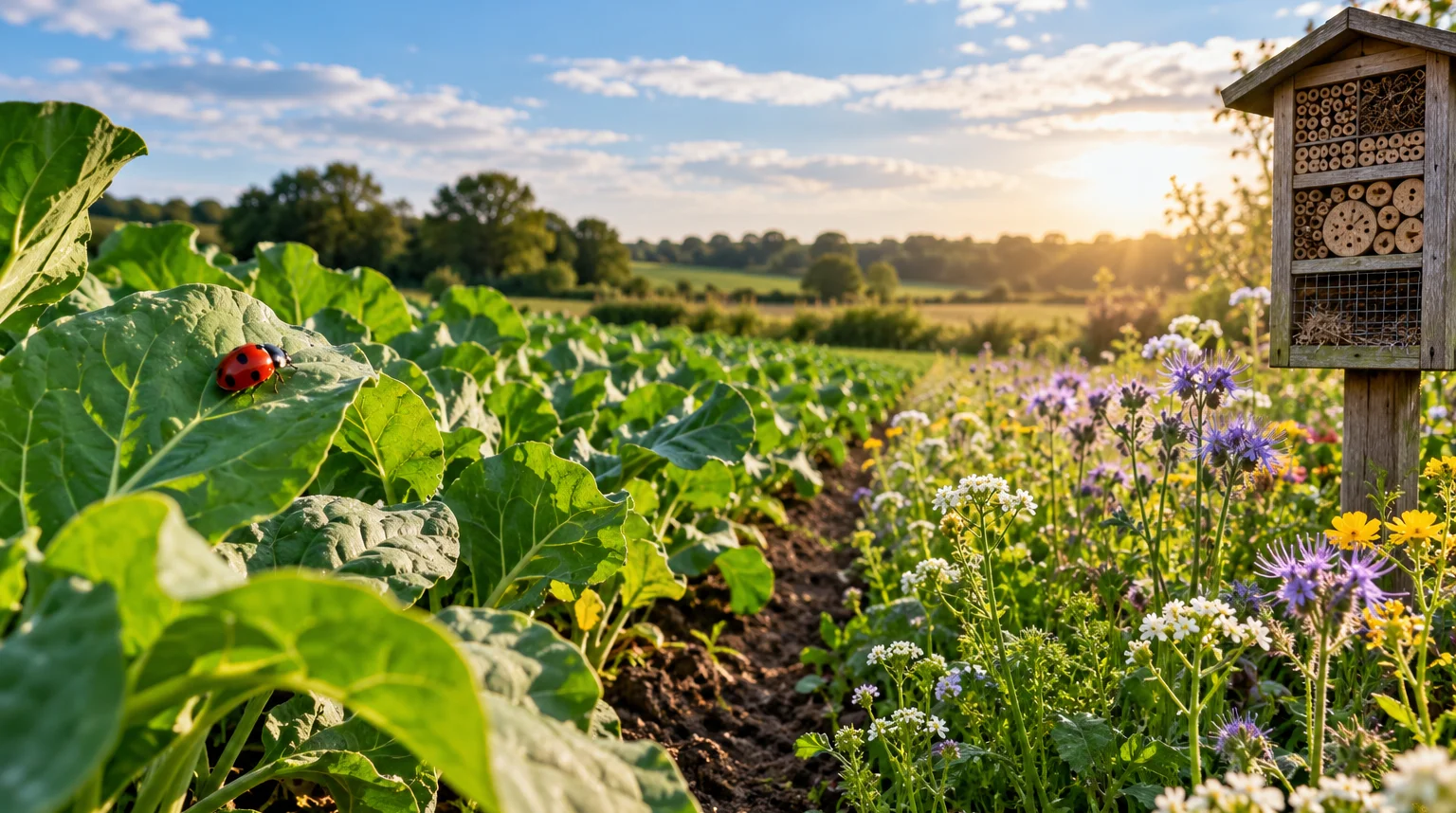
Altieri (1991) described how crop and habitat diversity can support predators and parasitoids by providing alternative prey, food and refuges. His [review of biodiversity and insect pest management](/abstracts/19921161478.html) presents this as a way to strengthen natural pest regulation, while stressing that outcomes depend on the local agroecosystem.
- Biological control uses predators, parasitoids, pathogens or other natural enemies as part of pest suppression rather than treating all organisms in the field as targets.
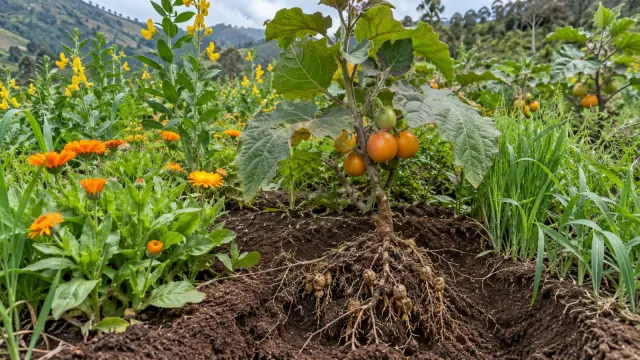
- [Cultural and agronomic controls](/agriculture/calendula-crotalaria-oats-root-knot-nematodes-naranjilla-agriculture) alter the crop system so that pests are less likely to establish, multiply or cause damaging levels of injury.
- Mechanical and physical controls remove pests, exclude them or make conditions less favourable without relying on broad chemical action.
- Chemical control remains available within IPM, but its role is conditional on monitoring, thresholds, expected effectiveness and the relative risks of available options.
These categories are not a recipe and they do not imply that every farm uses every method. The important feature is integration: methods are selected for the specific crop-pest system and considered together, including their effects on natural enemies and future pest pressure. In this sense, IPM is closer to an adaptive management framework than to a checklist of products or operations.
What is the goal of integrated pest management
IPM does not set out to eradicate every pest. Its goal is to keep pest populations and crop damage below levels that justify intervention while limiting unnecessary disruption to the agroecosystem. A field can therefore contain pests and still be managed successfully when expected losses remain below the relevant threshold. The emphasis is on economically and ecologically justified control rather than total elimination.
Economic injury-level theory turns that aim into a way of making decisions. Its injury level ties the number of pests to the harm they are likely to do, the value of the crop and the cost of control, and the economic threshold marks an earlier moment to decide (Pedigo, Hutchins and Higley, 1986). Keeping the two apart separates a pest simply being there from a pest costing money. A population can be easy to find yet too small to be worth treating, while preventive action can be justified well before losses climb to the injury level.
IPM also aims to keep the natural pest control a farm already has. From the start, integrated control set out to spare predators and parasitoids instead of killing them as a side effect of spraying (Stern et al., 1959). Current IPM frameworks apply the same thinking to a broader set of ecosystem services: they protect beneficial organisms and design cropping systems so that pest populations are less likely to reach damaging levels in the first place (Barzman et al., 2015).
In place of routine spraying, IPM asks growers to watch the crop, act only when the risk warrants it and draw on several methods instead of relying on one.
None of this makes crop protection run by itself. A threshold is only as reliable as the monitoring, pest identification and local evidence it rests on. Since pest development and crop vulnerability change with conditions, IPM works best when a threshold guides a wider ecological and economic judgement, not when it stands alone as a number cut off from its setting.
Does integrated pest management use chemicals
Yes. IPM can use chemical pesticides, but chemical control is one option inside a larger decision framework rather than the defining feature of the system. The EPA explicitly states that IPM includes the judicious use of pesticides, while distinguishing IPM from organic production, which restricts the types of pesticides that may be used. UC IPM likewise states that pesticides are used when monitoring indicates they are needed according to established guidelines and alongside other approaches (US EPA, 2026; UC IPM, 2026).
The important contrast is therefore not simply chemical versus non-chemical. It is routine or preventive pesticide use versus intervention justified by monitoring, thresholds and comparison with alternative controls. European Commission guidance says sustainable biological, physical and other non-chemical methods should be preferred when they provide satisfactory control, and that pesticide use should remain economically and ecologically justified (European Commission, accessed 2026). This places chemical control later in the decision process without pretending it can always be removed.
That ideal and farm practice do not always match. Deguine et al. (2021) reviewed six decades of IPM and argued that chemical control still forms the basis of plant-health programmes in many cases, despite longstanding goals to reduce synthetic pesticide dependence. Their review also highlights inconsistent definitions, uneven ecological integration and a gap between IPM principles and what is implemented under the IPM label. In other words, calling a programme IPM does not by itself prove that routine pesticide use has been replaced by threshold-based decisions.
This distinction is also why pesticide reduction should not be judged by a single application count. A credible assessment asks whether avoidable treatments were removed, whether preventive and non-chemical measures were integrated, whether the selected intervention was sufficiently targeted, and whether pest control remained effective. The studies discussed here evaluate decision frameworks and measured farm or project outcomes rather than product selection, dosage or application instructions.
What do studies show about reducing pesticide use
Farm-level evidence shows that substantial reductions can be possible without an automatic yield or profit penalty, but the size of the reduction is not universal. Lechenet et al. (2017) analysed 946 non-organic commercial arable farms across France. They found no detectable conflict between low pesticide use and both high productivity and high profitability in 77% of farms, and estimated that total pesticide use could be reduced by 42% without negative effects on both productivity and profitability in 59% of farms in the network. The estimated average reductions were 37% for herbicides, 47% for fungicides and 60% for insecticides.
Those figures are an estimate from a diverse observational farm network, not a promise that every farm can remove 42% of pesticide use. The authors reported that reduction potential was greater on farms with higher existing pesticide use and varied among production situations (Lechenet et al., 2017). Because the study compared commercial farms rather than randomly assigning farms to treatment programmes, it is strongest as evidence that high productivity and profitability can coexist with lower pesticide use in many real farming situations, not as a universal causal effect of one IPM package.
A broader synthesis by Pretty and Bharucha (2015) reviewed 85 IPM projects covering 115 crop combinations in 24 countries in Asia and Africa. Across the project datasets, reported yields increased by an average of 40.9%, while pesticide use fell to an average of 30.7% of baseline; 35 of the 115 crop combinations moved to zero pesticide use. The authors also stressed substantial variation between projects and noted that many programmes combined pest management with training, crop-system changes or other improvements, making it difficult to attribute every yield change to pesticide reduction alone.
Evidence | Setting and sample | Pesticide-related result | What it can support |
Stern et al. 1959 | Spotted alfalfa aphid, California | Intervention tied to economic thresholds within integrated biological and chemical control | Historical demonstration that monitoring and thresholds can replace automatic treatment timing |
Lechenet et al. 2017 | 946 commercial arable farms, France | Estimated 42% total-use reduction possible without harming both productivity and profitability in 59% of farms | Lower pesticide use can coexist with high farm performance in many, but not all, production situations |
Pretty & Bharucha 2015 | 85 projects; 115 crop combinations; 24 countries | Mean pesticide use fell to 30.7% of baseline; reported yield rose 40.9% | Large reductions are possible across diverse projects, but interventions and study designs were heterogeneous |
Parsa et al. 2014 | IPM professionals from 96 countries | 413 obstacle statements; 163 participants later rated the consolidated barriers | Perceived barriers to IPM adoption include training, technical support, incentives and institutional factors |
Evidence about adoption helps explain why research results do not automatically become routine practice. Parsa et al. (2014) collected 413 open-ended responses from IPM professionals and practitioners across 96 countries and consolidated them into 51 distinct obstacles; 163 participants then rated those obstacles. Insufficient training and technical support to farmers was the most frequently cited obstacle, with other themes including research and outreach weaknesses, weak incentives and industry interference. The study did not measure pesticide reduction directly; instead, it identified perceived obstacles to IPM adoption, including weaknesses in training, technical support, incentives and institutional support.
The evidence therefore supports a conditional conclusion: IPM can reduce pesticide use substantially while maintaining or sometimes improving production outcomes, especially where baseline pesticide use is high and multiple management changes are feasible. It does not support a single expected reduction percentage for all crops, regions or seasons. Deguine et al. (2021) further caution that the IPM label has often been applied to systems that remain chemically centred, so measured outcomes matter more than the label itself.
What is proven, and what is not
Several parts of IPM are well established. The threshold concept has been part of integrated control since Stern et al. (1959) and was developed into a general economic injury-level framework by Pedigo and colleagues (1986). Modern guidance from FAO, the EPA, the European Commission and UC IPM consistently places prevention, monitoring, identification and a combination of controls at the centre of the approach. Barzman et al. (2015) similarly show that contemporary IPM principles prioritise robust crop systems, monitoring, informed decisions and combinations of non-chemical methods before heavier pesticide reliance.
Field evidence also indicates that cutting pesticide use need not come at the expense of productive farming. A large network of French arable farms showed this pattern (Lechenet et al., 2017), and projects across Asia and Africa reported marked falls in pesticide use under IPM (Pretty and Bharucha, 2015). The two studies used different methods in different regions, so their percentages cannot be merged into a single effect size. Read side by side, however, they challenge the idea that higher yields or stronger farm performance always demand more pesticide.
The evidence does not show that calling a programme IPM secures a set environmental gain, a fixed drop in chemical use or the end of pesticides altogether. IPM has been defined and put into practice in many different ways, and programmes can slide back towards chemical control even when their written principles are much broader (Ehler, 2006; Deguine et al., 2021). What decides the result is whether monitoring, thresholds, prevention and alternative controls genuinely alter what happens in the field.
Thresholds do not take uncertainty away either. The link between pest numbers and likely damage can shift with weather, pest biology, crop stage, market prices, the activity of natural enemies and how well a field is monitored. IPM has long been described as an ecological approach that keeps evolving rather than a fixed technology (Kogan, 1998). That view still fits the evidence: the lasting principle is to combine information and methods so that each intervention matches the level of risk, while the precise threshold and mix of controls depend on local conditions.
Overall, the research backs IPM most firmly as a way of deciding when intervention is needed and avoiding treatments that are not. The approach holds up when pest pressure is tracked, action follows justified thresholds, prevention and non-chemical options are given real weight, and results are reviewed afterwards. It holds up far less when a routine calendar spray schedule simply carries on under the IPM name, with nothing to show that thresholds or alternative controls shaped the decisions.
Frequently asked questions
What makes IPM different from calendar-based spraying?
IPM bases intervention on monitoring, pest identification, expected damage and action thresholds rather than a preset treatment schedule. It also combines preventive, biological, cultural, mechanical and, when justified, chemical controls. The aim is to respond to measured risk instead of treating every pest presence as a reason for routine spraying.
Why are action thresholds important in IPM?
Action thresholds separate pest presence from a level of risk that justifies intervention. They use monitoring information to guide timing, rather than relying only on a calendar. Thresholds are context-specific because crop value, pest biology, expected damage, weather and the effectiveness of available controls can all change the decision.
Can IPM eliminate pesticide use completely?
Sometimes, but not by definition. Pretty and Bharucha (2015) reported that 35 of 115 crop combinations in the projects they reviewed moved to zero pesticide use, while many others reduced rather than eliminated it. IPM allows chemical control when monitoring and thresholds justify it and when other options do not provide adequate control.
Is integrated pest management the same as organic farming?
No. Both can emphasise prevention, biological control and non-chemical methods, but they are different frameworks. The US EPA notes that IPM may include judicious use of synthetic pesticides, whereas organic standards restrict which pesticide sources and products are permitted. IPM is primarily a pest-management decision process rather than a certification system.
What limits the adoption of integrated pest management?
Technical options are only part of the problem. Parsa et al. (2014) found barriers involving training and technical support, research and extension, incentives and institutions. Deguine et al. (2021) later described a continuing gap between IPM principles and field practice, including programmes that remain centred on routine chemical control.
Sources
- Stern VM, Smith RF, van den Bosch R, Hagen KS. The integration of chemical and biological control of the spotted alfalfa aphid: the integrated control concept. Hilgardia. 1959;29(2):81–101. DOI 10.3733/hilg.v29n02p081.
- Pedigo LP, Hutchins SH, Higley LG. Economic Injury Levels in Theory and Practice. Annual Review of Entomology. 1986;31:341–368. DOI 10.1146/annurev.en.31.010186.002013.
- Kogan M. Integrated Pest Management: Historical Perspectives and Contemporary Developments. Annual Review of Entomology. 1998;43:243–270. DOI 10.1146/annurev.ento.43.1.243.
- Ehler LE. Integrated pest management (IPM): definition, historical development and implementation, and the other IPM. Pest Management Science. 2006;62(9):787–789. DOI 10.1002/ps.1247.
- Parsa S, Morse S, Bonifacio A, et al. Obstacles to integrated pest management adoption in developing countries. Proceedings of the National Academy of Sciences USA. 2014;111(10):3889–3894. DOI 10.1073/pnas.1312693111.
- Barzman M, Barberi P, Birch ANE, et al. Eight principles of integrated pest management. Agronomy for Sustainable Development. 2015;35(4):1199–1215. DOI 10.1007/s13593-015-0327-9.
- Pretty J, Bharucha ZP. Integrated Pest Management for Sustainable Intensification of Agriculture in Asia and Africa. Insects. 2015;6(1):152–182. DOI 10.3390/insects6010152.
- Lechenet M, Dessaint F, Py G, Makowski D, Munier-Jolain N. Reducing pesticide use while preserving crop productivity and profitability on arable farms. Nature Plants. 2017;3:17008. DOI 10.1038/nplants.2017.8.
- Deguine JP, Aubertot JN, Flor RJ, Lescourret F, Wyckhuys KAG, Ratnadass A. Integrated pest management: good intentions, hard realities. A review. Agronomy for Sustainable Development. 2021;41:38. DOI 10.1007/s13593-021-00689-w.
- United States Environmental Protection Agency. Integrated Pest Management (IPM) Principles. July 22, 2026. https://www.epa.gov/safepestcontrol/integrated-pest-management-ipm-principles.
- Food and Agriculture Organization of the United Nations. Integrated Pest Management (IPM). Accessed November 10, 2026. https://www.fao.org/pest-and-pesticide-management/ipm/integrated-pest-management/en.
- European Commission. Integrated Pest Management (IPM). Accessed November 6, 2026. https://food.ec.europa.eu/plants/pesticides/sustainable-use-pesticides/integrated-pest-management-ipm_en.
- University of California Statewide Integrated Pest Management Program. What Is IPM? January 2026. https://ipm.ucanr.edu/home-and-landscape/what-is-ipm/.
- Altieri MA. Increasing biodiversity to improve insect pest management in agro-ecosystems. In: Hawksworth DL, ed. Biodiversity of Microorganisms and Invertebrates: Its Role in Sustainable Agriculture. 1991:165–182. archive record 19921161478

Tobias Mardle — author
Tobias Mardle is an author with a background in agricultural engineering. A graduate in Agricultural Engineering, his earlier work focused on explaining farm machinery, guidance systems and the use of field data to growers and agricultural advisers. At Cabdire...
Related
Biodiversity for Better Insect Pest Control in Agroecosystems
Calendula, crotalaria and oats for root-knot nematodes in naranjilla
Organic vs Conventional Farming: Economics and Ecology
Glyphosate’s Rise to Top Weedkiller: A 1997 Account
How Orchard Age and Herbicides Shift Soil Nitrogen and N2O
Why breadfruit mealybug control failed to last on Pacific atolls