





How Orchard Age and Herbicides Shift Soil Nitrogen and N2O
A 2018 laboratory study found that soils from 10- and 30-year citrus orchards transformed added urea and emitted greenhouse gases differently from nearby woodland soil, while butachlor increased N2O emissions in both orchard-age treatments. The experiment also showed that glyphosate and butachlor did not produce the same responses across soil types.
The experiment distinguishes effects associated with planting history from those of herbicide treatment and shows why nitrification, denitrification and microbial activity matter for nitrogen loss and greenhouse-gas formation. Because it was a controlled laboratory incubation, its numerical effects do not represent direct field-emission estimates for commercial citrus orchards.
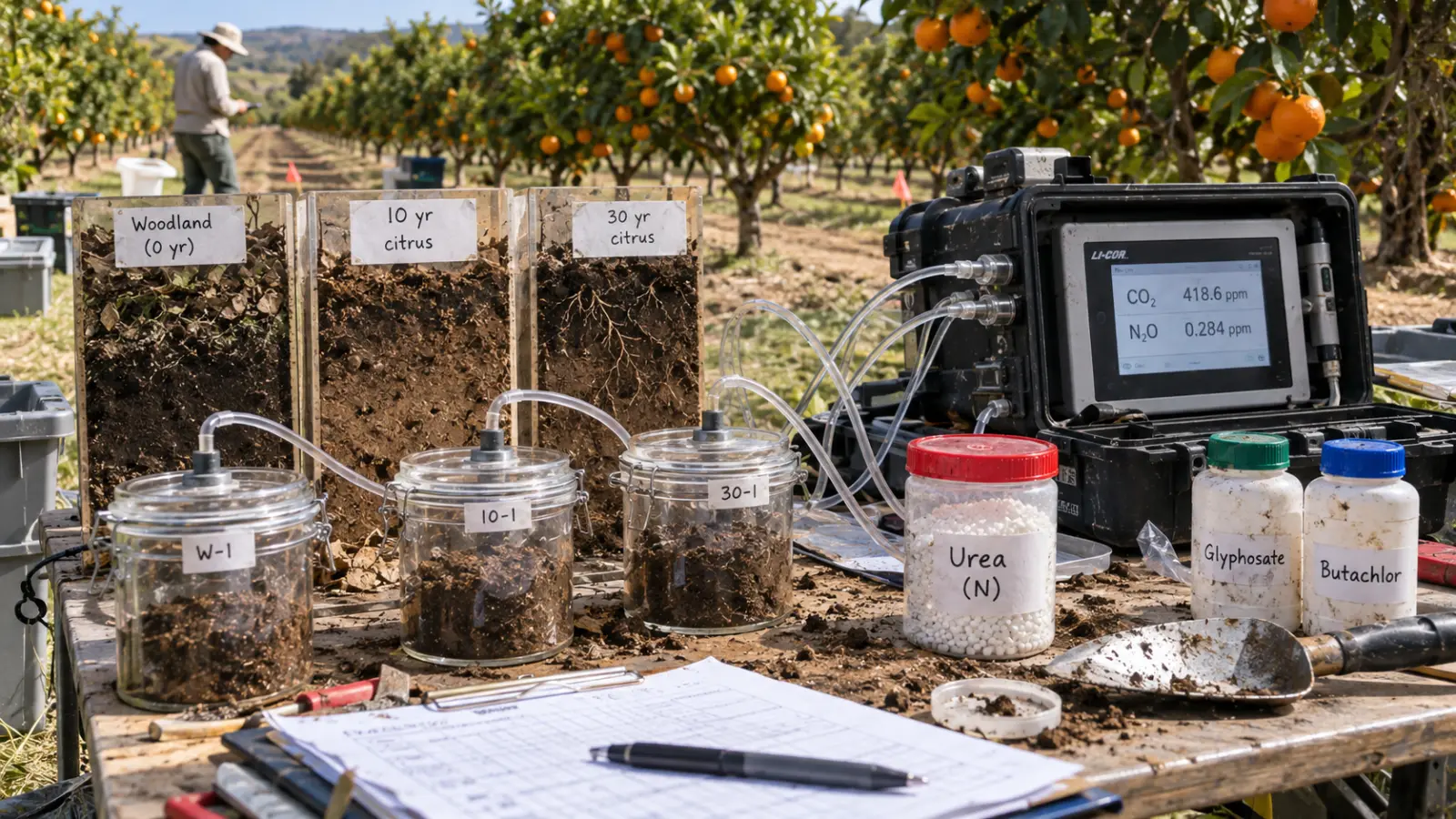
INFOBOX
Study | Zheng Xiangzhou et al., Chinese Journal of Eco-Agriculture, 2018 |
Design | Laboratory 3 × 3 factorial experiment |
Soils | Woodland (0-year), 10-year citrus orchard and 30-year citrus orchard |
Herbicides | No herbicide, glyphosate 10 mg kg-1 a.i., butachlor 10 mg kg-1 a.i. |
Urea addition | 200 mg N kg-1 dry soil in every treatment |
Measured processes | Urea hydrolysis, nitrification, denitrification loss, CO2 and N2O emissions |
Key herbicide result | Butachlor increased N2O in 10- and 30-year citrus orchard soils |
Archive record | 20183141714 |
What the experiment actually compared
The study used a two-factor, three-level design under laboratory conditions. The first factor was soil planting history: woodland soil treated as the 0-year reference, soil from a 10-year citrus orchard and soil from a 30-year citrus orchard. The second factor was herbicide treatment: no herbicide, glyphosate at 10 mg kg-1 active ingredient and butachlor at the same concentration.
Every treatment received 200 mg nitrogen per kilogram of dry soil as urea. The researchers then followed urea hydrolysis, nitrification, denitrification loss and emissions of carbon dioxide and nitrous oxide. This design allowed them to ask two separate questions: how soils differed after different histories of citrus cultivation, and whether herbicides changed nitrogen transformation within those soils.
The planting-year factor was not a before-and-after time series
The 0-, 10- and 30-year values came from different soil histories, not repeated measurements of the same plot as it aged. The experiment therefore compares woodland and citrus-orchard soils collected from different planting-duration categories. It supports associations with long-term orchard cultivation, but it does not by itself prove that orchard age caused every observed difference.
Orchard soils showed faster nitrogen turnover than woodland soil
Compared with woodland soil, both citrus orchard soils had higher urea hydrolysis, nitrification, denitrification loss and greenhouse-gas emissions. The differences were statistically significant for the principal comparisons reported in the abstract, indicating that the long-cultivated soils behaved differently from the woodland reference when all received the same urea addition.
The pattern was not identical for the 10- and 30-year orchards. The 30-year orchard soil had significantly higher urea hydrolysis, nitrification and CO2 emission than the 10-year orchard soil. Total denitrification loss, however, was not significantly different between the two orchard-age treatments.
The numerical contrasts need precise denominators
Comparison | Outcome | Reported change | Correct interpretation |
10-year citrus vs woodland | Total denitrification loss | 5.12 times higher | Cross-sectional soil-history comparison |
30-year citrus vs woodland | Total denitrification loss | 4.30 times higher | Cross-sectional soil-history comparison |
10-year citrus vs woodland | Total N2O emission | 7.80 times higher | Same urea input; different soil history |
30-year citrus vs woodland | Total N2O emission | 2.74 times higher | Same urea input; different soil history |
10-year citrus vs woodland | Total CO2 emission | 19.62% higher | Laboratory incubation comparison |
30-year citrus vs woodland | Total CO2 emission | 39.64% higher | Laboratory incubation comparison |
30-year citrus vs 10-year citrus | Total CO2 emission | 16.74% higher | Comparison between two orchard-age soils |
Butachlor vs no herbicide in 10-year citrus soil | Total N2O emission | 56.27% higher | Herbicide effect within one soil-history treatment |
Butachlor vs no herbicide in 30-year citrus soil | Total N2O emission | 85.41% higher | Herbicide effect within one soil-history treatment |
The strongest result was not that every herbicide changed every process, but that soil history shaped the response.
Why urea hydrolysis and nitrification matter
Urea first has to be hydrolysed before its nitrogen becomes available for subsequent transformations. Urease-producing microorganisms and soil enzymes convert urea rapidly into ammonium forms. Nitrifying microorganisms can then oxidize ammonium toward nitrate, creating substrates and conditions that connect fertilizer nitrogen with plant uptake, leaching and gaseous loss.
In the study, orchard soils generally showed faster urea hydrolysis and nitrification than woodland soil. The 30-year orchard soil also exceeded the 10-year orchard soil for these processes. Those results indicate a soil-history effect on nitrogen-processing capacity, but the experiment did not isolate one microbial species or one mechanism as the sole explanation.
Nitrification and denitrification both connect soil nitrogen with N2O
Nitrous oxide can be produced during microbially mediated nitrogen transformations, especially nitrification and denitrification. Its formation depends on mineral nitrogen supply, oxygen status, moisture, available carbon, pH, microbial communities and the timing of fertilizer inputs. That means the same herbicide can produce different outcomes in different soils.
The 2018 experiment is a clear example of that context dependence. Orchard soils had much higher total N2O emissions than woodland soil under the incubation conditions, but the relative increase was larger for the 10-year than for the 30-year orchard when each was compared with woodland.
Butachlor increased N2O without broadly changing orchard nitrogen transformation
The study's most distinct herbicide-related greenhouse-gas result concerned butachlor. Relative to the zero-herbicide treatment, butachlor increased total N2O emission by 56.27% in the 10-year orchard soil and by 85.41% in the 30-year orchard soil. Both increases were reported as statistically significant.
At the same time, the authors concluded that glyphosate and butachlor had no significant overall effect on nitrogen transformation in the citrus orchard soils. Those statements are not contradictory: a treatment can leave aggregate transformation measures statistically unchanged while still altering one gaseous endpoint such as N2O.
Butachlor responses differed in woodland soil
In woodland soil, both glyphosate and butachlor significantly accelerated urea hydrolysis. Butachlor also significantly reduced CO2 emission there, whereas that CO2 effect was not observed in the citrus orchard soils. This contrast is another reason not to generalize a single herbicide response across soils with different management histories.
Glyphosate did not change total CO2 or N2O in this experiment
Glyphosate had no significant effect on total CO2 or total N2O emissions in any of the three planting-history soils. It also did not affect nitrification in the 30-year orchard soil. These null results are important because they show that the study did not find a uniform greenhouse-gas increase from herbicide exposure.
Broader evidence on glyphosate and soil biology is also heterogeneous. A 2016 meta-analysis found that microbial biomass and respiration responses depended strongly on dose, soil properties and time after application, while a 2016 review of herbicide effects on soil function concluded that many impacts at field application rates are minor or temporary.
Soil history can modify herbicide effects
Long-term orchard management can change soil carbon inputs, fertilizer history, pH, microbial communities and substrate availability. Any of these factors may alter how added urea or herbicides interact with the soil system. The experiment did not assign the observed orchard-age differences to one specific cause, but it demonstrated that planting history was an important modifier of nitrogen turnover and gas emission.
That interpretation is consistent with later synthesis work showing that herbicide effects on soil processes depend on dose, soil organic carbon, pH, exposure time and the microbial community already present. The same active ingredient should therefore not be expected to produce identical responses in woodland, young orchard and long-established orchard soil.
One practical implication is that orchard age is best treated as a marker of accumulated management history rather than as a mechanism by itself. Years of cultivation can be accompanied by repeated fertiliser inputs, herbicide exposure, changes in organic matter, shifts in pH and differences in microbial activity. Any combination of these factors may alter how quickly added urea is hydrolysed, how much ammonium is nitrified and how much nitrogen is ultimately lost through denitrification or N2O production. The 2018 experiment did not separate these long-term influences, so the contrast between 10- and 30-year soils reflects the integrated condition of each soil at sampling.
This distinction matters for interpretation. A higher N2O response in one orchard soil does not mean that orchard age alone determines emissions, and it does not establish a universal progression from younger to older orchards. Instead, the results show that the background state of the soil can change the response to the same urea and herbicide treatment. Field studies that measure soil chemistry, moisture, microbial communities and management history together are therefore needed to explain which factors drive the observed differences.
What earlier butachlor studies add
Butachlor has produced variable effects on nitrogen-cycling microorganisms in other systems. Research in paddy soils has reported changes in microbial populations, nitrogen fixation, nitrification and respiration, with responses shifting over time and with dose. A 2009 study also found that butachlor altered bacterial and diazotrophic community structure and changed nitrogen-fixing activity during rice cultivation.
These paddy-soil results do not reproduce the citrus-orchard experiment, because flooded rice soil and upland orchard soil differ substantially in oxygen status and microbial ecology. They are useful mainly because they reinforce the study's broader message: butachlor effects are process- and environment-specific rather than fixed.
Laboratory incubation is a strength for control and a limitation for field inference
A laboratory design makes it easier to hold urea input and herbicide dose constant while comparing soils. That improves control over the treatment contrasts and helps identify biochemical responses that might be obscured by weather, root uptake, irrigation or spatial variability in the field.
The trade-off is realism. Field orchards have living roots, fluctuating moisture and temperature, variable herbicide deposition, plant uptake, runoff and repeated management events. The study therefore supports mechanistic and comparative conclusions about the tested soils, but not a claim that commercial orchard emissions would increase by the same percentages after field application.
These limitations also affect how the reported percentage differences should be interpreted. Gas fluxes measured in a controlled incubation reflect the behaviour of sampled soil under fixed experimental conditions, not the full variability of an orchard over a growing season. Repeated field measurements would be needed to capture changes after rainfall, irrigation, fertilisation and herbicide application, as well as interactions with roots and changing temperature.
What the study means for orchard nitrogen management
The results suggest that orchard soil history can be as important as the herbicide treatment when evaluating nitrogen transformation and greenhouse-gas risk. Older citrus soils in this experiment processed urea rapidly and produced more CO2 than the 10-year soil, while both orchard soils showed substantially greater N2O and denitrification losses than woodland.
For management, the practical lesson is not that one laboratory result dictates a universal herbicide rule. It is that fertilizer nitrogen, herbicide choice and soil condition should be considered together. Field measurements are needed to determine whether the laboratory N2O response to butachlor persists under real orchard moisture, temperature, rooting and application conditions.
Frequently asked questions
What soils were compared in the citrus-orchard experiment?
The laboratory study compared soil from woodland used as a 0-year reference with soil from 10-year and 30-year citrus orchards. These were different planting-history soils, not repeated measurements of one field through time. Every treatment received the same added urea nitrogen before nitrogen transformation and gas emissions were measured.
Did glyphosate increase N2O emissions in the study?
No significant increase in total N2O emission was reported for glyphosate in woodland, 10-year orchard or 30-year orchard soil. The study also found no glyphosate effect on total CO2 emission. Those findings apply to the laboratory conditions and herbicide concentration tested, not automatically to every field situation.
What did butachlor do to N2O emissions?
Compared with the no-herbicide treatment, butachlor increased total N2O emission by 56.27% in the 10-year citrus orchard soil and by 85.41% in the 30-year orchard soil. Both increases were statistically significant. The same result should not be assumed for other soils, doses or field conditions.
Why did orchard age matter for nitrogen transformation?
The experiment showed that orchard soils had faster urea hydrolysis, nitrification and greater nitrogen losses than woodland soil, with several processes also differing between 10- and 30-year orchard soils. The study demonstrates a planting-history effect but does not identify one single chemical or microbial change as the cause.
Can these laboratory emission percentages be used for field orchards?
Not directly. Laboratory incubation standardizes soil, urea and herbicide treatments but excludes many field factors, including living roots, rainfall, irrigation, temperature fluctuations, spatial variability and real application patterns. The percentages are valid for the tested incubation conditions and should be confirmed by field measurements before being used for orchard emission estimates.
Sources
- Zheng X, Wang Y, Zhang Y, Zhang J, Ding H. Effects of herbicides on urea nitrogen transformation and greenhouse gas emission of soil in citrus orchards with different planting years. Chinese Journal of Eco-Agriculture. 2018;26(3):338–346. doi:10.13930/j.cnki.cjea.170662.
- Rose MT, Cavagnaro TR, Scanlan CA, et al. Impact of Herbicides on Soil Biology and Function. Advances in Agronomy. 2016;136:133–220. doi:10.1016/bs.agron.2015.11.005.
- Nguyen DB, Rose MT, Rose TJ, Morris SG, van Zwieten L. Impact of glyphosate on soil microbial biomass and respiration: A meta-analysis. Soil Biology and Biochemistry. 2016;92:50–57. doi:10.1016/j.soilbio.2015.09.014.
- Allegrini M, Gómez EV, Zabaloy MC. Repeated glyphosate exposure induces shifts in nitrifying communities and metabolism of phenylpropanoids. Soil Biology and Biochemistry. 2017;105:206–215. doi:10.1016/j.soilbio.2016.11.024.
- Min H, Ye YF, Chen ZY, Wu WX, Du YF. Effects of butachlor on microbial populations and enzyme activities in paddy soil. Journal of Environmental Science and Health Part B. 2001;36(5):581–595. doi:10.1081/PFC-100106187.
- Chen WC, Yen JH, Chang CS, Wang YS. Effects of herbicide butachlor on soil microorganisms and on nitrogen-fixing abilities in paddy soil. Ecotoxicology and Environmental Safety. 2009;72(1):120–127. doi:10.1016/j.ecoenv.2008.03.013.
- Brochado MGS, Silva LBXS, Lima AC, Guidi YM, Mendes KF. Herbicides versus Nitrogen Cycle: Assessing the Trade-Offs for Soil Integrity and Crop Yield—An In-Depth Systematic Review. Nitrogen. 2023;4(3):296–310. doi:10.3390/nitrogen4030022.
- Chu Y, Che T, Gao X, et al. Coupled effects of glyphosate on soil carbon cycling regulated by dose, time, and environment: A global meta-analysis. Environmental Research. 2026;299:124281. doi:10.1016/j.envres.2026.124281.

Harriet Colbeck — author
Harriet Colbeck is an agriculture writer with a background in agricultural science and a master’s-level focus on soil science. Her earlier work involved preparing field-trial summaries and farmer-facing guidance on soil management, translating research finding...
Related
Calendula, crotalaria and oats for root-knot nematodes in naranjilla

Why breadfruit mealybug control failed to last on Pacific atolls
Organic vs Conventional Farming: Economics and Ecology

Hevea brasiliensis breeding: from crosses to field trials