













Hydroponics and how plants grow without soil, explained by science
Hydroponics lets plants grow without soil because roots do not require soil itself: they require water, oxygen and mineral ions, while leaves use light and carbon dioxide to build sugars. A hydroponic system replaces soil's roles as a reservoir, support and buffer with a nutrient solution and, in many systems, an inert rooting medium (Adams, 2023).
This article explains how that root environment works, compares nutrient film technique (NFT), deep water culture (DWC) and drip-fed substrate systems, and examines evidence on yield, water use and flavour. It also separates findings from particular crops and controlled experiments from broader claims about hydroponics, because system design, climate, cultivar and management can change the outcome (Savvas and Gruda, 2018; Gruda, 2009).
How hydroponics supplies water, minerals and oxygen
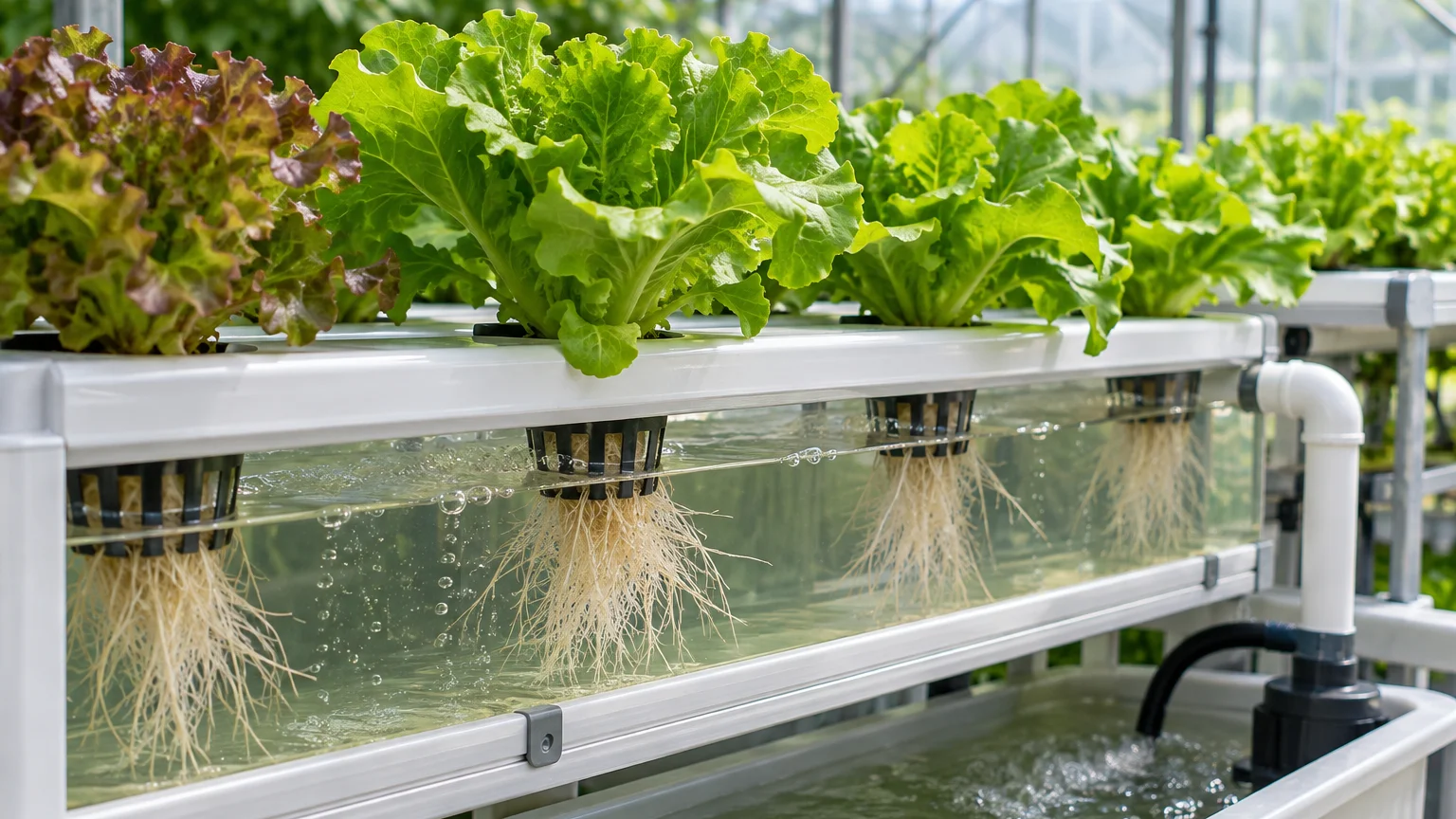
Soil normally stores water and mineral nutrients and provides pore spaces that contain air. In hydroponics, those functions are engineered instead, making root-zone monitoring a practical application of [precision agriculture](/agriculture/precision-agriculture-field-data). Nutrient salts dissolve into ions that roots can absorb, while the system keeps water in contact with the root surface and must still provide enough oxygen for root respiration (Adams, 2023; Sambo et al., 2019).
The plant is not being 'fed' sugar through the water. Photosynthesis in the leaves uses light energy to convert carbon dioxide and water into carbohydrates; the nutrient solution supplies elements such as nitrogen, phosphorus, potassium, calcium, magnesium and micronutrients that are needed for enzymes, membranes, pigments and new tissue. This distinction explains why removing soil is biologically possible: soil is a medium that stores and exchanges resources, not the source of the plant's carbon (Adams, 2023).
Nutrient solution chemistry
Hydroponic nutrient management therefore focuses on the chemistry of the root-zone solution. Electrical conductivity is used as a practical indicator of total dissolved salts, while pH affects nutrient solubility and availability. Oklahoma State University recommends a nutrient-solution pH of 5.0–6.0 (usually about 5.5) so the root environment remains around pH 6.0–6.5; crop-specific targets differ (Dunn and Singh, 2017). The same guide emphasises pH, electrical conductivity, alkalinity and nutrient ratios as central management variables.
Oxygen is equally important. Roots use aerobic respiration to release energy needed for active ion uptake and growth, so a waterlogged root zone can fail even when the nutrient recipe is chemically adequate. Deep solution systems normally aerate the reservoir, while NFT exposes part of the root mat to air as a shallow stream of solution passes through the channel (Adams, 2023; Savvas and Gruda, 2018).
Because roots remove water and different ions at different rates, a recirculating solution does not remain chemically identical through a crop cycle. Water replacement can concentrate ions that plants take up slowly, while rapid growth can deplete others; this is why a single EC reading cannot identify every nutrient imbalance. Sambo et al. (2019) describe hydroponic nutrition as a dynamic ion-management problem rather than a one-time fertiliser recipe.
NFT, DWC and drip systems compared
Nutrient film technique
In nutrient film technique, plants sit above a gently sloping channel and a thin, recirculating film of nutrient solution passes along the roots before returning to a reservoir. The high ratio of nutrient-solution surface area to solution volume contributes to better root aeration, and NFT is widely used for leafy vegetables (Dunn, 2025; Savvas and Gruda, 2018).
Its low buffering volume is also a weakness. Changes in solution temperature, chemistry or flow can reach roots quickly, and a prolonged interruption in circulation removes both water delivery and much of the designed nutrient transport. Results from NFT therefore cannot serve as a generic stand-in for all hydroponic systems (Yang et al., 2024).
Deep water culture
In deep water culture, roots extend into a larger body of nutrient solution and plants are commonly supported on rafts or lids. The larger water volume changes more slowly than an NFT film, but the solution must remain adequately oxygenated; the design is especially common for lettuce and other leafy crops (Adams, 2023; Dunn, 2025).
Yang, Samarakoon and Altland (2024) compared butterhead lettuce in DWC and NFT across summer and autumn greenhouse runs. DWC had more stable water conditions and supported higher photosynthetic rates, growth and fresh yield in autumn, whereas NFT produced greater yield in summer but also more severe tipburn; the direction of the difference changed with season, showing that the system label alone does not determine performance.
Drip-fed substrate culture
Drip systems usually place roots in a substrate such as rockwool, coir or perlite and deliver nutrient solution through emitters. Savvas and Gruda (2018) note that substrate culture is especially common for fruiting greenhouse crops, because the medium anchors larger plants while fertigation can be adjusted frequently. Drainage may be discarded in an open system or collected and reused in a closed or semi-closed system.
The substrate adds water-holding capacity and a physical buffer that bare-root systems lack, but it also introduces questions about drainage, salt accumulation, substrate disposal and reuse. 'Hydroponic' therefore describes a family of soilless systems rather than one machine or one root environment (Sambo et al., 2019; Savvas and Gruda, 2018).
Open and closed drip systems can look similar at the plant level but differ substantially in resource use. In a closed system, drainage can be collected, analysed and reused; in an open system, excess nutrient solution leaves the root zone and may carry dissolved fertiliser with it. Savvas and Gruda (2018) therefore treat recirculation strategy as a major part of system performance, not a minor plumbing detail.
What studies show about yield and water use
Modelled yield, water and energy trade-offs
Hydroponics can use water efficiently because a closed system can capture drainage and return it to the crop instead of losing it below the root zone. That mechanism is real, but the size of the advantage depends on the comparison: a recirculating greenhouse system is not equivalent to an open hydroponic system, and neither is equivalent to a field crop receiving rainfall and irrigation (Savvas and Gruda, 2018).
One widely cited analysis by Barbosa et al. (2015) compared modelled greenhouse hydroponic lettuce in Arizona with conventional lettuce production in the same region. The hydroponic scenario produced an estimated 41 ± 6.1 kg/m²/year versus 3.9 ± 0.21 kg/m²/year for conventional production, while water demand per kilogram was 20 ± 3.8 L versus 250 ± 25 L. These were engineering and agricultural-statistics estimates, not a single side-by-side farm trial, so the figures demonstrate a plausible system-level contrast rather than a universal hydroponic multiplier.
The same 2015 model shows the trade-off that is often lost in simplified sustainability claims: energy demand was estimated at 90,000 ± 11,000 kJ/kg for the hydroponic greenhouse and 1,100 ± 75 kJ/kg for conventional lettuce, about 82 ± 11 times higher. Heating, cooling and supplemental lighting dominated the hydroponic estimate, meaning that the energy penalty was tied largely to controlled-environment infrastructure rather than to the mere absence of soil (Barbosa et al., 2015).
Study | Crop and conditions | Comparison | Main result |
Barbosa et al., 2015 | Lettuce; Arizona system model | Greenhouse hydroponics vs conventional field production | 41 ± 6.1 vs 3.9 ± 0.21 kg/m²/year; 20 ± 3.8 vs 250 ± 25 L/kg |
Majid et al., 2021 | Romaine-type lettuce; protected cultivation | DWC and NFT vs protected soil | DWC gave the strongest crop performance; NFT was most water-efficient, with about 64% water savings compared with the other two techniques |
Verdoliva et al., 2021 | Tomato; controlled polytunnel and glasshouse trials | DWC and hydroponic drip vs soil | Polytunnel WUE differences were not significant; in the glasshouse, DWC and drip had significantly higher WUE than soil |
Yang et al., 2024 | Butterhead lettuce; greenhouse summer and autumn | DWC vs NFT | System ranking changed with season; DWC reduced tipburn and improved several quality traits in key runs |
Controlled comparisons across crops and systems
Direct experiments also show context dependence. Majid et al. (2021) found DWC the strongest overall lettuce system in their protected comparison, while NFT was the most water-efficient technique, with the authors reporting about 64% water savings compared with the other two techniques. Verdoliva et al. (2021), working with tomatoes in replicated polytunnel and glasshouse experiments, found no significant water-use-efficiency difference among systems in the polytunnel (p = 0.163), whereas in the glasshouse DWC and drip were significantly more water-efficient than soil (p = 0.0009).
The defensible conclusion is therefore narrower than 'hydroponics always yields more with less water'. Recirculation, root-zone control and dense or year-round production can raise water productivity and output per area, but crop choice, climate control, lighting, system design and the baseline farming method determine how large the advantage is and what other resources are consumed (Barbosa et al., 2015; Savvas and Gruda, 2018). The same need to distinguish between land-based and product-based metrics appears in [comparisons of farming systems](/agriculture/organic-vs-conventional-farming-economics-ecology-agriculture), where conclusions can change depending on the unit used for comparison.
Hydroponics works because soil is not itself a plant nutrient: the system replaces soil's storage and buffering roles with controlled water, mineral ions and oxygen around the roots.
Hydroponics, taste and nutritional quality
Taste is not determined by whether roots touch soil. Flavour and texture emerge from genetics and growing conditions that affect sugars, acids, volatile compounds, phenolics, water content and tissue structure; nutrient concentration, temperature, light and harvest timing can all matter. A review by Gruda (2009) concluded that soilless culture can produce vegetables without an inherent quality loss, but high quality is not automatic and depends on matching management to the crop and system.
A 2026 Food Chemistry study provides a recent example of how cultivation method can shift composition without producing a simple 'better versus worse' result. Li et al. (2026) compared four lettuce cultivars grown hydroponically or in substrate and found higher protein, potassium at 1.61–2.14 times the substrate values, and free amino acids in the hydroponic lettuce. Substrate-grown lettuce, however, accumulated more sugars at 1.24–2.43 times and more sesquiterpene lactones at 1.36–4.20 times, alongside many secondary metabolites.
The same study linked bitterness to the balance of sugars, polyphenols and sesquiterpene lactones and reported higher sensory acceptability for the hydroponic lettuce in its trained-panel assessment (Li et al., 2026). The result argues against the idea that soil is required for good flavour, but its scope is limited to the lettuce cultivars and production conditions tested.
What comparative studies found
Other experiments point to the same need for specificity. Yang et al. (2024) found DWC lettuce had higher concentrations of several antioxidants than NFT in particular seasonal runs. In Verdoliva et al. (2021), glasshouse tomatoes grown in both DWC and drip had significantly higher lycopene than soil-grown tomatoes, while beta-carotene was significantly higher only in DWC; beta-carotene was not assessed in the polytunnel experiment. These studies show that root-zone management can influence composition, not that hydroponics has one fixed nutritional signature.
Sensory conclusions are especially sensitive to what is being compared. A cultivar grown under one light regime and harvested at one maturity can differ from the same cultivar under another regime before the root medium is even considered. Gruda (2009) therefore frames soilless quality as a management outcome: hydroponics gives growers tighter control over several inputs, but that control can be used well or poorly and does not erase genetic or environmental variation.
Disadvantages of hydroponics and where systems fail
The main disadvantage of hydroponics is that replacing soil's buffering functions with engineering makes management more precise but also more dependent on equipment and monitoring. Oklahoma State University lists higher initial and operating costs, the need for skill and knowledge, and the possibility that diseases such as Fusarium and Verticillium can spread quickly through the system as important limitations (Dunn, 2025).
Recirculation illustrates the trade-off. Reusing nutrient solution can reduce water and fertiliser losses, yet it also means that pathogens or unwanted ions can move through the same loop. Savvas and Gruda (2018) describe disinfection and solution management as central challenges in closed systems, while Sambo et al. (2019) explain that nutrient interactions, precipitation and changing ion ratios can make the chemistry drift even when total electrical conductivity appears acceptable.
System-specific failure modes
Different designs fail in different ways. NFT has little stored solution around each plant, so flow interruption or rapid temperature change can stress roots quickly; DWC buffers short-term changes better but depends on adequate aeration and can develop oxygen problems if warm water holds less dissolved oxygen. Drip-fed substrates provide physical buffering but may accumulate salts or discharge nutrient-rich drainage when managed as open systems (Adams, 2023; Savvas and Gruda, 2018).
Energy use is another limit, and its source depends on system design. Pumps for nutrient circulation are one component, while artificial lighting, cooling, heating and dehumidification can dominate energy demand in fully controlled indoor production. The Barbosa et al. (2015) lettuce model shows that high water productivity can coexist with high energy use; hydroponics and vertical farming overlap, but they are not synonymous technologies.
Finally, hydroponics does not remove biological risk. Plants can still experience nutrient deficiencies, physiological disorders, algae, insects and microbial disease, and a controlled root zone can magnify mistakes because many plants share the same water chemistry. The advantage is that variables are measurable and adjustable; the disadvantage is that failures in those controls can propagate rapidly through a crop (Dunn and Singh, 2017; Savvas and Gruda, 2018).
What hydroponics proves - and what it does not
Hydroponics proves a basic point in plant biology: soil is not required if the functions it normally provides are replaced. Roots can obtain water and mineral ions from a nutrient solution, while the system supplies oxygen and physical support through water depth, channels, rafts or inert substrates. That principle is supported by decades of plant nutrition research and modern commercial practice (Adams, 2023).
The evidence also supports more conditional conclusions. Well-designed recirculating systems can use water very efficiently and can produce high yields per unit area, while controlled root-zone chemistry can alter nutrient composition and sensory traits. But no single study establishes that all hydroponic crops yield more, taste better or have a smaller environmental footprint than soil-grown crops under every set of conditions (Barbosa et al., 2015; Gruda, 2009; Li et al., 2026).
Interpretation therefore depends on the crop tested, the hydroponic system, whether the nutrient solution was recirculated, the environmental controls and the comparison method. NFT, DWC and drip-fed substrate culture can all grow plants without soil, but their water buffering, oxygen supply, failure modes and resource demands differ enough for results to be interpreted system by system (Yang et al., 2024; Majid et al., 2021).
Frequently asked questions
Can hydroponic roots run out of oxygen?
Yes. Roots still respire and need oxygen even when they grow in water. DWC therefore relies on aeration, while NFT keeps part of the root mat exposed to air as nutrient solution moves through the channel. Warm water holds less dissolved oxygen, so root-zone temperature and aeration can affect plant performance.
Do hydroponic plants get all the same nutrients as soil-grown plants?
They can receive the same essential mineral elements, but the source and buffering environment differ. In hydroponics, mineral ions are dissolved in the nutrient solution and their availability is managed through concentration, pH and water chemistry. Plant composition still varies with cultivar, light, temperature, nutrient formulation, growth stage and other environmental factors.
Is NFT better than deep water culture?
Neither system is universally better. NFT uses a shallow moving film and has a small solution volume, while DWC places roots in a larger aerated reservoir. In a 2024 lettuce study, system performance changed with season: DWC performed better in several autumn measures, while NFT produced greater summer yield but more tipburn (Yang et al., 2024).
Does hydroponic food taste different from soil-grown food?
It can, but there is no single hydroponic flavour. Controlled studies show that cultivation system can shift sugars, bitter compounds, antioxidants and texture, yet cultivar and environment also matter. A 2026 lettuce comparison reported higher acceptability for hydroponic samples (Li et al., 2026), while broader reviews find that soilless production does not automatically improve or reduce quality.
Does hydroponics always use less water?
Recirculating hydroponics can greatly reduce water use per kilogram because drainage is captured and reused, but the size of the saving depends on crop, system and comparison. In the Barbosa et al. (2015) Arizona lettuce model, hydroponics required about 20 L/kg versus 250 L/kg for conventional production, whereas other experiments report different values under different climates and designs.
Sources
- Dunn B. Hydroponics. Oklahoma State University Extension, HLA-6442. July 2025. https://extension.okstate.edu/fact-sheets/hydroponics
- Dunn B, Singh H. Electrical Conductivity and pH Guide for Hydroponics. Oklahoma State University Extension, HLA-6722. 2017. https://extension.okstate.edu/fact-sheets/electrical-conductivity-and-ph-guide-for-hydroponics
- Adams SA. Lunchbox Hydroponics. Nebraska Extension, G2358. 2023. https://extensionpubs.unl.edu/publication/g2358/lunchbox-hydroponics
- Savvas D, Gruda N. Application of soilless culture technologies in the modern greenhouse industry - a review. European Journal of Horticultural Science. 2018;83(5):280–293. doi:10.17660/eJHS.2018/83.5.2
- Sambo P, Nicoletto C, Giro A, Pii Y, Valentinuzzi F, Mimmo T, Lugli P, Orzes G, Mazzetto F, Astolfi S, Terzano R, Cesco S. Hydroponic Solutions for Soilless Production Systems: Issues and Opportunities in a Smart Agriculture Perspective. Frontiers in Plant Science. 2019;10:923. doi:10.3389/fpls.2019.00923
- Barbosa GL, Gadelha FDA, Kublik N, Proctor A, Reichelm L, Weissinger E, Wohlleb GM, Halden RU. Comparison of Land, Water, and Energy Requirements of Lettuce Grown Using Hydroponic vs. Conventional Agricultural Methods. International Journal of Environmental Research and Public Health. 2015;12(6):6879–6891. doi:10.3390/ijerph120606879
- Majid M, Khan JN, Shah QMA, Masoodi KZ, Afroza B, Parvaze S. Evaluation of hydroponic systems for the cultivation of lettuce (Lactuca sativa L., var. Longifolia) and comparison with protected soil-based cultivation. Agricultural Water Management. 2021;245:106572. doi:10.1016/j.agwat.2020.106572
- Yang T, Samarakoon U, Altland JE. Growth, phytochemical concentration, nutrient uptake, and water consumption of butterhead lettuce in response to hydroponic system design and growing season. Scientia Horticulturae. 2024;332:113201. doi:10.1016/j.scienta.2024.113201
- Verdoliva SG, Gwyn-Jones D, Detheridge A, Robson P. Controlled comparisons between soil and hydroponic systems reveal increased water use efficiency and higher lycopene and beta-carotene contents in hydroponically grown tomatoes. Scientia Horticulturae. 2021;279:109896. doi:10.1016/j.scienta.2021.109896
- Li X, Yu F, Wei S, Zhou C, Huo G, Li X, Zhang Y, Zhao X. Metabolomic, nutritional, and sensory insights into hydroponic vs. substrate-cultivated lettuce (Lactuca sativa L.). Food Chemistry. 2026;512:148837. doi:10.1016/j.foodchem.2026.148837
- Gruda N. Do soilless culture systems have an influence on product quality of vegetables? Journal of Applied Botany and Food Quality. 2009;82(2):141–147. doi:10.18452/9433
Anjali Dhanjal — author
Anjali Dhanjal is a plant science specialist with a degree in Plant Science and a master’s-level specialization in Plant Breeding. Her earlier work involved preparing reviews of variety trials and crop genetics research for farmers, translating scientific find...
Related
How fertiliser types affect rice yield and soil under SRI
Organic vs Conventional Farming: Economics and Ecology

How harmonised forest machine data supports dashboard control
What precision agriculture is and what field data actually change
Subsistence farming and how families grow food to feed themselves
No-till farming and what long-term field trials show about yields
What GMO means and what research shows about genetically modified food