





What Parents Actually Say on Youth Sport Sidelines
Direct observation of 110 parents at recreational youth games found that reinforcing comments accounted for about 31% of recorded comments and correcting comments about 28%. The study also reported significantly more positive comments at girls’ events than at boys’ events, while mothers and fathers did not differ significantly in the nature of their comments.
This explainer examines what Blom and Drane’s 2008 study measured, what its percentages mean, and why direct observation matters in research on sport parenting. It also places the findings alongside later observational and review literature without treating one local sample as a universal description of youth sport sidelines.
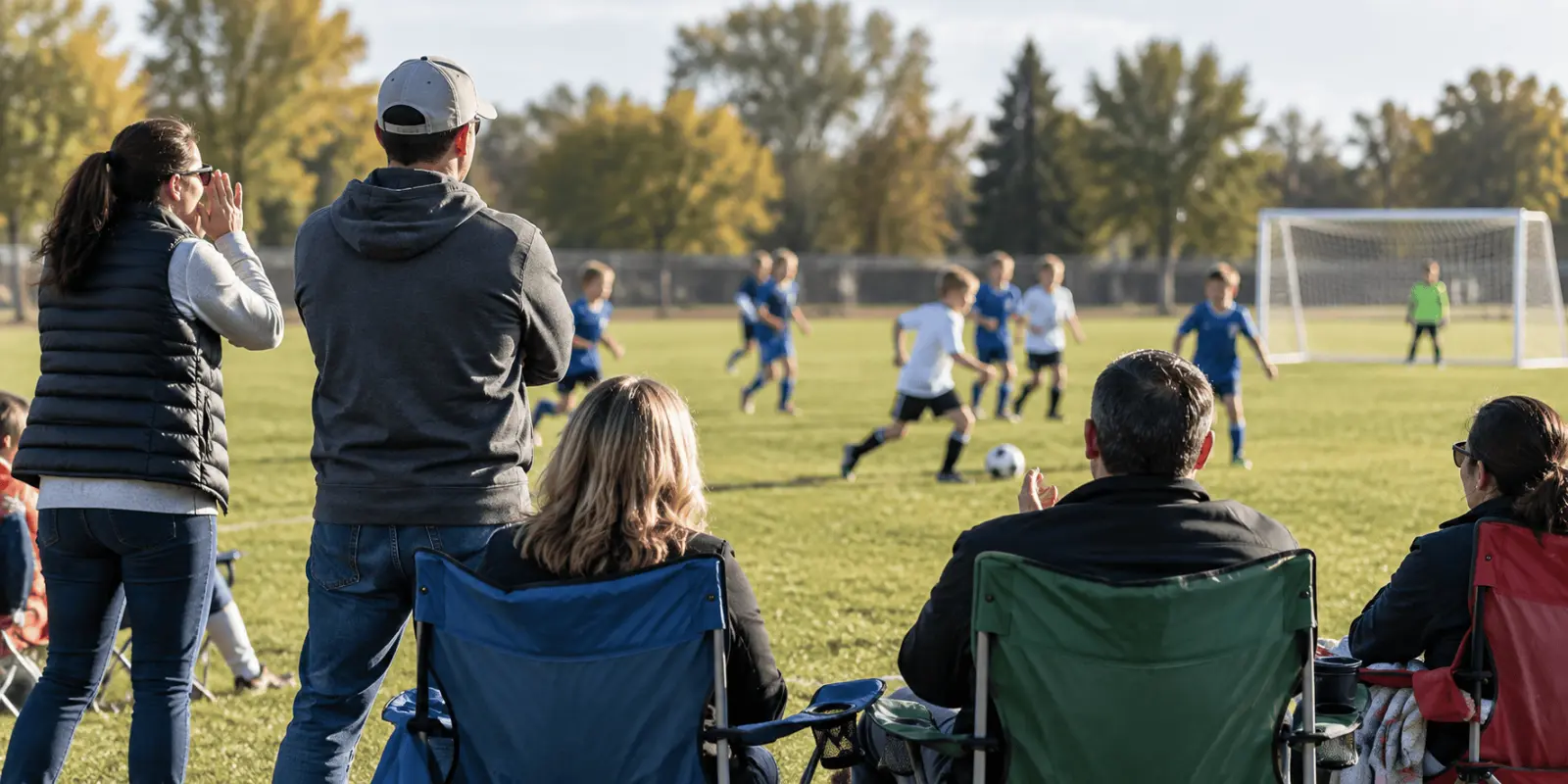
Why sideline comments are difficult to study
Stories about hostile or overinvolved sport parents are common, but anecdotes do not show how often particular kinds of comments actually occur. Blom and Drane began from that gap. Their abstract noted that empirical data on spectators’ comments at youth sporting events was scarce and that only a small number of earlier studies had directly examined the issue. That made systematic observation especially valuable: instead of asking parents what they believed they said, observers could classify comments made during real games.
This distinction matters because self-report and observed behavior answer different questions. A questionnaire can capture attitudes, intentions, or memories, while observation records behavior in a specific setting. Later work has continued to use direct observation for the same reason. Holt and colleagues combined interviews, audio diaries, and more than 120 hours of youth-soccer observation, while Sánchez-Romero and colleagues later coded tens of thousands of spectator comments across football, basketball, and volleyball. These studies differ in design, country, sport, and coding system, so their percentages should not be pooled as though they measured the same population.
What the 2008 study measured
Blom and Drane used the Parent Observation Instrument for Sport Events to examine comments made by 110 parents at recreational youth games. The abstract does not provide every procedural detail needed to reconstruct the full coding protocol, limiting interpretation to the observational design and findings reported in the available record. It was an observational study of parent comments, not an experiment in which researchers assigned parents to different communication styles and then measured child outcomes.
The reported comment categories included reinforcing remarks, described as generally positive, and correcting remarks, described as generally negative. About 31% of comments were reinforcing and 28% were correcting. Those two percentages do not sum to 100%, indicating that other types of comments were also coded, although the available abstract does not provide their complete distribution. Reinforcing and correcting comments were therefore both prominent parts of the observed sideline talk, rather than the only categories recorded.
The comparison by athlete gender
A chi-square analysis found significantly more positive comments at girls’ events than at boys’ events. This is a comparison between events involving girls and events involving boys; it is not a before-and-after change in the same parents, nor does the abstract establish why the difference occurred. Possible explanations involving sport type, competitive atmosphere, parental expectations, or local culture would require additional evidence.
The comparison between mothers and fathers
The study reported no significant difference between mothers and fathers in their comments. That finding is narrower than saying mothers and fathers behave identically in youth sport. It means that, within the measures and sample reported here, the analysis did not detect a significant difference in comment patterns by parent gender. Sample size, setting, coding categories, and statistical power all affect what such a result can establish.
What the numbers do and do not mean
The headline figures are easy to misread if their denominators are not kept clear. The sample consisted of 110 parents, while 31% and 28% refer to categories of comments, not percentages of parents. It would therefore be incorrect to say that 31% of parents were positive or 28% of parents were negative. A single parent could make comments in multiple categories during an event.
The study also does not show that reinforcing comments caused better performance or that correcting comments caused worse performance. No child outcome is reported in the abstract, and observational frequency alone cannot establish a causal effect. The work is best understood as a descriptive study of the sideline communication environment.
Measure | Reported result | Correct interpretation |
Observed parents | 110 | Number of parents in the recreational youth-game sample |
Reinforcing comments | About 31% | Share of observed comments coded as reinforcing, not share of parents |
Correcting comments | About 28% | Share of observed comments coded as correcting, not share of parents |
Girls vs boys events | More positive comments at girls’ events | Between-event comparison reported as statistically significant |
Mothers vs fathers | No significant difference reported | No detected difference within this study and coding framework |
The study describes what parents said on the sideline; it does not prove what those comments caused in young athletes.
How later research adds context
Later studies broadly support the value of looking at actual parent behavior rather than relying only on stereotypes. Holt and colleagues described parent verbal reactions on a continuum from praise and encouragement to instruction, criticism, and derogatory remarks. Bowker and colleagues used naturalistic observation at 69 youth hockey games and reported that most spectator comments were positive, with negative comments relatively uncommon and often directed at officials. These findings show why extreme media examples should not be assumed to represent the typical event.
Research also shows that children distinguish between kinds of parental involvement. Omli and Wiese-Bjornstal interviewed 57 young athletes aged 7 to 14 and identified three recognizable parental roles: the supportive parent, the demanding coach, and the crazed fan. Children consistently preferred supportive behaviors such as encouragement and attentive presence and were less favorable toward intrusive instruction or disruptive fan behavior. That study used interviews rather than sideline coding, so it complements rather than replicates Blom and Drane.
A 2020 observational study by Sánchez-Romero and colleagues examined 190 family spectators associated with 215 school-age athletes and coded 38,829 comments. It found that comment patterns varied with athlete gender, geographical area, sport, and competition category. The scale of that later dataset does not validate the exact percentages reported in 2008, but it reinforces an important point: sideline behavior is context-dependent and may differ across settings.
Why support, pressure, and instruction are not simple opposites
Broader sport-parenting research cautions against reducing behavior to a single positive-versus-negative axis. Lindstrom Bremer’s narrative review described parental involvement in terms of support, pressure, and family context, while Harwood and Knight argued that effective sport parenting requires parents to adapt their involvement to the child’s developmental stage and competitive environment. A comment intended as helpful instruction can be experienced differently depending on timing, tone, the child’s preference, and whether the parent is also acting as a coach.
This is one reason the labels in the 2008 study should be read as coding categories rather than moral judgments about individual parents. Reinforcement and correction are observable communication functions. Whether a specific comment is helpful to a particular child is a separate psychological question. Later systematic reviews of youth-sport motivation likewise associate supportive, autonomy-promoting involvement with more favorable motivational patterns, while controlling or pressuring involvement is more often linked with poorer experiences. Much of that literature is correlational, so causal conclusions still require care.
What youth sport organizations can take from the evidence
The practical lesson is not that parents should remain silent. Young athletes often value encouragement, attention, and emotional support. The stronger implication is that organizations should make expectations about sideline communication explicit and should distinguish support from coaching, criticism, or conflict with officials. Parent education can give families shared language for these boundaries before competition becomes emotionally intense.
Evidence for parent-education programs is developing rather than complete. Recent reviews report encouraging changes in parental knowledge, behavior, or relationships in evaluated programs, but also note variation in theory, measurement, and study quality. That means education initiatives should be assessed rather than assumed to work simply because they sound sensible.
- Emphasize encouragement and effort rather than public criticism of mistakes.
- Clarify whether tactical instruction should come from coaches rather than spectators.
- Set expectations for respectful behavior toward officials, opponents, and other families.
- Ask young athletes what forms of sideline support they actually prefer.
One useful way to interpret sideline behaviour is to separate the content of a comment from the context in which it is delivered. Encouragement, correction and instruction may have different effects depending on the athlete's age, the timing of the comment, the relationship with the parent and whether the message conflicts with coaching. A count of comments therefore describes what observers heard, but it cannot by itself establish how the young athlete experienced those remarks.
That distinction is important for parent-education programmes. Rules that simply demand silence may remove supportive communication as well as criticism, while vague requests to 'be positive' may not address tactical instruction, arguments with officials or repeated correction after mistakes. More useful guidance can define specific behaviours, explain the role of coaches and invite athletes to say what kind of support they prefer. Evaluation should then examine whether those expectations actually change sideline behaviour and the sporting experience rather than relying only on parent satisfaction. The 2008 observations are therefore best used to identify behaviours worth studying rather than to prescribe one universal sideline rule. They provide a baseline for asking more specific questions about timing, tone, athlete preference and the relationship between parental comments and outcomes such as enjoyment, confidence or continued participation.
Limits of the 2008 evidence
The original study remains useful because it replaced anecdote with direct observation, but the accessible abstract supports only a bounded interpretation. The sample was 110 parents at recreational youth games, and the record does not provide enough detail to establish national prevalence, sport-specific estimates, or effects on athletes. The significant difference between girls’ and boys’ events also should not be generalized to every age group or sport without replication.
The wider literature has grown substantially since 2008, including observational studies, qualitative work, reviews, and intervention research. Even so, context remains central. Competition level, sport culture, age, local norms, family relationships, and the emotional flow of a game can all shape what is said from the sideline. Blom and Drane’s study is therefore best treated as an early empirical snapshot within a larger research program on how parents participate in youth sport.
Frequently asked questions
What did the 2008 study find about positive and negative comments?
Among comments observed from 110 parents at recreational youth games, about 31% were coded as reinforcing and about 28% as correcting. These figures describe the distribution of comments, not the percentage of parents who were positive or negative. Other comment categories were also present, although their full distribution is not given in the available abstract.
Did parents comment differently at girls’ and boys’ events?
Yes, the study reported significantly more positive comments at girls’ events than at boys’ events. The abstract does not establish why this difference occurred, and it should not be generalized to every sport or age group. It is a between-event comparison from this particular recreational youth-sport sample.
Were mothers more positive than fathers?
The study reported no significant difference between mothers and fathers in the nature of their comments. That does not prove the two groups behave identically in all settings; it means the analysis did not detect a significant difference within this sample, instrument, and observational context.
Do correcting comments necessarily harm young athletes?
The 2008 study did not measure whether correcting comments caused harm or improved performance. It described what parents said. Later research suggests that young athletes generally prefer supportive involvement and that controlling or pressuring behavior can be associated with poorer experiences, but the effect of any specific comment depends on context and cannot be inferred from frequency alone.
What is the practical lesson for youth sport organizations?
Organizations can set clear expectations that distinguish encouragement from sideline coaching, criticism, or conflict with officials. Parent education may help, especially when it reflects athletes’ preferences and the local sport context. The evidence supports thoughtful guidance, but programs should still be evaluated rather than assumed to work automatically.
Sources
- Blom, L. C., & Drane, D. (2008). Parents’ sideline comments: exploring the reality of a growing issue. Athletic Insight: The Online Journal of Sport Psychology, 10(3).
- Kidman, L., McKenzie, A., & McKenzie, B. (1999). The nature and target of parents’ comments during youth sport competitions. Journal of Sport Behavior, 22(1), 54–68.
- Holt, N. L., Tamminen, K. A., Black, D. E., Sehn, Z. L., & Wall, M. P. (2008). Parental involvement in competitive youth sport settings. Psychology of Sport and Exercise, 9(5), 663–685.
- Bowker, A., Boekhoven, B., Nolan, A., Bauhaus, S., Glover, P., Powell, T., & Taylor, S. (2009). Naturalistic observations of spectator behavior at youth hockey games. The Sport Psychologist, 23(3), 301–316.
- Omli, J., & Wiese-Bjornstal, D. M. (2011). Kids speak: preferred parental behavior at youth sport events. Research Quarterly for Exercise and Sport, 82(4), 702–711.
- Lindstrom Bremer, K. (2012). Parental involvement, pressure, and support in youth sport: a narrative literature review. Journal of Family Theory & Review, 4(3), 235–248.
- Harwood, C. G., & Knight, C. J. (2015). Parenting in youth sport: a position paper on parenting expertise. Psychology of Sport and Exercise, 16, 24–35.
- Sánchez-Romero, E. I., Ponseti Verdaguer, F. J., Borràs, P. A., & García-Mas, A. (2020). Systematic observation of the verbal behavior of families of youth athletes in grassroots and team sports. International Journal of Environmental Research and Public Health, 17(4), 1286.
- Gao, Z., Chee, C. S., Norjali Wazir, M. R. W., Wang, J., Zheng, X., & Wang, T. (2024). The role of parents in the motivation of young athletes: a systematic review. Frontiers in Psychology, 14, 1291711.
- Burke, S., Sharp, L.-A., Woods, D., & Paradis, K. F. (2024). Enhancing parental support through parent-education programs in youth sport: a systematic review. International Review of Sport and Exercise Psychology, 17(1), 208–235.

Eleanor Hayes — author
Eleanor Hayes writes with an editorial focus on research methodology and study design, including experimental and observational studies, controls, sampling, measurement and the methodological choices that shape scientific conclusions. At CAB Direct, Eleanor co...
Related

Garlic Honey Tea and Blood Pressure: What the Study Found

Mycotoxins in Dried Raisins in Egypt: Fungi and Contamination
Teaching Young Children to Swim: Didactic Approaches in Slovenia

Metofluthrin Mosquito Repellent: Field Efficacy in Outdoor Trials

Capsaicin and Ascorbic Acid Variability in Chilli and Paprika

Seven Countries Study: Coronary Heart Disease Across Populations