Sydney and Melbourne: Divergent Sporting Cultures
R. Cashman and T. Hickie's 1990 article examines why Sydney and Melbourne developed markedly different sporting cultures. The authors begin with familiar contrasts, including the cities' adoption of different football codes, Melbourne's apparently stronger spectator culture and the very different public profiles of the Melbourne Cup and Sydney Cup.
Rather than treating one explanation as sufficient, the paper discusses and assesses seven possible historical hypotheses. These range from settlement patterns and public-school networks to wealth, topography, town planning and the influence of sporting administrators.
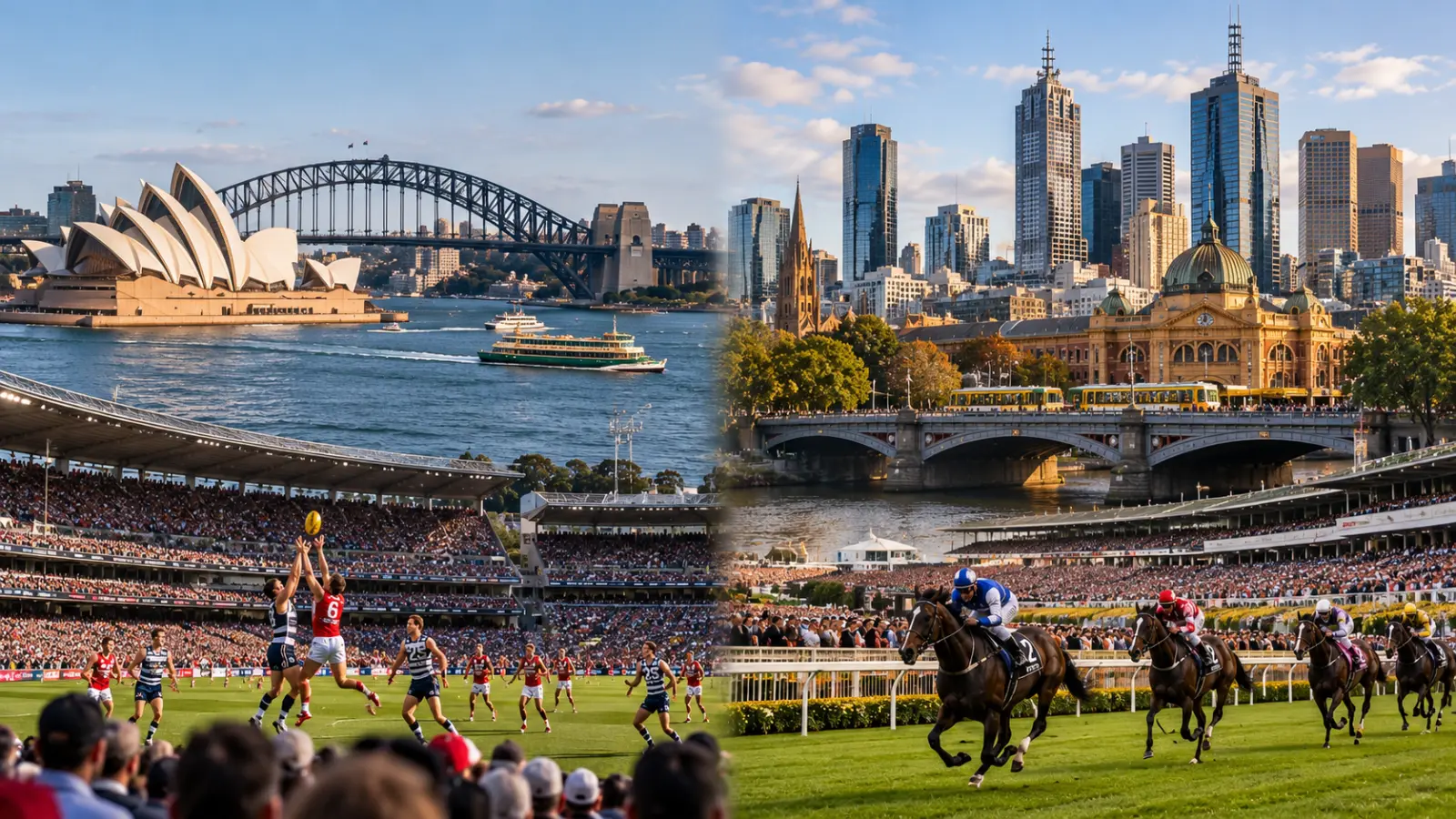
Why Sydney and Melbourne Became a Sporting Culture Debate
Sydney and Melbourne developed noticeably different sporting traditions during the nineteenth century, despite becoming Australia's two largest urban centres. Their contrasting preferences for football codes reflected broader differences in the organization of sporting clubs, educational institutions and local communities. Melbourne also became associated with particularly strong spectator traditions, attracting large audiences to major sporting events. These differences extended beyond football into horse racing, where the Melbourne Cup achieved a level of national recognition that the Sydney Cup did not match. Sporting participation, public attendance and the prestige of individual competitions became distinctive features of each city's cultural identity. Differences in settlement history, institutional development and urban conditions offer several possible explanations for these patterns, although no single factor can account for every aspect of the divergence. The relationship between sport and urban identity therefore extends beyond the popularity of individual competitions to the historical development of the cities themselves.
Football Codes and Spectator Culture Framed the Historical Question
Different football codes became established in Sydney and Melbourne during the nineteenth century, creating sporting traditions that remained closely associated with their respective cities. The divergence involved more than variations in playing rules because football clubs developed within particular educational, social and administrative environments. Public-school networks, patterns of settlement and the influence of sporting administrators were among the historical factors considered by Cashman and Hickie (1990). These institutions may have affected how sporting practices spread, how clubs organized competitions and how particular football traditions became established. Spectator culture added another dimension to the difference, with Melbourne developing a reputation for attracting especially large crowds to sporting events. The relationship between organized competition and public attendance was therefore closely connected to the broader development of sporting culture. Although the relative influence of individual historical factors remains uncertain, the football-code divide demonstrates how sporting preferences can become embedded in the social identity of a city.
How Racing Traditions Illustrate the Contrast Between the Cities
Horse racing provides another important example of the different sporting cultures that emerged in Sydney and Melbourne. The Melbourne Cup became a nationally recognized sporting occasion, extending its cultural influence beyond regular racing audiences and establishing a prominent place in Australian popular culture. The Sydney Cup, although an established racing competition, did not achieve comparable recognition among people outside the racing community. This contrast highlights differences in the public visibility and cultural significance of sporting events rather than simply differences in their competitive formats. The prominence of the Melbourne Cup also reflects the broader association between Melbourne and major spectator occasions, where sporting events became important elements of civic identity. Racing traditions developed alongside football competitions and other organized sports, contributing to the distinct public profiles of both cities. Cashman and Hickie (1990) connected these contrasts with wider questions about historical settlement, institutional influence, economic conditions and urban development. The different cultural positions of the two cups illustrate how sporting events can acquire significance that extends well beyond the competitions themselves.
The Melbourne Cup Became a National Cultural Reference Point
The article's racing example suggests that some Melbourne sporting traditions acquired significance beyond their immediate specialist audience. The Sydney Cup is presented as having a more limited profile outside racing circles. The comparison focuses on the cultural prominence of the two races rather than detailed attendance figures or their chronological development. A nationally recognizable event and a race chiefly familiar to specialist followers can occupy very different places in public memory. The authors use this contrast to introduce the historical question, not to quantify the success of either racing event. The distinction concerns the differing public prominence and cultural recognition of the two events.
Area | Melbourne | Sydney |
Football | A different football code developed in the 19th century | An alternative football code developed in the 19th century |
Racing | Melbourne Cup described as part of national popular culture | Sydney Cup described as less widely known outside racing |
Audiences | Presented as generating much larger sporting audiences | Presented as generating smaller audiences by comparison |
Table note: These are broad cultural comparisons; detailed attendance statistics were not reported.
Why Melbourne Appeared to Generate Larger Sporting Audiences
Cashman and Hickie (1990) identify Melbourne's larger sporting audiences as one of the most noticeable differences between the sporting cultures of Australia's two major cities. Melbourne developed a reputation for attracting substantial crowds to sporting competitions, particularly events that became closely associated with the city's public identity. Sydney also possessed established sporting traditions, but its spectator culture followed a different historical trajectory. Differences in attendance reflected more than the popularity of individual competitions, raising questions about the organization of sporting institutions, the influence of local communities and the development of urban recreational life. Melbourne's prominent spectator events contributed to its reputation as a major sporting centre, while Sydney's sporting identity developed around a different combination of codes and traditions. The contrast between the cities highlights the relationship between public sporting participation, institutional development and the cultural importance attached to major events.
Audience Size Was Treated as an Outcome Requiring Explanation
Sporting attendance became an important indicator of the contrasting public roles of organized sport in Sydney and Melbourne. Large crowds could strengthen the visibility of particular competitions, reinforce established sporting traditions and contribute to the reputation of a city as a centre of spectator sport. However, attendance patterns alone cannot establish why one city developed a more prominent spectator culture than another. Differences in settlement, educational institutions, economic resources, sporting administration and urban geography all formed part of the historical explanations considered by Cashman and Hickie (1990). These conditions may have influenced the development of clubs, sporting facilities and opportunities for public participation, although their individual effects were not established as definitive causes. Melbourne's apparently larger audiences therefore represent a historical contrast requiring explanation rather than conclusive evidence of superiority across every aspect of sporting life. The absence of precise comparative attendance figures also limits any attempt to measure the size of the difference or determine how consistently it appeared across particular sports and periods.
What Seven Hypotheses the Authors Considered
Drawing on previous work, Cashman and Hickie identify no fewer than seven possible hypotheses for the divergence between Sydney and Melbourne. The range of explanations shows that the paper considers social, institutional, economic and physical factors. One provocative explanation considered in the article was the suggestion that Melbourne's limited alternative attractions encouraged attendance at sporting events. Other explanations concern the power of sporting administrators, settlement history, schools, wealth and the physical form of the two cities.
The Proposed Explanations Span Institutions, Society and Urban Form
The authors discuss the differential character and timing of early settlement, as well as Melbourne's relatively larger network of public schools at an earlier stage. They also consider the possibility of greater wealth in Melbourne. Finally, the paper assesses topographical differences and the nature of town planning. These factors are examined as possible explanations rather than established causes of the sporting divergence.
Hypothesis | Focus |
Melbourne's alleged dullness | Whether limited alternatives encouraged attendance at sporting fixtures |
Power of sporting administrators | Institutional influence in Melbourne sport |
Early settlement | Different character and timing of settlement in the two cities |
Public-school networks | Melbourne's relatively larger early network of public schools |
Greater wealth | Possible economic advantage in Melbourne |
Topography | Physical differences between the cities |
Town planning | Differences in the organization of urban space |
Table note: The seven explanations were considered as hypotheses, not established as seven independently proven causes.
How Settlement History and Public Schools Enter the Explanation
Two hypotheses focus on the early social development of the cities. One concerns differences in the character and timing of settlement in Sydney and Melbourne. Another concerns Melbourne's relatively larger network of public schools at an earlier stage. In the paper's comparative framework, such institutions are considered as possible contributors to different sporting traditions.
Early Institutional Networks May Have Shaped Sporting Development
The inclusion of public schools points toward the role of organized institutions in creating or transmitting sporting practices. The settlement hypothesis similarly directs attention to the populations and social structures from which each city's sporting culture emerged. Neither factor is established as an independent cause of the divergence. Both are examined alongside other historical explanations. Schools and settlement histories could have shaped where clubs formed, how traditions were transmitted and which groups had access to organized competition. The paper treats these connections as questions for historical assessment, not as measured effects or a ranked explanation of sporting outcomes.
Why Wealth, Topography and Town Planning Were Considered
The authors also consider whether Melbourne possessed greater wealth and whether this contributed to its sporting culture. Economic resources could be relevant to sporting institutions and participation, but wealth remains one possible explanation among several rather than an established cause.
Two further hypotheses concern topography and town planning. These move the comparison beyond social institutions to the physical environments in which the cities developed.
Urban Form Was Included Alongside Social and Economic Factors
By including topography and town planning, the paper treats sporting culture as potentially connected to the organization and geography of urban life. This broadens the inquiry beyond the administration of sport itself. The investigation considers these geographical factors without establishing their individual causal importance. Nevertheless, these physical factors form an explicit part of the authors' comparative historical framework. Including the built environment alongside institutions and wealth widens the analysis beyond sport itself. It also makes clear why explanations of sporting differences may require urban and social history as well as the histories of individual clubs and competitions.
What Role Sporting Administrators May Have Played in Melbourne
One of the seven hypotheses concerns the power of administrators involved in sport in Melbourne. This places sporting governance and organizational influence directly within the explanation for the cities' divergence. The hypothesis is distinct from explanations based on wealth, schools or urban geography. It asks whether people and institutions administering sport had particular power in shaping Melbourne's sporting traditions.
Administrative Power Was One Candidate Explanation, Not a Final Verdict
The article considers sporting administrators as one possible influence on Melbourne's sporting development. This explanation is assessed alongside six other hypotheses involving settlement patterns, educational institutions, economic resources and urban geography.
How the Article Frames Divergent Sporting Traditions Overall
Cashman and Hickie's investigation treats the different sporting patterns of Sydney and Melbourne as a question requiring historical explanation. The visible contrasts in football, racing and spectator audiences are starting points rather than complete explanations. The article therefore returns to the emergence of each city's sporting traditions and evaluates multiple possible causes. Its framework resists a simple one-factor account.
The Paper Treats Sporting Culture as a Historical Urban Development
The seven hypotheses collectively connect sport with settlement, education, economic resources, administration and urban form. Their breadth shows why the authors regard the divergence as a question of historical culture rather than merely preference for particular sports.
The article presents the seven hypotheses as competing or potentially complementary historical explanations without establishing a single definitive cause of the cities' sporting divergence. The comparison is particularly useful because it separates observed sporting contrasts from the historical mechanisms proposed to explain them. Differences in football codes, racing prestige and spectator culture are identifiable features of the debate, whereas the seven proposed causes require distinct historical evidence. This distinction prevents a familiar cultural contrast from becoming an unsupported account of why it emerged.
Level | Historical factors examined |
Sporting culture | Football codes, racing prominence, audience size |
Institutional | Sport administrators, public schools |
Historical-social | Character and timing of settlement, wealth |
Urban-physical | Topography, town planning |
Table note: The grouping organizes the seven hypotheses by subject without assigning causal weight or ranking their importance.
Practical takeaway: Cashman and Hickie examine the contrasting sporting cultures of Sydney and Melbourne as a historical problem involving multiple possible explanations. Differences in football codes, racing prominence and sporting audiences provide the principal examples of divergence. The authors consider seven hypotheses involving administrators, settlement, schools, wealth, topography, town planning and the provocative suggestion that Melbourne's alleged dullness encouraged sporting attendance. The detailed relative importance of these factors remains unresolved, reflecting the complexity of the historical comparison. The research therefore illustrates the value of examining sporting traditions through their broader historical, institutional and urban contexts rather than attributing them to one cause.
Frequently asked questions
Why did Sydney and Melbourne develop different sporting cultures?
Sydney and Melbourne developed contrasting football, racing and spectator traditions through historical processes that Cashman and Hickie investigated in 1990. The researchers considered seven possible explanations, including settlement patterns, schools, sporting administration, wealth and urban geography. Their comparison does not establish one definitive cause, but shows why the differences require historical analysis.
Why is the Melbourne Cup more culturally prominent than the Sydney Cup?
Cashman and Hickie described the Melbourne Cup as a longstanding part of Australian national popular culture, while noting the Sydney Cup's lower profile outside racing circles. They used the contrast to illustrate different levels of public recognition. Their article examines this distinction historically rather than presenting a numerical comparison of attendance or popularity.
Did Melbourne historically attract larger sporting crowds than Sydney?
In their 1990 comparison, Cashman and Hickie described Melbourne as apparently attracting much larger sporting audiences than Sydney. They treated that observation as a feature of the cities' differing sporting cultures, not as a complete explanation. The discussion asks which historical, institutional and urban conditions may have contributed to the contrast over time.
What seven hypotheses explain Sydney and Melbourne's sporting differences?
Cashman and Hickie considered seven historical hypotheses: Melbourne's alleged dullness, powerful sporting administrators, differences in early settlement, public-school networks, wealth, topography and town planning. The explanations span social, institutional, economic and geographical factors. The authors examined these as possible contributors to divergence rather than seven independently demonstrated or equally important causes.
Sources
- Cashman, R., & Hickie, T. (1990). The divergent sporting cultures of Sydney and Melbourne. Sporting Traditions, 7(1), 26–46.
- Cashman, R. (1995). Paradise of Sport: The Rise of Organised Sport in Australia. Oxford University Press.
- Sharp, M. P. (1987). Australian football in Sydney before 1914. Sporting Traditions, 4(1), 27–45.
- Indian, M. O. (1980). Leisure in City and Suburb: Melbourne 1880–1900 [Doctoral dissertation, Australian National University].
- Cashman, R., & McKernan, M. (Eds.). (1981). Sport: Money, Morality and the Media. New South Wales University Press.
- Australian Sports Commission. (n.d.). Australian Football. Clearinghouse for Sport.
- Cashman, R. (2008). Sport. Dictionary of Sydney.

Adrian Foster — author
Adrian Foster writes with an editorial focus on experimental science, laboratory research, controlled comparisons, measurement techniques and the role of replication in evaluating scientific findings. At CAB Direct, Adrian covers experiments, laboratory method...
Related

Travel in Later Life: What an Eight-Person Study Found

Adult Literacy Classes in Kenya: What a 1980s Study Found
China cruise tourism: growth and changing passenger behaviour

Tradition, Modernity and Tourism in Swaziland: Social Effects

Tackling Climate Change Through Livestock: Emissions and Mitigation

Betalain-Rich Red Beet Extract and Osteoarthritis Discomfort