Tradition, Modernity and Tourism in Swaziland: Social Effects
The chapter placed this tension inside a growing tourism industry. International visitor numbers rose from 89,015 in 1972 to 257,997 in 1989, while tourism contributed about 3% of GDP and more than 4% of total exports in 1988. Harrison used these developments to explore how tourism, monarchy and modernization interacted.
Why Harrison Treated Tourism as a Social Question in Swaziland
Harrison's chapter focused explicitly on the social effects of tourism. Rather than treating visitor growth as a self-contained economic success, it examined how tourism interacted with political authority, cultural representation and changing social behaviour. The key concept was the ambiguous status of 'tradition'.
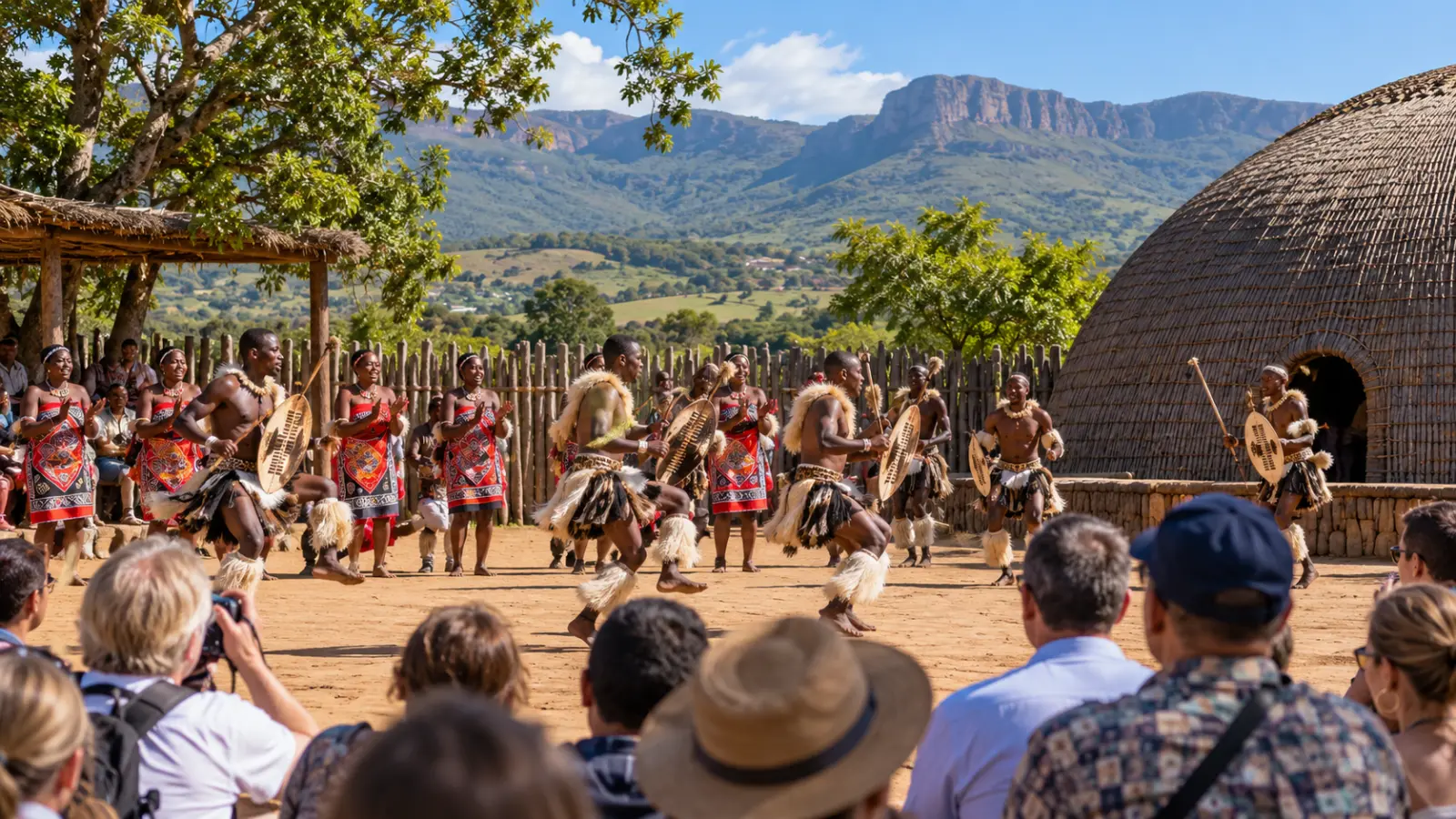
In Harrison's account, tradition simultaneously supported the legitimacy of the existing political structure and supplied a crucial theme for marketing Swaziland to tourists. Tourism therefore provided a setting in which tradition and modernity could reinforce, reshape and contradict one another.
Tourism can be counted through arrivals and economic contribution, but those measures leave open questions about who controls the images shown to visitors and how cultural practices acquire public meaning. In Swaziland, the importance of tradition to political authority made those questions especially significant. A ceremony presented as a cultural attraction could also belong to a much wider social and political setting. Harrison (1992) connected tourism to that setting instead of separating commercial promotion from questions of legitimacy and change.
The resulting tension was not simply a conflict between old customs and new businesses. A political institution could appeal to continuity while using modern forms of publicity and commerce to circulate a particular image of tradition. Visitors encountered that image through tourism, while residents lived with the broader social relationships surrounding it. The difference between cultural presentation and everyday experience is therefore important when interpreting the social consequences of tourism.
How Rapidly Tourism Expanded Between 1972 and 1989
The chapter documented substantial long-term growth in international visitation. Swaziland received 89,015 international visitors in 1972, while the reported total for 1989 was 257,997. Harrison characterized the increase as somewhat uneven, which matters when interpreting the two endpoint figures.
By 1988, tourism contributed about 3% of GDP and more than 4% of total exports according to the figures summarized in the chapter. These values provide economic context for Harrison's broader analysis of political authority, cultural presentation and modernization.
The two visitor totals show an increase of 168,982 arrivals, or approximately 190% relative to the 1972 figure. The 1989 total was almost 2.9 times the earlier level. These calculations describe the change between two reported years; they do not show the course of growth in each intervening year. Harrison (1992) specifically characterized the expansion as uneven, so the endpoint comparison should not be mistaken for a steady annual trend.
The GDP and export shares describe a different dimension of tourism. Arrivals count visits, while GDP and export contributions concern economic activity. A larger number of visitors does not automatically reveal how much each visitor spent or how benefits reached households and institutions. In Harrison’s analysis, the economic figures establish why tourism deserved attention while leaving the central questions of cultural representation and political influence unresolved.
Table 1. International Visitor Growth Reported by Harrison
Year | International visitors | Interpretation |
1972 | 89,015 | Earlier benchmark reported in the chapter |
1989 | 257,997 | Higher endpoint after uneven growth |
Table note: The figures describe international tourism in Swaziland between 1972 and 1989.
Who the Typical Visitors Were and Why Short Trips Mattered
Most tourists described in the chapter arrived by road from the Republic of South Africa. Their stays were generally short, lasting two or three days at most. Harrison linked some of this traffic to activities that had been restricted in South Africa amid international opposition to apartheid.
This visitor pattern placed Swaziland's tourism industry inside a wider southern African political context. The motivations described for the late 1980s should not be assumed to represent tourism in present-day Eswatini.
The prevalence of road travel and brief visits meant that the visitor experience described by Harrison (1992) was closely tied to access from neighbouring South Africa. A two- or three-day stay differs from a long residential holiday in the amount of time visitors may spend encountering local institutions and cultural settings. This distinction helps explain why visitor numbers alone provide an incomplete picture of tourism’s social footprint.
The political setting also shaped the meaning of cross-border movement. Harrison associated some visits with access to television programmes and sporting activities restricted in South Africa during the apartheid era. That context should be treated as a specific historical circumstance, not as an explanation for every tourist journey. The pattern illustrates how tourism demand may reflect restrictions and opportunities beyond the destination itself.
Why Tradition Was Politically Important to the Swazi Monarchy
In Harrison's analysis, the monarchy was dominant in Swaziland's political and economic life. Its position received important legitimation from the concept of 'tradition', which therefore functioned as more than a set of cultural practices in the chapter's argument.
Tourism complicated this role because the monarchy was also involved in presenting, packaging and selling Swazi tradition to attract visitors. The ambiguity Harrison emphasized was that tradition could validate existing authority while its tourist presentation participated in a modern economic and promotional system.
In this setting, tradition operated as a source of public authority as well as a set of practices available for cultural presentation. Harrison (1992) described the monarchy as central to political and economic life, making its relationship with tourism especially consequential. When an institution associated with tradition also participates in promoting that tradition, cultural symbolism and economic activity become intertwined. The meaning of a public ceremony cannot be reduced to its value as an attraction.
The monarchy’s involvement also complicates the idea that tourism simply imported outside influences into a traditional society. Domestic political actors participated in choosing how tradition would be represented. This does not establish how every community understood or responded to that representation. It does show why the study examined authority and marketing together rather than treating them as unrelated subjects.
Table 2. Visitor Pattern Described in the 1992 Chapter
Feature | Harrison's description |
Main origin | Republic of South Africa |
Main transport mode | Road |
Typical duration | Two or three days at most |
Activities specifically mentioned | Television programmes and sports activities |
Historical context | International opposition to apartheid affected access to some activities in South Africa |
Table note: The visitor patterns reflect tourism conditions in Swaziland during the period examined by Harrison.
How Tourism Turned Swazi Tradition Into a Marketable Theme
The tourism industry needed recognizable themes through which the destination could be presented to outsiders. Harrison identified Swazi tradition as a crucial element of that marketing process. Packaging tradition for visitors gave cultural representation a commercial purpose.
This is one of the chapter's central sociological tensions. Once tradition becomes part of destination marketing, it is reproduced through institutions, audiences and economic relationships associated with modern tourism. Harrison consequently treated tourism as part of modernization rather than as an external force acting on an otherwise unchanged traditional society.
Tourism promotion often relies on images that visitors can recognize before arrival. In the case examined by Harrison (1992), Swazi tradition became a prominent organizing theme for that recognition. Selecting a cultural theme for promotion can emphasize some aspects of public life while leaving others less visible. The resulting presentation has commercial value, yet its significance cannot be understood through marketing alone.
The important distinction is between a cultural practice and its representation to a visiting audience. Tourism creates additional settings in which tradition is described, displayed and interpreted. Those settings are part of modern economic exchange, even when the images emphasize historical continuity. Harrison’s argument concerns this coexistence of continuity and change, rather than a claim that all tourist presentations were inauthentic.
Why Modernization Was Seen as a Challenge to Existing Authority
The chapter situated tourism within a longer process of modernization that had allegedly weakened the authority of traditional male Swazi rulers over younger people and especially over women. Changes in behaviour and dress were among the developments considered threatening to the traditional Swazi way of life.
Tourism could support the political and commercial value of tradition while also connecting Swaziland to forms of consumption, mobility and behaviour associated with modernity. That contradiction prevents a simple conclusion that tourism either preserved tradition or destroyed it.
The chapter described concerns that changing patterns of dress and behaviour challenged established expectations, particularly those governing younger people and women. Such concerns reveal that debates about modernity were also debates about who could define acceptable conduct. Harrison (1992) placed these social tensions beside the monarchy’s use of tradition for political legitimacy and tourism promotion. The same language of tradition could therefore carry different meanings in different contexts.
Tourism did not stand outside this process. It involved visitors, commercial services and public images of cultural continuity while operating within a changing society. These overlapping roles make simple judgments about preservation or disruption inadequate. The historical material does not quantify tourism’s independent influence on gender relations or generational authority, so those issues are best understood as tensions discussed in the study rather than measured outcomes.
Table 3. Roles of Tradition in Harrison's Tourism Analysis
Role | How it functioned in the chapter |
Political legitimacy | Supported the existing political structure and monarchical authority |
Tourism marketing | Provided a crucial theme for attracting visitors |
Cultural representation | Swazi tradition was presented and packaged for tourist consumption |
Modernization tension | Commercial use of tradition became part of the modernizing process it appeared to contrast with |
Table note: These categories reflect the political, commercial and social roles of tradition examined in Harrison's analysis.
What the Historical Tourism Figures Show and What They Do Not
The visitor figures establish that international arrivals were substantially higher in 1989 than in 1972. The 1988 economic figures also show a visible contribution from tourism to GDP and exports. Those numbers do not by themselves demonstrate why tourism expanded, how benefits were distributed or how individual communities experienced social change.
The chapter's distinctive contribution lies in connecting the scale of tourism with questions about legitimacy, representation and modernization. Growth in arrivals is an economic indicator, whereas claims about tradition and authority require historical and sociological interpretation.
Between the reported endpoints, arrivals increased markedly, but the data do not identify which visitors attended cultural events or how frequently particular attractions were used. The figures also do not separate different forms of travel or establish the distribution of income from tourism. Any claim that increased visitation directly produced a particular social change would therefore require additional evidence beyond the two arrival totals.
It is equally important not to collapse economic contribution into political influence. Tourism’s reported share of GDP and exports describes its place in the economy in 1988. Harrison’s discussion of tradition and monarchy addresses a separate set of relationships that cannot be expressed as percentages. Keeping these forms of evidence distinct makes the historical interpretation more precise.
The Historical Relevance of Harrison's Tourism Research in Eswatini
The chapter uses the name Swaziland because that was the country's official name when Harrison wrote. The country name changed to the Kingdom of Eswatini in 2018, so current discussion should distinguish the historical terminology of the source from the present national name.
Harrison's figures and descriptions belong to the late twentieth-century setting he studied. Contemporary tourism in Eswatini operates under different economic, political and social conditions from those examined in the 1992 study. The study remains useful as a historical lens on tourism, cultural representation and political authority.
The country-name distinction matters when comparing research from different periods. Swaziland is appropriate when identifying the place studied in Harrison’s 1992 publication, whereas Eswatini is the current official name. Using both names with their historical context helps readers connect older scholarship with present-day geographical references without suggesting that conditions in the early 1990s have remained unchanged.
The wider relevance of the chapter lies in the relationship it draws between economic development and cultural authority. A tourism industry can market historical continuity while participating in changing social and commercial arrangements. That observation provides a useful question for later research, but Harrison’s figures and visitor descriptions remain evidence about a particular period. They should not be presented as current measurements of Eswatini’s tourism sector.
Practical takeaway: Harrison's 1992 analysis demonstrates that tourism influences cultural representation and political authority alongside economic development. In the Swaziland case, the same idea of 'tradition' could support political legitimacy, attract tourists and become part of a modern commercial system, creating tensions over authority, gender, youth and cultural change.
Frequently asked questions
Why was Swaziland renamed Eswatini?
Swaziland became the Kingdom of Eswatini in 2018. The earlier name appears in historical tourism research because it was the official country name during the period studied. David Harrison's 1992 chapter therefore discusses Swaziland, while present-day geographical references generally use Eswatini. The change in name does not update the chapter's historical statistics.
How many international tourists visited Swaziland in 1972 and 1989?
Harrison (1992) reported 89,015 international visitors in 1972 and 257,997 in 1989. That represents an increase of 168,982 arrivals, or approximately 190% between the two reported years. Growth was described as uneven, so these endpoints should not be interpreted as evidence of a consistent annual increase throughout the intervening period.
How much did tourism contribute to Swaziland’s economy in 1988?
Tourism accounted for about 3% of Swaziland's gross domestic product in 1988 and more than 4% of total exports, according to figures reported by Harrison (1992). These measures describe economic contribution rather than the distribution of tourism income. They also do not establish how tourism affected individual communities or political institutions.
How did tourism affect Swazi tradition and the monarchy?
Harrison (1992) examined how Swazi tradition supported the legitimacy of the monarchy while also becoming a central theme in tourism marketing. Royal involvement in presenting tradition linked political authority with commercial promotion. The chapter also considered tensions surrounding modernization, including changing behaviour and expectations affecting younger people and women. These relationships resist a simple preservation-versus-change interpretation.
Sources
- Harrison D. Tradition, modernity and tourism in Swaziland. In: Harrison D, ed. Tourism and the Less Developed Countries. Belhaven Press; 1992:148–162.
- Harrison D. Tradition, Modernity and Tourism in Swaziland. In: Tourism, Tradition and Culture: A Reflection on Their Role in Development. 2021.
- Harrison D. Development of tourism in Swaziland. Annals of Tourism Research. 1995;22(1):135–156.
- Harrison D. Tourism and prostitution: sleeping with the enemy? The case of Swaziland. Tourism Management. 1994;15(6):435–443.
- Scheyvens R, Biddulph R. A reflection on the work and legacy of Professor David Harrison (1941–2021). Tourism Planning & Development. 2022.
- Permanent Mission of the Kingdom of Eswatini to the United Nations. The Kingdom of Eswatini Is the New Name of the Kingdom of Swaziland. 8 June 2018.
- Mashwama VC, Chiliya N, Chuchu T. Destination image of Swaziland: perceptions of local and international tourists. 2019.
- Gwebu A. An investigation into culture and its influence on socio-economic development in the Kingdom of Swaziland. University of Namibia; 2018.

Adrian Foster — author
Adrian Foster writes with an editorial focus on experimental science, laboratory research, controlled comparisons, measurement techniques and the role of replication in evaluating scientific findings. At CAB Direct, Adrian covers experiments, laboratory method...
Related
Travel in Later Life: What an Eight-Person Study Found
Adult Literacy Classes in Kenya: What a 1980s Study Found

China cruise tourism: growth and changing passenger behaviour

Sydney and Melbourne: Divergent Sporting Cultures
Tackling Climate Change Through Livestock: Emissions and Mitigation

Betalain-Rich Red Beet Extract and Osteoarthritis Discomfort