Macadamia Nut Husks in Sheep Rations: What the 1970 Trial Found
A 1970 Hawaii Agricultural Experiment Station research report tested ground macadamia nut husks as a feed ingredient for sheep. Crossbred wethers received diets in which husks replaced cracked maize and barley in concentrate rations or pangola grass in roughage rations at 12%, 24% or 36%. The 1970 study found that the husks did not reduce palatability, but increasing inclusion was associated with lower nutrient digestibility, reduced nitrogen retention and poorer growth in yearling lambs. The findings distinguish feed acceptance from nutritional performance when agricultural residues replace conventional ration ingredients.
Why researchers tested macadamia husks as ruminant feed
The distinction between an outer husk and a processed nut product is central to the study. A macadamia husk is a plant residue with a different role in a ration from a cereal grain, forage or oil-extraction cake. When researchers substitute one ingredient for another, the result reflects the replacement as well as the material introduced. The question in the 1970 trial was therefore not whether macadamia trees produce edible material in general, but how ground husks performed when incorporated into the particular sheep diets tested (Campbell, Nolan and Lee, 1970).
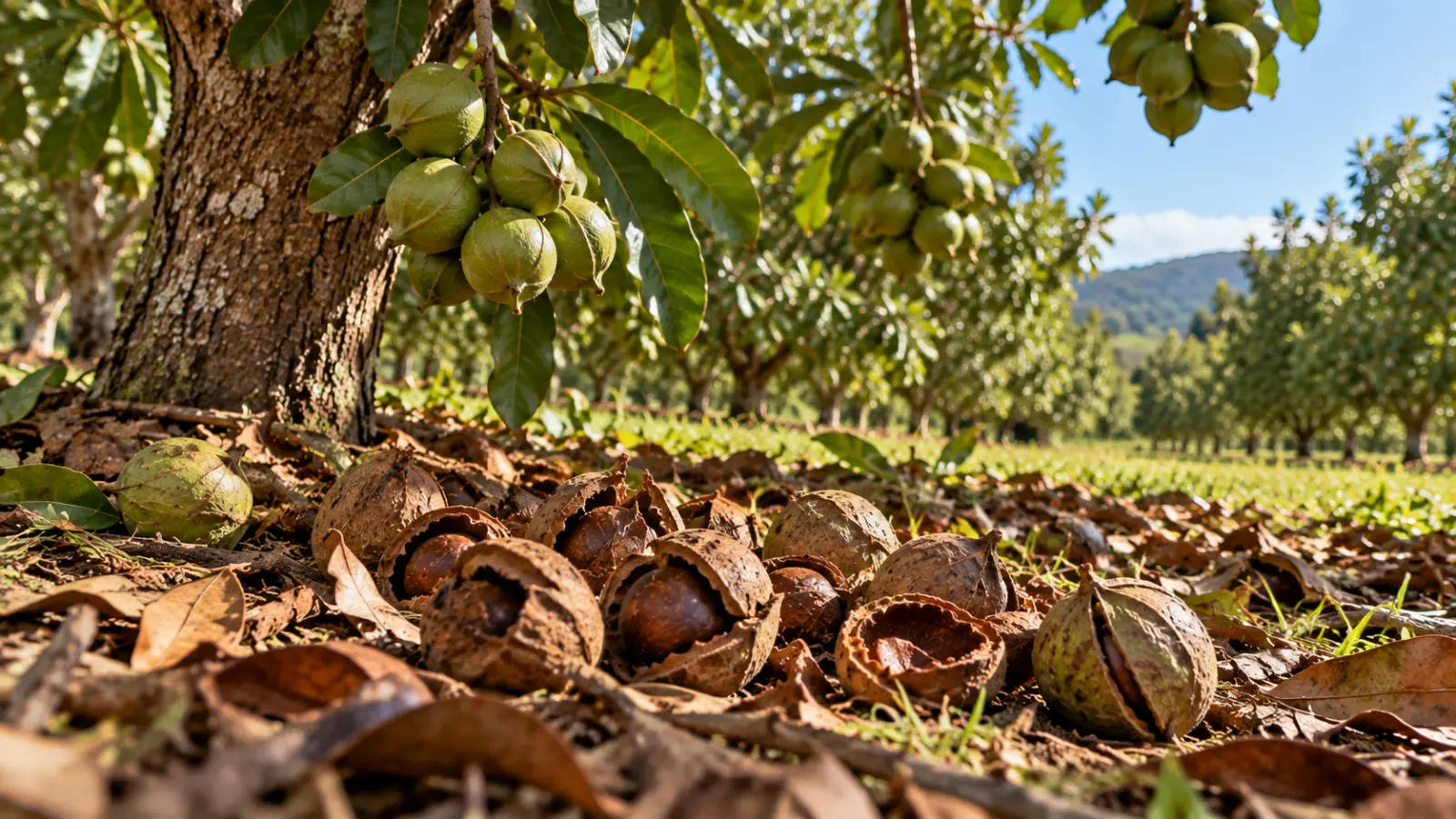
Macadamia processing leaves a fibrous outer husk after the nut is removed. In Hawaii, where macadamia production generated this material locally, testing it as livestock feed addressed whether an agricultural by-product could replace part of more conventional ration ingredients. The 1970 report combined observations on palatability with nutrient digestibility, nitrogen retention and a growth trial with yearling lambs.
A by-product can be readily consumed while still lowering the nutritional value of a ration if its nutrients are poorly digested or if it reduces utilization of the diet as a whole. The experiment therefore tested increasing proportions of ground husks rather than a single inclusion level, allowing an inclusion-related response to be observed.
How the graded feeding design worked
A graded design helps distinguish a response that changes with the amount of a test ingredient from an observation at only one level. Here, the comparisons involved replacement of grain components in one type of ration and forage in another. Because those baseline ingredients play different nutritional roles, a response in a concentrate ration should not automatically be equated with a response in a roughage ration. The historical report supports comparisons within its experimental conditions; it does not provide a general recipe for feeding husks to sheep (Campbell, Nolan and Lee, 1970).
Campbell, Nolan and Lee (1970) reported that crossbred wethers averaging 142 lb liveweight received ground macadamia nut husks at 12%, 24% or 36% of the ration. In concentrate diets, the husks replaced equal weights of cracked maize and barley; in roughage diets, they replaced equal amounts of pangola grass.
The 1970 research report is cited for the feeding design; complete ration formulations, sample sizes for every phase and detailed analytical tables are not established here.
Table 1. Diet substitutions reported by Campbell, Nolan and Lee (1970)
Diet context | Husk levels | Ingredient replaced |
Concentrate ration | 12%, 24%, 36% | Cracked maize and barley |
Roughage ration | 12%, 24%, 36% | Pangola grass |
Growth trial | Increasing proportions | Diet varied with husk level |
Table note: The diets contained ground macadamia husks at graded inclusion levels, replacing grain ingredients or pangola grass.
What happened to palatability and digestibility
Palatability describes whether animals are willing to eat a feed, whereas digestibility concerns the proportion of consumed nutrients that is made available through digestion. These are related but separate endpoints. An animal can consume a ration without showing an immediate feeding problem while extracting less usable nutrition from it. That distinction is the main reason the 1970 observations should not be summarized simply as a successful use of husks as feed. The report describes acceptance alongside declining digestibility as inclusion increased (Campbell, Nolan and Lee, 1970).
Campbell, Nolan and Lee (1970) found no adverse effect on palatability. The sheep therefore accepted the husk-containing diets, an important observation because it separates feed acceptance from nutritional performance. A 1970 industry research summary of Campbell, Nolan and Lee also describes the rations as palatable and reports no digestive troubles during the trial.
Digestibility told a different story. With increasing husk inclusion, the study reports a linear reduction in digestibility for the nutrients summarized there, with ether extract in the roughage diets identified as the exception. Individual digestibility coefficients are not established by the reported results.
Why chemical composition was not enough
This result illustrates why chemical composition alone cannot establish the practical feeding value of an agricultural residue. A material can appear potentially useful from proximate composition while producing poorer nutrient utilization when it replaces conventional feed in an actual ration.
Later feed references distinguish sharply among macadamia husks, feed-grade nuts and oil cake. These materials differ in fiber, fat and processing history, so evidence for one form should not be treated as direct evidence for another.
How nitrogen retention and lamb growth changed
Nitrogen retention is an indicator of how much nitrogen remains in the animal after intake and losses are considered. It is not interchangeable with feed intake or with the protein percentage printed on a feed analysis. When retention decreases, a ration may be supplying nitrogen that is not used as effectively under the conditions studied. The yearling-lamb growth observation provides a separate performance endpoint consistent with the nutritional concern, although the reported directional findings cannot support a numerical prediction of weight gain in a different flock (Campbell, Nolan and Lee, 1970).
Campbell, Nolan and Lee (1970) found that nitrogen retention was reduced as the proportion of husks increased. The direction of the nitrogen-retention response was reported by Campbell, Nolan and Lee (1970), but absolute nitrogen intake, fecal loss, urinary loss and retention values are not established here.
The growth trial produced a parallel response. In the yearling lambs studied by Campbell, Nolan and Lee (1970), gain was inversely related to the proportion of husks in the diet. Average daily gain, feed conversion, trial duration and carcass outcomes are not established by the reported findings.
Table 2. Responses reported by Campbell, Nolan and Lee (1970)
Outcome | Reported response | What the record does not provide |
Palatability | No adverse effect reported | Quantitative intake data |
Digestibility | Linear reduction with increasing husks | Individual coefficients in the abstract |
Nitrogen retention | Reduced | Absolute balance values |
Yearling lamb gain | Inverse relation with husk proportion | Daily-gain and feed-conversion figures |
Table note: The qualitative outcomes follow Campbell, Nolan and Lee (1970); individual digestibility coefficients and nitrogen-balance values are not specified here.
What the historical experiment can establish
The reported pattern is informative because the outcomes do not all move in the same direction. Acceptance of the husk-containing feed remained satisfactory, while digestibility, nitrogen retention and growth became less favorable as inclusion rose. Those outcomes answer different questions and should be kept separate in any retelling of the trial. They also show why a statement that a by-product is usable as feed needs qualification: usable in the sense of being eaten is not the same as nutritionally equivalent to the ingredient it replaces (Campbell, Nolan and Lee, 1970).
Taken together, the historical observations form a coherent pattern. Feed acceptance was maintained, but the nutritional consequences became less favorable as the proportion of ground husks increased: digestibility declined, nitrogen retention fell and lamb gain was lower at higher husk proportions.
The evidence is specific to the material and diets tested. It does not establish a universal maximum inclusion rate for all ruminants, all macadamia residues or all processing methods.
Why later macadamia feeds should be compared cautiously
The 1970 record specifically concerns ground macadamia nut husks. Studies of oil cake left after oil extraction, feed-grade nuts or other industrial residues ask different nutritional questions because these materials have different fat, fiber and protein profiles.
Later work can therefore broaden the context without overturning the original result. Research on macadamia oil cake in cattle and lambs, and on other macadamia residues in sheep, demonstrates why the identity and processing of the by-product must be specified before results are compared.
How later evidence changes the context, not the original result
Later studies have reported that some macadamia oil-cake or industrial by-products can be included in ruminant diets under particular conditions. Those findings concern different ingredients and inclusion strategies from the fleshy outer husks evaluated in 1970.
A favorable result for oil cake cannot be used to erase an unfavorable response to increasing husk inclusion, just as the 1970 husk study cannot define the value of every modern macadamia co-product. Ingredient identity, analysis and appropriate feeding evidence remain essential.
Table 3. Historical findings and later macadamia-feed context
Evidence | Material or focus | Main implication |
Campbell, Nolan & Lee, 1970 | Ground macadamia nut husks in sheep diets | Higher inclusion reduced digestibility, N retention and growth |
Sherrod & Ishizaki, 1967 | Feed-grade macadamia nuts in sheep concentrate | Nut material and dietary fat create a different feeding question |
Later cattle and lamb studies | Macadamia oil cake | Oil cake can perform differently from outer husks |
Recent sheep research | Macadamia processing by-product/cake | Modern residues require ingredient-specific evaluation |
Table note: Later studies examined different macadamia by-products and feeding conditions rather than directly replicating the 1970 experiment.
What the study means for agricultural by-product feeding today
Comparing historical and modern work requires attention to the physical identity of the ingredient. A husk, whole nut and oil cake are not interchangeable descriptions. Their processing histories may change the fraction of the plant represented in the feed and the nutrients available to animals. Later publications on macadamia oil cake or other co-products therefore provide context for the broader research question but cannot supply missing measurements from the 1970 husk experiment. This is a limitation of cross-study comparison, not evidence that the historical observations were incorrect. The 1970 observations also should not be read as an instruction to replace one feed ingredient with another. They document what happened in a particular experiment and provide a starting point for asking questions about nutrient use. In evaluating a different residue, the researcher would need to establish its identity and composition, specify the basal ration, and measure outcomes that distinguish consumption from utilization. Without those steps, a superficially similar product name can conceal an entirely different feeding question. A historical comparison is most useful when the test material and the endpoint are described precisely.
The report remains relevant because it demonstrates the difference between making use of an abundant residue and proving that the residue is an effective nutrient substitute. Replacing conventional feed with a locally available by-product can reduce waste and potentially lower ingredient costs, but those benefits depend on maintaining animal performance.
Modern ration formulation requires a fuller description of the feed than the figures summarized for Campbell, Nolan and Lee (1970) establish. Fiber fractions, dry matter, protein, fat, minerals, processing history and batch variability can all affect how a residue behaves in the rumen.
Why dose and substitution matter in by-product feeding
The substitution approach also affects how a trial should be interpreted. If a test ingredient displaces energy-rich grain, the resulting ration differs from one in which it displaces forage. A change in performance may reflect both the properties of the added residue and the nutrients removed from the original diet. Without complete diet formulations and analytical data, the historical observations should not be turned into a precise explanation of which nutrient caused each outcome. Campbell, Nolan and Lee (1970) establish the direction of the reported responses, not a universal mechanism. Another interpretive issue is the difference between a measured decline and its practical significance. The historical report describes the direction of changes in digestibility, nitrogen retention and growth, but the account does not establish enough numerical detail here to calculate the size of every effect. This prevents a defensible estimate of expected production losses under modern conditions. The appropriate conclusion is therefore qualitative: increasing ground-husk inclusion was associated with poorer nutritional outcomes in the diets tested. That conclusion is important without requiring unsupported extrapolation to all sheep, all feeds or all macadamia-processing residues.
The sheep's willingness to consume the diets did not mean that the husks could replace progressively larger quantities of other feed without consequences. The decline in digestibility, nitrogen retention and growth demonstrates why feeding trials must assess utilization and performance rather than relying only on palatability or proximate composition.
Replacing grain is also nutritionally different from replacing forage. The 1970 design is useful precisely because it examined husks in both concentrate and roughage contexts rather than assuming that the ingredient would behave identically in every ration.
The historical significance of the 1970 macadamia feeding trial
Nutritive value of macadamia nut husks in ruminant rations was published in 1970 as Research Report No. 183 of the Hawaii Agricultural Experiment Station and runs to 11 pages. The report was authored by C. M. Campbell, J. C. Nolan, Jr. and J. H. F. Lee.
The 1970 experiment evaluated the nutritional effects of a crop-processing residue through measurements of digestibility, nitrogen retention and animal growth. The experiment illustrates the importance of evaluating agricultural by-products through nutrient utilization and animal performance.
Practical takeaway: The 1970 trial found that sheep accepted macadamia-husk diets, but increasing husk inclusion reduced digestibility and nitrogen retention and was associated with poorer lamb growth. Modern use should distinguish the exact macadamia by-product and evaluate it at the intended inclusion level rather than assuming that palatability or chemical composition proves feeding value.
Frequently asked questions
What are macadamia nut husks used for in sheep feed?
Ground macadamia nut husks were investigated as a substitute for conventional ration ingredients in a 1970 sheep-feeding experiment by Campbell, Nolan and Lee. Sheep accepted the diets, but greater husk inclusion was linked to poorer digestibility and nitrogen retention. Acceptance alone did not establish that the husks were nutritionally equivalent to the replaced ingredients.
Do macadamia nut husks reduce feed palatability in sheep?
Campbell, Nolan and Lee (1970) reported no adverse effect on palatability when ground macadamia nut husks were incorporated into the tested sheep rations. The animals' willingness to consume the feed did not mean that nutritional performance remained unchanged. Digestibility and nitrogen retention declined as the proportion of husks increased in the historical experiment.
How do macadamia husks affect nutrient digestibility in sheep?
In the 1970 study by Campbell, Nolan and Lee, digestibility generally declined as the share of ground macadamia nut husks increased. Ether extract in roughage diets was the stated exception. The reported direction of change is relevant to the specific rations tested, but it does not establish digestibility coefficients for modern husk products or feeding systems.
Can macadamia nut husks affect weight gain in lambs?
Yes. Campbell, Nolan and Lee (1970) reported that gain in yearling lambs was inversely related to the proportion of macadamia husks in the diet. This means higher inclusion was associated with poorer growth in that trial. The finding does not provide a universal weight-gain prediction for other breeds, ages, formulations or processing methods.
Sources
- Campbell CM, Nolan JC Jr, Lee JHF. Nutritive value of macadamia nut husks in ruminant rations. Hawaii Agricultural Experiment Station Research Report No. 183; 1970.
- Australian Macadamia Society. Nutritive value of macadamia nut husks in ruminant rations. Industry research archive summary; 1970.
- Heuzé V, Tran G, Edouard N, Lebas F. Macadamia (Macadamia integrifolia). Feedipedia, INRAE, CIRAD, AFZ and FAO.
- Sherrod LB, Ishizaki SM. Further studies on levels of feed-grade macadamia nuts in concentrate rations for sheep. Journal of Animal Science. 1967;26(4):862–866.
- Acheampong-Boateng O, Mikasi MS, Benyi K, Amey AKA. Growth performance and carcass characteristics of feedlot cattle fed different levels of macadamia oil cake. Tropical Animal Health and Production. 2008;40(3):175–179.
- Acheampong-Boateng O, Bakare AG, Nkosi DB, Mbatha KR. Effects of different dietary inclusion levels of macadamia oil cake on growth performance and carcass characteristics in South African mutton merino lambs. Tropical Animal Health and Production. 2017;49(4):733–738.
- Bozzi AR, Beltrame RT, Costa RLD, et al. Effect of sheep diets with macadamia by-product and protected fat on the quality of fresh and frozen semen. Boletim de Indústria Animal. 2019;76:1–12.
- Takahashi LS, Sanches TP, Issakowicz J, Bueno MS, et al. Lipid supplementation with macadamia by-product reduces methane emissions by sheep. Small Ruminant Research. 2024;231:107174.

Eleanor Hayes — author
Eleanor Hayes writes with an editorial focus on research methodology and study design, including experimental and observational studies, controls, sampling, measurement and the methodological choices that shape scientific conclusions. At CAB Direct, Eleanor co...
Related

Travel in Later Life: What an Eight-Person Study Found

Adult Literacy Classes in Kenya: What a 1980s Study Found

China cruise tourism: growth and changing passenger behaviour

Tradition, Modernity and Tourism in Swaziland: Social Effects

Sydney and Melbourne: Divergent Sporting Cultures
Tackling Climate Change Through Livestock: Emissions and Mitigation