Pseudomonas aeruginosa and why this bacterium is so hard to treat
Pseudomonas aeruginosa is a Gram-negative bacterium that causes opportunistic infections and can withstand antibiotics through cellular resistance mechanisms and protective biofilms (Qin et al., 2022; Ciofu and Tolker-Nielsen, 2019). Infections range from pneumonia to wound and urinary tract disease, with patients receiving hospital care among the groups at greatest risk (CDC, 2025).
Clinical outcomes vary by site and strain. Exposure and infection are different events. Controlled trials establish that some antibiotics treat hospital-acquired pneumonia, but direct comparisons for difficult-to-treat Pseudomonas remain limited (Tamma et al., 2026).

Evidence last checked 19 de nov. 2026 · 13 min
What Pseudomonas aeruginosa is and where it lives
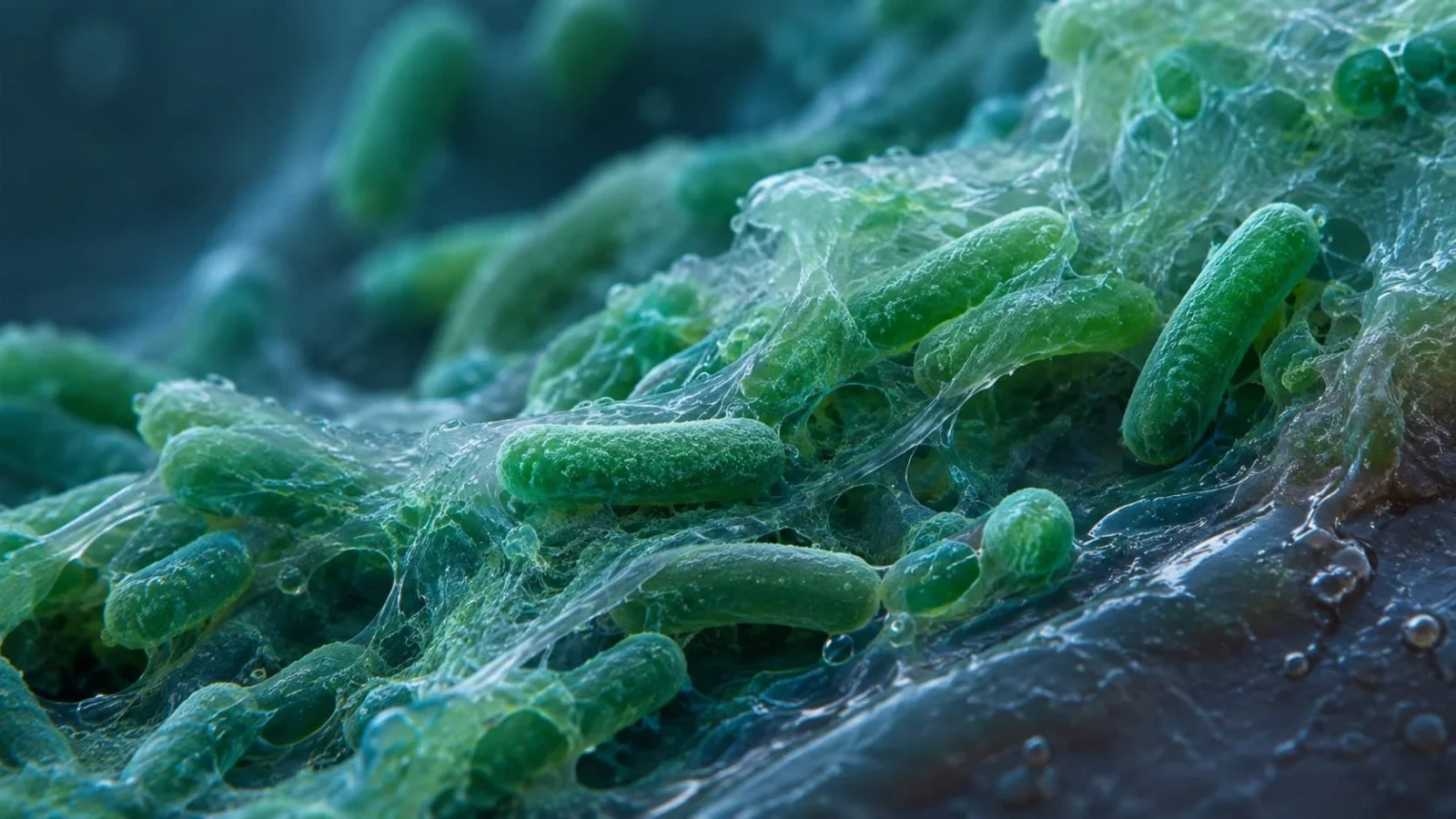
Pseudomonas aeruginosa belongs to a group of bacteria that occurs in soil and water. The US Centers for Disease Control and Prevention identifies it as the Pseudomonas species most commonly involved in human infection (CDC, 2025). It is Gram-negative, a description of its cell-envelope structure rather than a judgement about how severe any particular infection will become (Qin et al., 2022).
Environmental survival is part of its biology. Letizia and colleagues (2025) describe metabolic flexibility, genomic variation and differences in bacterial behaviour that allow the organism to occupy multiple habitats. The same species can occur in the environment without causing illness and can also infect vulnerable hosts. Its appearance in a sample therefore needs a clinical setting before it can be interpreted as disease (Letizia et al., 2025).
Environmental reservoirs
Water-associated sites matter in healthcare environments. Letizia and colleagues (2025) identify sink surfaces, drains, shower heads and tap water as possible locations or transmission routes. CDC (2025) records the organism in environmental soil and water. Neither finding means that exposure necessarily ends in infection.
Contaminated equipment adds another route from a reservoir to a patient. Water used around medical care and moist device surfaces create exposure opportunities identified in the scientific literature (Letizia et al., 2025). The relevant biological event is contact between the organism and a susceptible body site. The bacterium's location alone cannot indicate whether that contact has occurred.
Opportunistic infection and colonisation
Host vulnerability influences infection. In the review by Qin and colleagues (2022), affected groups included people with cystic fibrosis, burns, immune deficiency, cancer and severe illness requiring ventilation. Letizia and colleagues (2025) also identify patients with underlying immune deficiencies among those experiencing acute and chronic infections.
Colonisation can occur without illness. Chronic carriage and a clinically damaging infection are therefore distinct observations, although the same bacterial species can be involved in both. Ciofu and Tolker-Nielsen (2019) describe persistent bacterial communities in chronic respiratory and urinary tract settings. An isolate from one of these settings provides microbiological information, while the illness itself must be interpreted in its clinical context.
Which infections and symptoms Pseudomonas aeruginosa causes
Symptoms vary with the organ. CDC (2025) lists bloodstream infection, pneumonia, urinary tract infection and infection after surgery as recognised presentations. A detailed account by Letizia and colleagues (2025) adds eye and soft-tissue infections, including cases associated with contact lenses and wounds. Symptoms vary by infection site.
Respiratory and bloodstream infections differ. Disease can also persist in a previously affected organ. Ciofu and Tolker-Nielsen (2019) identify chronic pulmonary infection in cystic fibrosis and chronic obstructive lung disease, alongside catheter-associated urinary infection and chronic wounds.
Lung and bloodstream infections
Pseudomonas aeruginosa causes pneumonia in healthcare settings, including among patients receiving mechanical ventilation. The organism is also associated with chronic lung infection in people with cystic fibrosis or chronic obstructive lung disease (Ciofu and Tolker-Nielsen, 2019). A chronic respiratory infection can involve biofilm growth that complicates bacterial clearance.
Chest imaging can show lung abnormalities, but it cannot identify Pseudomonas aeruginosa on its own. A related article on radiological diagnosis of chest diseases explains why imaging findings must be interpreted alongside other clinical evidence. Identifying Pseudomonas requires microbiological testing, with results considered in the context of the patient's illness (CDC, 2025).
Bloodstream infection is invasive. The bacterium may be isolated from blood in patients with serious illness, and the CDC (2025) lists blood infection separately from lung and urinary disease. The exact significance of an isolate depends on its collection site and the condition of the patient.
Urinary tract, wounds and eye infections
Patients with long-term bladder catheters can experience chronic urinary infection involving this species. Ciofu and Tolker-Nielsen (2019) identify catheter-associated disease alongside infections of chronic wounds. Wound infection is also relevant after surgery and burns, settings in which damaged skin provides a route into tissue (CDC, 2025).
Eye exposures have specific routes. Letizia and colleagues (2025) describe keratitis linked with contaminated contact lenses, eye drops and ocular procedures. Keratitis affects the cornea. The history of an eye exposure cannot, by itself, reveal which organism is responsible.
An outbreak linked with artificial tears demonstrates that eye-related products can carry bacteria to a susceptible surface. CDC (2023) identified 81 patients in 18 US states with an extensively drug-resistant strain as of 15 May 2023. This was a defined outbreak involving a particular strain and exposure pathway. It does not estimate the ordinary frequency of Pseudomonas eye infections.
How Pseudomonas aeruginosa spreads and who is at risk
Transmission occurs through contact with contaminated equipment or surfaces, environmental water or soil, and hands involved in person-to-person contact (CDC, 2025). Exposure does not guarantee infection. Risk is highest in hospital patients (CDC, 2025).
Letizia and colleagues (2025) describe bacteria on hospital water fixtures as well as contaminated ventilators and catheters. The organism can pass through environments used by many patients. A reservoir does not prove transmission.
Healthcare equipment and water
Medical devices connect vulnerable body sites. CDC (2025) identifies patients receiving ventilation or carrying catheters among the highest-risk hospital groups. Equipment contamination and hand contact are among the transmission routes described in the same guidance.
Hospital water can harbour bacteria. Letizia and colleagues (2025) mention sinks, drains and shower heads in their description of environmental occurrence and transmission. Bacteria on a wet surface are a microbiological observation, but attribution of an infection to that site requires evidence about exposure and bacterial identity.
Contaminated artificial tears caused an outbreak. CDC (2023) identified 81 patients across 18 states with a rare extensively drug-resistant strain. Its defining feature was a linked outbreak strain, rather than a claim that every eye-care product is contaminated.
Vulnerable patients and chronic disease
Open wounds increase vulnerability. The CDC also specifies ventilation and catheter use as risk factors in healthcare settings (CDC, 2025). Burns and surgical wounds expose tissue to infection.
Chronic airways permit persistent carriage. The review by Qin and colleagues (2022) identifies cystic fibrosis, chronic obstructive pulmonary disorder, immune deficiency and cancer among the clinical contexts in which infection develops. Ciofu and Tolker-Nielsen (2019) describe chronic pulmonary infection in patients with underlying lung disease.
Carriage and invasive disease differ. The account of how staph infections reach the bloodstream concerns a separate organism, with its own reservoirs and evidence. For Pseudomonas, patient vulnerability and the location of the isolate remain central to deciding what microbiological detection means (Letizia et al., 2025).
How Pseudomonas aeruginosa establishes persistent infections
Toxins can damage host tissues. Qin and colleagues (2022) describe secretion systems that deliver toxins into host cells and alter cellular functions involved in defence. Ciofu and Tolker-Nielsen (2019) identify aggregates enclosed within a self-produced matrix as a basis for difficult-to-eradicate chronic infection.
Persistence has multiple mechanisms. A strain's toxins influence its interaction with host tissues, while matrix production changes the local environment of bacterial cells. Laboratory measurements cannot directly quantify clinical recovery.
Toxins and tissue damage
The type three secretion system is a bacterial apparatus that transfers effector proteins into host cells. Qin and colleagues (2022) identify ExoU, ExoT, ExoS and ExoY among the proteins involved and describe effects on processes such as phagocytosis and bacterial clearance. Phagocytosis is the uptake of particles and microbes by immune cells. A laboratory mechanism of immune interference does not tell how frequently a given clinical strain will produce a severe infection.
The effects of secretion systems are one part of pathogenesis. In the 2022 review, Qin and colleagues examine bacterial virulence alongside the host immune response, including its capacity to recognise and respond to infection. The resulting clinical course depends on the bacterium and the host. A toxin's presence in the organism's repertoire does not make every infection equivalent.
Biofilms and bacterial signalling
Biofilms contain attached bacterial communities. Ciofu and Tolker-Nielsen (2019) describe a matrix containing polysaccharides, proteins, extracellular DNA and lipids, with composition varying by strain and growth conditions. Cells within that structure can experience different local conditions from isolated bacteria growing freely in liquid culture.
The molecular control of the matrix has been tested directly. Carey and colleagues (2024) studied Pseudomonas aeruginosa PAO1 cultures and identified LasR and RhlR as regulators of the matrix polysaccharide Psl. Their experiments found distinct actions: LasR activated transcription of Psl biosynthetic genes, while RhlR affected translation of the corresponding transcripts (Carey et al., 2024).
Quorum sensing responds to population density. The Carey laboratory experiments concerned a defined strain under laboratory culture conditions. They establish a mechanism of Psl production without measuring whether a quorum-sensing drug improves the survival of infected patients.
How Pseudomonas aeruginosa infections are diagnosed
Diagnosis begins with sampling. The CDC (2025) describes laboratory testing of clinical specimens and antimicrobial susceptibility testing when Pseudomonas infection is suspected. Specimens provide organism-level evidence. The presence of bacteria alone cannot establish the extent of tissue damage or whether a patient is symptomatic.
Tests have distinct purposes. Identification establishes which organism has been recovered; susceptibility testing examines its response to particular antimicrobial agents. The two results require interpretation alongside the suspected source of infection and the clinical state of the patient. Resistant strains may require testing beyond a basic antibiotic panel (Tamma et al., 2026).
Culture and organism identification
The sample location matters. CDC (2025) identifies laboratory examination of specimens as part of determining Pseudomonas infection. A respiratory sample and a blood sample come from different compartments and therefore answer different clinical questions. The location of the specimen is part of its interpretation.
Keratitis may require ocular sampling. Letizia and colleagues (2025) identify eye infection after exposure to contaminated contact lenses or eye drops as a recognised presentation. Isolating bacteria from an exposed surface is microbiological evidence, while determining the clinical significance involves the patient's findings.
Antimicrobial susceptibility testing
Susceptibility is measured in the laboratory. CDC (2025) states that interpretation uses antimicrobial susceptibility breakpoints. A breakpoint is a threshold used to classify susceptibility test results. A laboratory result does not describe a biofilm.
Guidance issued by Tamma and colleagues (2026) recognises variable activity among agents tested against difficult-to-treat strains. The guidance discusses additional laboratory susceptibility testing for isolates with that phenotype (Tamma et al., 2026). The result concerns the particular isolate. It cannot establish that every strain in the species has the same susceptibility profile.
Why Pseudomonas aeruginosa resists antibiotics and complicates treatment
Resistance has several biochemical routes. Tamma and colleagues (2026) list outer-membrane porins, efflux pumps, enzyme changes and target alterations among the mechanisms found in resistant Pseudomonas. Different strains can arrive at a similar test result through different combinations of these mechanisms.
Biofilm tolerance is a second complication. Ciofu and Tolker-Nielsen (2019) distinguish the protective physiological and physical circumstances of a biofilm from resistance caused by genetic mutations. A biofilm-grown population may survive exposure even when the same organism is susceptible in another growth state. The mechanisms of survival and inherited resistance therefore require separate investigation.
Intrinsic and acquired resistance
Intrinsic resistance reflects features of the organism that impede antimicrobial activity without requiring a newly acquired resistance gene. The 2026 infectious-disease guidance identifies reduced entry through OprD, increased drug export through efflux pumps and enzymes that affect antibiotic activity among mechanisms associated with resistant isolates (Tamma et al., 2026). Acquired mutations alter susceptibility.
Wardell and colleagues (2019) used experimental evolution to examine genetic changes associated with antibiotic exposure in Pseudomonas aeruginosa. They then examined corresponding genes in 558 isolates from patients with chronic lung disease and 172 environmental isolates. The clinical isolates frequently contained predicted functional changes in genes identified during laboratory evolution, while environmental isolates showed a different pattern.
The experiment selected resistant mutants. Wardell and colleagues (2019) evolved a reference strain under antimicrobial pressure, then investigated the resulting mutations. It was an experiment on bacterial evolution, not a trial of treatment outcomes in infected people. The comparison with clinical isolates supported the relevance of some genetic pathways to chronic infection without proving how an individual patient would respond.
Biofilm tolerance and treatment research
Ciofu and Tolker-Nielsen (2019) identify physical, physiological and genetic determinants of biofilm tolerance. The self-produced matrix provides a structure for bacterial aggregates, and conditions can differ within the population. A susceptibility result measured under standard laboratory conditions does not capture every feature of such a community.
Matrix production responds to signalling. Carey and colleagues (2024) found that the quorum-sensing regulators LasR and RhlR controlled Psl production through different stages of gene expression in laboratory cultures. Their results describe a molecular target for investigation. They do not establish a clinical benefit from disrupting the signalling pathway.
Treatment research also examines antimicrobial agents capable of acting against resistant isolates. Tamma and colleagues (2026) discuss agents with potential activity in difficult-to-treat infection and identify a lack of trials directly comparing several newer treatments. Laboratory activity and patient outcomes remain separate questions, since antibiotic efficacy depends on the infection site and the clinical population examined.
Evidence from resistance studies
Wardell and colleagues (2019) compared laboratory-evolved mutants with isolates collected from chronic lung disease and environmental settings. Their genomic analysis covered 558 clinical and 172 environmental isolates, while the experimental arm sequenced mutants selected under different antibiotics. The study measured genetic alterations and antimicrobial tolerance, not mortality or recovery in treated patients.
The following studies answer different questions about this bacterium and its treatment. Their endpoints are not interchangeable.
Study | Evidence and setting | Reported result | Boundary |
Wardell et al., 2019 | Experimental evolution; 558 clinical and 172 environmental isolates | Mutated genes from laboratory evolution were also found in clinical isolates | Genomics, not clinical treatment effectiveness |
Carey et al., 2024 | Laboratory PAO1 cultures | LasR regulated transcription and RhlR regulated translation of Psl genes | Molecular experiment, not patient trial |
CDC, 2023 | Artificial-tears outbreak | 81 patients in 18 US states | Defined outbreak, not population incidence |
Kollef et al., 2019 | Randomised nosocomial-pneumonia trial; 726 patients | Ceftolozane-tazobactam met non-inferiority against meropenem | Trial included Gram-negative pneumonia, not solely difficult-to-treat Pseudomonas |
Resistance research spans cells and patients. Elfadadny and colleagues (2024) review resistance across several antimicrobial classes, while Tamma and colleagues (2026) distinguish multidrug resistance from the narrower difficult-to-treat phenotype. The classifications describe susceptibility, not disease severity.
What is proven about Pseudomonas aeruginosa treatment and what is not
Antibiotics are used to treat Pseudomonas aeruginosa infection, but resistant isolates and biofilm-associated persistence restrict the options (CDC, 2025; Ciofu and Tolker-Nielsen, 2019). Treatment evidence depends on the organism's susceptibility, the body site involved and the patients studied. The evidence is strongest when these conditions are stated explicitly.
Resistance mechanisms and biofilm tolerance explain bacterial survival, while clinical trials establish treatment outcomes only for the populations and infections they actually studied.
Kollef and colleagues (2019) enrolled 726 pneumonia patients in a randomised comparison of ceftolozane-tazobactam and meropenem. The investigators reported non-inferiority for mortality and clinical response in the enrolled pneumonia population. These patients were not a trial population defined exclusively by difficult-to-treat Pseudomonas infection.
More recent specialist guidance reviews the evidence for drug-resistant Gram-negative infection. Tamma and colleagues (2026) report that direct trials comparing some newer agents for difficult-to-treat Pseudomonas have not been conducted. Observational studies provide information about outcomes, but their results cannot establish comparative treatment effects with the same control over confounding as random allocation.
Resistance can emerge during treatment. Tamma and colleagues (2026) describe mutational and adaptive changes in gene expression during treatment. The same review identifies several mechanisms affecting entry, export and drug activity, making a resistance label a summary of an isolate's measured phenotype rather than a complete explanation of its genes.
Biofilm studies address another boundary. Ciofu and Tolker-Nielsen (2019) describe aggregate growth with antibiotic tolerance, while Carey and colleagues (2024) demonstrate regulation of matrix production in laboratory cultures. Neither type of experiment directly measures whether inhibiting that pathway improves recovery in patients with established chronic infections. Trials restricted to verified resistant isolates, defined infection sites and clinical endpoints would address that remaining question.
Frequently asked questions
Can Pseudomonas aeruginosa live on healthy skin?
Pseudomonas aeruginosa is an environmental opportunistic bacterium, and detection of the organism does not automatically establish disease. The species occupies diverse habitats and may be present without producing an acute infection (Letizia et al., 2025). Its clinical significance depends on the body site, the host and evidence of tissue involvement.
Is Pseudomonas aeruginosa contagious between people?
Transmission between people is possible. CDC (2025) identifies contaminated hands as one route, along with contaminated equipment, surfaces, soil and water. Contact with bacteria does not necessarily lead to infection. Patients receiving ventilation, carrying catheters or having open surgical wounds are among those at greatest risk in healthcare settings (CDC, 2025).
Can Pseudomonas aeruginosa cause an ear infection?
Yes. Pseudomonas aeruginosa can cause otitis externa, an infection of the outer ear canal commonly called swimmer’s ear. Exposure to contaminated water is one possible route. However, ear pain does not identify the responsible bacterium, and finding Pseudomonas in nearby water does not prove it caused an individual infection.
What is the difference between colonisation and infection?
Colonisation can be symptom-free. Infection refers to a process involving host tissues and illness. Letizia and colleagues (2025) describe the organism as both an environmental inhabitant and an opportunistic pathogen. A laboratory isolate must therefore be interpreted with the patient's condition and the specimen source.
Are all Pseudomonas aeruginosa strains resistant to antibiotics?
No. The CDC (2025) says that some types resist nearly all antibiotics, which does not describe every isolate of the species. Susceptibility testing establishes the response of a particular strain to tested drugs. Tamma and colleagues (2026) describe different resistance mechanisms and variable activity of antimicrobial agents against difficult-to-treat isolates.
Sources
- Centers for Disease Control and Prevention. About Pseudomonas aeruginosa. 12 June 2025. https://www.cdc.gov/pseudomonas-aeruginosa/about/index.html
- Letizia M, Diggle SP, Whiteley M. Pseudomonas aeruginosa: ecology, evolution, pathogenesis and antimicrobial susceptibility. Nature Reviews Microbiology. 2025;23(11):701–717. DOI 10.1038/s41579-025-01193-8.
- Qin S, Xiao W, Zhou C, et al. Pseudomonas aeruginosa: pathogenesis, virulence factors, antibiotic resistance, interaction with host, technology advances and emerging therapeutics. Signal Transduction and Targeted Therapy. 2022;7:199. DOI 10.1038/s41392-022-01056-1.
- Ciofu O, Tolker-Nielsen T. Tolerance and Resistance of Pseudomonas aeruginosa Biofilms to Antimicrobial Agents: How P. aeruginosa Can Escape Antibiotics. Frontiers in Microbiology. 2019;10:913. DOI 10.3389/fmicb.2019.00913.
- Carey JN, Lamont S, Wozniak DJ, Dandekar AA, Parsek MR. Quorum sensing regulation of Psl polysaccharide production by Pseudomonas aeruginosa. Journal of Bacteriology. 2024;206(12):e00312-24. DOI 10.1128/jb.00312-24.
- Wardell SJT, Rehman A, Martin LW, et al. A large-scale whole-genome comparison shows that experimental evolution in response to antibiotics predicts changes in naturally evolved clinical Pseudomonas aeruginosa. Antimicrobial Agents and Chemotherapy. 2019;63(12):e01619-19. DOI 10.1128/AAC.01619-19.
- Elfadadny A, Ragab RF, AlHarbi M, et al. Antimicrobial resistance of Pseudomonas aeruginosa: navigating clinical impacts, current resistance trends, and innovations in breaking therapies. Frontiers in Microbiology. 2024;15:1374466. DOI 10.3389/fmicb.2024.1374466.
- Tamma PD, Bonomo RA, Heil EL, et al. Infectious Diseases Society of America 2026 Guidance on the Treatment of Antimicrobial-Resistant Gram-Negative Infections. Clinical Infectious Diseases. 2026. DOI 10.1093/cid/ciag481.
- Centers for Disease Control and Prevention. Outbreak of Extensively Drug-resistant Pseudomonas aeruginosa Associated with Artificial Tears. 15 May 2023. https://archive.cdc.gov/www_cdc_gov/hai/outbreaks/crpa-artificial-tears.html
- Kollef MH, Nováček M, Kivistik Ü, et al. Ceftolozane-tazobactam versus meropenem for treatment of nosocomial pneumonia (ASPECT-NP): a randomised, controlled, double-blind, phase 3, non-inferiority trial. The Lancet Infectious Diseases. 2019;19(12):1299–1311. DOI 10.1016/S1473-3099(19)30403-7.

Elias Norford — author,editor
Elias trained in biomedical science before completing postgraduate study in epidemiology, where he developed a particular interest in study design, population risk, disease surveillance and the interpretation of health data. He later moved into non-clinical re...
This article is for general information and is not medical advice. It was reviewed for accuracy by a qualified clinician; decisions about your health should be made with your own doctor.
Related
How staph infections start on the skin and reach the blood
Chest disease diagnosis: radiologic signs and differentials

How RSV spreads: lessons from a 1981 transmission study

Swimmer's ear and why water in the ear canal leads to infection
How the Epstein-Barr virus causes mono and stays in the body for life
How HPV causes plantar warts on the soles of the feet

Common cold symptoms and why rhinoviruses cause them