Vitamin C benefits and the common cold myth that won't go away
The best-supported vitamin C benefits concern collagen, antioxidant protection and iron uptake, while taking it every day does not lower the chance of catching a cold for most people (IOM, 2000; Hemilä and Chalker, 2013). Among 10,708 people studied in everyday settings, the risk ratio for getting a cold was 0.97 (Hemilä and Chalker, 2013). The picture changes for people under brief, extreme physical strain and for the length of colds.
The article starts with what the vitamin does and how much of it the body needs. It then traces where the cold claim came from and sets out what the trials found for prevention, treatment and special groups, before turning to high intakes and open questions. Sources include European and US reference reports, a Cochrane review, later meta-analyses, cohort studies and EU legislation.

Evidence last checked 18 Nov 2026 · 10 min
Vitamin C benefits in the body
Vitamin C dissolves in water, acts as an antioxidant and helps enzymes that build collagen, carnitine and several neurotransmitters (IOM, 2000). European scientists add that it takes part in turning cholesterol into bile acids (EFSA, 2017).
Its electrons let it neutralise oxidants formed in normal metabolism or from pollutants such as cigarette smoke (Carr and Maggini, 2017). The same review describes support for both innate and adaptive immunity (Carr and Maggini, 2017). Low levels go with weaker immune defences, and infections in turn drain the body's supply (Carr and Maggini, 2017). One author works for Bayer, a multivitamin maker, and the other has received Bayer funding in a key-opinion-leader role (Carr and Maggini, 2017).
EU law lists the health claims that food labels may use for vitamin C. They include normal collagen formation for blood vessels and normal immune function (European Commission, 2012). None mentions colds.
Iron is a clearer case. Adding the vitamin to a meal helps the gut take up non-haem iron (IOM, 2000). Over long periods, though, extra vitamin C in meals did not measurably improve the body's iron stores (IOM, 2000). Low iron and its effects are covered in iron deficiency symptoms.
Other health outcomes have been studied too. An umbrella review pooling 76 meta-analyses linked each extra 50 to 100 mg a day with fewer deaths from any cause, less cardiovascular disease and lower rates of several cancers (Xu et al., 2022).
How much vitamin C the body needs
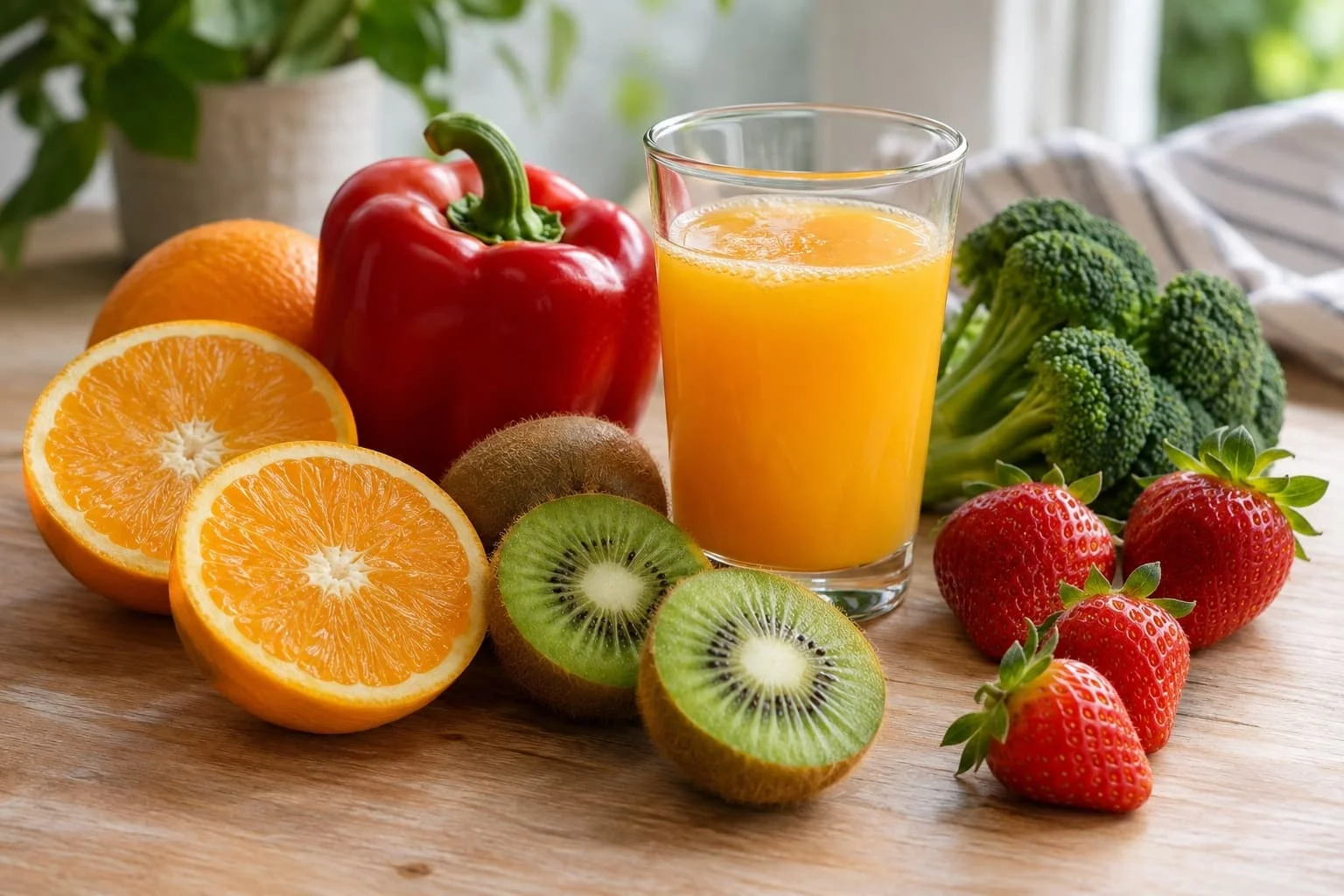
Reference bodies set requirements from the intake that keeps blood and tissue levels steady while replacing what the body loses each day, and the resulting figures describe maintenance needs for healthy people (EFSA, 2017; IOM, 2000). In ordinary diets, fruit and vegetables provide about 90% of the vitamin (Gandhi et al., 2023).
Reference intakes in Europe and the US
In Europe, men need an average of about 90 mg a day to replace what they lose daily (EFSA, 2017). On that basis EFSA set population reference intakes of 110 mg a day for men and 95 mg for women (EFSA, 2017). Pregnancy adds 10 mg a day (EFSA, 2017).
The US and Canadian figures are lower. Their allowance is 90 mg a day for adult men, and 75 mg for adult women, chosen to keep white blood cells nearly saturated (IOM, 2000). Smokers are given an extra 35 mg a day because smoking speeds up turnover (IOM, 2000).
Far less is needed to ward off scurvy. About 10 mg a day prevents it, and about 80% of a 100 mg intake is absorbed (EFSA, 2017). Most comes from fruit, vegetables, juices and potatoes, and average European intakes from food alone range from 65 to 138 mg a day (EFSA, 2017).
In North America, median adult intakes were estimated at 102 mg a day for Americans and 72 mg for Canadians at the time the US panel reported (IOM, 2000). How storage and processing affect the vitamin in vegetables is described in vitamin C in peas.
Who runs short of vitamin C
In a US survey of 7,277 people in 2003 and 2004, 7.1% had blood levels low enough to count as deficient (Schleicher et al., 2009). That share was about 13% in the earlier survey of 1988 to 1994 (Schleicher et al., 2009). Smokers had blood levels about a third lower than non-smokers (Schleicher et al., 2009).
Smokers and people on low incomes were among those at higher risk (Schleicher et al., 2009). In wealthy countries, full scurvy is now seen mainly in older or malnourished people and is linked to alcohol misuse and poor diets (Gandhi et al., 2023). Because vitamin C is sensitive to heat, the way food is cooked also matters (Gandhi et al., 2023). A WHO technical document from 1999 reported scurvy in several refugee populations that relied wholly on food aid (WHO, 1999).
How the belief about colds began
The belief spread widely during the 1970s, once the chemist and Nobel prize winner Linus Pauling read earlier placebo trials as proof that the vitamin could ward off and soften colds (Hemilä and Chalker, 2013). His book on the subject appeared in 1970 (Hemilä, 2017). A year later he combined the results of the only four placebo trials published by then (Hemilä and Chalker, 2023).
Pauling judged the vitamin by what he called integrated morbidity, the combined burden of how often colds strike and how long they last (Hemilä, 2017). His claim set off a wave of research: between 1972 and 1979, 29 trials with placebo groups enrolled 8,409 people in total (Hemilä, 2017).
A US government trial cooled the debate. Among NIH employees, three hundred and eleven people swallowed vitamin C or dummy capsules thrice daily over nine months, and one hundred and ninety finished (Karlowski et al., 1975). In their reading the vitamin made at best a small difference to how long and how badly colds lasted, perhaps because participants could tell which capsules they had (Karlowski et al., 1975).
Later critics disputed that verdict. Hemilä (2017) notes that 42% of cold episodes were dropped from the subgroup analysis behind its conclusion. He ties the abrupt fall in interest to three 1975 papers, from Chalmers, from Karlowski's team and from Dykes and Meier. Over the 30 years to 2014, just 11 such trials appeared, with 538 people between them (Hemilä, 2017).
The US panel that set the American reference values later observed that much of the cold research had been stimulated by Pauling's views (IOM, 2000). The panel summarised earlier reviews as finding that very large doses do not change how often colds occur but give a moderate benefit for duration and severity in some groups (IOM, 2000).
Evidence from controlled trials on colds
Upwards of 200 viruses can produce the symptoms of a cold (Hemilä and Chalker, 2013). The Cochrane analysis dropped studies giving under 0.2 g a day and any without a dummy pill. Most remaining studies were randomised and double-blind, and dropping the others left the conclusions unchanged.
Daily supplements and new colds
Twenty-nine comparisons, together involving 11,306 people, tested whether daily vitamin C keeps colds from starting (Hemilä and Chalker, 2013). In ordinary community settings, with 10,708 people, the risk ratio came out at 0.97, the interval running from 0.94 to 1.00.
Duration is a different matter. Thirty-one comparisons covering 9,745 colds showed regular vitamin C cutting the length of colds by 8% for adults and 14% for children (Hemilä and Chalker, 2013). Even so, the reviewers saw no case for routine use by the public at large.
A 2023 analysis kept only trials of 1 g a day or more in people who were healthy at the start (Hemilä and Chalker, 2023). Pooling 15 comparisons drawn from 10 trials, severity fell by 15%. Bad symptoms ended 26% sooner in the five trials that reported them, while mild symptoms lasted just as long as on placebo.
Starting supplements after symptoms appear
Beginning supplements once symptoms show has weaker backing. Seven comparisons with 3,249 colds found no reliable change in how long or how badly colds lasted (Hemilä and Chalker, 2013). Few such trials exist, and none has studied children.
Athletes and soldiers in hard training
The clearest effect appears in a narrow group. Among people doing heavy short-term exercise, vitamin C cut new colds by half (Hemilä, 2017). Five trials with 598 people, such as marathon runners, skiers and troops exercising in subarctic cold, gave a risk ratio of 0.48 (Hemilä and Chalker, 2013). Three trials involved South African marathon runners, one Canadian soldiers on winter exercise and one Swiss schoolchildren at a ski camp (Hemilä, 2017).
EU law separately permits a label claim that vitamin C helps keep immune function normal during and after hard physical exercise (European Commission, 2012). Training and diet for athletes are covered more broadly in sport nutrition.
Question | Trials and size | Result |
Daily intake, general public | 10,708 people | Risk ratio 0.97 |
Daily intake, heavy exertion | 5 trials, 598 people | Risk ratio 0.48 |
Daily intake, duration | Thirty-one comparisons, 9,745 colds | 8% shorter in adults, 14% in children |
Started after symptoms | 7 comparisons, 3,249 colds | No clear change |
Severity, high-dose trials | 15 comparisons, 10 trials | 15% lower severity |
Note: the first four rows come from Hemilä and Chalker (2013) and the last from their 2023 analysis. The percentages are relative changes in average cold length or intensity measured in trials. They do not translate into a fixed number of days saved for any individual.
What happens with very high intakes
The trials in the Cochrane review did not report adverse effects (Hemilä and Chalker, 2013). Reference bodies still drew a line.
The upper limit and digestive effects
For adults the North American upper limit is 2 g a day, chosen because larger amounts can draw water into the bowel and upset digestion (IOM, 2000). Volunteers had wind, colic and diarrhoea at 3 to 4 g a day, and the panel divided the lowest effect level of 3 g by 1.5 to reach 2 g (IOM, 2000). People receiving vitamin C from a doctor are outside the scope of this limit (IOM, 2000).
Europe has no upper limit. Such a limit marks the most a person can take every day over the long term, from all sources, without expected harm, and EFSA found too few adequate data to set one for vitamin C (EFSA, 2025).
Kidney stones
In US cohorts of 156,735 women and 40,536 men, 6,245 first kidney stones were recorded during median follow-up periods of 11.3 to 11.7 years (Ferraro et al., 2016). Men taking in 1,000 mg a day or more in total had a hazard ratio of 1.43 compared with those below 90 mg, while women showed no link (Ferraro et al., 2016).
The link followed supplements. Supplement doses of 1,000 mg a day or more carried a hazard ratio of 1.19 in men, while vitamin C from food showed no link in either sex (Ferraro et al., 2016). Ferraro and colleagues also cite a Swedish study of more than 23,000 men in which supplement users had a hazard ratio of 1.92 compared with non-users (Ferraro et al., 2016).
A proposed reason is that vitamin C can raise oxalate in urine (Ferraro et al., 2016). These are observational data, and residual confounding cannot be ruled out (Ferraro et al., 2016). In 2000, the US panel had found no epidemiological support for a link in apparently healthy people, a view formed before the large cohort results described above were published (IOM, 2000).
What is established about vitamin C and what is not
Vitamin C has firm roles in collagen formation, antioxidant defence and iron uptake, and EU labelling rules accept them (IOM, 2000; European Commission, 2012). For colds, the evidence supports a modest shortening of colds with regular intake and little effect on how often colds start (Hemilä and Chalker, 2013).
For the general public, daily vitamin C made no meaningful difference to the chance of a cold, whereas five trials with 598 people under brief, extreme physical strain gave a risk ratio of 0.48 (Hemilä and Chalker, 2013).
Some points are settled. Neither EFSA nor the US panel used colds to set intake requirements, and the US panel judged the cold data too inconsistent for that purpose (EFSA, 2017; IOM, 2000). Daily use made colds shorter, a result the handful of studies begun at the first symptoms could not reproduce (Hemilä and Chalker, 2013).
Other points are open. The best dose and the largest possible benefit for colds are unknown (Hemilä and Chalker, 2023). The umbrella review linked supplement use with more breast cancer and kidney stones and urged caution (Xu et al., 2022).
The history matters too. Hemilä (2017) suggests that some researchers probably wanted to prove Pauling right or wrong, while others were drawn by the topic itself. He also led the Cochrane review and the later severity analysis, so his reading of that debate is one voice among several.
Industry links shape other parts of the literature. The immune review cited earlier was written by a Bayer employee and a researcher paid by the same company in a key-opinion-leader role, so its broader statements about supplements call for the same caution (Carr and Maggini, 2017). EFSA based its intake values on vitamin balance and left colds and chronic disease out of the calculation (EFSA, 2017).
Frequently asked questions
Can food alone supply enough vitamin C?
It can. Country averages from food alone range from 65 to 138 mg a day across Europe, so some populations eat less than the reference values (EFSA, 2017). Fruit, vegetables, their juices and potatoes are the main sources (EFSA, 2017). About 90% of dietary vitamin C comes from fruit and vegetables (Gandhi et al., 2023).
Do smokers need more vitamin C?
US reference values say so. Smoking raises oxidative stress and speeds up vitamin C turnover, so the US panel adds 35 mg a day to the requirement for smokers (IOM, 2000). In a national survey, adult smokers had blood vitamin C levels about one third lower than non-smokers (Schleicher et al., 2009).
Does vitamin C help the body absorb iron?
Yes, for non-haem iron eaten in the same meal. Vitamin C helps the gut absorb this form of iron (IOM, 2000). In studies lasting longer, adding the vitamin to meals did not significantly improve iron stores, so its practical effect is smaller than single-meal tests suggest (IOM, 2000).
Is vitamin C from supplements different from vitamin C in food?
The evidence on risk differs. In large US cohorts, vitamin C from food showed no link with kidney stones, while supplement intake of 1,000 mg a day or more was linked to stones in men (Ferraro et al., 2016). An umbrella review also urged caution with supplements (Xu et al., 2022).
What happens when the body lacks vitamin C?
A long shortage leads to scurvy. According to WHO, it appears two to three months after a diet without vitamin C and causes widespread bleeding (WHO, 1999). Typical signs include bleeding gums, bruising, joint pain and poor wound healing (IOM, 2000). Refugee populations relying entirely on food aid developed it in the 1990s (WHO, 1999).
Sources
- Hemilä H, Chalker E. Vitamin C for preventing and treating the common cold. Cochrane Database of Systematic Reviews. 2013;(1):CD000980. DOI 10.1002/14651858.CD000980.pub4.
- Carr AC, Maggini S. Vitamin C and immune function. Nutrients. 2017;9(11):1211. DOI 10.3390/nu9111211.
- Xu K, Peng R, Zou Y, Jiang X, Sun Q, Song C. Vitamin C intake and multiple health outcomes: an umbrella review of systematic reviews and meta-analyses. International Journal of Food Sciences and Nutrition. 2022;73(5):588–599. DOI 10.1080/09637486.2022.2048359.
- Hemilä H. Vitamin C and infections. Nutrients. 2017;9(4):339. DOI 10.3390/nu9040339.
- Karlowski TR, Chalmers TC, Frenkel LD, Kapikian AZ, Lewis TL, Lynch JM. Ascorbic acid for the common cold: a prophylactic and therapeutic trial. JAMA. 1975;231(10):1038–1042. DOI 10.1001/jama.1975.03240220018013.
- Hemilä H, Chalker E. Vitamin C reduces the severity of common colds: a meta-analysis. BMC Public Health. 2023;23(1):2468. DOI 10.1186/s12889-023-17229-8.
- Institute of Medicine. Dietary Reference Intakes for Vitamin C, Vitamin E, Selenium, and Carotenoids. Washington, DC: The National Academies Press; 2000. DOI 10.17226/9810.
- European Food Safety Authority. Dietary Reference Values for nutrients: Summary report. EFSA Supporting Publications. 2017;14(12):e15121. DOI 10.2903/sp.efsa.2017.e15121.
- European Food Safety Authority. Overview on Tolerable Upper Intake Levels as derived by the Scientific Committee on Food and the EFSA Panel on Dietetic Products, Nutrition and Allergies. Version 11, August 2025. https://efsa.europa.eu/sites/default/files/assets/UL_Summary_tables.pdf
- European Commission. Commission Regulation (EU) No 432/2012 of 16 May 2012 establishing a list of permitted health claims made on foods, other than those referring to the reduction of disease risk and to children's development and health. Official Journal of the European Union. 2012;L 136:1–40.
- Schleicher RL, Carroll MD, Ford ES, Lacher DA. Serum vitamin C and the prevalence of vitamin C deficiency in the United States: 2003–2004 National Health and Nutrition Examination Survey (NHANES). American Journal of Clinical Nutrition. 2009;90(5):1252–1263. DOI 10.3945/ajcn.2008.27016.
- Gandhi M, Elfeky O, Ertugrul H, Chela HK, Daglilar E. Scurvy: rediscovering a forgotten disease. Diseases. 2023;11(2):78. DOI 10.3390/diseases11020078.
- World Health Organization. Scurvy and its prevention and control in major emergencies. WHO/NHD/99.11. Geneva: World Health Organization; 1999. https://who.int/publications/i/item/WHO-NHD-99.11
- Ferraro PM, Curhan GC, Gambaro G, Taylor EN. Total, dietary, and supplemental vitamin C intake and risk of incident kidney stones. American Journal of Kidney Diseases. 2016;67(3):400–407. DOI 10.1053/j.ajkd.2015.09.005.

Elias R. Westbrook — author
Elias R. Westbrook is academic background in human nutrition and nutritional sciences, with a focus on food composition, nutrient intake, dietary patterns, and the relationship between foods and nutritional health. For Cabdirect, this persona is intended to co...
This article is for general information and is not medical advice. It was reviewed for accuracy by a qualified clinician; decisions about your health should be made with your own doctor.
Related

Vitamin C in Peas: Effects of Shipping, Freezing and Canning
Iron deficiency and how it affects your health
Sport Nutrition: Energy, Fuel and Athletic Performance
How much protein the body really needs each day
How omega-3 fatty acids EPA, DHA and ALA differ and why it matters
Magnesium for sleep and what the research really shows
Vitamin K and why your body needs it for healthy bones