Vitamin C in Peas: Effects of Shipping, Freezing and Canning
Fresh peas can begin losing vitamin C before they are cooked or processed, and this problem was already being investigated experimentally in the 1930s. In their 1935 study, C. R. Fellers and W. Stepat compared peas subjected to shipping, cooking, freezing, defrosting and canning. Their results showed that the amount of ascorbic acid reaching the consumer depended strongly on what happened between harvest and consumption.
The researchers examined two principal pea varieties and used both biological and chemical approaches to assess vitamin C. Freshly picked immature peas contained the highest reported concentration, while market handling, preservation and especially prolonged defrosting were associated with progressively lower values.

Evidence last checked 9 Jun 2026 · 10 min
Why researchers compared fresh, frozen and canned peas
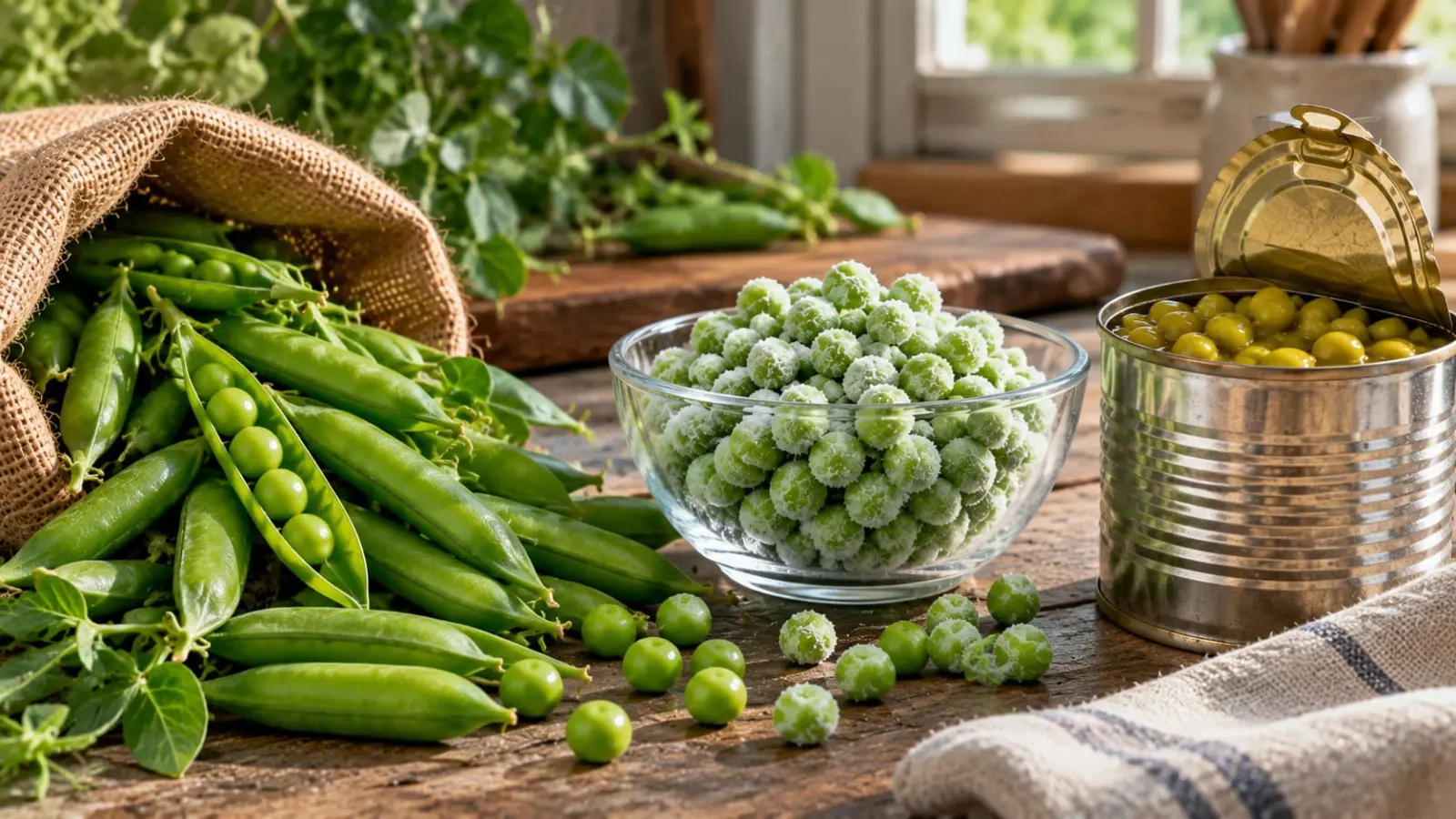
The study addressed a practical food-quality problem: freshly harvested vegetables do not necessarily reach consumers immediately. Peas may spend time in shipment or storage, undergo cooking, be frozen for later use or be preserved by canning. Each stage can alter a water-soluble and oxidation-sensitive nutrient such as vitamin C.
Fellers and Stepat therefore compared peas under several conditions rather than examining preservation as a single step. Their study included market peas, cooked market peas, cooked frozen peas and reheated canned peas. Freshly picked immature peas provided an important reference for understanding how much ascorbic acid could be present before post-harvest handling.
How the two pea varieties were used in the comparison
The principal varieties were Thomas Laxton and Alderman Telephone, grown in southern New Jersey and central New York State. The study found no marked difference in ascorbic acid content between the two pea varieties. This meant that the reported changes could be discussed mainly in relation to handling and processing rather than a large difference between these two varieties.
The historical experiment also approached vitamin C in two ways. It reported protective doses determined with guinea pigs by Sherman's method and chemical measurements obtained by 2:6-dichlorphenolindophenol titration. The chemical results provide a numerical comparison across the preservation conditions examined by Fellers and Stepat in 1935.
The two methods addressed related but distinct questions. The biological test assessed the amount of a pea preparation needed to protect guinea pigs under the test conditions, whereas the chemical method estimated ascorbic acid concentration in the material examined. Fellers and Stepat (1935) could therefore compare an experimentally observed protective effect with a measured chemical constituent. Agreement in the broad ordering of samples strengthens the historical comparison, but it does not make a protective dose equivalent to a modern dietary serving or a clinical measure of human vitamin C status. This distinction matters when reading historical nutrition research because experimental endpoints, food portions and laboratory measurements describe different aspects of the same material.
Table 1. Vitamin C content of peas under different conditions (Fellers and Stepat, 1935)
Pea condition | Ascorbic acid reported |
Freshly picked immature peas | 0.354 mg/g |
Market peas, 1–2 days old | 0.174 mg/g |
Cooked market peas | 0.137 mg/g |
Cooked frozen peas | 0.109 mg/g |
Reheated canned peas | 0.057 mg/g |
Frozen peas defrosted for several hours | 0.041 mg/g |
These figures are measurements from Fellers and Stepat (1935), rather than universal nutrient values for modern pea products. Variety, maturity, post-harvest time, processing technology and storage conditions can all influence vitamin C retention. The values are expressed per gram of the sampled product, which makes it possible to compare the reported conditions without implying that every serving supplies the same amount of vitamin C. Differences in moisture content and preparation can also complicate comparisons across foods. The study is most informative when its measurements are read as observations from specific experimental samples, not as a timeless food-composition chart.
What shipping and storage did to vitamin C levels
The study identified substantial vitamin C losses during the period before preservation or cooking. Fellers and Stepat (1935) found that shipping or storing peas in the pod for one or more days substantially reduced their ascorbic acid content. Market peas that were one to two days old contained 0.174 mg/g by the chemical method.
Freshly picked immature peas, by comparison, had a reported mean of 0.354 mg/g. These measurements illustrate why a simple contrast between fresh and processed food can be misleading when the time elapsed since harvest is ignored. A vegetable sold as fresh may already have undergone nutrient changes during distribution. In the 1935 comparison, the difference between freshly picked immature peas and market peas shows why elapsed time deserves attention alongside processing method. This does not imply that every shipment produces an identical loss: temperature, duration and initial quality can change the outcome. Nor does it establish a fixed rate of decline for peas stored under different conditions. The useful conclusion is that a product’s label describes only part of its journey from field to plate.
The comparison between freshly picked peas and market peas also raises a timing question. Fellers and Stepat (1935) examined products at different points between harvest and use, so the observed concentrations reflect a sequence of handling conditions rather than a single isolated event. A lower value in a market sample cannot by itself identify the contribution of transport, elapsed time, temperature and subsequent cooking. It does, however, demonstrate why a vegetable described as fresh may already have undergone substantial changes before it reaches a kitchen. The historical evidence is strongest as a comparison of the sampled conditions, not as a prediction for every journey from farm to retailer.
How freezing and defrosting changed the ascorbic acid picture
Cooked frozen peas contained 0.109 mg/g in the reported chemical measurements. That was below the values for freshly picked peas and cooked market peas but above the 0.057 mg/g reported for reheated canned peas. Fellers and Stepat (1935) also reported a 6–12% loss of ascorbic acid when fresh or frozen peas were cooked.
The most striking frozen-product observation concerned peas left defrosted for several hours. Their ascorbic acid concentration fell to 0.041 mg/g, documented by Fellers and Stepat (1935) as nearly a 70% loss relative to the amount present in the frozen vegetable. Frozen and defrosted were therefore not equivalent conditions in this experiment. The distinction is particularly important when historical preservation methods are compared with present-day household practices. The measurement after several hours of defrosting describes a specific handling sequence, not the vitamin C content of every thawed vegetable. It also should not be used to infer the effects of shorter thawing periods that were not separately quantified in the account. The finding instead demonstrates how a change occurring after preservation can alter the final nutrient measurement.
The defrosting result should also be interpreted in relation to the preparation sequence. In the 1935 comparison, freezing was not synonymous with complete vitamin C loss; cooked frozen peas still contained measurable ascorbic acid. The notably low value after several hours of defrosting describes a further handling condition after the food had already been preserved. It would be misleading to assign that entire difference to the initial freezing step. The finding instead illustrates how a product can change again between removal from frozen storage and consumption. Because the report compared specific treatments, it does not establish the effect of every possible defrosting duration or temperature.
What canning meant for the vitamin C comparison
In their 1935 chemical measurements, Fellers and Stepat found 0.057 mg/g of ascorbic acid in reheated canned peas. This was below the 0.109 mg/g measured in cooked frozen peas and the 0.137 mg/g measured in cooked market peas in the same investigation.
The comparison also highlights the importance of distinguishing cumulative processing losses from losses attributable to the final heating step. Canning involves a sequence of treatments before the food reaches the consumer, whereas the reheating observation concerns an additional step after preservation. These are not equivalent experimental conditions. The result does not mean that reheating itself accounted for the entire difference. Fellers and Stepat (1935) reported that reheating canned peas in an open vessel to 180°F caused very little additional loss, so the measured value reflected the cumulative history of the product rather than one isolated treatment.
Canning also combines several stages that are difficult to disentangle from a final measurement alone. The 1935 result for reheated canned peas represents the product as tested after preservation and preparation, rather than a direct measurement of every stage in the canning process. Fellers and Stepat (1935) reported little additional loss when canned peas were reheated in an open vessel to 180°F. That observation helps separate the last reheating step from the lower concentration already present in the preserved product. It does not establish that reheating never affects vitamin C under other conditions, nor does it quantify the contribution of each earlier processing stage.
Table 2. Protective dose and ascorbic acid by pea product (Fellers and Stepat, 1935)
Product | Daily protective dose | Ascorbic acid |
Market peas, 1–2 days old | 2–2.25 g | 0.174 mg/g |
Cooked market peas | 2.5–3 g | 0.137 mg/g |
Cooked frozen peas | 4.5–5.5 g | 0.109 mg/g |
Reheated canned peas | 6.5–8.5 g | 0.057 mg/g |
The two methods should not be treated as interchangeable measurements, but their ordering is informative. In Fellers and Stepat’s 1935 tests, products with lower chemically measured ascorbic acid required larger protective doses in the biological assessment.
What the study can establish about preservation losses
The strongest evidence comes from the comparisons actually reported. Freshly picked immature peas had a mean ascorbic acid concentration of 0.354 mg/g, whereas the values were lower after market handling, cooking, freezing and canning. Several hours of defrosting were associated with a particularly large decline.
The results should not be converted into a universal ranking for every fresh, frozen and canned pea product. The study was conducted in the 1930s using particular varieties, growing locations, processing conditions and analytical methods.
An additional limitation is that concentration and total intake are not identical. A value expressed as milligrams per gram describes the material tested, while the amount consumed depends on the portion and the product actually served. Fellers and Stepat (1935) provided useful comparative measurements, but those measurements should not be converted into claims about a person's vitamin C intake without the corresponding food quantity and preparation details. Likewise, differences between pea samples do not alone reveal whether one processing method is always nutritionally preferable. The most defensible conclusion is narrower: the study documented substantial variation in ascorbic acid across particular harvesting, handling and preservation conditions.
How later research places the 1935 findings in context
Later research supports the broader point that vitamin C can change at several stages between harvest and consumption. Studies of post-harvest handling, blanching, commercial processing, frozen storage and modern fresh-versus-frozen comparisons provide useful context, but they do not replace the measurements made by Fellers and Stepat.
This historical perspective remains valuable even though the study predates contemporary food processing and analytical practice. Later investigations cited in Sources address vitamin C retention in vegetables under different conditions, but they should not be treated as direct replications of the 1935 pea experiment. Their relevance lies in the recurring need to account for handling, storage and preparation when interpreting nutrient measurements. Comparing studies also requires attention to whether results concern raw or cooked foods, concentrations or retention, and laboratory samples or commercially distributed products. Without those distinctions, figures from different experiments may appear more directly comparable than their methods justify.
The historical comparison is also notable for combining a biological protective-dose test with a chemical titration method. These approaches addressed vitamin C activity and concentration from different angles, and the figures should not be converted directly from one measurement into the other. Their agreement in the general ordering of products strengthens the descriptive comparison, but it does not remove the limitations of the original design. This distinction matters because modern processing technologies and analytical methods differ from those used in 1935. The historical figures should therefore remain attached to the original experiment, while later work is used to explain why storage time, heat treatment, leaching and frozen handling continue to matter.
Table 3. Historical Findings and Later Research Context
Evidence | Focus | Interpretive value |
Fellers & Stepat, 1935 | Shipping, freezing and canning of peas | Original historical measurements |
Lathrop & Leung, 1980 | Vitamin C losses during commercial pea processing | Shows stage-specific thermal loss and leaching |
Favell, 1998 | Fresh versus frozen vegetables | Places distribution and frozen storage in a modern comparison |
Lee & Kader, 2000 | Pre- and post-harvest vitamin C factors | Explains effects of time, temperature and handling |
Rickman et al., 2007 | Fresh, frozen and canned produce review | Synthesizes preservation and storage effects |
What the experiment means for interpreting fresh and preserved peas
The study shows why labels such as fresh, frozen and canned do not by themselves describe a vegetable's entire nutritional history. Fresh peas may lose vitamin C during shipment and storage, frozen peas may undergo losses during processing or after defrosting, and canned peas have already experienced thermal preservation before household reheating begins.
Practical takeaway: The 1935 study recorded the highest ascorbic acid concentration in freshly picked immature peas, with lower values after market handling and preservation. Shipping or storage, cooking, freezing, canning and especially prolonged defrosting could all influence the vitamin C reaching the consumer. The historical figures should be interpreted within the original experimental conditions rather than applied directly to modern pea products.
Frequently asked questions
Do fresh peas contain more vitamin C than frozen or canned peas?
In Fellers and Stepat’s 1935 experiment, freshly picked immature peas had the highest measured ascorbic acid concentration, averaging 0.354 mg/g. Market peas one to two days old contained 0.174 mg/g. These historical measurements show that the freshness of produce at harvest and the time spent in distribution both matter when comparing products.
Did freezing destroy all of the vitamin C in peas?
No. Fellers and Stepat (1935) measured 0.109 mg/g of ascorbic acid in cooked frozen peas, demonstrating that vitamin C remained after freezing and cooking. Their results also showed that storage and thawing conditions influenced the final amount. Freezing should therefore not be confused with complete destruction of this nutrient.
How does defrosting affect vitamin C levels in frozen peas?
Peas defrosted for several hours contained only 0.041 mg/g of ascorbic acid. Fellers and Stepat (1935) described this as nearly a 70% loss relative to the amount present in the frozen vegetable. This was one of the most substantial losses specifically identified in the record.
How does modern pea processing affect vitamin C retention?
Modern processing, packaging and storage conditions can differ from those examined by Fellers and Stepat in 1935. Their numerical results therefore should not be treated as current nutrient values for all frozen or canned peas. Contemporary comparisons need measurements from modern products and must account for storage time, preparation and handling.
Sources
- Fellers, C. R., & Stepat, W. (1935). Effect of shipping, freezing and canning on the ascorbic acid (vitamin C) content of peas. Proceedings. American Society for Horticultural Science, 32, 627–633.
- Fenton, F., & Tressler, D. K. (1938). Losses of vitamin C during commercial freezing, defrosting, and cooking of frosted peas. Food Research, 3, 409–416.
- Lathrop, P. J., & Leung, H. K. (1980). Thermal degradation and leaching of vitamin C from green peas during processing. Journal of Food Science, 45, 995–998.
- Favell, D. J. (1998). A comparison of the vitamin C content of fresh and frozen vegetables. Food Chemistry, 62(1), 59–64.
- Lee, S. K., & Kader, A. A. (2000). Preharvest and postharvest factors influencing vitamin C content of horticultural crops. Postharvest Biology and Technology, 20(3), 207–220.
- Hunter, K. J., & Fletcher, J. M. (2002). The antioxidant activity and composition of fresh, frozen, jarred and canned vegetables. Innovative Food Science & Emerging Technologies, 3(4), 399–406.
- Korus, A., Lisiewska, Z., & Kmiecik, W. (2002). Effect of freezing and canning on the content of selected vitamins and pigments in seeds of two grass pea cultivars at the not fully mature stage. Nahrung/Food, 46(4), 233–237.
- Rickman, J. C., Barrett, D. M., & Bruhn, C. M. (2007). Nutritional comparison of fresh, frozen and canned fruits and vegetables. Part 1: Vitamins C and B and phenolic compounds. Journal of the Science of Food and Agriculture, 87(6), 930–944.

Sophie Bennett — author
Sophie writes the health and nutrition explainers. Her editorial focus includes nutrients, dietary patterns, energy metabolism, hydration, supplements, sports nutrition and the interpretation of health research for general readers. She approaches health conten...
This article is for general information and is not medical advice. It was reviewed for accuracy by a qualified clinician; decisions about your health should be made with your own doctor.
Related

DDT in Human Fat and Breast Milk: What Early Biomonitoring Found
Can Pistachios Help With Diabetes? What a 2009 Rat Study Found

Alkaline Water and Blood Lipids: What a 2009 Rat Study Tested
Does Glycogen Hold 3 g of Water? What the 1941 Rat Study Found
Sport Nutrition: Energy, Fuel and Athletic Performance
Mainly fruit diet study: biochemical effects in 1971