
















Why do cats purr and how the larynx makes the sound
Cats purr in contexts including nursing, food solicitation, contentment and stress, but no single function has been established; the sound is produced by vibrations in the larynx during both phases of breathing (Tavernier et al., 2020; Herbst et al., 2023). For decades the standard explanation held that purring required active muscle contractions driven by nerve signals, typically described as bursts at 20 to 30 hertz; in 2023 eight excised cat larynges produced self-sustained oscillation in the same range with no nerves and no muscle activity involved (Herbst et al., 2023).
This explainer separates what has been measured from what is repeated: how the sound is defined, what the older explanation claimed and on what evidence, what the 2023 experiment actually showed, why its authors did not declare the question closed, and what behavioural work says about when cats purr. Wider coverage of the subject area sits in the animals section.
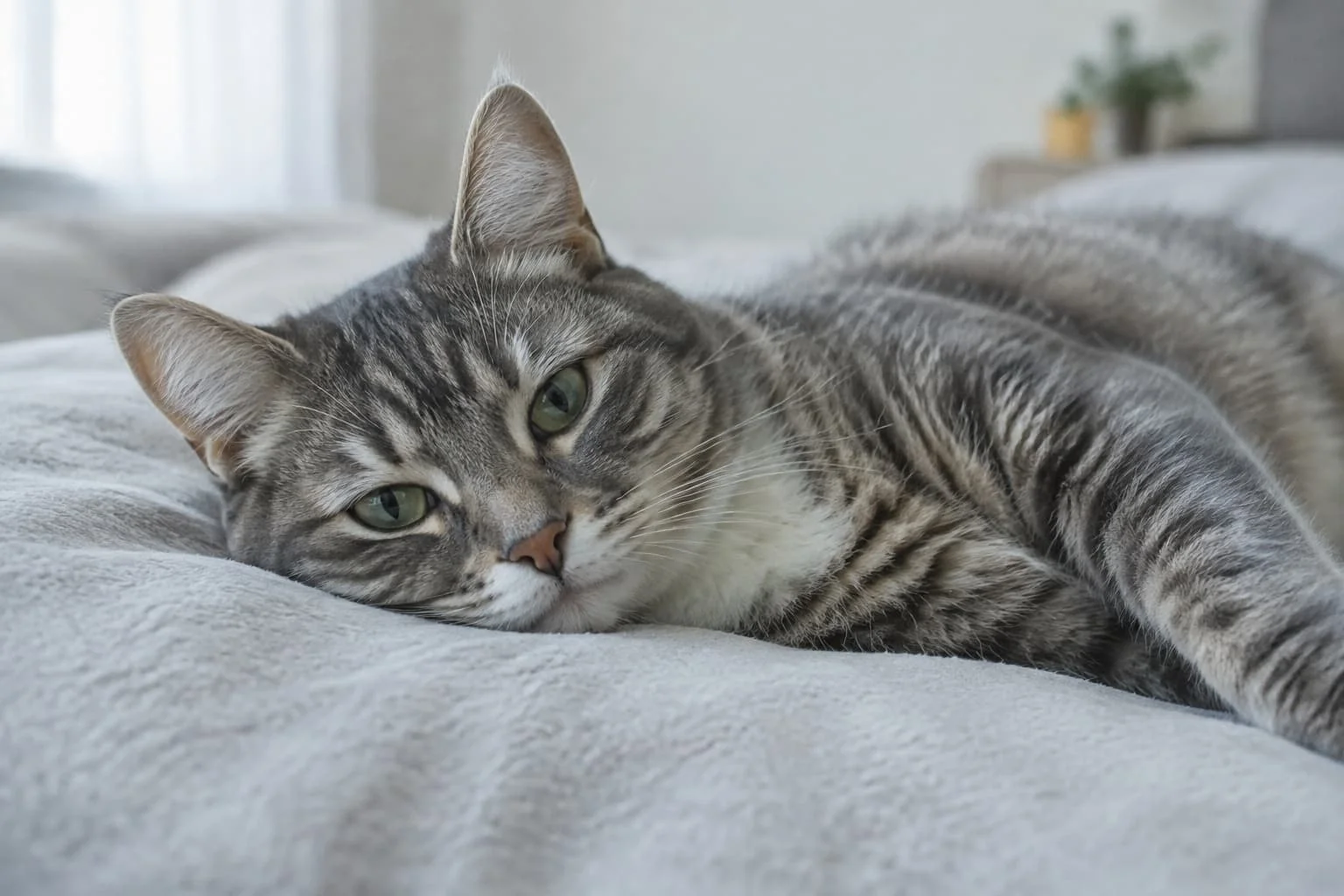
What the purr is as a sound
The purr is unusual among mammal calls because it does not stop between breaths. Measurements of domestic cats describe a low, continuous vibration that runs through both inhalation and exhalation, which is what separates it from a meow or a growl (Sissom et al., 1991). That continuity is the feature any mechanism has to account for.
Purring is also not unique to the domestic cat. A review of purring across mammals applied a strict definition and concluded that purring had then been documented only in the purring cats and in the civet family, so an explanation has to fit those animals rather than everything described as a purr (Peters, 2002).
The second feature is the frequency. Purring sits far below the range of most cat calls, in the low tens of hertz rather than the hundreds, and a vocal organ the size of a domestic cat's larynx is not an obvious candidate for producing it. The combination of a very low pitch and an uninterrupted sound is exactly why the explanation stayed unsettled for so long.
Classification work on cat vocalisations gives the wider context. A review of feline vocal communication counts up to 21 described call types and notes that the repertoire is probably larger, and that the boundaries between types are not always clear, since the same call can vary with the situation (Tavernier et al., 2020). Purring is one of the few that nearly everyone recognises, which is part of why it attracts confident explanations.
One more point about terminology is worth making before the mechanism. Purring is named after what it sounds like, not after how it is produced, so the word gathers together sounds that may not share a single origin. Any account of the mechanism therefore has to say which sound it is explaining, and the experimental literature is clearest where it works with recordings and measurements rather than with labels.
What the older explanation claimed
Most mammal sounds follow what acousticians call the myoelastic-aerodynamic principle: airflow sets tissue in the larynx oscillating, and the oscillation sustains itself. Purring was treated as the exception. The accepted account held that it worked by active muscle contraction, with nerve signals driving the intrinsic laryngeal muscles in rhythmic bursts, typically given as 20 to 30 hertz, which chopped the airflow into the pulses heard as a purr (Remmers & Gautier, 1972).
The appeal of that explanation is that it accounts for both odd features at once. A muscle rhythm can run during inhalation and exhalation alike, which explains the continuity, and a rhythm set by nerve firing is not limited by the size of the vocal folds, which explains the low frequency.
Isolated cat larynges can produce purring frequencies without neural input, but this finding does not establish how the sound is controlled in living animals (Herbst et al., 2023).
The weakness was the evidence base. Direct empirical support for the active contraction mechanism has been described as sparse, which is an unusual position for an explanation repeated as settled fact in both popular and veterinary writing (Herbst et al., 2023).
What the 2023 experiment measured
The test was built around a clean prediction. If purring requires neural drive, then a larynx with no nerve supply and no muscle activity cannot purr. Researchers took larynges from eight domestic cats, mounted them in an excised larynx setup where airflow is delivered mechanically, and looked for oscillation in the purring range (Herbst et al., 2023).
All eight produced self-sustained oscillation at typical purring rates, with fundamental frequencies of 25 to 30 hertz and no neural input or muscular contraction involved. Histology then pointed to a plausible reason: the vocal folds contain connective tissue masses up to 4 millimetres across, a specialisation that appears to allow the unusually low frequencies (Herbst et al., 2023).
The design matters as much as the result. An excised larynx carries no nerve supply, so any oscillation it produces cannot be driven by neural commands; that is what makes the preparation a test rather than a demonstration. The prediction was specific enough to fail, and it failed: all eight larynges vibrated without any nerve supply.
Question | Older account | What the 2023 study found |
Source of the rhythm | Nerve-driven muscle bursts at 20 to 30 hertz | Self-sustaining tissue oscillation at 25 to 30 hertz |
Role of the nervous system | Required for the sound to exist | Not required for oscillation in the purr range |
Why the pitch is so low | Set by the rate of nerve firing | Connective tissue masses up to 4 millimetres in the vocal fold |
Relation to other cat calls | A separate mechanism | The same principle as meows and most vertebrate calls |
Note: this was a laboratory preparation, not a recording of a living animal. It establishes what the tissue is capable of on its own, which is a narrower claim than a full account of how a cat purrs in a living body (Herbst et al., 2023).
Why the question is not closed
The authors are explicit about the limit. Their data do not fully reject the active contraction hypothesis; they show that cat larynges can easily produce sounds in the purr regime without neural input, which suggests that purring rests on the same mechanisms as other cat vocalisations but is potentially augmented by active contraction (Herbst et al., 2023).
That is a different conclusion from the one headlines carried. Showing that a mechanism is not necessary in a preparation is not the same as showing that it is absent in life, and the honest reading is that one explanation lost its status as the only possibility rather than being replaced outright.
What behaviour says about when cats purr
The purpose is studied separately from the mechanism, and the clearest result concerns purring aimed at people. Purrs recorded while cats were soliciting food were compared with purrs recorded in other settings, and human listeners rated the soliciting version as more urgent and less pleasant. The difference tracked a high-frequency element embedded in the purr: when that element was removed by re-synthesis, the ratings of urgency fell (McComb et al., 2009).
Two things follow. The first is that purring is not a single signal with one meaning, since the same basic sound carries an added component in one context and not in another. The second is that the added component works on listeners who do not own cats, which points to a general sensitivity rather than to learning by a particular owner.
Listener studies elsewhere point the other way on experience. When people were asked to sort recorded cat calls into behavioural contexts, those who lived with cats classified recorded meows more accurately than those who did not, and accuracy was modest overall (Nicastro & Owren, 2003). Reading a cat by ear is harder than it feels.
Beyond that case the behavioural picture stays descriptive. Reviews of feline vocal communication record purring in contexts as different as nursing, food solicitation, contentment and states of stress or pain, and note the difficulty of deciding whether these are different call types or one call varying with the situation (Tavernier et al., 2020). Comparable work on how other species signal is collected in the account of chemical communication in social insects.
The solicitation result is often summarised as proof that cats manipulate their owners. A narrower reading fits the data better: one acoustic element shifts the way listeners rate the same call, and that element appears in one context more than another (McComb et al., 2009). Whether the cat is doing anything deliberate is not something the recordings can settle.
Comparative work on cat sociality gives a reason to be careful. The domestic cat descends from a largely solitary ancestor, and its social behaviour towards other cats and towards people is reviewed as flexible, recently acquired and variable between individuals rather than as a fixed repertoire (Bradshaw, 2016). A signal that works on humans need not have evolved for that purpose.
This is also where a lot of confident writing goes wrong. Purring is described as a greeting, as a self-soothing device, as a request and as a sign of pain, sometimes in the same article, and each description is drawn from an observed context rather than from a test. Describing when a behaviour occurs is a legitimate first step; it is not the same as explaining what it is for.
Why big cats are a separate question
The familiar division between cats that roar and cats that purr is usually explained by the hyoid apparatus, the small chain of bones that supports the larynx. Comparative dissection of the lion, tiger, jaguar, cheetah and domestic cat found a real structural difference: in the lion, tiger and jaguar one element of that chain, the epihyoid, is an elastic ligament rather than a bony element as in the cheetah and the domestic cat, and one muscle present in those big cats is absent in the others (Weissengruber et al., 2002).
What the anatomy does not do is settle the behavioural claim on its own. The same study records further differences between the lion, the tiger and the jaguar themselves, which is a reminder that a two-way split into roarers and purrers is tidier than the anatomy that supposedly produces it. The cheetah groups with the domestic cat on this feature while being a large cat by any ordinary measure, which is a useful corrective to the idea that body size decides the matter.
How animals are compared across species is a recurring problem in behavioural research, as the review of what chickens can learn and remember also shows. A trait named in one species is easy to look for in another, and harder to measure the same way twice.
For a reader, the practical consequence is modest. Nothing in the excised larynx work changes how a cat should be looked after, and it says nothing about health in either direction (Herbst et al., 2023). What it changes is the confidence with which the mechanism can be stated, which matters mainly when an article claims to explain the sound.
It is also a reasonable model of how a settled explanation comes apart. The older account was not displaced by a competing theory but by a preparation that removed the thing it depended on, and the people who ran it were careful to say what their result did not show. That combination is rarer in coverage of animal behaviour than it should be, and it is the part most worth copying.
What the evidence supports and what it does not
Supported: purring is continuous across the breathing cycle, and isolated cat larynges can oscillate in the purring range with no nerve supply (Sissom et al., 1991; Herbst et al., 2023). The vocal folds contain connective tissue masses that plausibly allow such low frequencies, and purrs produced while soliciting food are heard differently from other purrs (Herbst et al., 2023; McComb et al., 2009).
Not supported: the confident claim that purring is produced by nerve-driven muscle contraction and nothing else. That account was repeated for decades on thin direct evidence, and a preparation without any nervous system has now produced the sound (Remmers & Gautier, 1972; Herbst et al., 2023).
Unsettled: what a cat is doing when it purrs. The contexts are well described and one of them has been tested with listeners, but there is no single measured function covering nursing, food solicitation and states of stress or pain, and the call types themselves are hard to separate (Tavernier et al., 2020). The honest summary is that the physics has moved and the meaning has not. How behaviour categories are fixed before the data arrive is visible in farm animal behaviour problems.
Frequently asked questions
Do cats purr using their vocal cords or their muscles?
The older account said muscles driven by nerves. In 2023 isolated cat larynges produced the same low frequencies with no nerves attached, which points to tissue vibration of the ordinary kind. The authors note that muscle activity may still add to the effect in a living animal. (Herbst et al., 2023)
How low is the sound of a purr?
In the excised larynx experiment the fundamental frequency sat between 25 and 30 hertz, far below the range of a meow. Histology found connective tissue masses up to 4 millimetres across inside the vocal folds, which appears to be what allows frequencies that low. (Herbst et al., 2023)
Why does a purr not stop when the cat breathes in?
Continuity across both phases of breathing is the defining feature of the sound, and it is the part any explanation has to account for. It was one reason the muscle-contraction account held for so long, since a muscle rhythm can continue regardless of airflow direction.
Does a purr always mean the cat is content?
The contexts recorded in reviews include nursing, food solicitation, contentment and states of stress or pain, so one meaning does not fit. In a listening experiment, purrs recorded during food solicitation were rated as more urgent (McComb et al., 2009). Purring also occurs during veterinary handling, so the sound alone does not show a cat is relaxed.
Can big cats purr?
Anatomy differs between species. In the lion, tiger and jaguar one element of the hyoid chain is an elastic ligament rather than bone, and a muscle present in them is absent in the cheetah and the domestic cat. The same work also found differences among the big cats themselves. (Weissengruber et al., 2002)
Sources
- Herbst CT, Prigge T, Garcia M, et al. Domestic cat larynges can produce purring frequencies without neural input. Current Biology. 2023;33(21):4727–4732.e4. DOI 10.1016/j.cub.2023.09.014.
- Remmers JE, Gautier H. Neural and mechanical mechanisms of feline purring. Respiration Physiology. 1972;16(3):351–361. DOI 10.1016/0034-5687(72)90064-3.
- Sissom DEF, Rice DA, Peters G. How cats purr. Journal of Zoology. 1991;223(1):67–78. DOI 10.1111/j.1469-7998.1991.tb04749.x.
- McComb K, Taylor AM, Wilson C, Charlton BD. The cry embedded within the purr. Current Biology. 2009;19(13):R507–R508. DOI 10.1016/j.cub.2009.05.033.
- Weissengruber GE, Forstenpointner G, Peters G, Kubber-Heiss A, Fitch WT. Hyoid apparatus and pharynx in the lion (Panthera leo), jaguar (Panthera onca), tiger (Panthera tigris), cheetah (Acinonyx jubatus) and domestic cat (Felis silvestris f. catus). Journal of Anatomy. 2002;201(3):195–209. DOI 10.1046/j.1469-7580.2002.00088.x.
- Tavernier C, Ahmed S, Houpt KA, Yeon SC. Feline vocal communication. Journal of Veterinary Science. 2020;21(1):e18. DOI 10.4142/jvs.2020.21.e18.
- Peters G. Purring and similar vocalizations in mammals. Mammal Review. 2002;32(4):245–271. DOI 10.1046/j.1365-2907.2002.00113.x.
- Bradshaw JWS. Sociality in cats: a comparative review. Journal of Veterinary Behavior. 2016;11:113–124. DOI 10.1016/j.jveb.2015.09.004.
- Nicastro N, Owren MJ. Classification of domestic cat (Felis catus) vocalizations by naive and experienced human listeners. Journal of Comparative Psychology. 2003;117(1):44–52. DOI 10.1037/0735-7036.117.1.44.

Lena Okonjo — author
Lena Okonjo is a Zoology graduate with a master’s-level specialization in Animal Behaviour. Her earlier work involved preparing summaries of field studies on animal behaviour and insects for general audiences. At Cabdirect, Lena covers animal behaviour, insect...
Related
Chicken cognition: learning, memory, social behaviour, navigation

Insect pheromones and chemical communication in social insects

Behavioural Problems of Farm Animals: What the 1977 Review Covered
Why do cats knead and make biscuits on blankets and people
Why do dogs eat grass and what veterinary research has found
How maternal investment and play relate to foal condition
How hormones time seasonal reproduction in temperate-zone birds