Psoriatic arthritis and why a skin condition affects the joints
Psoriatic arthritis can affect both skin and joints because psoriasis is part of a systemic immune-mediated process that can also involve musculoskeletal tissues. In some patients, inflammation also develops in synovial tissue, tendon and ligament attachment areas, complete digits or the axial skeleton. The severity of these musculoskeletal features may bear little relation to the amount of skin affected.
The article examines where inflammation can occur, which signs may appear first, why musculoskeletal symptoms sometimes precede recognised psoriasis, factors associated with later disease, the way diagnosis is reached and the complications that can follow. Its evidence base combines official clinical guidance with longitudinal research, specialist reviews and the international work used to develop CASPAR.

Evidence last checked 10 Nov 2026 · 11 min
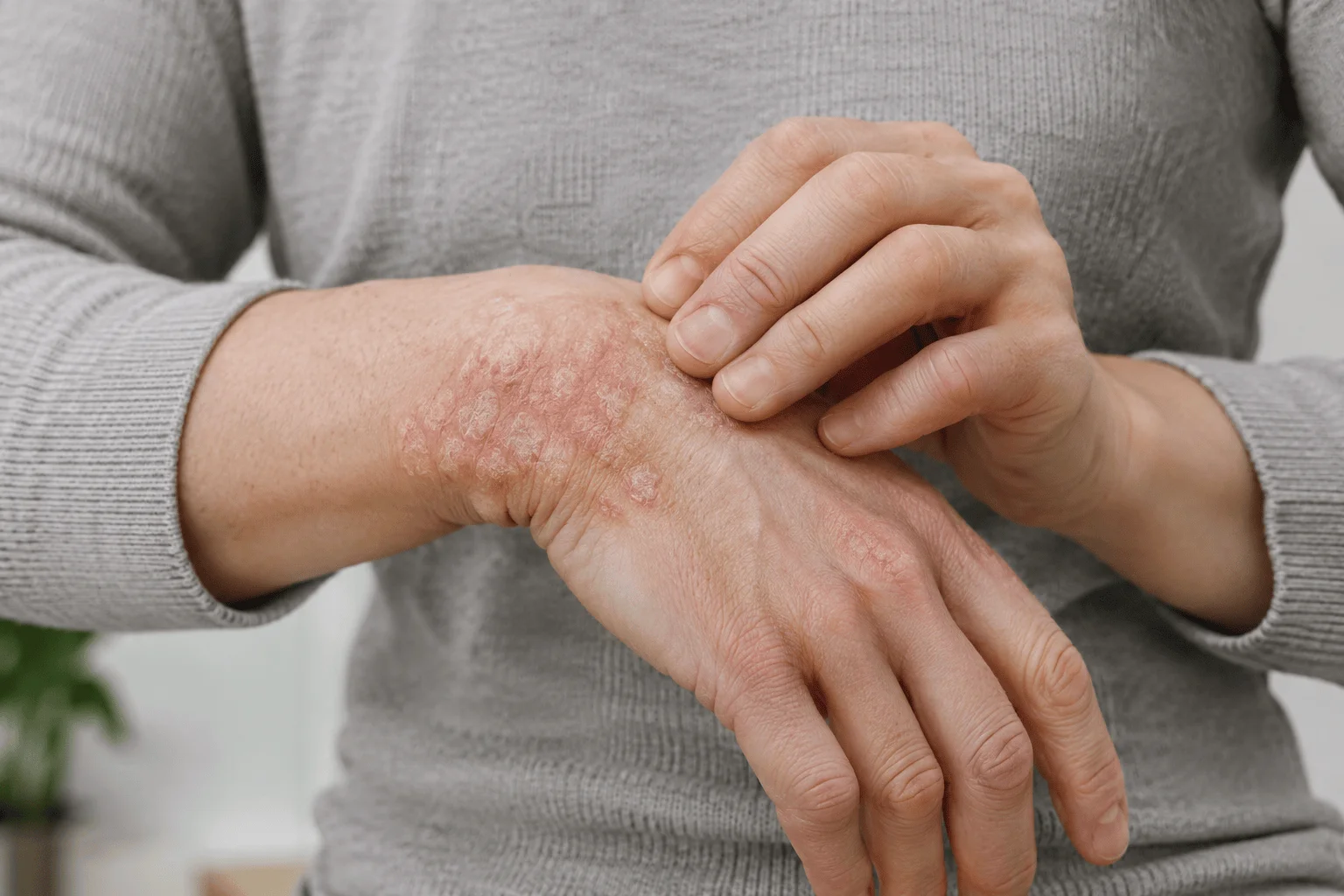
What is psoriatic arthritis, and how are skin and joints connected
Musculoskeletal involvement is one possible component of the wider psoriatic disease spectrum. Inflammatory changes may develop in synovial tissue, entheses, whole digits and axial structures rather than remaining confined to conventional peripheral joints.
A plaque on the skin does not directly extend into a nearby joint. The relationship is biological: inherited predisposition and overlapping inflammatory signalling can affect several tissues at once, although each tissue responds differently. Pathogenesis reviews place tumour necrosis factor and the IL-23/IL-17 axis among the key networks, alongside interactions involving immune cells, vasculature, bone and stromal tissue (Ritchlin et al., 2017; Veale and Fearon, 2018).
A 2026 review synthesises recent direct evidence supporting the idea of a functional skin-joint axis. Studies using single-cell methods and lineage tracing have found related immune-cell populations in psoriatic skin and inflamed synovial tissue, supporting movement and communication between tissues; however, the review also stresses that cell trafficking alone is not enough to explain arthritis because the local joint or entheseal environment helps determine whether persistent inflammation develops (Raimondo et al., 2026). These findings help explain possible biological pathways, but they cannot yet identify in advance which person with psoriasis will later develop musculoskeletal disease.
The joint manifestations do not result from a skin lesion physically spreading inward. Instead, related immune activity can affect several tissues independently, including the skin, nails, entheses and joints.
Skin severity cannot be used as a reliable measure of musculoskeletal activity. Limited plaques may coexist with pronounced joint or entheseal inflammation, whereas extensive psoriasis may occur without clinically apparent arthritis. This disconnect supports viewing psoriatic arthritis as one possible manifestation within a broader systemic psoriatic disorder rather than as a simple reflection of rash severity (FitzGerald et al., 2021).
Which joints and other structures can psoriatic arthritis affect
Peripheral disease may remain limited to a few digital joints or extend to the wrists, knees, ankles and other larger joints. Its distribution varies between patients: involvement may be uneven between the two sides of the body or become sufficiently symmetrical to resemble rheumatoid disease. Distal interphalangeal joints, located closest to the nails, are another recognised site and help illustrate the clinical link between nail changes and musculoskeletal disease (Ritchlin et al., 2017).
Joint cavities are only one potential site of inflammation. Enthesitis affects attachment points where tendons or ligaments meet bone and may cause heel or sole pain; dactylitis produces diffuse swelling through an entire finger or toe. NIAMS (2024) identifies both as characteristic manifestations, and the NHS (2023) likewise lists swollen fingers or toes and morning stiffness among important clinical clues.
Axial involvement may affect the sacroiliac region or vertebral column and can present with inflammatory back or neck stiffness. Nails may show pitting, crumbling or lifting away from the underlying bed, and these changes can accompany musculoskeletal disease. Uveitis and inflammatory bowel disease occur in a subset of patients, illustrating that psoriatic inflammation may involve tissues beyond a single joint group (NIAMS, 2024; FitzGerald et al., 2021).
When these findings persist or recur, the combination can be more informative than any one symptom. Clinicians also assess recurring patterns when deciding whether musculoskeletal complaints fit psoriatic arthritis.
- Joint pain, swelling or stiffness that is worse after rest or on waking.
- Swelling of an entire finger or toe (dactylitis).
- Pain at an enthesis, particularly around the heel or sole of the foot.
- Inflammatory back or pelvic stiffness.
- Nail pitting, thickening, crumbling or separation.
- Fatigue occurring alongside other inflammatory musculoskeletal symptoms.
None of these findings is unique to psoriatic arthritis, so their duration, inflammatory pattern and relationship to psoriasis or nail disease are important when clinicians interpret them. The overall pattern carries more diagnostic weight than any isolated symptom.
What are the early signs, and can arthritis appear before psoriasis
In the usual sequence, psoriasis becomes apparent before inflammatory joint disease. NIAMS (2024) says skin manifestations commonly come first and notes that a small group can experience joint symptoms before a recognisable rash. NHS guidance also advises assessment of recurrent joint symptoms in people without known psoriasis. Consequently, the absence of visible plaques during a single visit does not rule out psoriatic arthritis when other clues, such as nail disease or a personal or family history of psoriasis, are present.
Early symptoms can be subtle. Persistent morning stiffness, a repeatedly swollen joint, heel pain caused by enthesitis, a swollen digit or new inflammatory back pain may appear before a person recognises the pattern as inflammatory arthritis. Symptoms can also fluctuate, which can make a short clinical examination look less dramatic than the history suggests. The NHS lists recurrent joint pain, stiffness and swelling as symptoms that warrant clinical assessment, including when psoriasis is not known to be present (NHS, 2023).
Delayed recognition has been associated with poorer structural and functional outcomes. Haroon et al. (2015) studied 283 people with established disease and found that patients whose rheumatology assessment occurred more than six months after symptoms began had greater peripheral erosive damage and poorer long-term physical function. The study cannot prove that delay itself caused every adverse outcome, but it supports the clinical emphasis on identifying persistent inflammatory symptoms rather than waiting for severe damage to become obvious.
Early symptoms can resemble several unrelated musculoskeletal disorders. Finger discomfort may come from degenerative change such as osteoarthritis, sudden swelling may result from crystal deposition, rheumatoid disease can produce inflammation across multiple joints, and mechanical tendon problems may create pain close to an attachment site. The combination of skin or nail psoriasis, the distribution of musculoskeletal inflammation, imaging and laboratory results is therefore more informative than any single symptom.
Why does psoriatic arthritis develop, and who is at higher risk
The exact cause is not known. Research points to several interacting influences rather than a single trigger, including inherited predisposition, altered immune regulation and signals arising from the environment or local tissues. NIAMS (2024) describes genetic and environmental contributions, while mechanistic reviews show that several immune pathways can converge on skin, synovium, entheses and bone (Veale and Fearon, 2018). Having a risk factor changes probability; it does not mean arthritis is inevitable.
Psoriatic arthritis usually develops in people who already have psoriasis. Among people with psoriasis, factors associated with progression to psoriatic arthritis include greater psoriasis severity, nail involvement, higher BMI and family history.
Estimates of how often this happens vary because studies use different populations, diagnostic methods and follow-up periods. A 2019 systematic review and meta-analysis combined 266 studies involving 976,408 people with psoriasis and found a pooled psoriatic arthritis prevalence of 19.7%, with substantial between-study heterogeneity (Alinaghi et al., 2019). This pooled figure illustrates why prevalence estimates should be interpreted in the context of study design and population rather than treated as a universal percentage.
Prospective and population-based cohorts also produce different incidence estimates. Eder et al. (2016) monitored 464 people with psoriasis over eight years and recorded 51 new cases of psoriatic arthritis. The authors calculated an annual rate of about 2.7 cases per 100 participants, while more extensive psoriasis and pitted nails were among the characteristics linked with subsequent joint disease.
Wilson et al. (2009) followed a population-based group of 1,593 people with psoriasis and reported clinically recognised psoriatic arthritis in 5.1% over 20 years. Nail dystrophy and psoriasis affecting the scalp, intergluteal region or perianal skin were among the characteristics associated with later disease.
Obesity, more severe psoriasis, nail involvement and family history are repeatedly identified as risk markers in clinical literature, although their strength varies by study. Certain HLA variants are associated with particular psoriatic arthritis phenotypes, but no genetic result currently determines an individual diagnosis. The 2026 skin-joint review further suggests that risk depends on a combination of inflammatory skin activity, systemic immune-cell trafficking and a permissive musculoskeletal tissue environment rather than on one trigger acting alone (Raimondo et al., 2026).
The variation between studies is visible when three commonly cited datasets are placed side by side. Each measures a different aspect of risk or disease frequency in a different population and study design.
Study | Design | Population | Key estimate | Important limitation |
Alinaghi et al., 2019 | Systematic review and meta-analysis | 266 studies; 976,408 people with psoriasis | Pooled PsA prevalence 19.7% | Substantial between-study heterogeneity |
Eder et al., 2016 | Prospective psoriasis cohort | 464 people; 8 years | 51 developed PsA; 2.7 cases per 100 patients annually | Single specialist cohort; risk estimates are not universal |
Wilson et al., 2009 | Population-based psoriasis cohort | 1,593 people | 5.1% cumulative clinically recognised PsA at 20 years | Historical cohort and clinically recognised cases only |
The figures are not directly interchangeable: one is a pooled prevalence across many settings, one is an incidence estimate from a specialist prospective cohort and one is cumulative clinically recognised disease in a population-based historical cohort. Their differences are evidence of study design and population effects, not proof that one estimate is universally correct.
How is psoriatic arthritis diagnosed when there is no single test
There is no single blood test, scan or skin finding that confirms psoriatic arthritis in every case. NIAMS (2024) describes diagnosis as a synthesis of history, examination, laboratory testing and imaging. Clinicians look for inflammatory joint swelling, enthesitis, dactylitis, spinal symptoms, psoriasis and nail changes, and they ask about family history when skin disease is absent or uncertain.
Blood tests may be used to help assess other possible causes of arthritis, including rheumatoid arthritis. Imaging can also contribute to assessment: X-rays, ultrasound and MRI may reveal changes affecting joints, entheses or the spine (NIAMS, 2024). Radiography is mainly used to assess structural damage, while ultrasound and MRI can identify inflammatory abnormalities that may not be apparent on clinical examination.
The CASPAR criteria are often mentioned in this context, but they were developed as classification criteria for research rather than as a stand-alone diagnostic test. In the 2006 international CASPAR study, data from 588 psoriatic arthritis cases and 536 controls produced a specificity of 98.7% and sensitivity of 91.4% for the new criteria (Taylor et al., 2006). Those values describe performance in the study setting and should not be treated as the accuracy of a simple screening test in every clinic or population.
Diagnosis can be especially difficult when joint symptoms come before obvious psoriasis, when skin lesions are mild or hidden, or when several common causes of musculoskeletal pain coexist. The 2021 disease primer therefore emphasises phenotype recognition rather than a single biomarker: inflammatory features in joints, entheses or the spine are interpreted alongside skin or nail psoriasis and the exclusion of plausible alternatives (FitzGerald et al., 2021).
What complications can develop beyond painful joints
Persistent inflammation can damage cartilage and bone, reduce joint function and lead to lasting deformity in a minority of patients. A rare severe pattern called arthritis mutilans can cause marked destruction of small bones in the hands. The more common concern is progressive structural damage and loss of function over time, which is why studies of diagnostic delay focus on erosions and physical disability rather than pain alone (Haroon et al., 2015).
Psoriatic arthritis is also associated with health problems outside the musculoskeletal system. Uveitis can cause a painful red eye and blurred vision, and inflammatory bowel disease occurs more often than in the general population. Reviews and clinical summaries also describe higher burdens of obesity, metabolic syndrome, cardiovascular disease and mood disorders in psoriatic arthritis, although these associations are influenced by shared risk factors and systemic inflammation and do not mean that every patient develops these conditions (FitzGerald et al., 2021).
The skin-joint relationship can complicate monitoring because one domain may improve or worsen independently of another. Nail disease, enthesitis, axial symptoms and fatigue may be important even when the number of visibly swollen peripheral joints is small. A complete assessment therefore considers the whole pattern of psoriatic disease rather than using the skin rash as a proxy for joint inflammation.
What is established about psoriatic arthritis, and what remains uncertain
Several conclusions are supported consistently across current research. Psoriatic disease can produce musculoskeletal inflammation in peripheral joints, entheses, whole digits and axial structures, while in a smaller proportion of patients these manifestations become evident before recognised skin disease. There is no single definitive diagnostic test, so diagnosis depends on a characteristic clinical pattern supported by investigations and exclusion of competing explanations (NIAMS, 2024; NHS, 2023; FitzGerald et al., 2021).
What remains less certain is why only some people with psoriasis progress to arthritis and exactly when that transition begins. Cohort studies identify risk markers such as severe psoriasis and nail involvement, but estimates vary across populations and none is deterministic (Eder et al., 2016; Alinaghi et al., 2019). The 2026 evidence for immune-cell connections between skin and joint strengthens a biological skin-joint model, yet it has not produced a routine test that can forecast arthritis with sufficient certainty for an individual (Raimondo et al., 2026).
Current evidence supports a shared biological basis for skin and joint manifestations without suggesting that inflammation simply travels in one direction from the skin into a joint. The disease emerges from interacting immune, genetic and tissue factors, and its visible manifestations can differ markedly between people and over time.
Frequently asked questions
Can psoriatic arthritis occur without obvious psoriasis?
Yes. Most people develop psoriasis before musculoskeletal symptoms. NIAMS (2024) notes that a small group can experience joint symptoms before a clearly recognised skin rash. Diagnosis then relies more heavily on the pattern of inflammation, nail findings, family history, imaging and the exclusion of other causes of arthritis.
Does nail pitting mean someone has psoriatic arthritis?
No. Nail pitting and other nail changes are associated with psoriasis and are more common in people with psoriatic arthritis, but they are not diagnostic by themselves. Prospective studies have linked nail involvement with higher future risk, yet many people with nail psoriasis never develop inflammatory arthritis.
Is psoriatic arthritis the same as rheumatoid arthritis?
No. Both can cause inflammatory joint pain, swelling and stiffness, but they are distinct diseases with different clinical patterns and biological associations. Psoriatic arthritis is linked to psoriasis, nail disease, enthesitis and dactylitis, while laboratory and imaging findings are interpreted to help distinguish it from rheumatoid arthritis.
Can psoriatic arthritis affect the eyes or bowel?
It can. Uveitis, an inflammatory eye condition, occurs in some people with psoriatic arthritis, and inflammatory bowel disease is also associated with the broader psoriatic and spondyloarthritis spectrum. These problems are not present in every patient, but they show that the disease can involve more than skin and joints.
Is there a blood test that confirms psoriatic arthritis?
No single blood test confirms psoriatic arthritis. Blood tests can measure inflammation and help rule in or rule out competing diagnoses, but normal results do not exclude the disease. Diagnosis depends on the overall clinical pattern, examination of skin and nails, and imaging when it is useful.
Sources
- National Institute of Arthritis and Musculoskeletal and Skin Diseases. Psoriatic Arthritis. Last reviewed August 2024. Accessed 2 November 2026. https://www.niams.nih.gov/health-topics/psoriatic-arthritis
- National Institute of Arthritis and Musculoskeletal and Skin Diseases. Psoriatic Arthritis: Diagnosis, Treatment, and Steps to Take. Last reviewed August 2024. Accessed 2 November 2026. https://www.niams.nih.gov/health-topics/psoriatic-arthritis/diagnosis-treatment-and-steps-to-take
- NHS. Psoriatic arthritis. Last reviewed 6 September 2023. https://www.nhs.uk/conditions/psoriatic-arthritis/
- FitzGerald O, Ogdie A, Chandran V, Coates LC, Kavanaugh A, Tillett W, Leung YY, deWit M, Scher JU, Mease PJ. Psoriatic arthritis. Nature Reviews Disease Primers. 2021;7:59. DOI 10.1038/s41572-021-00293-y
- Raimondo MG, Gandolfo S, Gensler LS, Thomas R, Schett G, Ramming A, Ciccia F. From psoriatic plaque to synovium: decoding the skin-joint axis in psoriatic arthritis. Nature Reviews Rheumatology. 2026;22:615–625. DOI 10.1038/s41584-026-01412-3
- Veale DJ, Fearon U. The pathogenesis of psoriatic arthritis. The Lancet. 2018;391(10136):2273–2284. DOI 10.1016/S0140-6736(18)30830-4
- Ritchlin CT, Colbert RA, Gladman DD. Psoriatic Arthritis. New England Journal of Medicine. 2017;376(10):957–970. DOI 10.1056/NEJMra1505557
- Taylor W, Gladman D, Helliwell P, Marchesoni A, Mease P, Mielants H; CASPAR Study Group. Classification criteria for psoriatic arthritis: development of new criteria from a large international study. Arthritis & Rheumatism. 2006;54(8):2665–2673. DOI 10.1002/art.21972
- Alinaghi F, Calov M, Kristensen LE, Gladman DD, Coates LC, Jullien D, Gottlieb AB, Gisondi P, Wu JJ, Thyssen JP, Egeberg A. Prevalence of psoriatic arthritis in patients with psoriasis: a systematic review and meta-analysis of observational and clinical studies. Journal of the American Academy of Dermatology. 2019;80(1):251–265.e19. DOI 10.1016/j.jaad.2018.06.027
- Eder L, Haddad A, Rosen CF, Lee KA, Chandran V, Cook R, Gladman DD. The Incidence and Risk Factors for Psoriatic Arthritis in Patients With Psoriasis: A Prospective Cohort Study. Arthritis & Rheumatology. 2016;68(4):915–923. DOI 10.1002/art.39494
- Wilson FC, Icen M, Crowson CS, McEvoy MT, Gabriel SE, Maradit Kremers H. Incidence and clinical predictors of psoriatic arthritis in patients with psoriasis: a population-based study. Arthritis & Rheumatism. 2009;61(2):233–239. DOI 10.1002/art.24172
- Haroon M, Gallagher P, FitzGerald O. Diagnostic delay of more than 6 months contributes to poor radiographic and functional outcome in psoriatic arthritis. Annals of the Rheumatic Diseases. 2015;74(6):1045–1050. DOI 10.1136/annrheumdis-2013-204858

Nora Veldin — author
Nora Veldin is a health science writer with academic training in biomedical science and public health. After completing a BSc in Biomedical Science, she undertook an MPH focused on epidemiology, population health and the interpretation of health evidence. Her...
This article is for general information and is not medical advice. It was reviewed for accuracy by a qualified clinician; decisions about your health should be made with your own doctor.
Related

Betalain-Rich Red Beet Extract and Osteoarthritis Discomfort

Pregnancy-Associated Osteoporosis: Fractures, Causes and Care

Collagen Hydrolysate and Stratum Corneum Moisture

How Graves’ disease antibodies push the thyroid into overdrive

How the tetanus shot protects and why boosters are needed

How myasthenia gravis antibodies block nerve signals to muscles

What autoimmune disease is and why the immune system attacks the body