














Blue spirulina and its health benefits, nutrients and properties
Blue spirulina is a blue, phycocyanin-rich extract obtained from cultivated spirulina, rather than the complete green-blue biomass sold as ordinary spirulina powder. Its striking colour comes mainly from a water-soluble pigment-protein complex, not from an added synthetic blue dye (Citi et al., 2024).
The difference matters when considering nutrition and health claims. This article explains what the extract contains, how it is produced and used in foods, what laboratory and human studies have actually tested, and where the evidence remains too indirect for confident conclusions.

Evidence last checked 7 Nov 2026 · 12 min
What is blue spirulina, and where does its colour come from?
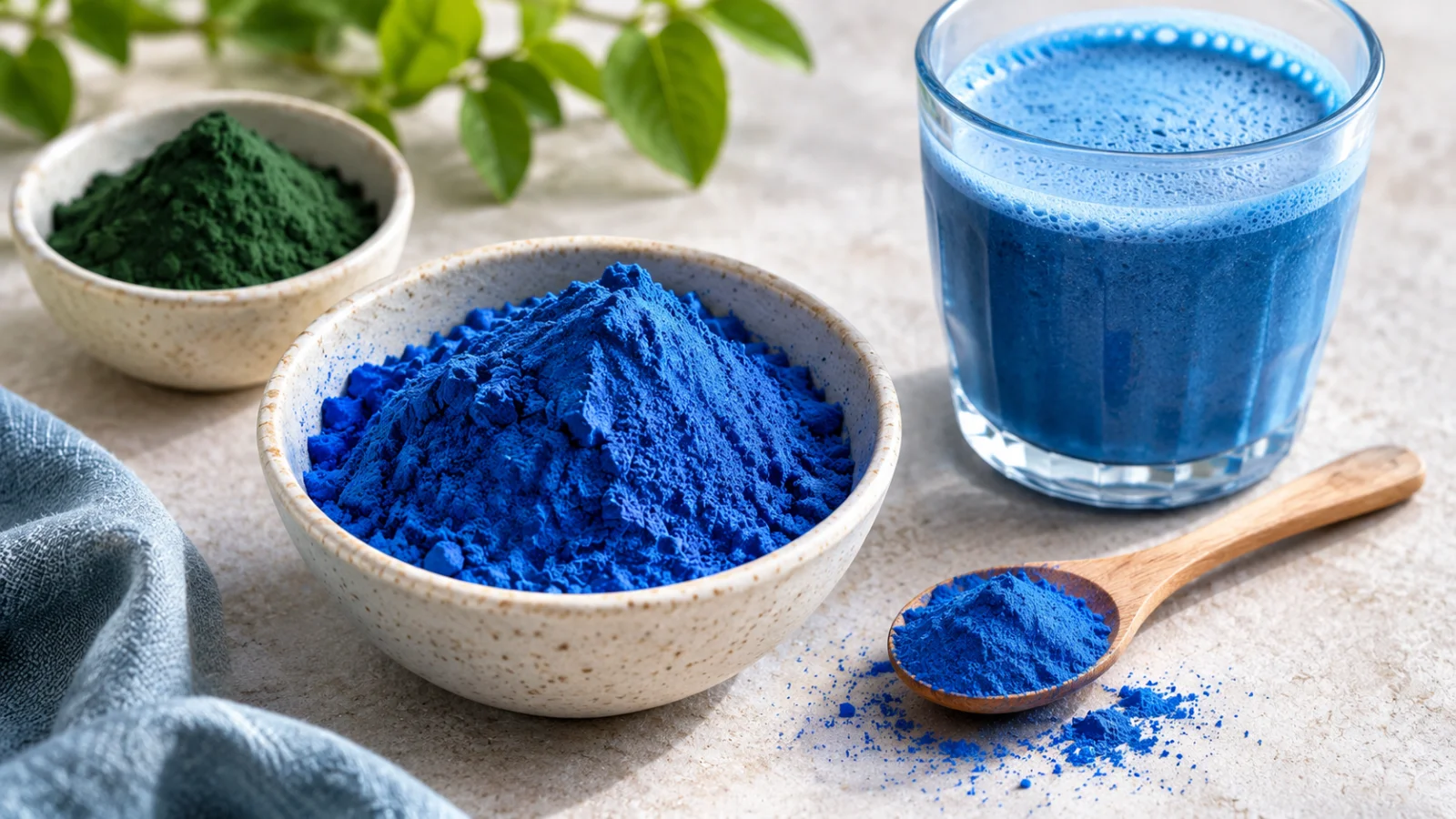
Blue spirulina is best understood as a selected fraction of spirulina rather than another species of algae. Producers start with Arthrospira biomass, which is technically a cyanobacterium, and separate compounds that dissolve in water. The resulting blue material is especially rich in phycocyanin, the molecule responsible for much of its appearance (Citi et al., 2024).
Whole spirulina is typically dark green because chlorophyll and other pigments remain alongside proteins, minerals and additional cellular material. Extracting the water-soluble fraction shifts the balance towards blue phycobiliproteins. This makes a blue product visually distinctive, but the colour alone cannot reveal how concentrated, pure or nutritionally complete a particular powder may be.
C-phycocyanin is a protein complex attached to a light-absorbing chromophore called phycocyanobilin. The chromophore gives the complex its characteristic hue, while the protein portion affects how it behaves in water. Citi and colleagues (2024) reviewed these chemical features and the experimental findings that have made the compound interesting to food scientists.
Calling the ingredient a superfood is a marketing classification rather than a scientific definition. It does not indicate that a serving has a standard amount of phycocyanin or that an effect seen in a laboratory will occur in people. The meaningful questions are which fraction is present, how it was measured and what outcome a study assessed.
The scientific name on a product label can add another layer of confusion. Arthrospira platensis and related cultivated strains are frequently discussed under the familiar name spirulina, while the blue colour ingredient may be identified by its extracted pigment rather than its organism. The FDA (2013) defines spirulina extract for a specific regulatory purpose. That definition helps distinguish a recognised food-colour ingredient from the much wider collection of products marketed under the same popular name.
How is blue spirulina different from regular spirulina?
Products sold under the spirulina name do not necessarily contain the same material. Dried Arthrospira retains much of the original biomass, whereas a blue extract represents a selected portion obtained during processing. This difference changes which compounds remain in the finished ingredient. Bortolini and colleagues (2022) describe the diversity of constituents in whole spirulina, but their findings cannot automatically be applied to an extract selected primarily for its pigment.
Ingredient declarations provide a more useful basis for comparison than the product's colour or marketing name. One manufacturer may use dried Arthrospira, another may specify a water-soluble extract, and a third may report the concentration of phycocyanin. These descriptions refer to different compositional characteristics.
Even when the pigment content has been measured accurately, the figure does not establish that consuming the ingredient produces a particular health benefit. The need to distinguish ingredient identity from evidence of health benefits is also discussed in [research on herbal medicine monographs](/nutrition/herbal-medicine-commission-e-monographs-nutrition), where individual preparations are assessed rather than treated as interchangeable.
The two materials also behave differently in food. Whole biomass contributes an earthy flavour and a green tone; a blue extract can provide colour with less of the original biomass. This makes the extract useful where a vivid appearance is wanted without the same visible plant-like particles, although flavour and stability still depend on formulation.
Blue spirulina and whole spirulina at a glance
Feature | Blue spirulina extract | Whole spirulina biomass |
Dominant visual pigment | Blue phycocyanin fraction | Green chlorophyll plus blue pigments |
Composition | Selected water-soluble compounds | Broader original cell components |
Most direct evidence | Colour chemistry and laboratory studies | Some human nutrition trials |
What cannot be inferred | Whole-biomass nutrient profile | Benefits of isolated blue extract |
It is misleading to transfer the nutritional profile of whole spirulina directly to blue spirulina. The extraction process may leave behind some constituents and concentrate others. Gentscheva and colleagues (2023) discuss the nutrient diversity of Arthrospira biomass, a diversity that cannot simply be assumed for an isolated colour fraction.
This difference also matters when interpreting photographs and recipes. A deep blue smoothie demonstrates that the ingredient can colour a mixture, but it says nothing about whether the finished drink contains substantial amounts of iron or other micronutrients. A whole-biomass nutrition table cannot fill that information gap. Product-specific composition would be needed before making a meaningful nutrient comparison, as the distinct emphases of Bortolini et al. (2022) and Citi et al. (2024) illustrate.
Which nutrients and compounds does blue spirulina contain?
The most distinctive component of blue spirulina is phycocyanin, not a broad collection of vitamins. As a pigment-protein, it contributes protein-derived material and its associated chromophore, but the amount in a finished food varies. Li and colleagues (2022) describe how the chemical structure influences both its biological behaviour and its sensitivity to processing.
Other water-soluble components may remain after extraction, including smaller amounts of proteins, carbohydrates and minerals. Their presence depends on the starting biomass, extraction method, filtration and subsequent drying. A product made primarily for colour should not automatically be described as a comprehensive source of the nutrients found in the whole organism.
Claims about iron, vitamin B12 or complete protein often refer to conventional spirulina biomass. They are not interchangeable with measured values for purified or partially purified phycocyanin. The review by Gentscheva et al. (2023) addresses biomass composition, while Citi et al. (2024) focuses more narrowly on the pigment complex.
Two blue powders can look nearly identical while delivering different quantities of phycocyanin per gram. The finished composition depends partly on residual moisture, the extent of purification and any substances added to make the extract easier to handle. Laboratory identification of a compound is only the first step in assessing its nutritional relevance. That assessment also requires information about the quantity consumed, which is not consistently available in studies of pigment preparations.
A second complication is that extraction and storage are not neutral steps. Processing may preserve the pigment while reducing other constituents, and some formulations contain carriers that affect the weight of the finished powder. Li et al. (2022) examine why researchers develop protective formulations for phycocyanin. This makes a simple claim such as more nutrients because it is concentrated scientifically incomplete: concentration of one molecule does not mean concentration of every nutrient.
What are the possible health benefits of blue spirulina?
The biological interest in blue spirulina centres on phycocyanin and its interaction with oxidation and inflammation-related pathways. These are plausible research questions because the molecule has measurable chemical activity. They are not, by themselves, demonstrations that consuming a blue-coloured food improves a person’s health (Citi et al., 2024).
In their 2022 review, Liu, Qin and Li brought together experiments investigating phycocyanin and inflammation-associated signalling. The proposed mechanisms include changes in cellular pathways involved in inflammatory responses. Much of this work concerns isolated compounds, cultured cells or animal models, which cannot establish clinical benefits for a food ingredient. A similar evidence limitation appears in [research on alkaline water and blood lipids](/nutrition/alkaline-water-blood-lipids-evidence-nutrition), which distinguishes findings from animal experiments from evidence collected in humans.
Antioxidant experiments require similar care in interpretation. A substance may interact with reactive molecules in a test system yet behave differently after digestion, absorption and metabolism. The 2024 review by Citi and colleagues connects these experimental observations to potential applications but does not turn them into proof of disease prevention in humans.
Another source of confusion is research on whole spirulina. A 2023 systematic review by Rahnama and colleagues combined 20 randomised studies involving 1,076 participants and reported changes in blood lipid measures. Those trials investigated spirulina interventions, not standardised blue phycocyanin powders, so their results cannot be presented as direct evidence for blue spirulina.
Potential effects on immune responses, cardiovascular outcomes or metabolic health should therefore be described with the tested material attached. The more specific the claim, the more closely the product in the evidence must resemble the product being discussed. At present, that link is often missing for everyday blue spirulina foods.
A useful way to evaluate a health claim is to separate its biological target from its human outcome. A laboratory result might concern a marker of oxidative stress, whereas a consumer-facing claim might promise better energy or stronger immunity. Those are not equivalent measurements.
Liu et al. (2022) describe molecular hypotheses, while the clinical review by Rahnama et al. (2023) evaluates a different preparation and different endpoints. Neither closes the evidential gap for blue food-colour powders.
What do studies of phycocyanin actually show?
Studies fall into several categories, each answering a different question. Food chemistry work can identify the pigment and measure how it changes during processing. Laboratory biology can explore molecular pathways, while human trials are needed to evaluate outcomes that matter to people. Treating these forms of evidence as equivalent creates a false sense of certainty.
Li and colleagues (2022) examined ways of protecting phycocyanin during processing through microencapsulation. Their review is valuable for understanding why a pigment may lose colour or activity under unfavourable conditions. It is not a clinical trial showing that microencapsulated blue spirulina improves health.
Citi et al. (2024) reviewed the pigment’s potential biological actions and explained the molecular rationale for continued research. Liu et al. (2022) considered inflammation-related mechanisms. These papers describe a developing experimental field, but much of the evidence is mechanistic rather than based on robust clinical endpoints.
Human evidence does exist for some related preparations, yet it must be read narrowly. Jensen and colleagues (2016) published a randomised, placebo-controlled study of a phycocyanin-enriched aqueous Arthrospira extract focused on safety, platelet activation and anticoagulant activity. Its design does not establish broad benefits for skin, immunity, weight or chronic disease.
The blue pigment is well characterised as a food ingredient; claims of specific human health benefits remain much less certain.
Whole-spirulina research provides additional context rather than a substitute. Rahnama et al. (2023) found pooled differences in lipid markers, but noted substantial differences across trials. Differences in participant health, product composition and study design limit any attempt to infer the effect of a specific commercial blue powder.
Study design also affects how much can be concluded. A short investigation of selected biomarkers may detect a measurable change without showing whether it is durable or important to daily health. Likewise, a safety study with a particular preparation cannot substitute for a long-term efficacy trial. The focused endpoints in Jensen et al. (2016) and the broader mechanistic questions reviewed by Citi et al. (2024) demonstrate why these publications should not be merged into one sweeping benefits claim.
How is blue spirulina used in food, and what affects its quality?
Food producers value spirulina extract chiefly for the appearance it can give to a finished product. Its water-dispersible pigment allows blue colouring to be introduced into suitable formulations, although the result depends on the ingredient and processing conditions. In the United States, spirulina extract is subject to a food-colour regulation introduced by the Food and Drug Administration in 2013. That regulation defines the permitted additive and its use; it does not establish therapeutic properties (FDA, 2013).
Food applications include confectionery, dairy-style desserts and beverages, but blue colour is not equally stable in every product. Heat, acidity, light and oxygen can change the appearance or structure of phycocyanin. Li et al. (2022) describe encapsulation approaches designed to protect the pigment during processing and storage. A separate example of processing-related changes appears in [research on vitamin C in peas](/nutrition/vitamin-c-in-peas-effects-of-shipping-freezing-and-canning), which examines how handling, freezing and canning affect measured nutrient content.
Because it is protein-based, phycocyanin behaves differently from many synthetic colour molecules. A product may look bright when freshly mixed and then fade or shift under challenging processing conditions. This is a formulation issue rather than evidence that the ingredient has stopped being nutritious or become medically ineffective.
Quality also concerns the identity of the starting material and possible unwanted contaminants. Gentscheva and colleagues (2023) note toxin concerns in cyanobacteria, including microcystin production in algae harvested from open lakes. That warning does not mean every cultivated Arthrospira extract is contaminated, but it explains why species identity and manufacturing controls matter.
The FDA (2013) also describes specifications for spirulina extract used as a food colour, illustrating that regulatory permission is tied to defined uses and standards. Such permission is not a regulatory endorsement of claimed antioxidant, anti-inflammatory or disease-related benefits. Food-colour approval and clinical efficacy address different questions.
For consumers, the presence of a blue ingredient in a dessert or beverage is principally a description of the food, not a clinical promise. The colour may be attractive and the ingredient may be derived from cultivated biomass, but neither feature identifies a health outcome. The FDA (2013) regulation deals with a defined additive and permitted uses. Gentscheva et al. (2023) address a separate issue, the possible health risks of cyanobacterial products.
What is proven, and what remains uncertain about blue spirulina?
The clearest findings concern identity and function: blue spirulina contains a phycocyanin-rich fraction, the pigment can colour foods, and its stability can be measured under different processing conditions. The evidence for these points comes from chemistry, food-technology research and regulation (Li et al., 2022; FDA, 2013).
There is a plausible experimental basis for studying antioxidant and inflammation-related mechanisms, but a plausible mechanism is not a demonstrated health outcome. Citi et al. (2024) and Liu et al. (2022) describe biological pathways worth investigating. Their reviews do not establish that ordinary servings of blue spirulina prevent or treat disease.
Human trials of whole spirulina, including those assessed by Rahnama et al. (2023), cannot resolve that gap because whole biomass differs from a blue extract. Likewise, a focused safety study of a particular enriched extract cannot guarantee that all products are identical (Jensen et al., 2016).
Safety and composition should be discussed without exaggeration. Gentscheva et al. (2023) record possible health risks such as toxins and lead contamination in cyanobacterial biomass. Petrus and colleagues (2010) documented a case in which phycocyanin was identified as an allergen, showing why the label natural is not synonymous with risk-free.
Blue spirulina is therefore a distinctive food-colour ingredient with scientifically interesting chemistry, not a clinically established remedy. Stronger conclusions would require well-characterised products, human trials designed around specific outcomes and reproducible results. Until then, its visible colour is a more certain property than its advertised health effects.
The most responsible interpretation is neither to dismiss the pigment as scientifically uninteresting nor to elevate preliminary findings into established benefits. Chemical research has explained much of its colour and processing behaviour, and experimental biology has generated hypotheses worth testing. What remains uncertain is whether those hypotheses translate into meaningful outcomes at typical food exposures. The next advance would be trials that clearly identify the extract, compare it appropriately and report outcomes people can understand.
Frequently asked questions
Is blue spirulina the same as blue-green algae?
Blue spirulina comes from Arthrospira, a cyanobacterium often called blue-green algae. The commercial blue powder is usually an extract enriched in phycocyanin rather than the whole organism. The wider term blue-green algae also covers other cyanobacteria, so it does not guarantee the same species or ingredient composition.
Why is blue spirulina blue rather than green?
The blue colour is mainly associated with phycocyanin, a light-harvesting pigment-protein. Extraction can favour this water-soluble compound while reducing the relative contribution of chlorophyll and other biomass components. The result is visually different from ordinary spirulina, although the exact shade and concentration depend on processing and formulation.
Does blue spirulina have more protein than ordinary spirulina?
Not necessarily. Phycocyanin itself contains protein, but a blue extract is not automatically a more complete protein food than whole spirulina. Extraction changes the mixture of constituents, and products differ in concentration and added ingredients. A reliable comparison would require measured nutrition information for the actual materials, not colour alone.
Can blue spirulina replace food colouring?
Spirulina extract has an established role as a food colour in the United States under specified regulatory conditions. Its blue pigment can be useful in foods and beverages, but stability varies with acidity, temperature and processing. Approval for colouring does not mean the ingredient has been shown to produce a particular health benefit.
Is blue spirulina proven to reduce inflammation in humans?
No broad clinical conclusion is established for ordinary blue spirulina foods. Researchers have examined phycocyanin in laboratory systems and reviewed possible inflammation-related pathways, but those findings do not prove an effect in people. Studies of whole spirulina or specialised extracts cannot automatically be generalised to every blue powder sold for food.
Sources
- Citi V, Torre S, Flori L, et al. Nutraceutical Features of the Phycobiliprotein C-Phycocyanin: Evidence from Arthrospira platensis (Spirulina). Nutrients. 2024;16(11):1752. doi: 10.3390/nu16111752.
- Li Y, Li X, Liang Z-P, et al. Progress of Microencapsulated Phycocyanin in Food and Pharma Industries: A Review. Molecules. 2022;27(18):5854. doi: 10.3390/molecules27185854.
- Liu R, Qin S, Li W. Phycocyanin: Anti-inflammatory effect and mechanism. Biomedicine & Pharmacotherapy. 2022;153:113362. doi: 10.1016/j.biopha.2022.113362.
- Bortolini DG, Maciel GM, Fernandes IAA, et al. Functional properties of bioactive compounds from Spirulina spp.: Current status and future trends. Food Chemistry: Molecular Sciences. 2022;5:100134. doi: 10.1016/j.fochms.2022.100134.
- Gentscheva G, Nikolova K, Panayotova V, et al. Application of Arthrospira platensis for Medicinal Purposes and the Food Industry: A Review of the Literature. Life. 2023;13(3):845. doi: 10.3390/life13030845.
- Rahnama I, Arabi SM, Chambari M, et al. The effect of Spirulina supplementation on lipid profile: GRADE-assessed systematic review and dose-response meta-analysis of data from randomized controlled trials. Pharmacological Research. 2023;193:106802. doi: 10.1016/j.phrs.2023.106802.
- Jensen GS, Drapeau C, Lenninger M, Benson KF. Clinical Safety of a High Dose of Phycocyanin-Enriched Aqueous Extract from Arthrospira (Spirulina) platensis: Results from a Randomized, Double-Blind, Placebo-Controlled Study with a Focus on Anticoagulant Activity and Platelet Activation. Journal of Medicinal Food. 2016;19(7):645–653.
- Petrus M, Culerrier R, Campistron M, Barre A, Rougé P. First case report of anaphylaxis to spirulin: identification of phycocyanin as responsible allergen. Allergy. 2010;65(7):924–925.
- US Food and Drug Administration. Listing of Color Additives Exempt From Certification; Spirulina Extract. Final rule, 13 August 2013. Federal Register. 2013;78:49117. https://www.federalregister.gov/documents/2013/08/13/2013-19550/listing-of-color-additives-exempt-from-certification-spirulina-extract

Sophia L. Mitchell — author
Sophia L. Mitchell is a nutrition writer with a background in nutrition science and biochemistry. Her work focuses on translating research about dietary assessment, food composition and nutrient intake into clear information for general readers, with particula...
This article is for general information and is not medical advice. It was reviewed for accuracy by a qualified clinician; decisions about your health should be made with your own doctor.
Related
Herbal Medicine Monographs: What Commission E Still Teaches
Alkaline Water and Blood Lipids: What a 2009 Rat Study Tested
Vitamin C in Peas: Effects of Shipping, Freezing and Canning
What is matcha, it's benefits and unique properties
Can Pistachios Help With Diabetes? What a 2009 Rat Study Found
Mainly fruit diet study: biochemical effects in 1971
Iron deficiency and how it affects your health