















What is matcha, it's benefits and unique properties
Matcha is a finely milled green tea made from specially grown Camellia sinensis leaves, and its distinctive properties come from shade cultivation and the fact that the leaf itself is consumed. The powder contains caffeine, amino acids and plant polyphenols, but those constituents do not automatically translate into proven medical benefits.
This explainer follows the tea from leaf to powder, compares it with ordinary brewed green tea and examines laboratory analyses alongside human trials. It separates established facts about composition from early findings on attention, stress and long-term health, where the evidence is less certain.

Evidence last checked 9 Nov 2026 · 12 min
What is matcha and how is it made?
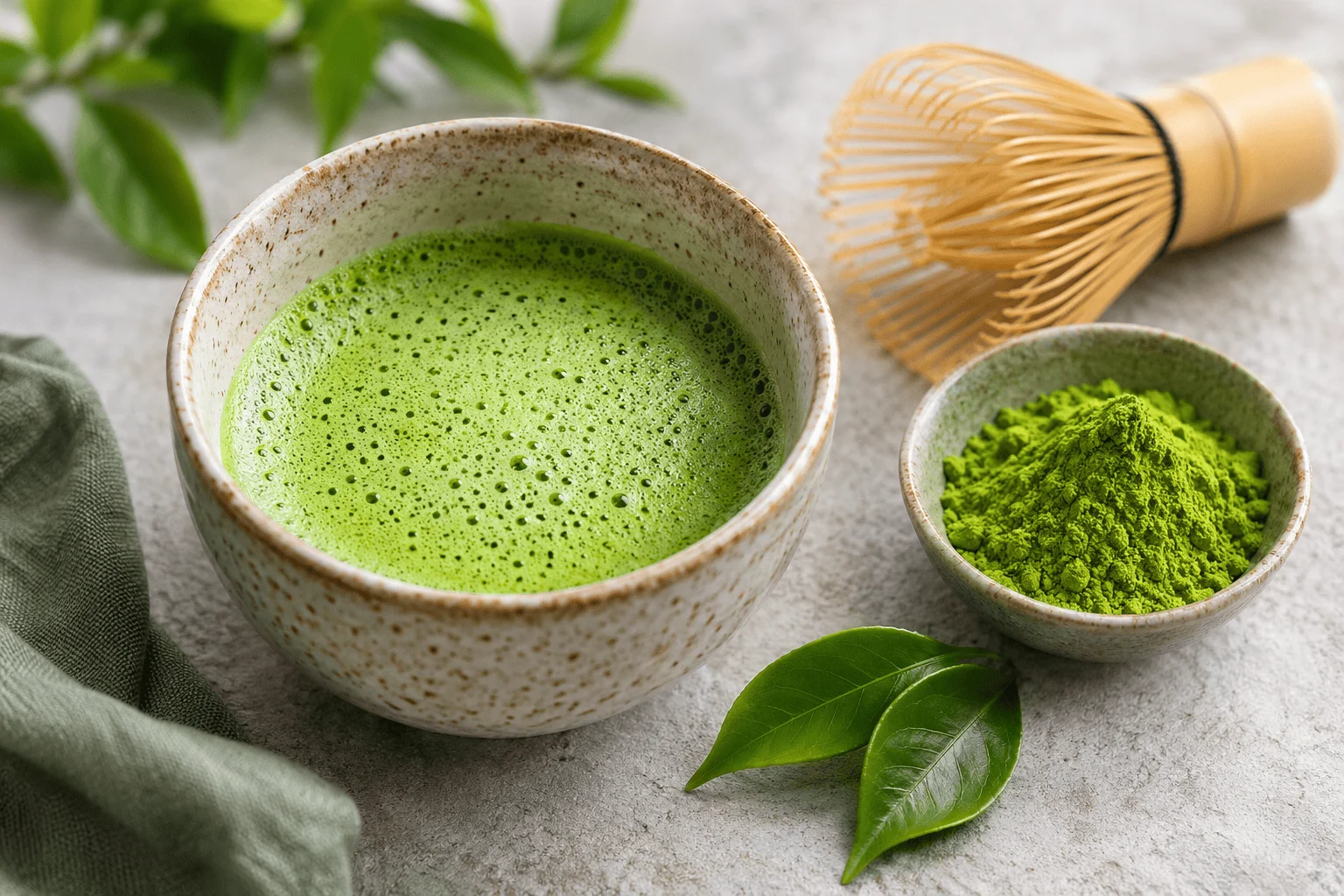
The word matcha refers to a particular form of green tea, not to a separate plant species. The leaves come from Camellia sinensis, but their journey from field to cup differs from that of loose-leaf tea. In traditional Japanese production, growers restrict sunlight before harvesting, then process and grind suitable leaves into a fine powder (Kochman et al., 2020).
Shading changes the conditions under which the leaf develops. With less direct light, the plant adjusts its chemistry, including pathways involving amino acids and pigments. This helps explain matcha's characteristic deep colour and savoury taste, although the final composition also depends on cultivar, harvest season, origin and processing (Kika et al., 2024).
Matcha is also connected with a particular food culture, including careful handling of powder and attention to texture. Those practices explain why the ingredient is often presented differently from a teabag, but cultural prestige is not a scientific quality grade. Research into composition needs measurable sample information rather than labels such as ceremonial or premium, which have no single clinical definition.
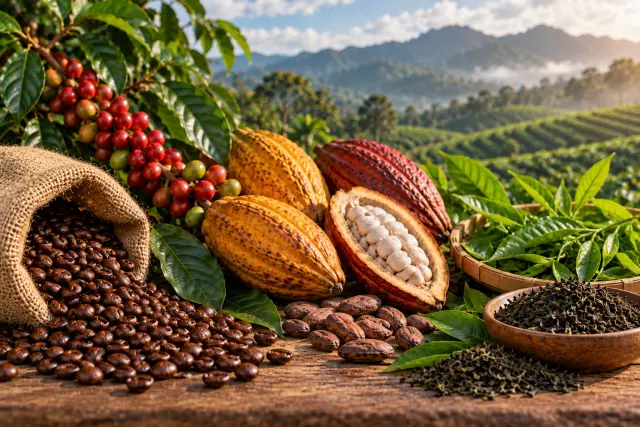
After harvesting, the leaves are heated to limit enzymatic browning, dried and prepared for milling. The leaf material used for traditional matcha is commonly known as tencha. Removing tougher components before fine grinding contributes to the powder's texture, which is one reason genuine matcha differs from simply pulverising any green tea leaf (Kochman et al., 2020). For a broader view of tea production, [research on coffee, cocoa and tea cultivation](/plants/coffee-cocoa-and-tea-cultivation-management-and-production) explains how crop management and processing fit into the production of different beverage crops.
Because the powder remains suspended in the drink, a serving includes material that would ordinarily stay behind in a tea strainer. This is a physical difference, not proof that every nutrient is absorbed more efficiently. The amount actually consumed varies with the quantity of powder, the liquid used and what remains in the cup.
How is matcha different from regular green tea?
Both drinks begin with the same tea species, so their chemistry overlaps considerably. The main contrast is what happens before and after harvest: matcha involves a particular shading and milling process, whereas many green teas are prepared by steeping intact leaves in water and discarding them. That distinction affects both flavour and the range of leaf components reaching the drink (Kochman et al., 2020). Harvard Health Publishing (Frank, 2024) similarly distinguishes matcha's whole-leaf form from ordinary steeped tea.
A brewed tea is primarily an extraction. Water draws out some soluble compounds, but the result depends on brewing time, temperature, leaf size and repeated infusions. Matcha introduces the powdered leaf into the beverage, although compounds still differ in solubility and biological availability. Calling matcha 'stronger' without specifying a compound or comparison method is therefore misleading.
A fair comparison also needs to specify the unit being compared. The mass of dry leaf, the volume of liquid and the quantity of a named compound answer different questions. A larger amount of leaf material in a cup does not establish greater exposure to every compound, especially when brewing conditions, particle size and digestion differ between products (Weiss and Anderton, 2003).
Matcha and brewed green tea at a glance
Feature | Matcha | Typical brewed green tea |
Leaf handling | Fine leaf powder remains in drink | Leaves generally removed after steeping |
Appearance | Opaque, usually vivid green | Clearer, often pale yellow or green |
Comparison caveat | Composition depends on powder and amount | Extraction depends on leaves and brewing |
An often-repeated laboratory comparison illustrates this problem. Weiss and Anderton (2003) found a much higher concentration of extractable epigallocatechin gallate in their tested matcha than in one commercial green tea preparation. Their result described specific samples and extraction conditions; it was not a universal multiplier for all matcha products or evidence of an equivalent difference in human health outcomes.
The visual and sensory differences are easier to recognise than the clinical ones. Matcha typically looks opaque and bright green, with a grassy, slightly bitter and umami character. Brewed green tea is generally translucent and can vary from pale yellow to green depending on the leaf and preparation. Neither appearance alone establishes purity, nutrient concentration or quality.
What gives matcha its colour, flavour and chemical properties?
Matcha's vivid colour is associated with chlorophyll-containing leaf tissue, while its taste reflects a mixture of amino acids, polyphenols and other plant compounds. L-theanine contributes to the savoury profile; catechins can add bitterness and astringency. The balance is shaped by agricultural conditions rather than by one supposedly unique ingredient (Kochman et al., 2020).
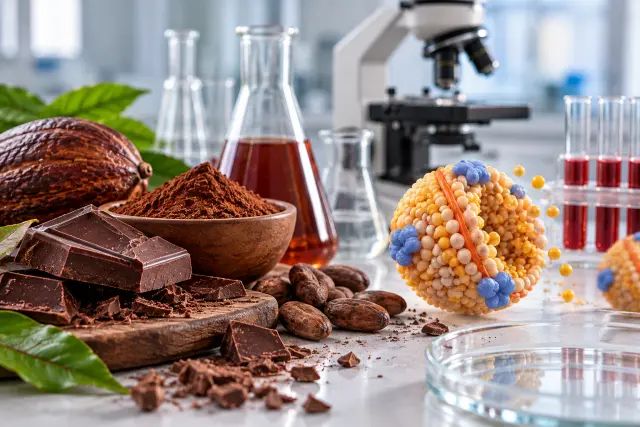
Catechins are members of the flavonoid family, and epigallocatechin gallate, usually abbreviated EGCG, is one of the compounds most frequently studied. Laboratory antioxidant activity is a property of these molecules under particular test conditions. It should not be interpreted as a direct measure of protection against cancer, cardiovascular disease or ageing in people (Sokary et al., 2022). The distinction between laboratory antioxidant activity and clinical benefits is also illustrated by [research on chocolate polyphenols and LDL oxidation](/research/chocolate-polyphenols-and-ldl-oxidation-antioxidant-effects), which measured biochemical changes rather than long-term disease prevention.
In a detailed food-composition study, Kika and colleagues (2024) examined Japanese matcha powder for nutrients, phenolic acids, caffeine and fatty acids. The work established what could be measured in those samples, including dietary fibre and several polyphenols. It did not test whether drinking the product changed clinical outcomes, and its figures cannot be assumed to describe every product on the market.
The distinction between the dry powder and a finished drink is easy to miss in nutrition discussions. A laboratory can report nutrients per unit of dry powder, while consumers encounter the ingredient diluted in water or mixed with other foods. The two descriptions are not contradictory, but they should never be treated as equivalent serving-level measurements without knowing how much powder is present (Kika et al., 2024).
Caffeine is another major component. It can contribute to alertness, but it also makes the beverage a source of a stimulant rather than a caffeine-free alternative to coffee. L-theanine and caffeine are often discussed together because their combined effects have been tested in attention experiments, although such experiments do not always use matcha as the drink itself (Payne et al., 2025).
The same plant can yield powders with noticeably different chemical profiles. Shade duration, processing, storage and the portion of the harvest selected all matter, while added milk or sweeteners change the nutritional profile of the finished drink. Consequently, 'matcha' on a menu is a description of a tea ingredient, not a standardised laboratory formulation.
What are the possible benefits of matcha?
Research interest in matcha centres on its polyphenols, caffeine and amino acids. These substances have plausible biological actions, but plausibility is not the same as demonstrated benefit from a particular drink. Reviews have found that the most informative human work so far concerns short-term cognitive tasks and stress-related measures, rather than disease prevention (Sokary et al., 2022).
What do studies suggest about attention and stress?
In a small randomised trial involving young adults, Baba and colleagues (2021) studied performance after a mild laboratory stress task. Some measures of attention and emotion recognition differed between matcha and placebo groups, while several other tested outcomes did not. The result suggests a narrow, testable effect in that setting rather than a general improvement in intelligence, productivity or mental health.
Another trial followed older adults with cognitive concerns for a year. Uchida and colleagues (2024) reported a difference in a social-cognition measure, but the principal cognitive and daily-function outcomes did not show a significant benefit. This distinction matters: an interesting secondary finding cannot be presented as proof that matcha prevents dementia.
Harvard Health Publishing's review of possible matcha benefits (Frank, 2024) makes a similar separation between promising ingredients and firm conclusions about health. The presence of a compound associated with a beneficial effect in another setting does not show that the complete food has the same effect. This is particularly relevant when studies involve concentrated extracts rather than a beverage.
Why disease-prevention claims remain uncertain
Stress-related findings are also mixed in interpretation. Unno and colleagues (2018) combined animal experiments with human investigations and examined how the balance of matcha constituents might affect stress markers. The work helped generate hypotheses about formulation and biological response, but the animal component cannot establish what a typical beverage will do for an individual person.
Claims about blood glucose, cholesterol, weight control and cancer need still greater caution. Sokary and colleagues (2022) noted that much of the matcha-specific evidence for cardiometabolic and anti-tumour effects came from animal or cell studies. Results in these models can guide further research, but they cannot demonstrate prevention or treatment of those conditions in humans.
What have human trials actually found?
The most useful way to read a matcha trial is to ask who participated, what was compared and which outcome was chosen in advance. A study may detect a change in reaction time without showing an effect on memory, or find a secondary signal while missing its primary endpoint. These differences are not technical footnotes; they determine how much weight the conclusion can carry. A separate example of these methodological limits appears in [a small human study of garlic honey tea and blood pressure](/research/garlic-honey-tea-and-blood-pressure-what-a-small-human-study-found), where the sample size and incomplete reporting restricted the conclusions.
Baba and colleagues (2021) randomly assigned 42 younger adults to matcha or placebo in a short study involving a stress task. The matcha group performed better on selected attention and emotion-perception measures, but not across the full test battery. The limited duration and relatively small group mean that the findings need replication outside the laboratory.
Uchida and colleagues (2024) studied 99 older participants with subjective cognitive decline or mild cognitive impairment over 12 months. Their trial found no statistically significant difference on the main cognitive assessment or daily-living outcome. A social-acuity measure improved, while a sleep-quality measure showed only a trend, leaving the overall clinical interpretation cautious.
Study sponsorship and product standardisation also deserve attention when interpreting small trials. Some investigations involve tea-industry researchers or carefully formulated products that may not resemble every retail powder. Funding or commercial involvement does not invalidate a result, but transparent methods, preregistered outcomes and independent replication make a claim more persuasive than an isolated statistically significant comparison (Uchida et al., 2024).
A broader 2025 systematic review by Payne and colleagues pooled research on tea, L-theanine and combinations of L-theanine with caffeine. It found some small-to-moderate advantages on selected cognitive tasks, alongside confidence intervals that often included little or no effect. Importantly, trials of isolated ingredients cannot be treated as direct tests of ordinary matcha drinks.
Taken together, the human evidence points towards possible task-specific effects rather than a settled health claim. Trial participants, products and outcome measures differ substantially, making simple comparisons difficult. The results also leave open whether any short-term laboratory change translates into a meaningful difference in everyday wellbeing.
Matcha's composition is measurable; its long-term health effects are not yet established by comparably strong human evidence.
Does matcha contain caffeine, and what are its limits?
Matcha naturally contains caffeine because it is made from tea leaves. The amount in a finished drink is not fixed: it depends on the powder's composition and how much is used. That variability makes broad claims that matcha always contains more or less caffeine than coffee unreliable without comparable serving definitions (Kika et al., 2024).
Caffeine may help explain some of the attention effects seen in experiments. Yet caffeine sensitivity differs among people, and a stimulant can also affect sleep or cause unwanted sensations. The US National Center for Complementary and Integrative Health (2025) identifies caffeine as a relevant consideration for green tea beverages and distinguishes them from concentrated green tea extracts.
That distinction is especially important when discussing safety. The NCCIH (2025) notes that liver injury has been reported with certain concentrated green tea extracts, mainly in tablet or capsule form. This does not establish the same risk for an ordinary matcha beverage, nor does it justify describing every tea-derived product as interchangeable.
For the same reason, statements that matcha provides 'calm energy' are better understood as informal descriptions than as established clinical outcomes. Alertness, perceived calmness, reaction time and sleep are different endpoints. A result in one of them does not demonstrate an effect in the others, and the timing of a measurement can alter what a short experiment detects (Payne et al., 2025).
The finished food also matters. Plain matcha dispersed in water differs nutritionally from a sweetened café drink or dessert made with matcha flavouring. A beverage's sugar content and energy contribution cannot be inferred from the word 'matcha' alone, and claims about weight loss cannot be separated from the wider dietary context.
Finally, laboratory measurements of catechins describe composition, not a guaranteed biological effect. The 2003 analysis by Weiss and Anderton remains useful for understanding how extraction and product selection influence comparisons, but its chemical measurements should not be recast as a recommendation to consume a particular amount.
What is known and still uncertain about matcha?
There is strong descriptive evidence for what matcha is: a finely ground, specially processed green tea whose constituents include catechins, caffeine, pigments and amino acids. Chemical studies can characterise these components and show how samples differ. They do not, by themselves, establish that the beverage changes the course of disease (Kika et al., 2024).
Human experiments provide a more restricted picture. Some small trials report differences in attention or selected stress-related outcomes, but other measurements show no clear change. The 2024 study by Uchida and colleagues is a useful example because its secondary findings were more encouraging than its principal outcomes.
A convincing future evidence base would compare well-characterised matcha with an appropriate control, measure the outcomes that matter to participants and report negative results as clearly as positive ones. Studies should also account for caffeine and the overall diet. Such designs could show whether matcha has effects beyond those of ordinary tea components, rather than merely confirming that it contains biologically active molecules.
The distinction between matcha and green tea research must also remain visible. The NCCIH (2025) summarises evidence on green tea and extracts broadly, while Payne and colleagues (2025) assess tea compounds across different preparations. Neither evidence base can be transferred wholesale to matcha, whose chemistry and use may vary substantially.
For now, matcha is best understood as a distinctive tea food with an interesting chemical profile and a developing research literature. Its flavour, cultivation and whole-leaf format are established characteristics; sweeping promises about preventing illness, reversing ageing or reliably improving cognition are not. Future trials will need clearly described products, meaningful clinical endpoints and results that can be reproduced independently.
Frequently asked questions
Is matcha the same plant as green tea?
Yes. Matcha and conventional green tea both come from Camellia sinensis. Their differences arise mainly from cultivation, processing and preparation. Matcha is milled into a fine powder that remains in the drink, whereas most green teas are steeped and the leaves are removed. The resulting composition still varies among products.
Why does matcha taste grassy or savoury?
Matcha's flavour comes from a mixture of plant compounds, including amino acids and catechins. Shade cultivation can influence their relative proportions, while harvest conditions and storage also affect the result. Savoury notes are often associated with L-theanine and related amino acids, whereas catechins contribute bitterness and astringency. Individual powders can therefore taste different.
Is matcha higher in antioxidants than green tea?
Some laboratory comparisons have measured more extractable catechins in particular matcha samples than in selected brewed teas. That does not mean every matcha is richer than every green tea, or that a higher test-tube antioxidant reading guarantees better health. Sample selection, extraction conditions and the amount consumed all influence the comparison.
Can matcha improve concentration?
Small human studies have reported improvements on certain attention tasks, sometimes following a laboratory stress challenge. Other cognitive measures have shown little or no difference. Caffeine and L-theanine are plausible contributors, but findings from isolated compounds cannot automatically be assigned to matcha drinks. Larger independent trials are needed to establish everyday relevance.
Is matcha naturally caffeine-free?
No. Matcha is produced from tea leaves and naturally contains caffeine. The concentration in a prepared drink varies with the powder and preparation, so one universal figure would be misleading. Caffeine can contribute to alertness, but it also distinguishes matcha from caffeine-free herbal infusions and is relevant when considering its overall effects.
Sources
- Kochman J, Jakubczyk K, Antoniewicz J, Mruk H, Janda K. Health Benefits and Chemical Composition of Matcha Green Tea: A Review. Molecules. 26 December 2020;26(1):85. DOI: 10.3390/molecules26010085.
- Kika J, Jakubczyk K, Ligenza A, Maciejewska-Markiewicz D, Szymczykowska K, Janda-Milczarek K. Matcha Green Tea: Chemical Composition, Phenolic Acids, Caffeine and Fatty Acid Profile. Foods. 11 April 2024;13(8):1167. DOI: 10.3390/foods13081167.
- Weiss DJ, Anderton CR. Determination of catechins in matcha green tea by micellar electrokinetic chromatography. Journal of Chromatography A. 5 September 2003;1011(1–2):173–180. DOI: 10.1016/S0021-9673(03)01133-6.
- Sokary S, Al-Asmakh M, Zakaria Z, Bawadi H. The therapeutic potential of matcha tea: A critical review on human and animal studies. Current Research in Food Science. 23 November 2022;6:100396. DOI: 10.1016/j.crfs.2022.11.015.
- Baba Y, Kaneko T, Takihara T. Matcha consumption maintains attentional function following a mild acute psychological stress without affecting a feeling of fatigue: A randomized placebo-controlled study in young adults. Nutrition Research. 2 January 2021;88:44–52. DOI: 10.1016/j.nutres.2020.12.024.
- Uchida K, Meno K, Korenaga T, et al. Effect of matcha green tea on cognitive functions and sleep quality in older adults with cognitive decline: A randomized controlled study over 12 months. PLOS ONE. 30 August 2024;19(8):e0309287. DOI: 10.1371/journal.pone.0309287.
- Payne ER, Aceves-Martins M, Dubost J, Greyling A, de Roos B. Effects of Tea (Camellia sinensis) or its Bioactive Compounds L-Theanine or L-Theanine plus Caffeine on Cognition, Sleep, and Mood in Healthy Participants: A Systematic Review and Meta-Analysis of Randomized Controlled Trials. Nutrition Reviews. 2 May 2025;83(10):1873–1891. DOI: 10.1093/nutrit/nuaf054.
- Unno K, Furushima D, Hamamoto S, et al. Stress-Reducing Function of Matcha Green Tea in Animal Experiments and Clinical Trials. Nutrients. 10 October 2018;10(10):1468. DOI: 10.3390/nu10101468.
- Frank C. Matcha: A look at possible health benefits. Harvard Health Publishing. 25 November 2024. URL: https://www.health.harvard.edu/healthy-aging-and-longevity/matcha-a-look-at-possible-health-benefits.
- National Center for Complementary and Integrative Health (NCCIH). Green Tea: Usefulness and Safety. February 2025. URL: https://www.nccih.nih.gov/health/green-tea.

Mara Kenwick — author
Mara Kenwick is a health science writer with academic training in biomedical science and public health. She completed a BSc in Biomedical Science before an MPH focused on epidemiology, prevention and the interpretation of population-health evidence. Her early...
This article is for general information and is not medical advice. It was reviewed for accuracy by a qualified clinician; decisions about your health should be made with your own doctor.
Related
Coffee, Cocoa and Tea: Cultivation, Management and Production
Chocolate Polyphenols and LDL Oxidation: Antioxidant Effects
Garlic Honey Tea and Blood Pressure: What the Study Found
Blue spirulina and its health benefits, nutrients and properties
Can Pistachios Help With Diabetes? What a 2009 Rat Study Found
Alkaline Water and Blood Lipids: What a 2009 Rat Study Tested
Mainly fruit diet study: biochemical effects in 1971