Vitamin K and why your body needs it for healthy bones
Vitamin K helps activate several proteins involved in blood clotting and bone metabolism, including osteocalcin. Carboxylation increases osteocalcin’s calcium-binding properties and affinity for bone mineral, although its precise physiological role remains under study, and this relationship has driven research into whether additional vitamin K can influence bone density or fracture risk (Office of Dietary Supplements, 2026).
So far the findings are messier than supplement advertising implies. The sections below look at the forms of the vitamin and the foods that supply them, the chemistry that lets it activate proteins and the results of clinical trials and pooled analyses on bone mass and fracture rates. The evidence comes from US and EU intake guidance, four meta-analyses and a series of randomised trials in women past the menopause.

Evidence last checked 13 Nov 2026 · 12 min
What is vitamin K?
The name covers a group of related molecules rather than a single substance. Vitamin K compounds share a common 2-methyl-1,4-naphthoquinone ring but differ in their side chains. Menaquinones are designated MK-4 to MK-13 according to the length of their isoprenyl side chain. Two naturally occurring versions are relevant to diet.
Plants make K1, known chemically as phylloquinone. K2 is a set of menaquinones numbered from MK-4 to MK-13 by tail length, and research has concentrated on MK-4, MK-7 and MK-9 (Office of Dietary Supplements, 2026). A man-made version, menadione or K3, has dropped out of supplements and fortified foods after laboratory work linked it to harm in liver cells.
Where vitamin K comes from in food
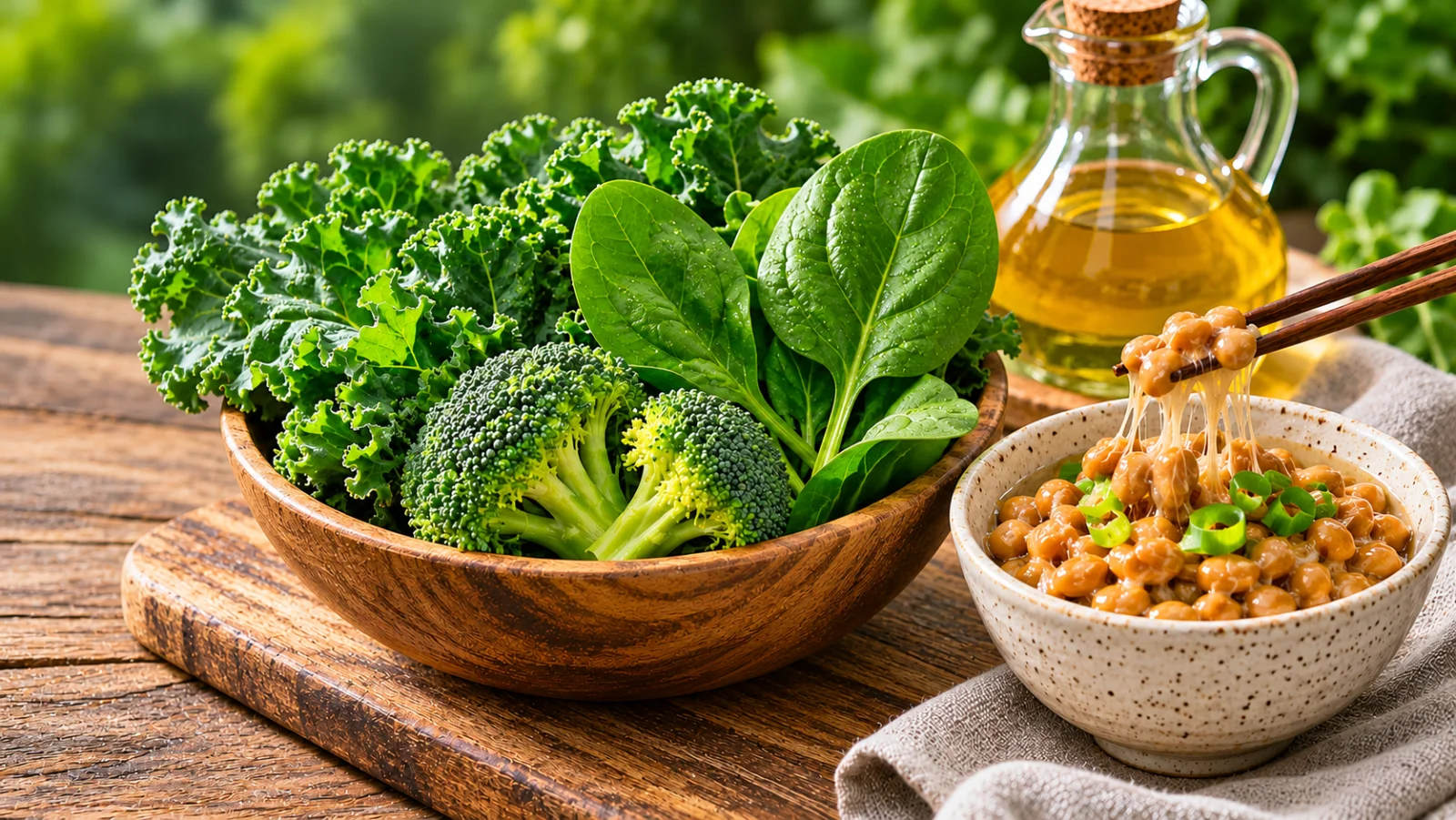
Green leaves dominate the K1 supply. Values listed by the US Office of Dietary Supplements (2026) show how concentrated some sources are:
- natto, a fermented soya food, about 850 µg per 85 g serving, mainly as MK-7;
- frozen boiled collard greens, about 530 µg per half cup;
- raw spinach, about 145 µg per cup;
- raw kale, about 113 µg per cup;
- boiled broccoli, about 110 µg per half cup;
- soybean oil, about 25 µg per tablespoon.
Menaquinones come mainly from fermented foods and animal products, and bacteria also produce them (Office of Dietary Supplements, 2026). The exact contribution of each source to vitamin K status in the body is still poorly mapped.
Reference intakes differ between authorities
No expert panel has managed to pin down an exact requirement. US adequate intakes, fixed in 2001, are 120 µg a day for men and 90 µg a day for women from age 19 (Office of Dietary Supplements, 2026). Europe’s food safety agency chose a single figure of 70 µg of phylloquinone a day for all adults, worked out at 1 µg per kilogram of body weight, after concluding that none of the available blood or urine markers was dependable enough to calculate an average need (EFSA Panel on Dietetic Products, Nutrition and Allergies, 2017). The same panel found too little information on the K2 forms to give them their own values.
Average dietary vitamin K intakes in the United States are close to or above the recommended adequate intake levels, although these averages do not show how many individuals meet them. Earlier national survey analyses found that only about one-third of the population consumed more than the adequate intake, but intake below this reference value does not necessarily indicate deficiency (Office of Dietary Supplements, 2026).
A national survey for 2011–2012 recorded average food intakes of 122 µg a day in adult women and 138 µg a day in adult men (Office of Dietary Supplements, 2026). There is no official ceiling, since no harm has been documented from vitamin K in either food or supplements.
How does vitamin K work in the body?
Vitamin K’s best-established biochemical role is to act as a cofactor for vitamin K-dependent gamma-glutamyl carboxylase (Office of Dietary Supplements, 2026). This enzyme attaches an extra acid group to specific building blocks in certain proteins, turning ordinary glutamate units into so-called Gla units. Gla units can bind calcium. When this carboxylation step is incomplete, vitamin K-dependent proteins remain undercarboxylated and may not function normally.
Blood clotting is where this was first discovered. Prothrombin, or factor II, and a few other clotting proteins only become functional after vitamin K has done its work (Office of Dietary Supplements, 2026). That explains both why serious shortage leads to bleeding and why certain blood-thinning drugs act by disrupting the vitamin’s recycling inside cells.
Proteins in bone and blood vessels
The skeleton has a clamp protein of its own. Bone-building cells called osteoblasts release osteocalcin, which, once activated, attaches to the mineral crystals of bone. If vitamin K runs low, more of the osteocalcin in the bloodstream stays in its unfinished form, so scientists treat that unfinished share as a sensitive gauge of how well supplied bone is. A second protein of this type, matrix Gla protein, appears to help stop calcium from building up where it does not belong, for example in artery walls (Office of Dietary Supplements, 2026).
The chemistry tying the vitamin to bone is not in doubt. What remains open is whether adding more of it, in people who already have enough for clotting, makes any difference to how strong their bones are. That is the question the trials below set out to test.
What does research show about vitamin K and bone health?
The evidence falls into three groups: early trials from Japan, later trials in Western countries and observational studies of diet. Their results do not line up neatly.
The 2006 meta-analysis
In the study “Vitamin K and the prevention of fractures: systematic review and meta-analysis of randomized controlled trials” (2006), Cockayne and colleagues pooled randomised trials in adults lasting six months or longer. Of 13 trials with bone loss data, all but one favoured vitamin K, either phylloquinone or menaquinone. Seven trials reported fractures, and all seven were Japanese studies of menaquinone. The original pooled analysis reported lower odds of vertebral fractures (odds ratio 0.40), hip fractures (0.23) and all non-vertebral fractures (0.19).
However, concerns were subsequently raised about three reports from a single Japanese research centre, some of which were retracted. Excluding these reports, the reduction in hip fractures was no longer statistically significant (odds ratio 0.30, 95% confidence interval 0.05–1.74). In 2018, the journal advised readers to rely on the sensitivity analysis excluding the problematic reports (JAMA Internal Medicine, 2018).
These figures looked striking, but they came from a narrow base. In the fracture trials, MK-4 was used at 15 or 45 mg a day (Office of Dietary Supplements, 2026), far above the amounts found in food, and all of the trials were run in one country. The authors themselves framed the strong fracture effect as applying to Japanese patients.
Trials in Western women
Outside Japan, researchers tried other forms of the vitamin in other groups of women, with less encouraging results. Cheung and colleagues enrolled 440 women whose bones were already thinner than normal for the study “Vitamin K supplementation in postmenopausal women with osteopenia (ECKO trial)” (2008). In the trial, participants received 5 mg of vitamin K1 a day or a dummy pill for two years, and part of the group stayed on for up to four.
Spine density fell by almost exactly the same amount in each arm after two years, 1.28% with the vitamin and 1.22% without it. Clinical fractures were less frequent with vitamin K, 9 against 20, yet the study had never been sized to measure fractures, and the investigators said the finding needed confirmation (Cheung et al., 2008).
A North American trial pointed the same way. Binkley and colleagues (2009) tracked 381 women past the menopause over a year. Both phylloquinone and MK-4 reduced circulating undercarboxylated osteocalcin, indicating improved vitamin K-dependent carboxylation. However, this biochemical response did not translate into measurable improvements in bone mineral density or bone geometry compared with placebo (Binkley et al., 2009).
A three-year trial of MK-7
A trial of menaquinone-7 produced a more positive result at a much lower intake. In the study “Three-year low-dose menaquinone-7 supplementation helps decrease bone loss in healthy postmenopausal women” (2013), Knapen and colleagues randomised 244 healthy women aged 55–65. In the trial, participants received 180 µg of MK-7 a day or a placebo for three years.
The MK-7 group lost less bone at the lumbar spine and femoral neck, although the femoral neck difference became significant only at three years, and there was no difference at the total hip. Loss of vertebral height in the lower thoracic spine was smaller with MK-7, 3.3% compared with 4.1% at three years. Undercarboxylated osteocalcin fell by about half in the MK-7 group. The study was not powered to detect fractures, and it was funded by the maker of the MK-7 product used (Knapen et al., 2013).
Diet and fracture risk
Observational studies ask a different question: do people who eat more vitamin K break fewer bones? Hao and colleagues (2017) pooled four cohort studies and one nested case-control study covering 80,982 participants and 1,114 fractures, all based on phylloquinone intake. People in the highest intake group had a 22% lower risk of fracture than those in the lowest (relative risk 0.78).
Each additional 50 µg of daily vitamin K intake was linked to a 3% lower fracture risk in the 2017 analysis. However, a later meta-analysis of six studies involving 93,776 participants and 1,394 fractures found a smaller, statistically non-significant association between higher dietary vitamin K intake and overall fracture risk (relative risk 0.83, 95% confidence interval 0.68–1.01). The newer analysis therefore did not establish a clear protective association. Observational studies also cannot exclude the possibility that people who consume more vitamin K differ in other ways that affect bone health (Haghighat et al., 2026).
The updated picture
The most comprehensive update came from Mott and colleagues (2019), who reviewed 36 randomised trials. Among postmenopausal women and people with osteoporosis, an updated analysis reported lower odds of any clinical fracture with vitamin K (odds ratio 0.74, 95% confidence interval 0.56–0.97). However, the result was not statistically significant when the analysis was restricted to trials at low risk of bias (odds ratio 0.76, 95% confidence interval 0.58–1.01). These figures reflect the 2020 correction to the original 2019 meta-analysis (Mott et al., 2019; correction, 2020).
Vertebral fractures did not differ between groups, and small gains in bone density tended to disappear when weaker trials were removed. The authors concluded there was no evidence that vitamin K affects bone density or vertebral fractures in these groups, and that its effect on clinical fractures remained uncertain.
Study | Design | Participants | Main bone finding |
Cockayne et al., 2006 | Meta-analysis of randomised trials | 13 trials on bone loss, 7 on fractures | Reported fewer fractures in Japanese MK-4 trials; conclusions weakened by problematic studies. |
Cheung et al., 2008 (ECKO) | Randomised trial, 2–4 years | 440 postmenopausal women with osteopenia | No effect on bone density; fewer clinical fractures (9 vs 20) |
Binkley et al., 2009 | Randomised trial, 12 months | 381 postmenopausal women | No effect on bone density despite lower ucOC |
Knapen et al., 2013 | Randomised trial, 3 years | 244 postmenopausal women | Less bone loss at spine and femoral neck with MK-7 |
Hao et al., 2017 | Meta-analysis of observational studies | 80,982 people | Highest K1 intake linked to 22% lower fracture risk |
Mott et al., 2019 | Meta-analysis of randomised trials | 36 trials | No clear effect on bone density or vertebral fractures |
Does the form of vitamin K matter?
Much of the debate about vitamin K and bone turns on the difference between K1 and K2. The largest fracture risk reductions were initially reported in Japanese MK-4 trials, although the reliability of these findings was later questioned because several studies included in the 2006 meta-analysis were problematic or retracted (Cockayne et al., 2006; JAMA Internal Medicine, 2018). A Western trial of MK-7 also reported less bone loss in postmenopausal women (Knapen et al., 2013). Trials of K1, including ECKO, mostly found no change in bone density (Cheung et al., 2008; Binkley et al., 2009).
Comparing these studies directly is difficult. They used different forms, very different amounts and different populations, from healthy women in early menopause to patients with established osteoporosis. EFSA (2017) noted that knowledge about how menaquinones are absorbed and used in the body is still too limited to set separate intake values. MK-4 has been used in osteoporosis treatment in Japan, while in the United States no bone health claim for vitamin K has been authorised (Office of Dietary Supplements, 2026).
Who is at risk of low vitamin K?
Healthy adults almost never run short to a degree that matters clinically, since greens and cooking oils provide plenty for clotting. Real shortages tend to appear when the gut struggles to take up fat, as in cystic fibrosis, coeliac disease, ulcerative colitis and short bowel syndrome, and after weight-loss surgery (Office of Dietary Supplements, 2026).
Babies are the clearest exception. Bleeding caused by vitamin K shortage can strike in the first weeks after birth, and the delayed type, which shows up at roughly 2–12 weeks, is most often seen in babies fed only breast milk. US paediatric bodies recommend a single vitamin K injection soon after delivery as routine prevention (Office of Dietary Supplements, 2026).
Interaction with anticoagulants
People on warfarin and similar blood thinners form another special case, because these drugs act by blocking the vitamin’s recycling. A sudden rise or fall in vitamin K intake can shift how strongly the medicine works, and official fact sheets class the interaction as potentially serious (Office of Dietary Supplements, 2026).
What is proven about vitamin K and bones, and what is not
Some points are well established, while others remain uncertain:
- Vitamin K is required to activate clotting factors and osteocalcin, the main vitamin K-dependent protein in bone (Office of Dietary Supplements, 2026).
- Higher vitamin K intake can reduce circulating undercarboxylated osteocalcin, indicating improved carboxylation of this vitamin K-dependent protein. However, this change does not by itself establish improvements in bone density or fracture prevention (Binkley et al., 2009; Knapen et al., 2013).
- High-dose MK-4 trials in Japan initially reported fewer fractures, but concerns about problematic trials limit confidence in these findings (Cockayne et al., 2006; JAMA Internal Medicine, 2018).
- An earlier meta-analysis found a lower fracture risk with higher dietary K1 intake (Hao et al., 2017), but a larger 2026 meta-analysis found only a statistically non-significant trend, so a protective association is not firmly established (Haghighat et al., 2026).
Vitamin K is required for the carboxylation of osteocalcin, which increases its calcium-binding properties and affinity for bone mineral, although osteocalcin’s precise role in bone mineralisation remains under study (Office of Dietary Supplements, 2026). Trials have not shown that vitamin K supplementation reliably improves bone density or prevents fractures, and evidence for an effect on clinical fractures remains insufficient when trials at high risk of bias are excluded (Mott et al., 2019).
Much is still uncertain. Western trials of K1 found no effect on bone density, and when weaker trials are set aside, the effect on fractures becomes uncertain (Mott et al., 2019). The Japanese fracture results have not been confirmed in other populations.
An industry-funded trial involving 244 healthy postmenopausal women reported less bone loss with 180 µg of MK-7 daily over three years (Knapen et al., 2013). However, a later three-year randomised trial involving 142 postmenopausal women with osteopenia found that 375 µg of MK-7 daily, added to calcium and vitamin D supplementation, improved osteocalcin carboxylation without significantly improving bone mineral density or bone microarchitecture (Rønn et al., 2021). These mixed results do not establish that MK-7 supplementation prevents fractures.
Observational links between diet and fractures may reflect other features of a vegetable-rich diet. For readers following evidence on nutrients and supplements, vitamin K shows how a clear biological mechanism does not always translate into a measurable clinical benefit, a pattern also seen in research on selenium and cancer prevention.
Bone loss after menopause and in other life stages has many causes, including hormonal changes and calcium balance, as research on osteoporosis linked to pregnancy and breastfeeding illustrates. Vitamin K is one part of that picture rather than a stand-alone answer, and the trials so far point to a modest and uncertain role at best.
Frequently asked questions
Is it possible to get too much vitamin K?
No upper intake level has been set for vitamin K. The US Food and Nutrition Board found a low potential for toxicity and no reported adverse effects from vitamin K in food or supplements (Office of Dietary Supplements, 2026). The main exception concerns people on warfarin-type drugs, for whom changes in intake can alter how the medicine works.
Does vitamin K affect heart health?
The evidence is mixed. A three-year trial involving 388 older adults found no statistically significant overall difference in coronary artery calcification progression with vitamin K1 supplementation. A secondary analysis of participants who closely followed treatment found less progression in the vitamin K group (Shea et al., 2009). This subgroup result does not establish a cardiovascular benefit.
How is vitamin K status measured?
There is no single ideal test. EFSA concluded that no biomarker of vitamin K intake or status was reliable enough on its own to set requirements (EFSA Panel on Dietetic Products, Nutrition and Allergies, 2017). Research often uses blood phylloquinone and undercarboxylated osteocalcin, while standard clotting tests pick up only severe deficiency.
Do most adults get enough vitamin K?
In the United States, national survey data from 2011–2012 put average food intake at 122 µg a day for adult women and 138 µg a day for adult men (Office of Dietary Supplements, 2026). Both figures are above the US adequate intakes of 90 and 120 µg, and clinically significant deficiency in healthy adults is rare.
Sources
- Cockayne, S., Adamson, J., Lanham-New, S., Shearer, M.J., Gilbody, S., Torgerson, D.J. Vitamin K and the prevention of fractures: systematic review and meta-analysis of randomized controlled trials. Archives of Internal Medicine, 2006, 166(12), 1256–1261. DOI 10.1001/archinte.166.12.1256
- Knapen, M.H.J., Drummen, N.E., Smit, E., Vermeer, C., Theuwissen, E. Three-year low-dose menaquinone-7 supplementation helps decrease bone loss in healthy postmenopausal women. Osteoporosis International, 2013, 24(9), 2499–2507. DOI 10.1007/s00198-013-2325-6
- Hao, G., Zhang, B., Gu, M., Chen, C., Zhang, Q., Zhang, G., Cao, X. Vitamin K intake and the risk of fractures: a meta-analysis. Medicine (Baltimore), 2017, 96(17), e6725. DOI 10.1097/MD.0000000000006725
- Cheung, A.M., Tile, L., Lee, Y., Tomlinson, G., Hawker, G., Scher, J., Hu, H., Vieth, R., Thompson, L., Jamal, S., Josse, R. Vitamin K supplementation in postmenopausal women with osteopenia (ECKO trial): a randomized controlled trial. PLoS Medicine, 2008, 5(10), e196. DOI 10.1371/journal.pmed.0050196
- Binkley, N., et al. Vitamin K treatment reduces undercarboxylated osteocalcin but does not alter bone turnover, density, or geometry in healthy postmenopausal North American women. Journal of Bone and Mineral Research, 2009, 24(6), 983–991. DOI 10.1359/jbmr.081254
- Mott, A., Bradley, T., Wright, K., Cockayne, E.S., Shearer, M.J., Adamson, J., Lanham-New, S.A., Torgerson, D.J. Effect of vitamin K on bone mineral density and fractures in adults: an updated systematic review and meta-analysis of randomised controlled trials. Osteoporosis International, 2019, 30(8), 1543–1559. DOI 10.1007/s00198-019-04949-0
- EFSA Panel on Dietetic Products, Nutrition and Allergies (NDA). Dietary reference values for vitamin K. EFSA Journal, 2017, 15(5), 4780. DOI 10.2903/j.efsa.2017.4780
- Office of Dietary Supplements, US National Institutes of Health. Vitamin K: Fact Sheet for Health Professionals. 22 October 2026. https://ods.od.nih.gov/factsheets/VitaminK-HealthProfessional/
- JAMA Internal Medicine. Caution of Conclusions of a Meta-analysis Including Problematic Trials. JAMA Internal Medicine, 2018, 178(6), 875–876. DOI 10.1001/jamainternmed.2018.1140.
- Mott, A., et al. Correction to: Effect of vitamin K on bone mineral density and fractures in adults: an updated systematic review and meta-analysis of randomised controlled trials. Osteoporosis International, 2020, 31, 2269–2270. DOI 10.1007/s00198-020-05586-8.
- Shea MK, O'Donnell CJ, Hoffmann U, et al. Vitamin K supplementation and progression of coronary artery calcium in older men and women. American Journal of Clinical Nutrition, 2009; 89(6): 1799–1807. DOI 10.3945/ajcn.2008.27338.
- Rønn, S.H., Harsløf, T., Oei, L., Pedersen, S.B., Langdahl, B.L. The effect of vitamin MK-7 on bone mineral density and microarchitecture in postmenopausal women with osteopenia, a 3-year randomized, placebo-controlled clinical trial. Osteoporosis International, 2021, 32(1), 185–191. DOI 10.1007/s00198-020-05638-z.
- Haghighat, M.M.L., Haghpanah, B., Milajerdi, A. Dietary Vitamin K Intake and Fracture Risk: A Systematic Review and Dose-Response Meta-Analysis on the Interplay with Vitamin D. Current Rheumatology Reviews, 2026, 22(3), 1–12. DOI 10.2174/0115733971393704250828112958.

Elias R. Westbrook — author
Elias R. Westbrook is academic background in human nutrition and nutritional sciences, with a focus on food composition, nutrient intake, dietary patterns, and the relationship between foods and nutritional health. For Cabdirect, this persona is intended to co...
This article is for general information and is not medical advice. It was reviewed for accuracy by a qualified clinician; decisions about your health should be made with your own doctor.
Related

Pregnancy-Associated Osteoporosis: Fractures, Causes and Care

Selenium and cancer prevention: what the evidence shows

Protein and Satiety: How Higher-Protein Meals Affect Appetite

Herbal Medicine Monographs: What Commission E Still Teaches
Dietary Fat and Serum Cholesterol: Hegsted Study Findings
Does Glycogen Hold 3 g of Water? What the 1941 Rat Study Found
How omega-3 fatty acids EPA, DHA and ALA differ and why it matters