What erythritol is and what studies say about its effect on blood clots
Erythritol is a low-energy sugar alcohol used to sweeten foods, and laboratory and cohort work has tied it to clotting, though nothing yet shows that eating it causes heart disease (JECFA, 2000; Witkowski et al., 2023; EFSA, 2023). In patients referred for heart checks, the top quarter for erythritol in plasma carried adjusted hazard ratios of 1.80 in a US cohort and 2.21 in a cohort in Europe for later cardiac events (Witkowski et al., 2023).
The article starts with the substance itself. It explains how the body handles erythritol and how regulators in Europe and the US have assessed it, before turning to the clotting research. That part covers cohort, platelet and genetic studies, followed by digestive effects and open questions. Sources include regulatory opinions, cohort and case-control studies, small intervention trials, Mendelian randomisation analyses and reviews.

Evidence last checked 17 Nov 2026 · 11 min
Erythritol as a substance and its natural sources
Chemically, erythritol is a four-carbon polyol carrying 60 to 80% of sugar's sweetness (JECFA, 2000). Small amounts turn up naturally in fruit, mushrooms, wine, sake and soya sauce, usually at 700 to 1,300 mg/kg (JECFA, 2000).
Commercial supplies come from fermentation instead, and the body also makes some of its own through the pentose phosphate pathway (Mazi and Stanhope, 2023). One US notice describes production with the yeast-like fungus Moniliella pollinis and lists uses from flavour enhancer to texturiser (FDA, 2019).
The EU lists it as E 968 in 66 food categories (EFSA, 2023). It supplies negligible energy, and one review says it sits better in the gut than other polyols because so much of it enters the bloodstream (Mazi and Stanhope, 2023). The Cleveland group, which later tied the sweetener to cardiac events, described its use in processed and keto foods as rising quickly (Witkowski et al., 2023). Why sweet foods affect how much people eat is a separate question, covered in sensory-specific satiation.
Uptake, excretion and internal production
Once swallowed, erythritol does not behave like most polyols. Its concentration in plasma has two sources: food and the body's own production.
Uptake from the gut and loss in urine
Uptake in the upper gut reaches 60 to 90% of a dose across studies (EFSA, 2023). What is taken up then leaves through the kidneys in its original form, and only a small share becomes erythronate (EFSA, 2023). That share is below 1% of the dose (EFSA, 2023).
In the JECFA review, about 90% of a dose was recovered unchanged within 48 hours (JECFA, 2000). Another review reports about 90% of a 20 g dose within 24 hours, but 80% when people took 1 g/kg (Mazi and Stanhope, 2023). What happens to the remaining 10 to 20% is not clear (Mazi and Stanhope, 2023). If gut bacteria ferment the missing 10%, the energy value would be about 0.4 kcal/g (JECFA, 2000).
Production from glucose in human cells
The body makes some itself. Hootman and colleagues (2017) showed this conversion through the pentose phosphate pathway in tracer experiments with blood.
The team enrolled 264 university freshmen in a nine-month study, but only 172 had data at both the start and the end of the year (Hootman et al., 2017). Students who went on to gain central fat had 15 times as much erythritol in their plasma as students whose fat stayed stable, a gap measured in pooled samples from small groups (Hootman et al., 2017). The authors concluded that the body's own production may help explain why erythritol tracks with obesity (Hootman et al., 2017).
A later review drew the same conclusion for heart and metabolic disease. Circulating levels in these studies are unlikely to reflect diet and more likely signals disturbed glucose metabolism (Mazi and Stanhope, 2023).
Regulatory limits in Europe and the US
Food safety bodies in Europe and the US have looked at erythritol several times. Their limits are set around its effect on the gut. Separately, WHO (2023) excludes sugar alcohols such as erythritol from its recommendation on non-sugar sweeteners for weight control.
The intake limit set by EFSA
Before 2023, Europe had no numerical ADI for erythritol (EFSA, 2023). Reviewing the additive again, the EFSA panel treated diarrhoea as an adverse effect because of its possible association with an imbalance of electrolytes and water in the body (EFSA, 2023). It took 0.5 g/kg of body weight, the lower end of the no-adverse-effect range for diarrhoea, as its reference point (EFSA, 2023).
From that point the panel set an ADI of 0.5 g/kg of body weight per day (EFSA, 2023). It was the first time an ADI for a food additive rested on an immediate effect such as diarrhoea (EFSA, 2023). High consumers could exceed the new limit after single and repeated exposure, although the panel judged that its brand-loyal, maximum-level and per-meal exposure scenarios all overestimated intake (EFSA, 2023).
On heart health, the panel found that the evidence did not show a causal link between dietary erythritol and cardiovascular illness (EFSA, 2023). Further studies might help, it added.
GRAS notices and FDA letters
In the US, erythritol reached the market through notices claiming it was generally recognised as safe. FDA answered earlier notices in 2001, 2007, 2011 and 2012 with letters saying it had no questions (FDA, 2019). A 2019 letter said the same (FDA, 2019).
That is not approval. FDA states that it is not an affirmation of GRAS status under federal rules (FDA, 2019). As reported in the FDA letter, the notifier Cargill estimated exposure at 32.1 g a day on average and 63.0 g at the 90th percentile, and said probable intake would be about half, in line with earlier estimates of 13 and 30 g (FDA, 2019). Internationally, the FAO and WHO expert committee gave erythritol an ADI of "not specified" at its 53rd meeting in 1999 (FDA, 2019).
Research on erythritol, platelets and clotting
Concern about clotting comes mainly from one research group in Cleveland. It used cohorts, lab tests and drinks.
Cohorts of cardiac patients
In an untargeted screen, the Cleveland team first flagged erythritol, where it ranked near the top of the molecules tied to cardiac events, its hazard ratio 3.22 before adjustment (Witkowski et al., 2023). They then measured it directly in a US cohort of 2,149 and a European cohort of 833 patients undergoing heart evaluation (Witkowski et al., 2023).
After adjustment, those in the top quarter had hazard ratios of 1.80 and 2.21 versus the bottom quarter (Witkowski et al., 2023). Each 1 µM rise matched a 21% and 16% higher adjusted risk across the two groups.
The authors list several limits. Erythritol was measured once, as a fasting level at enrolment (Witkowski et al., 2023). The patients came from referral centres with high rates of heart disease, so the results may not carry over to the general population. By design, the cohorts can show association only, and unmeasured factors such as diet could have affected the results.
EFSA reviewed these data. It noted that no dietary information was available and that the low blood levels pointed to internal production as the main source for most participants (EFSA, 2023).
Platelet tests after a sweetened drink
Under lab conditions, erythritol boosted platelet reactivity and promoted clot formation in mice (Witkowski et al., 2023). Effects appeared at 4.5 to 45 µM in test tubes. EFSA judged that these lab and mouse experiments gave too little basis for predicting effects in humans and could not contribute to its own risk assessment of erythritol (EFSA, 2023).
The same 2023 paper tested a 30 g drink in eight healthy volunteers (Witkowski et al., 2023). Plasma levels rose from a median of 3.84 µM to 5.85 mM at 30 minutes and stayed high for more than two days. The authors compared the dose with a can of sweetened drink or a pint of keto ice cream.
In 2024 the group gave 30 g of erythritol to one set of 10 healthy volunteers and 30 g of glucose to another (Witkowski et al., 2024). After erythritol, plasma reached a median of 6,480 µM against 3.8 µM at baseline. Platelet responses rose in every person who drank it. The authors call the study small and note that long-term effects were not tested.
Larger cohorts, genetic analyses and critics
Larger cohorts point in different directions. In the ARIC study of 4,006 older adults without heart disease, higher concentrations of erythritol and erythronate, its breakdown product, went with total mortality, cardiovascular death and heart failure (Abushamat et al., 2025). Coronary heart disease and stroke tracked erythronate instead (Abushamat et al., 2025). Intake was never recorded (Abushamat et al., 2025).
In 762 women who later developed coronary heart disease and 762 matched controls from the Nurses' Health Study, the highest quarter of erythritol had a relative risk of 1.55 (Heianza et al., 2025). Once diabetes was taken into account, the figure fell to 1.21, with a confidence interval that included no effect (Heianza et al., 2025). Its blood samples date from 1989–90 and 2000–02, so not all of them predate the first FDA letter on erythritol, sent in 2001 (Heianza et al., 2025; FDA, 2019). The authors think the measured levels mainly reflected production from glucose inside the body (Heianza et al., 2025).
Genetic studies disagree. One Mendelian randomisation analysis, which uses genetic variants as a stand-in for lifelong blood levels, found nothing indicating that higher circulating erythritol raises coronary artery disease risk (Khafagy et al., 2024). Another, using 60 genetic variants from 8,167 Europeans, linked genetically higher erythritol with coronary heart disease and ischaemic stroke (Sun et al., 2025). It found only a suggestive signal for deep vein thrombosis and no reliable evidence of a causal link with venous clots (Sun et al., 2025).
An independent crossover trial in 14 healthy people found that platelets clumped no more after 50 g of erythritol compared with water, though it is a preprint without peer review (Wölnerhanssen et al., 2026). Its blood tests came 60 minutes after the drink, against 30 minutes in the Cleveland work. Critics also point out that EU rules cap erythritol as a flavour enhancer in energy-reduced or no-added-sugar flavoured drinks at 1.6%, or 4.8 g in a 300 ml drink (Cramer et al., 2023).
Study | Design and size | What was measured | Main finding |
Witkowski et al. (2023) | Cohorts of 2,149 and 833 patients | Heart events by blood erythritol | Adjusted HR 1.80 and 2.21 |
Witkowski et al. (2024) | 10 per group, one 30 g drink | Platelet reactivity at 30 min | Higher responses after erythritol |
Abushamat et al. (2025) | Cohort of 4,006 older adults | Heart failure, death, CHD, stroke | CHD and stroke linked to erythronate |
Heianza et al. (2025) | 762 cases, 762 controls | Coronary heart disease | RR 1.21 after diabetes adjustment |
Wölnerhanssen et al. (2026), preprint | Crossover, 14 people, 50 g | Platelet aggregation at 60 min | No increase |
Note: cohort figures describe associations with plasma concentrations, which partly reflect production inside the body. The two drink trials measured laboratory platelet tests after one dose, not clots or heart events.
Gut effects and weak points of the cohort data
The best-documented side effect concerns digestion. The clotting question is harder to settle because of how the studies were built.
Laxative effects of large doses
A big dose taken at once can loosen the bowels. In three studies, the dose without laxative effect was 0.46 to 0.66 g/kg in men and 0.76 to 0.80 g/kg in women, given in one go as a drink or jelly (JECFA, 2000). Spread across meals for five days, 1 g/kg a day caused no effect, while the same amount taken as a drink on an empty stomach did (JECFA, 2000).
Other polyols are tolerated less well (Mazi and Stanhope, 2023). EU labels must still carry a laxative warning on foods with more than 10% added polyols (European Parliament and Council, 2011). EFSA refused to exempt it from that label (EFSA, 2023).
Problems in reading blood levels
Timing is one problem. In the two largest US studies behind the early links with metabolic and heart disease, samples were collected before erythritol was cleared as a food ingredient (Mazi and Stanhope, 2023). The ARIC authors make a similar point about their own cohort and the earlier Cleveland data: both were observational and neither recorded participants' erythritol intake (Abushamat et al., 2025).
Confounding and reverse causality remain concerns in such designs (Abushamat et al., 2025). People with higher blood sugar may simply produce extra erythritol, making it a marker of poor glucose control (Abushamat et al., 2025). The Nurses' Health Study analysis relied on semi-quantitative measurements, a limitation the authors acknowledge (Heianza et al., 2025). Cohort studies can generate hypotheses, but they cannot prove cause (Cramer et al., 2023).
What is settled about erythritol and what remains open
As a substance, erythritol is well characterised: the gut takes up the bulk of a dose, which then leaves through the kidneys in its original form, and big single doses can cause diarrhoea. One small trial found higher platelet reactivity in lab tests after a single large dose, but effects on actual clots, heart events and long-term health have not been shown (Witkowski et al., 2024).
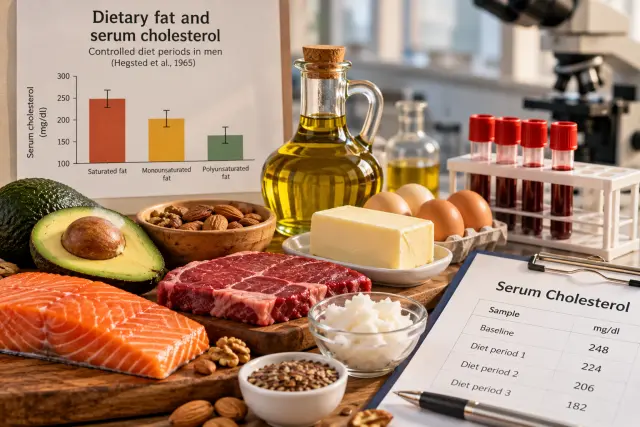
Older research on diet and heart risk, such as the Hegsted study on dietary fat, shows how long such questions can take to settle.
In the cohorts, erythritol was measured once in plasma, and EFSA judged that most of it probably came from internal production (EFSA, 2023).
Some points are settled. EFSA set its ADI on the basis of diarrhoea and found no demonstrated causal link with heart disease (EFSA, 2023). In the Nurses' Health Study, the association for erythritol did not hold up independently of diabetes (Heianza et al., 2025).
Other points are open. The Cleveland authors want long-term safety studies, and their 2024 trial did not test chronic effects (Witkowski et al., 2024). Whether raised erythritol levels contribute to disease or simply mark disturbed glucose metabolism is still unresolved (Mazi and Stanhope, 2023). Even the independent preprint states that its results cannot confirm long-term heart safety (Wölnerhanssen et al., 2026).
Long-term trials of benefit are almost completely lacking (Mazi and Stanhope, 2023). Blood sugar control, a common reason for choosing sweeteners, is discussed in a separate article on pistachios and diabetes.
Frequently asked questions
Is erythritol a sugar alcohol?
Yes. JECFA describes it as a four-carbon sugar alcohol (JECFA, 2000). EU law defines polyols as alcohols with more than two hydroxyl groups, and erythritol is regulated as one (European Parliament and Council, 2011). The WHO places sugar alcohols outside its definition of non-sugar sweeteners (WHO, 2023). Its sweetness is lower than that of table sugar.
Does erythritol raise blood sugar?
The available studies suggest it does not in the short term. In healthy adults, single doses of 0.3 and 1 g/kg had no effect on blood glucose or insulin (JECFA, 2000). EFSA found the evidence limited but consistent in showing no short-term effect on blood sugar after meals (EFSA, 2023). Long-term trials in people with diabetes are scarce.
Does erythritol have calories?
Very few. For food labels, erythritol is counted as 0 kcal per gram, against 2.4 kcal per gram for other sugar alcohols (Mazi and Stanhope, 2023). Physiological estimates are slightly higher: if gut bacteria ferment the 10% not excreted in urine, the energy value would be about 0.4 kcal per gram (JECFA, 2000).
Is erythritol found naturally in foods?
Yes, in small amounts. It occurs in fruits such as pears and watermelon (Hootman et al., 2017). JECFA also lists mushrooms and fermented products such as wine, sake and soya sauce, usually at 700 to 1,300 mg/kg (JECFA, 2000). The erythritol added to foods is produced industrially by fermentation (Mazi and Stanhope, 2023).
Does the WHO sweetener guideline cover erythritol?
No. The 2023 WHO guideline recommends against non-sugar sweeteners for weight control (WHO, 2023). It explicitly excludes sugar alcohols, which WHO treats as sugar derivatives that contain calories and therefore not as non-sugar sweeteners (WHO, 2023). As a sugar alcohol, erythritol falls outside the guideline.
Sources
- Witkowski M, Nemet I, Alamri H, et al. The artificial sweetener erythritol and cardiovascular event risk. Nature Medicine. 2023;29(3):710–718. DOI 10.1038/s41591-023-02223-9.
- Witkowski M, Wilcox J, Province V, et al. Ingestion of the non-nutritive sweetener erythritol, but not glucose, enhances platelet reactivity and thrombosis potential in healthy volunteers - Brief Report. Arteriosclerosis, Thrombosis, and Vascular Biology. 2024;44(9):2136–2141. DOI 10.1161/ATVBAHA.124.321019.
- Mazi TA, Stanhope KL. Erythritol: an in-depth discussion of its potential to be a beneficial dietary component. Nutrients. 2023;15(1):204. DOI 10.3390/nu15010204.
- EFSA Panel on Food Additives and Flavourings (FAF). Re-evaluation of erythritol (E 968) as a food additive. EFSA Journal. 2023;21(12):e8430. DOI 10.2903/j.efsa.2023.8430.
- U.S. Food and Drug Administration. Response letter to GRAS Notice No. GRN 000789 (erythritol). Signed 20 February 2019. https://fda.gov/media/121983/download
- Joint FAO/WHO Expert Committee on Food Additives. Erythritol. In: Safety evaluation of certain food additives and contaminants. WHO Food Additives Series 44. Geneva: World Health Organization; 2000.
- Hootman KC, Trezzi JP, Kraemer L, et al. Erythritol is a pentose-phosphate pathway metabolite and associated with adiposity gain in young adults. Proceedings of the National Academy of Sciences of the United States of America. 2017;114(21):E4233–E4240. DOI 10.1073/pnas.1620079114.
- Abushamat LA, Yu B, Hoogeveen RC, et al. Erythritol, erythronate, and cardiovascular outcomes in older adults in the ARIC study. JACC: Advances. 2025;4(3):101605. DOI 10.1016/j.jacadv.2025.101605.
- Heianza Y, Sun Q, Wang X, et al. Plasma levels of polyols erythritol, mannitol, and sorbitol and incident coronary heart disease among women. European Journal of Preventive Cardiology. 2025;32(5):404–414. DOI 10.1093/eurjpc/zwae288.
- Khafagy R, Paterson AD, Dash S. Erythritol as a potential causal contributor to cardiometabolic disease: a Mendelian randomization study. Diabetes. 2024;73(2):325–331. DOI 10.2337/db23-0330.
- Sun Y, Sun D, Wu J, Peng Z, Jin J. Role of erythritol in coronary heart disease, ischemic stroke, and venous thromboembolism: a Mendelian randomization analysis. Medicine (Baltimore). 2025;104(43):e45187. DOI 10.1097/MD.0000000000045187.
- Cramer T, Gonder U, Kofler B. Plasma erythritol and cardiovascular risk: is there evidence for an association with dietary intake? Frontiers in Nutrition. 2023;10:1195521. DOI 10.3389/fnut.2023.1195521.
- Wölnerhanssen BK, Altstädt A, Flad E, et al. No evidence for increased platelet reactivity with xylitol or erythritol sweeteners in healthy humans. medRxiv preprint, not peer reviewed, posted 29 September 2026. DOI 10.64898/2026.09.25.26364060.
- World Health Organization. WHO advises not to use non-sugar sweeteners for weight control in newly released guideline. 15 May 2023. https://who.int/news/item/15-05-2023-who-advises-not-to-use-non-sugar-sweeteners-for-weight-control-in-newly-released-guideline
- European Parliament and Council of the European Union. Regulation (EU) No 1169/2011 on the provision of food information to consumers. Official Journal of the European Union. 2011;L 304:18–63.

Elias R. Westbrook — author
Elias R. Westbrook is academic background in human nutrition and nutritional sciences, with a focus on food composition, nutrient intake, dietary patterns, and the relationship between foods and nutritional health. For Cabdirect, this persona is intended to co...
This article is for general information and is not medical advice. It was reviewed for accuracy by a qualified clinician; decisions about your health should be made with your own doctor.
Related
Dietary Fat and Serum Cholesterol: Hegsted Study Findings
Can Pistachios Help With Diabetes? What a 2009 Rat Study Found

How Sensory-Specific Satiation Shapes Appetite and Food Intake

What studies say about whether aspartame is bad for you

What kombucha is and what is actually in the fizzy fermented tea

Green tea benefits and which catechin claims hold up in studies
How much protein the body really needs each day