











What kombucha is and what is actually in the fizzy fermented tea
Kombucha is sweetened tea fermented by a mixed community of yeasts and bacteria, and while its sourness is fairly predictable, much of what ends up in a given bottle is not (Greenwalt et al., 2000; Yang et al., 2022). Among 12 drinks bought in US shops, live microbes ranged from 10^3 to 10^7 cfu/mL, and one bottle held none that could be detected (O'Sullivan and O'Sullivan, 2024). Evidence in people is thin: a search of 310 articles in 2018 found a single study with human results (Kapp and Sumner, 2019).
The article first explains how the drink is brewed and which organisms do the work. It then sets out laboratory measurements of acids, sugar, caffeine and alcohol, the trials in people published so far and the case reports linked to the drink. Sources include laboratory surveys of retail products, controlled trials, case reports and US federal guidance.

Evidence last checked 18 Nov 2026 · 13 min
Kombucha as a drink and how it is brewed
Food scientists describe kombucha as a tea drink that is a little sweet and a little sour, drunk around the world and traditionally in Germany, Russia and China (Greenwalt et al., 2000). Its origin is unclear (May et al., 2019). Written mentions, though, go back to Russia in the early nineteenth century (May et al., 2019). Its recent spread in the United States has been tied to the market for functional foods (Kapp and Sumner, 2019).
US federal regulators work with a similar definition: a fermented drink of brewed tea plus sugar that bacteria and yeasts act on (TTB, 2015). A 1995 health report still called that culture the "Kombucha mushroom", though it is in fact a mat produced by bacteria (CDC, 1995; Harrison and Curtin, 2021). How the tea itself is grown and processed is covered in coffee, cocoa and tea cultivation.
Sweet tea and the starter culture
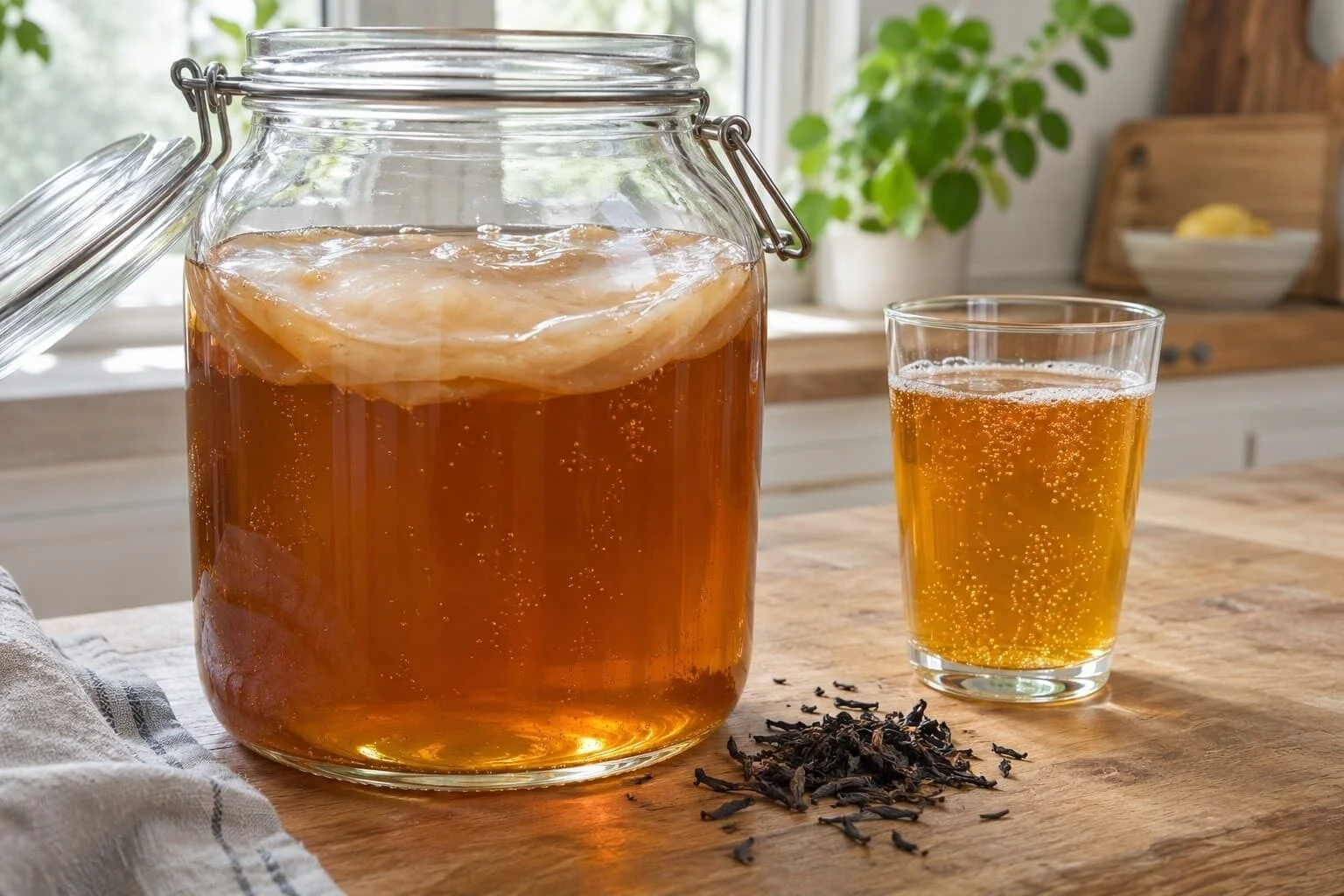
In the usual method summarised by microbiologists, green or black tea is steeped for 5 min or longer, sweetened with 5–10% sucrose, cooled to about 20 °C and mixed with liquid from an earlier batch, usually 10–20% of the volume (May et al., 2019). These figures describe common practice reported in the literature rather than a tested recipe. Fermentation also begins when the solid cellulose layer is moved into fresh sweet tea and the microbes it carries start working (Harrison and Curtin, 2021).
The cellulose film on the surface
A mat of bacterial cellulose from a previous brew, often called the mother or SCOBY, is usually laid on top, and fermentation then runs for 10–14 days (May et al., 2019). The mat forms only when at least one cellulose-making acetic acid bacterium of the genus Komagataeibacter is present (Harrison and Curtin, 2021).
SCOBY is shorthand for a culture in which bacteria and yeast live together symbiotically (Harrison and Curtin, 2021). The term names the solid layer, which brewers also call the mother, and not the liquid that people drink (May et al., 2019).
The microbes that ferment the tea
The work is split between yeasts and bacteria. Yeast enzymes split table sugar into fructose and glucose and convert those into carbon dioxide and ethanol, and bacterial enzymes then oxidise the ethanol into acetic acid, which pushes the pH down (May et al., 2019). The result is a fizzy, sour drink with a little alcohol (May et al., 2019).
The species vary (May et al., 2019). Profiles appear to differ partly by region, and no single standard set of species holds across all ingredients and conditions (May et al., 2019). A survey of 103 starter cultures found no regional pattern (Harrison and Curtin, 2021).
Yeasts in the culture
The yeast side is the more changeable one, with Saccharomyces, Pichia, Candida, Zygosaccharomyces, Torulaspora, Schizosaccharomyces and Brettanomyces among the genera reported (May et al., 2019). Earlier papers more often named Zygosaccharomyces as the leading yeast (Harrison and Curtin, 2021).
A sequencing survey of 103 starter cultures from brewers, mostly in North America, found Brettanomyces in 99% of them instead (Harrison and Curtin, 2021). Where Brettanomyces was scarcer, Zygosaccharomyces, Lachancea or Starmerella filled the gap (Harrison and Curtin, 2021). The brewers' trade body Kombucha Brewers International paid for part of that work (Harrison and Curtin, 2021).
Bottled drinks give a different picture again. Among 12 US retail products, Lachancea cidri turned up in 10, Brettanomyces in 9, Malassezia in 6 and Saccharomyces in 5 (O'Sullivan and O'Sullivan, 2024).
Acetic acid bacteria
On the bacterial side, Komagataeibacter led (Harrison and Curtin, 2021). It was detected in 97% of the same 103 cultures, which fell into four distinct community types, but these shares come from DNA in the solid film and so show which organisms are present rather than how many living cells reach a glass (Harrison and Curtin, 2021).
In most of the nine bottled US products already mentioned, the leading bacteria were either Bacillus coagulans, a probiotic, or fermenting species such as Komagataeibacter, Gluconobacter, Gluconacetobacter and the lactobacillus L. nagelii (Yang et al., 2022). Some of those labels listed extra probiotic cultures among the ingredients (Yang et al., 2022).
Live counts vary even more (O'Sullivan and O'Sullivan, 2024). Of 12 US retail drinks, 8 held live kombucha cultures and 3 of the rest held live Bacillus added as a probiotic (O'Sullivan and O'Sullivan, 2024). The last one, sold under the name 'Live Probiotic Kombucha', had no detectable live cells, while the others held 10^3 to 10^7 cfu/mL (O'Sullivan and O'Sullivan, 2024).
The presence of living fermentation microbes does not automatically mean that a drink has demonstrated probiotic benefits. A related article on probiotic foods and live cultures explains why fermentation, microbial viability and proven health effects must be considered separately.
Chemical make-up of the finished drink
Laboratory tests agree on acidity more than on anything else. Nine US products had nearly the same acidity yet differed widely in chemicals, microbes and antioxidant activity (Yang et al., 2022). They were chosen by market share, as the six makers behind them accounted for an estimated 86% of the American market in 2021 (Yang et al., 2022). That work was funded by one of the makers, GT's Living Foods, and tested a single batch of each product (Yang et al., 2022).
Organic acids and acidity
Acetic, gluconic and glucuronic acids are the main organic acids that the community produces (May et al., 2019). In a drink made for one clinical study, acetic acid measured 1.06 g/L, lactic acid 0.26 g/L and ethanol 1.5% alcohol by volume, with a pH of 3.52 against 6.30 for the unfermented placebo (Mendelson et al., 2023).
Shop products are just as sour (Yang et al., 2022). One set of nine ranged from pH 3–3.2 and another set of 12 from 3.0–3.8 (Yang et al., 2022; O'Sullivan and O'Sullivan, 2024). Part of the drink's ability to stop pathogens in laboratory dishes has been put down to this acidity, but only in part (May et al., 2019). Flavour research cited by one team places the taste threshold for acetic acid at 180 mg/L and for lactic acid at 400 mg/L (Harrison and Curtin, 2021).
Sugar, caffeine and tea polyphenols
Residual sugar went unmeasured in the clinical drink (Mendelson et al., 2023). The study team judged that it likely held less sugar than the sweetened placebo (Mendelson et al., 2023). Labels on nine US products gave 3 to 17 kcal per 100 g (Yang et al., 2022). Label data from 35 New Zealand products averaged 43.6 kJ per serving, and sugars and carbohydrates explained most of the spread between them (Nordstrom et al., 2026).
Caffeine differed too (Yang et al., 2022). Levels ran from 15.1 to 112.6 µg/mL across the nine US products, and tea catechin levels also varied widely (Yang et al., 2022). A black tea kombucha studied in Brazil contained 145 phenolic compounds, 81% of them flavonoids (Costa et al., 2025). Matcha, a powdered tea with its own composition, is described in what is matcha.
Alcohol and the half percent threshold
Yeasts make ethanol (May et al., 2019). Eight of nine US products contained it (Yang et al., 2022). Levels ran from 0% to 1.29%, given as a plain percentage rather than as alcohol by volume (Yang et al., 2022). In nine New Zealand samples the mean was 0.56% alcohol by volume by gas chromatography, and 22% of samples exceeded the 1.15% line the authors give for non-alcoholic drinks there (Nordstrom et al., 2026).
Producers market it as a non-alcoholic product (Ivory et al., 2021). Yet the production process makes small amounts of ethanol likely, and unpasteurised kombucha kept above 4 °C can go on fermenting in the bottle, so a level below 0.5% at production may be higher by the time the drink is opened (Ivory et al., 2021). Brewers interviewed in New Zealand pointed to high starting sugar, flavourings added after fermentation and loose control of pH and temperature (Nordstrom et al., 2026).
The US federal line is 0.5% alcohol by volume (TTB, 2015). Federal law treats a kombucha as an alcoholic beverage if it hits that level at bottling, during production or at any point once bottled, even if it was below the line when it left the producer (TTB, 2015). Below that line it falls under FDA food rules, while at or above it the container must carry the federal alcohol health warning (TTB, 2015). TTB does not accept refrigeration alone as a safeguard, since a maker has no say over how bottles are stored after sale (TTB, 2015).
Measure | Products tested | Range reported |
pH | 12 US products | 3.0–3.8 |
Ethanol, unit not stated | Nine US products | 0% to 1.29% |
Ethanol, mean | Nine New Zealand samples | 0.56% alcohol by volume |
Caffeine | Nine US products | 15.1 to 112.6 µg/mL |
Live microbes | 12 US products | None in one, 10^3 to 10^7 cfu/mL in the rest |
Energy on labels | Nine US products | 3 to 17 kcal per 100 g |
Note: the rows come from laboratory tests of small sets of commercial products by Yang et al. (2022), O'Sullivan and O'Sullivan (2024) and Nordstrom et al. (2026), and Yang et al. sampled one batch of each product. The figures show how far products differ from one another. They do not describe what any single bottle contains or how much of any component is suitable to drink.
Research on kombucha in humans
Human data remain scarce (O'Sullivan and O'Sullivan, 2024). Nearly all claimed benefits of kombucha rest on cell and animal studies, according to the authors of one of the few human trials (Mendelson et al., 2023). An earlier review noted that only a few studies had shown antimicrobial activity in laboratory tests and changes in sleep and pain sensitivity in rats (Greenwalt et al., 2000).
A controlled trial on gut bacteria followed in 2024: 20 adults on a Western-style diet were assigned to kombucha and 10 to a control group, and 16 and 8 were analysed (Ecklu-Mensah et al., 2024). The commercial product contained three added probiotic strains, the participants knew their group, and the drink maker funded the study (Ecklu-Mensah et al., 2024).
Blood chemistry and inflammation markers did not change significantly, and overall gut diversity was similar in the two groups, although the authors saw marked differences in community composition and highly individual microbiomes (Ecklu-Mensah et al., 2024). Among kombucha drinkers alone, fasting insulin and HOMA-IR went up, and Weizmannia, the added probiotic, was among the microbes overrepresented in stool (Ecklu-Mensah et al., 2024). Diarrhoea and bloating were reported by 31.25% of kombucha drinkers against 12.5% of controls (Ecklu-Mensah et al., 2024).
A Brazilian team gave black tea kombucha to forty-six adults, 23 with obesity and 23 of normal weight, for 8 weeks (Costa et al., 2025). It reported a rise in the butyrate producer Subdoligranulum in the obesity group, but every participant drank kombucha, so there was no group to compare against (Costa et al., 2025).
A systematic search for human data
For their 2019 systematic review, Kapp and Sumner searched PubMed, Scopus and Ovid in July 2018 for any document on the drink (Kapp and Sumner, 2019). Of 310 articles, one reported empirical results from people, and neither the trial registries nor the NIH database of federal research grants held a single kombucha entry at the time of the search (Kapp and Sumner, 2019).
That count dates from July 2018 (Kapp and Sumner, 2019). A 2024 survey of retail drinks still described clinical trials in people as very limited (O'Sullivan and O'Sullivan, 2024).
A pilot trial in adults with type 2 diabetes
In their 2023 pilot, Mendelson and colleagues tested an idea drawn from animal models (Mendelson et al., 2023). The design was a randomised, double-blind crossover at one urban hospital (Mendelson et al., 2023). As trial procedure, each participant drank 240 mL of kombucha or placebo for 4 weeks and switched drinks after a washout of 8 weeks (Mendelson et al., 2023).
Both drinks were made with 10% sucrose before fermentation and the same ginger powder (Mendelson et al., 2023). Fasting glucose fell from 164 to 116 mg/dL during the kombucha period, while the placebo change from 162 to 141 mg/dL was not significant (Mendelson et al., 2023). The direct comparison of the two drinks at week 4 did not reach significance, with p = 0.265 (Mendelson et al., 2023).
Glucose data were complete for seven of the 12 participants (Mendelson et al., 2023). Readings were self-reported, a single kombucha was tested, and the number of people who dropped out before the end was high (Mendelson et al., 2023). The authors write that the trial lacked the power for firmer conclusions, and they state that Craft Kombucha, which supplied both the kombucha and the placebo, had no access to any of the data (Mendelson et al., 2023).
Reported illness and brewing hazards
A review in 2000 stated that drinking kombucha had caused harm in a number of recorded cases (Greenwalt et al., 2000). US health officials noted in 1995 that neither the benefits nor the harms of the drink had been established by research (CDC, 1995).
Case reports since 1995
In April 1995, two people in a small town in the north-west of Iowa, both daily kombucha drinkers for about 2 months, fell severely ill (CDC, 1995). One of them died (CDC, 1995). The report called the illness unexplained and linked it to the tea only as a possibility (CDC, 1995). State health officials, the CDC and the FDA investigated, and on April 10 the Iowa health department put out a press statement asking people to stop drinking it until the cases were assessed (CDC, 1995).
A later case report concerned a man of 22 with newly diagnosed HIV who became feverish and short of breath within twelve hours of drinking kombucha (Kole et al., 2009). Within 15 hours he had lactic acidosis and acute kidney failure, with lactate at 12.9 mmol/L and creatinine at 2.1 mg/dL (Kole et al., 2009). The authors cited other reports of serious liver problems and lactic acidosis soon after drinking it (Kole et al., 2009).
Contamination and vessel problems
A Spanish public health team traced lead poisoning in one family to kombucha the family made both to sell and to drink, and in their samples lead in the drink rose from 0.95 mg/kg after fermenting for 14 days to 7.1 mg/kg after 19 days (Munilla García et al., 2023). The bottled product held 47 mg/kg (Munilla García et al., 2023).
The containers were to blame (Munilla García et al., 2023). Investigators named the ceramic containers used for sale as where the lead came from, and tests of lead leaching from such containers gave results between 5.8 and 73 mg/l (Munilla García et al., 2023). The team called for the legal migration limits to be revised (Munilla García et al., 2023).
Shop bottles raise another issue (Yang et al., 2022). Sequencing of nine shop products picked up DNA from gut bacteria such as Escherichia coli and Enterococcus faecalis in all of them (Yang et al., 2022). The authors could not say how many of those cells were alive, and they did not rule out contamination during laboratory processing (Yang et al., 2022).
What is known about kombucha and what remains unproven
Some points are settled. Kombucha is tea fermented by yeasts and acetic acid bacteria into an acidic, lightly fizzy drink (Greenwalt et al., 2000; May et al., 2019). Its pH sits in a narrow low band across products, while alcohol, caffeine and live microbe counts differ widely (O'Sullivan and O'Sullivan, 2024; Yang et al., 2022).
In the pilot glucose trial, fasting glucose dropped during the kombucha period, yet kombucha and placebo did not differ significantly at week 4, and only seven people supplied complete data (Mendelson et al., 2023).
Health effects are the open question. A review of the drink's microbial ecology stated that it remained unknown how the drink affects people (May et al., 2019). The authors of the gut trial said it was unclear whether the changes they saw were large enough to matter (Ecklu-Mensah et al., 2024). The systematic review called for human trials to test the benefits claimed in studies of cells and animals (Kapp and Sumner, 2019).
Funding also matters. Two of the composition and microbiome studies were paid for by a kombucha maker, and the brewers' trade body partly funded another (Yang et al., 2022; Ecklu-Mensah et al., 2024; Harrison and Curtin, 2021). The human data so far come from small groups, short periods and single products (Mendelson et al., 2023; Ecklu-Mensah et al., 2024).
Frequently asked questions
Does kombucha contain live probiotics?
Live microbes occur in many products, but their presence alone does not establish a probiotic health benefit. O'Sullivan and O'Sullivan (2024) found live kombucha cultures in 8 of 12 US retail drinks, added Bacillus cultures in 3 others, and no detectable viable cells in the remaining product.
Why does kombucha taste sour?
Bacteria in the culture turn the ethanol made by yeasts into acetic acid, which lowers the pH (May et al., 2019). Gluconic and glucuronic acids form as well (May et al., 2019). Acetic acid can be tasted from 180 mg/L, lactic acid from 400 mg/L (Harrison and Curtin, 2021).
How much caffeine does kombucha contain?
It depends on the product. Nine US kombuchas tested in one laboratory study ranged from 15.1 to 112.6 µg/mL of caffeine (Yang et al., 2022). The same products also differed widely in tea catechins (Yang et al., 2022). Only one batch of each drink was tested (Yang et al., 2022).
Is homemade kombucha different from bottled kombucha?
None of the studies cited here compared the two directly. The traditional method ferments sweetened tea with liquid and a cellulose mat from an earlier batch (May et al., 2019). Shop products vary, and four of 12 retail drinks had no live kombucha cultures, likely because of pasteurisation (O'Sullivan and O'Sullivan, 2024).
Can kombucha count as an alcoholic drink?
In the United States it can. Federal rules treat kombucha as an alcohol beverage if it reaches 0.5% alcohol by volume or more at any time, including after bottling (TTB, 2015). Such products must carry the federal alcohol health warning (TTB, 2015). Nine shop products held 0% to 1.29% ethanol, with no stated unit (Yang et al., 2022).
Sources
- Kapp JM, Sumner W. Kombucha: a systematic review of the empirical evidence of human health benefit. Annals of Epidemiology. 2019;30:66–70. DOI 10.1016/j.annepidem.2018.11.001.
- Mendelson C, Sparkes S, Merenstein DJ, Christensen C, Sharma V, Desale S, Auchtung JM, Kok CR, Hallen-Adams HE, Hutkins R. Kombucha tea as an anti-hyperglycemic agent in humans with diabetes: a randomized controlled pilot investigation. Frontiers in Nutrition. 2023;10:1190248. DOI 10.3389/fnut.2023.1190248.
- Greenwalt CJ, Steinkraus KH, Ledford RA. Kombucha, the fermented tea: microbiology, composition, and claimed health effects. Journal of Food Protection. 2000;63(7):976–981. DOI 10.4315/0362-028x-63.7.976.
- May A, Narayanan S, Alcock J, Varsani A, Maley C, Aktipis A. Kombucha: a novel model system for cooperation and conflict in a complex multi-species microbial ecosystem. PeerJ. 2019;7:e7565. DOI 10.7717/peerj.7565.
- Harrison K, Curtin C. Microbial composition of SCOBY starter cultures used by commercial kombucha brewers in North America. Microorganisms. 2021;9(5):1060. DOI 10.3390/microorganisms9051060.
- Yang J, Lagishetty V, Kurnia P, Henning SM, Ahdoot AI, Jacobs JP. Microbial and chemical profiles of commercial kombucha products. Nutrients. 2022;14(3):670. DOI 10.3390/nu14030670.
- O'Sullivan EN, O'Sullivan DJ. Viability and diversity of the microbial cultures available in retail kombucha beverages in the USA. Foods. 2024;13(11):1707. DOI 10.3390/foods13111707.
- Ivory R, Delaney E, Mangan D, McCleary BV. Determination of ethanol concentration in kombucha beverages: single-laboratory validation of an enzymatic method, First Action Method 2019.08. Journal of AOAC International. 2021;104(2):422–430. DOI 10.1093/jaoacint/qsaa122.
- Nordstrom K, Naila A, Wan M, Flint S, Hall D. Comparing Alcolyzer and GC-FID for ethanol measurement in kombucha: insights from nutritional labeling and brewer practices in New Zealand. Journal of Food Science. 2026;91(1):e70853. DOI 10.1111/1750-3841.70853.
- TTB (Alcohol and Tobacco Tax and Trade Bureau, U.S. Department of the Treasury). Kombucha. TTB G 2010-3A. 2015, updated 2019. https://ttb.gov/regulated-commodities/beverage-alcohol/kombucha
- CDC (Centers for Disease Control and Prevention). Unexplained severe illness possibly associated with consumption of Kombucha tea, Iowa, 1995. MMWR Morbidity and Mortality Weekly Report. 1995;44(48):892–893, 899–900.
- Munilla García Z, Costa Ferrer MÁ, Escrivà Cerrudo S, Magistris Sancho A, Rey-Maquieira Palmer T, Vidal Coll C. Brote familiar de saturnismo asociado al consumo de kombucha fabricada y comercializada en envases cerámicos. Revista Española de Salud Pública. 2023;97:e202305040.
- Kole AS, Jones HD, Christensen R, Gladstein J. A case of kombucha tea toxicity. Journal of Intensive Care Medicine. 2009;24(3):205–207. DOI 10.1177/0885066609332963.
- Ecklu-Mensah G, Miller R, Maseng MG, Hawes V, Hinz D, Kim C, Gilbert JA. Modulating the human gut microbiome and health markers through kombucha consumption: a controlled clinical study. Scientific Reports. 2024;14:31647. DOI 10.1038/s41598-024-80281-w.
- Costa MAC, Duarte VS, Fraiz GM, Cardoso RR, da Silva A, Martino HSD, D'Almeida CTS, Ferreira MSL, Corich V, Hamaker BR, Giacomini A, Bressan J, de Barros FAR. Regular consumption of black tea kombucha modulates the gut microbiota in individuals with and without obesity. The Journal of Nutrition. 2025;155(5):1331–1349. DOI 10.1016/j.tjnut.2024.12.013.

Sophia L. Mitchell — author
Sophia L. Mitchell is a nutrition writer with a background in nutrition science and biochemistry. Her work focuses on translating research about dietary assessment, food composition and nutrient intake into clear information for general readers, with particula...
This article is for general information and is not medical advice. It was reviewed for accuracy by a qualified clinician; decisions about your health should be made with your own doctor.
Related
What is matcha, it's benefits and unique properties
Blue spirulina and its health benefits, nutrients and properties
Can Pistachios Help With Diabetes? What a 2009 Rat Study Found
Alkaline Water and Blood Lipids: What a 2009 Rat Study Tested

Herbal Medicine Monographs: What Commission E Still Teaches
Probiotic foods and which fermented foods still carry live cultures
Green tea benefits and which catechin claims hold up in studies