














Probiotic foods and which fermented foods still carry live cultures
Yoghurt, kefir and unheated fermented vegetables commonly retain live cultures, whereas baking and pasteurisation after fermentation can inactivate them (Marco et al., 2021). However, the presence of live microorganisms does not automatically make a food probiotic: that designation requires evidence of health benefits from adequately characterised organisms (Binda et al., 2020). Whether a particular product retains viable cultures depends on its processing and storage history (Marco et al., 2021).
Whether a fermented food delivers living microorganisms depends on its final composition and production history. Identifying those microbes is only part of the assessment; evidence about their effects must also be considered. Regulatory standards, scientific consensus documents and clinical trials address these questions from different perspectives. Even measurable shifts in the gut microbiome do not, by themselves, demonstrate protection against disease.

Evidence last checked 17 Nov 2026 · 15 min
What probiotic foods are and how their cultures work
Fermentation changes food through the activity of microorganisms, although those organisms do not necessarily survive in the product being consumed. Marco and colleagues (2021) describe the process in terms of microbial growth and enzyme-driven transformations rather than the continued presence of viable cells. The NIH Office of Dietary Supplements (2025) identifies both bacteria and yeasts among the microorganisms associated with certain fermented foods. Fermentation therefore describes a production process, while probiotic status depends on evidence concerning living microbes and their health effects.
The changes brought about by fermentation extend beyond the microorganisms themselves. Dimidi et al. (2019) describe the formation of peptides and biogenic amines, modifications to phenolic compounds and reductions in certain antinutritional substances. These alterations may persist even when the original microbes are no longer present. Whether they translate into measurable health benefits, however, remains a question for human studies.
Fermented foods versus probiotics
The presence of bacteria alone does not justify calling a product probiotic. Binda et al. (2020) explain that qualifying microorganisms must be adequately identified, supported by safety data and positive human clinical findings, and remain viable in effective quantities throughout the stated shelf life. Marco et al. (2021) also emphasise the need to distinguish microbial effects from benefits attributable to the food's nutritional composition. Consequently, a traditional fermented product can contain living bacteria without meeting the requirements for probiotic classification.
Sauerkraut fermented without a defined starter illustrates this limitation. Marco et al. (2021) explain that it may harbour several strains of Lactiplantibacillus plantarum even when their precise identities and quantities have not been established. Finding these organisms alive does not demonstrate that the strains present have produced beneficial effects in human clinical studies.
Microbes and fermentation
The ingredients and conditions used to ferment a food influence which microbial groups become active. Marco et al. (2021) describe processes involving lactic acid bacteria, acetic acid bacteria, yeasts and filamentous fungi, each contributing in different ways. Some of these organisms perform their role during production but do not survive the subsequent steps before the food reaches consumers.
The review by Dimidi et al. (2019) covers a diverse range of foods, from cultured dairy drinks to vegetable preparations, fermented soy products and sourdough. Their shared production history does not mean that the same organisms are found in each. For example, yoghurt relies on cultures deliberately added to milk, while traditional vegetable fermentation may develop through mixed microbial communities.
Which fermented foods still contain live cultures
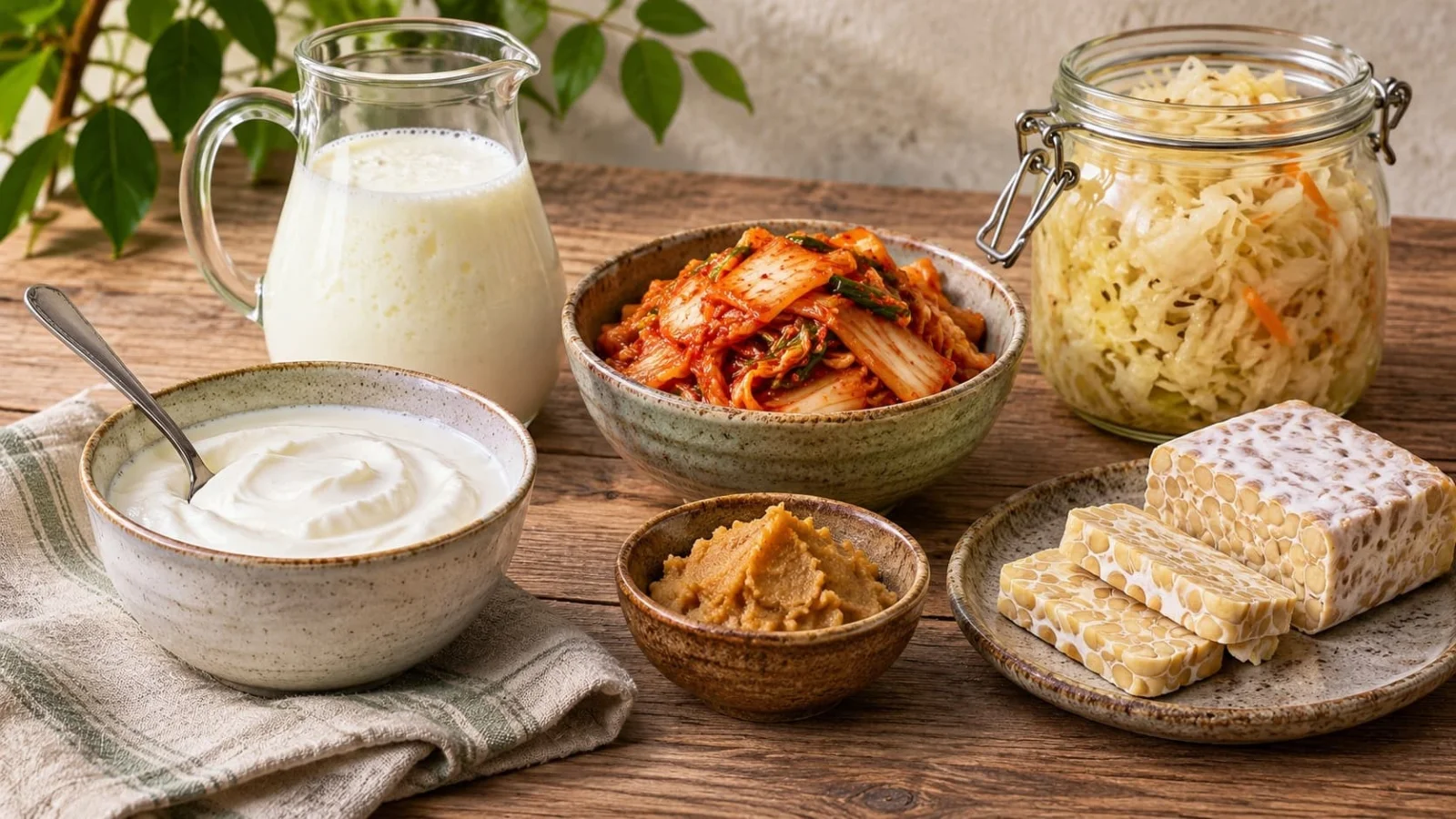
What matters is not simply how a food was fermented, but whether its microbes survive the steps that follow. In the classification published by Marco et al. (2021), yoghurt and kefir share a category with most cheeses, miso, tempeh, most kombuchas and fermented vegetables served without further heating. Bread provides a contrasting example: its dough undergoes fermentation, yet baking destroys the organisms involved. Similar losses occur in certain other fermented products subjected to heat before sale.
Yoghurt, kefir and cheeses
US regulations specify which bacteria give yoghurt its characteristic fermentation. Under 21 CFR §131.200, the required culture includes Lactobacillus delbrueckii subsp. bulgaricus and Streptococcus thermophilus (Office of the Federal Register, 2026). These names identify organisms used during production, but they do not establish that a particular yoghurt delivers a clinically validated probiotic strain.
The situation is less uniform across other fermented dairy products. Marco et al. (2021) include kefir and most cheeses in their group of foods generally retaining microorganisms after production. Although Dimidi et al. (2019) discuss kefir in research on gastrointestinal health, their review does not provide a way to determine the surviving microbes in an individual product. Its precise microbial composition therefore cannot be established from the name kefir or cheese alone.
The stage at which heat is applied makes a difference. Under the US yoghurt standard, manufacturers may use a treatment that inactivates microorganisms after culturing (Office of the Federal Register, 2026). Pasteurising milk before adding the starter is therefore not equivalent to heating the finished yoghurt, since the latter treatment can destroy cultures introduced during production.
Kimchi, sauerkraut and pickles
Kimchi and sauerkraut illustrate how products with the same familiar names may differ in their microbial content. Both feature in the review by Dimidi et al. (2019), while Marco et al. (2021) identify fermented vegetables that have not undergone subsequent heating as foods usually retaining living organisms. Additional heat treatment may eliminate those microbes, making the final processing stage important when assessing an individual product.
The term pickle does not reveal which preservation method was used. Some vegetables are preserved in vinegar or brine without undergoing a microbial fermentation process. Marco et al. (2021) exclude these preparations from the fermented-food category. Consequently, acidity and a long shelf life do not establish that a pickled product contains living fermentation organisms.
The distinction also matters in interpreting clinical results. Schropp and colleagues (2025) compared fresh and pasteurised sauerkraut in healthy participants. Individual bacterial species changed after both preparations. Their crossover comparison does not isolate live cultures as the cause of every observed microbial response.
Miso, tempeh and kombucha
Miso and tempeh are among foods commonly carrying live microorganisms (Marco et al., 2021). The same classification places most kombuchas in the live group, but identifies heat-treated versions that lack them. Individual servings may differ after processing.
The finishing stage determines what reaches the plate or cup. A fermented ingredient used in a subsequently heated dish is no longer equivalent to an unheated fermented product, since heat can inactivate the organisms (Marco et al., 2021). Hot miso dishes and cooked tempeh have undergone processing beyond the initial fermentation. The precise survival of microbes under a particular cooking condition requires product-specific measurement.
Kombucha was tested under controlled conditions. Ecklu-Mensah and colleagues (2024) compared 16 intervention participants with 8 controls and measured their gut microbiome and blood markers. No statistically significant cohort-wide changes in biochemical or circulating inflammatory markers were detected. However, within-group comparisons showed increases in fasting insulin and HOMA-IR in the kombucha group.
How processing changes live cultures in fermented foods
Microorganisms involved in producing a food are not necessarily present when it reaches consumers. Bread illustrates this distinction: although its dough undergoes fermentation, baking inactivates the organisms responsible for that process (Marco et al., 2021). Certain fermented beverages also undergo processing that removes living microorganisms. In both cases, the product retains its fermented identity without necessarily containing viable cultures.
[Research on vitamin C in peas after shipping, freezing and canning](/nutrition/vitamin-c-in-peas-effects-of-shipping-freezing-and-canning) examines a different consequence of food handling. Nutrient measurements from peas cannot establish whether fermented-food cultures remain viable.
Pasteurisation and heat treatment
Pasteurisation after fermentation can inactivate a food's cultures. In the US yoghurt regulation, treatment after culturing is explicitly recognised as a method of inactivating viable microorganisms to extend shelf life (Office of the Federal Register, 2026). Marco et al. (2021) distinguish those products from fermented foods that retain live cultures.
Sauerkraut trials provide a separate experimental angle. Schropp and colleagues (2025) compared fresh and pasteurised sauerkraut in a crossover study rather than treating both foods as microbiologically equivalent. Microbial sequencing detected changes in individual bacterial species after both preparations. The study did not establish strain-specific probiotic benefits.
Baking, filtering and storage
Baking can eliminate viable fermentation microbes. In the classification by Marco and colleagues (2021), bread remains a fermented product after its preparation has killed the organisms that fermented its dough, and certain beverages are similarly cleared of living organisms after production.
Storage affects survival. Binda and colleagues (2020) require a qualified probiotic strain to remain alive in an efficacious amount throughout the product's shelf life. Their criterion concerns the finished food over time, whereas the presence of an organism in a fermentation starter describes an earlier manufacturing stage. Without an identity and viable count near the end of shelf life, a starting culture list cannot establish the final dose of that strain.
What live culture labels can and cannot establish
Microbial information on food packaging may refer to several different things: the cultures used during production, their continued survival in the product, or a health effect supported by scientific research. These descriptions should not be interpreted as interchangeable. As Marco et al. (2021) explain, the expression live and active cultures can describe suitable fermented products, whereas probiotic claims require identifiable microorganisms backed by evidence of beneficial effects.
Live and active culture claims
The US yoghurt standard supplies an unusually concrete labelling example. The Office of the Federal Register (2026) permits the wording contains live and active cultures where specified viable counts are expected at manufacture and through shelf life. If a yoghurt has instead been treated after culturing to inactivate microorganisms, the standard requires a declaration that it does not contain live and active cultures.
A named starter organism on the ingredients list answers a narrower question. The same US regulation identifies bacteria required to manufacture yoghurt while allowing the final product to undergo further heat treatment (Office of the Federal Register, 2026). Manufacturing bacteria may be absent from the food at purchase. Neither a starter list nor a viable count alone proves a health effect.
Species, strains and viable counts
Strains differ within species. The NIH Office of Dietary Supplements (2025) describes probiotic identification using genus, species and an alphanumeric strain designation. Binda and colleagues (2020) require appropriate human trial evidence for an organism to qualify as a probiotic.
A live-culture statement describes organism viability in the finished food. Probiotic status requires a sufficiently characterised organism, documented safe use, human clinical evidence and survival through shelf life (Binda et al., 2020). The NIH Office of Dietary Supplements (2025) notes that some foods labelled as probiotics lack proven health benefits. A large unspecified microbial count cannot identify which strains are responsible for a claimed effect.
What human studies show about fermented foods and gut health
Human studies can test outcomes that microbiological classification cannot. They may measure microbial diversity, blood markers, bowel symptoms or changes in individual bacterial species. Wastyk and colleagues (2021) examined both microbiome and immune measures in a controlled dietary intervention. Baron et al. (2024) and Ecklu-Mensah et al. (2024) found no statistically significant group-level changes in the inflammatory outcomes examined during their fermented-vegetable and kombucha trials.
Gut microbiome and immune markers
In a randomised prospective study using a 17-week protocol that included a 10-week dietary intervention, Wastyk and colleagues (2021) compared diets enriched in fermented foods and plant fibre in healthy adults, with 18 participants per arm in the final analysis. The fermented-food group showed a steady rise in measured gut microbial diversity and a decline in inflammatory markers.
Microbial diversity is an ecological measure. A clinically useful change would require its connection to a named health outcome, assessed under the same conditions. Wastyk et al. (2021) measured both diversity and immune markers, but the results alone cannot establish that fermented foods prevent long-term inflammatory disease. The participants were healthy adults, and the intervention concerned a whole dietary pattern.
Selected human study findings
Schropp and colleagues (2025) studied 87 healthy participants in a four-week crossover comparison of fresh and pasteurised sauerkraut. Their microbial sequencing found greater changes in individual bacterial species after the pasteurised product. Serum short-chain fatty acids rose only with that preparation.
Schropp et al. (2026) reported findings from the sauerkraut crossover involving 87 healthy participants and both fresh and pasteurised preparations. Systolic blood pressure fell slightly with either product, while the authors observed no change in gut-barrier integrity. They found no appreciable systemic health benefit over the intervention period.
Kombucha results differed. In the controlled study by Ecklu-Mensah and colleagues (2024), 16 people received the kombucha intervention and 8 were in the control group. No statistically significant cohort-wide changes in circulating inflammatory markers or biochemical measurements were detected.
However, within-group analysis showed increases in fasting insulin and HOMA-IR among kombucha recipients. These findings do not establish a treatment effect relative to the control group, and the four-week intervention and small sample size limit their interpretation.
Baron and colleagues (2024) studied fermented vegetables in adults at increased cardiovascular risk. Their randomised comparison found no statistically significant difference in the reported inflammatory biomarkers or gut bacterial alpha diversity between groups. Participants and outcomes differed from those in the Wastyk study; the results do not form a direct contradiction about an identical diet in identical people.
Evidence limits and study design
A systematic review by Mukherjee and colleagues (2025) included 25 studies with 4,328 participants, of which 19 randomised trials entered the meta-analysis. Pooled analyses indicated changes in bowel movement frequency, stool consistency and other gastrointestinal outcomes, but the authors rated certainty as mostly low.
Human study | Design and participants | Measured outcome | Main finding |
Wastyk et al., 2021 | Randomised dietary study; 18 per arm; 17-week protocol, including a 10-week intervention | Microbiome diversity and immune markers | Fermented-food arm showed increased diversity and decreased inflammatory markers |
Schropp and colleagues, 2025 | Crossover; 87 healthy participants, 4 weeks per intervention | Gut microbial composition and serum metabolites | Individual bacterial species shifted; pasteurised product showed more pronounced changes |
Ecklu-Mensah et al., 2024 | Controlled study; 16 intervention, 8 control | Blood markers and microbiome | No significant cohort-wide changes in inflammatory or biochemical markers; within-group increases in fasting insulin and HOMA-IR in the kombucha arm |
Baron et al., 2024 | Randomised trial; adults at cardiovascular risk | Inflammation and microbial alpha diversity | No statistically significant between-group changes on these outcomes |
Schropp et al., 2026 | Crossover; 87 healthy participants | Blood pressure and gut-barrier markers | Small systolic-pressure reduction in both conditions; no change in gut-barrier integrity |
The outcome matters as much as the food name. Wastyk et al. (2021) measured diversity during an entire fermented-food dietary intervention, whereas Schropp and colleagues (2025) measured microbial species responses to sauerkraut. Baron et al. (2024) focused on adults at cardiovascular risk and detected no statistically significant diversity change. A finding for one metric cannot be converted into an established benefit on another.
The metabolic and sensory consequences of eating are also distinct from changes in gut bacteria. [Research on sensory-specific satiation](/nutrition/sensory-specific-satiation-appetite-food-intake-nutrition) concerns changes in the appeal of food during eating; it cannot substitute for microbial measurements in a fermented-food trial. Clinical conclusions require a defined exposure and a directly measured outcome, as the differing intervention designs in the 2021 and 2025 studies show (Wastyk et al., 2021; Schropp and colleagues, 2025).
Safety and variability of live-culture fermented foods
A food containing living organisms is not automatically a risk, and fermented foods have a long record of consumption. Marco and colleagues (2021) identify contamination hazards in some cheeses and low-acid fermented foods. Conditions of manufacture and storage can influence safety independently of any proposed health effect. A bacterial count by itself does not identify pathogenic contamination.
Differences between food products
Fermented foods differ in their ingredients, microbes and processing steps. The consensus classification distinguishes living cultures in unheated vegetables from the absence of those organisms after heat treatment (Marco et al., 2021). The same paper identifies histamine, tyramine and other biogenic amines produced during some fermentations of cheese, meat, vegetables and soybeans. The food matrix therefore carries constituents beyond the living microbial population.
Product differences were visible in human trials. Schropp and colleagues (2025) observed changes in individual gut bacterial species after both fresh and pasteurised sauerkraut, and the serum-metabolite response differed by preparation. Schropp et al. (2026) observed no change in gut-barrier integrity across its intervention conditions.
Safety and vulnerable populations
The NIH Office of Dietary Supplements (2025) describes probiotics as unlikely to cause harm in healthy people and reports that side effects are usually minor. It also reports serious infections linked to probiotic use in some severely ill or immunocompromised individuals. The cited safety discussion covers probiotics as products and organisms, so those medical findings cannot be assigned indiscriminately to a serving of ordinary yoghurt or sauerkraut.
Some probiotic safety trials do not adequately assess adverse effects. The NIH Office of Dietary Supplements (2025) reports such study-design gaps, while Marco et al. (2021) identify foodborne pathogens as a separate contamination hazard in certain fermented foods.
What is proven about probiotic foods and what is not
A food may undergo microbial fermentation without delivering living cultures when eaten. This is particularly relevant to products exposed to heat, including baked bread and certain processed vegetables, which remain fermented despite the loss of viable microorganisms (Marco et al., 2021). Even when microbes survive, their presence is not sufficient to establish probiotic benefits. Such claims depend on identifying the organisms involved and demonstrating relevant health effects in human research (Binda et al., 2020).
Living cultures establish microbiological presence; proven probiotics require documented benefits from defined organisms. Fermentation can remain part of a food's history even after its original microbes have been removed.
The distinction is established at the level of definitions and production. Marco et al. (2021) separate foods that retain live cultures from foods where processing removes them; Binda et al. (2020) set out the additional conditions for probiotic status. United States yoghurt rules make the post-fermentation treatment distinction visible on labels (Office of the Federal Register, 2026). These are product and regulatory facts, not estimates of clinical protection.
The human evidence has narrower boundaries. Wastyk et al. (2021) detected greater microbial diversity and reduced inflammatory markers during a fermented-food dietary intervention. Baron et al. (2024) found no statistically significant differences in the corresponding studied inflammatory biomarkers or microbial alpha diversity after a fermented-vegetable intervention in a different population. Neither result permits a general claim about every food carrying live cultures.
Fresh and pasteurised sauerkraut produced microbial responses in the crossover study by Schropp and colleagues (2025). Schropp et al. (2026), analysing the same cohort, reported no change in gut-barrier integrity even though both preparations were associated with a small reduction in systolic blood pressure.
Mukherjee and colleagues (2025) combined randomised trial evidence on gastrointestinal wellbeing, reporting pooled changes but mostly low certainty. Proving a benefit from one strain in one product would require its identity, viability through shelf life and a human trial measuring that claimed outcome, as Binda et al. (2020) specify. None of those steps can be replaced by a list of popular fermented foods.
Frequently asked questions
Does sauerkraut always contain live bacteria?
No. Unheated, fermented sauerkraut is normally placed among foods with living cultures, but heat treatment can inactivate those organisms (Marco et al., 2021). Schropp and colleagues (2025) compared fresh and pasteurised sauerkraut and found changes in certain gut bacterial species after both products.
Is kimchi still fermented after pasteurisation?
Yes. Fermentation refers to microbial growth and enzymatic changes during production, according to Marco and colleagues (2021). Heating after that process can eliminate viable microorganisms while leaving the product classified as fermented. Kimchi made through fermentation therefore remains fermented even when later processing changes its live-culture status; a heat-treated product cannot be assumed to supply living fermentation bacteria.
Does miso soup contain live cultures?
Miso is listed among fermented foods that commonly retain live microorganisms (Marco et al., 2021). Whether a prepared soup still contains viable cultures depends on processing after fermentation, because heat can inactivate the organisms responsible for making the food. Neither the word miso nor a recipe name establishes the microbial count in a finished hot dish.
Do all yoghurts contain probiotic strains?
No. The US yoghurt standard requires characteristic bacterial starter cultures, but permits treatment after culturing that inactivates them (Office of the Federal Register, 2026). Probiotic status also requires evidence for a defined live organism, including a documented human benefit and survival through shelf life (Binda et al., 2020). A yoghurt label describing its starter does not establish that additional standard.
Can fermented foods contain live microbes without being probiotic?
Yes. Marco and colleagues (2021) describe spontaneously fermented sauerkraut containing strains whose identities and viable amounts may be unknown. Binda et al. (2020) require microbial characterisation, safe use, positive human clinical evidence and viability through shelf life before probiotic status is justified. Living organisms in a food therefore establish their presence without demonstrating a particular clinical benefit.
Sources
- Marco ML, Sanders ME, Gänzle M, et al. The International Scientific Association for Probiotics and Prebiotics (ISAPP) consensus statement on fermented foods. Nature Reviews Gastroenterology & Hepatology. 2021;18(3):196–208. DOI 10.1038/s41575-020-00390-5.
- Dimidi E, Cox SR, Rossi M, Whelan K. Fermented Foods: Definitions and Characteristics, Impact on the Gut Microbiota and Effects on Gastrointestinal Health and Disease. Nutrients. 2019;11(8):1806. DOI 10.3390/nu11081806.
- Wastyk HC, Fragiadakis GK, Perelman D, et al. Gut-microbiota-targeted diets modulate human immune status. Cell. 2021;184(16):4137–4153.e14. DOI 10.1016/j.cell.2021.06.019.
- Binda S, Hill C, Johansen E, et al. Criteria to Qualify Microorganisms as “Probiotic” in Foods and Dietary Supplements. Frontiers in Microbiology. 2020;11:1662. DOI 10.3389/fmicb.2020.01662.
- Office of the Federal Register. Electronic Code of Federal Regulations, 21 CFR § 131.200, Yogurt. Version current to 12 November 2026. https://www.ecfr.gov/current/title-21/chapter-I/subchapter-B/part-131/subpart-B/section-131.200
- Schropp N, Bauer A, Stanislas V, Michels KB. Fermented foods and inflammation: a crossover intervention trial with fresh and pasteurized sauerkraut. European Journal of Clinical Nutrition. 2026;80(9):928–935. DOI 10.1038/s41430-026-01776-5.
- Schropp N, Bauer A, Stanislas V, et al. The impact of regular sauerkraut consumption on the human gut microbiota: a crossover intervention trial. Microbiome. 2025;13:52. DOI 10.1186/s40168-024-02016-3.
- Ecklu-Mensah G, Miller R, Maseng MG, et al. Modulating the human gut microbiome and health markers through kombucha consumption: a controlled clinical study. Scientific Reports. 2024;14:31647. DOI 10.1038/s41598-024-80281-w.
- Baron M, Zuo B, Chai J, et al. The effects of fermented vegetables on the gut microbiota for prevention of cardiovascular disease. Gut Microbiome. 2024;5:e6. DOI 10.1017/gmb.2024.4.
- National Institutes of Health Office of Dietary Supplements. Probiotics: Fact Sheet for Health Professionals. 25 March 2025. https://ods.od.nih.gov/factsheets/Probiotics-HealthProfessional/
- Mukherjee A, Farsi DN, Garcia-Gutierrez E, et al. Impact of fermented foods consumption on gastrointestinal wellbeing in healthy adults: a systematic review and meta-analysis. Frontiers in Nutrition. 2025;12:1668889. DOI 10.3389/fnut.2025.1668889.

Daniel K. Reynolds — author
Daniel K. Reynolds is an independent nutrition writer with academic training in nutritional sciences and food science. His background combines nutrition research literacy with food-composition analysis and public-facing science communication. He focuses on how...
This article is for general information and is not medical advice. It was reviewed for accuracy by a qualified clinician; decisions about your health should be made with your own doctor.
Related
Vitamin C in Peas: Effects of Shipping, Freezing and Canning
How Sensory-Specific Satiation Shapes Appetite and Food Intake

Protein and Satiety: How Higher-Protein Meals Affect Appetite
Mainly fruit diet study: biochemical effects in 1971
Whole grains and what the bran and germ add that refined flour loses
What is matcha, it's benefits and unique properties
Blue spirulina and its health benefits, nutrients and properties