Whole grains and what the bran and germ add that refined flour loses
Whole grains are grain foods that keep the bran, germ and endosperm, while refined flour usually removes the bran and germ. In meta-analyses, higher whole-grain intake was associated with lower risks of cardiovascular disease and all-cause mortality, while Reynolds et al. (2019) graded the certainty for whole grains as low to moderate.
The sections below explain what refining changes, what the bran and germ contribute, and what human studies actually show. They draw on a consensus definition paper, composition reviews and pooled analyses in BMJ, The Lancet, Nutrition Journal and Food Science & Nutrition, while keeping nutrient composition separate from disease-outcome evidence.

Evidence last checked 16 Nov 2026 · 11 min
What whole grains are and how they differ from refined flour
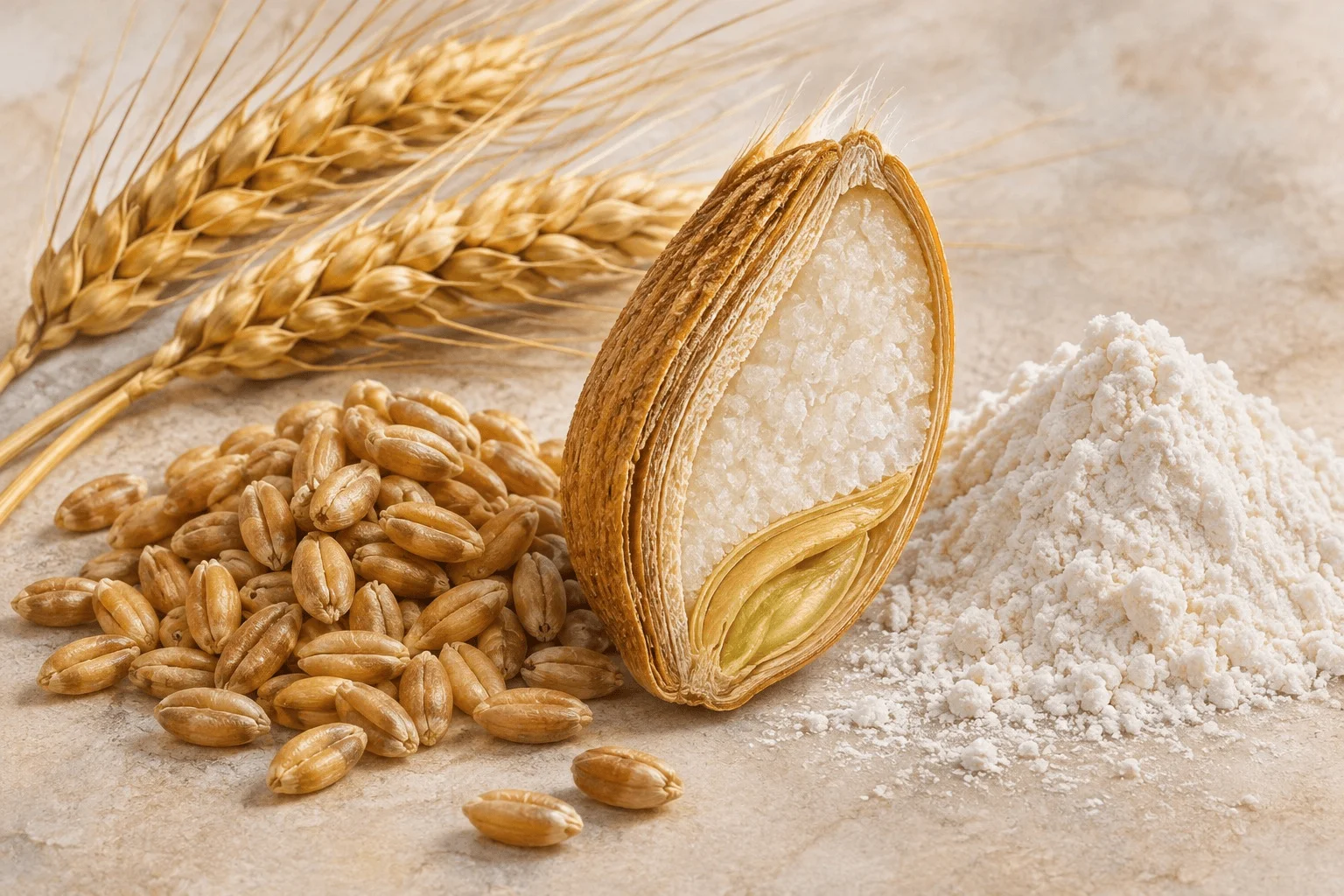
The anatomy of a grain determines what survives milling. Under the definition set out by van der Kamp et al. (2022), an intact or processed whole grain retains its bran, germ and endosperm in the same relative proportions as the original kernel.
Bran, germ and endosperm
van der Kamp et al. (2022) wrote that whole grains may be intact, ground, cracked or flaked, but all anatomical components must remain in the same relative proportions as in the intact kernel. Ariyarathna et al. (2025) described wheat structure as 80–85% endosperm, about 12–18% bran and about 2–3% germ.
Those proportions explain why white flour can still look substantial after milling. The endosperm is the largest fraction of the seed, but the smaller outer and embryonic tissues carry much of the material that changes the nutritional profile.
The same structural rule applies whether the grain is eaten intact or milled into flour. For a separate example of how a grain-like food is analysed, [protein quality of amaranth grain](/research/nutritive-value-of-amaranthus-caudatus-grain) focuses on amaranth rather than on the milling losses that define the whole-grain question described by van der Kamp et al. (2022).
What refining removes
Clemson University Cooperative Extension (2020) describes white flour and white rice as refined grain products from which the bran and germ have been removed, leaving mainly the endosperm. This milling process reduces dietary fibre and several other nutrients.
Enrichment does not restore the whole kernel. Clemson University Cooperative Extension (2020) explains that some B vitamins and iron may be added back to refined grains, but fibre and many other micronutrients are not restored.
van der Kamp et al. (2022) extend that logic to the finished product and propose that a whole-grain food should contain at least 50% whole-grain ingredients by dry weight. Foods below that threshold can still contain whole grain, but they are not defined here as whole-grain foods.
What the bran and germ add to a grain
Nutrients are distributed unevenly through a cereal kernel. Clemson University Cooperative Extension (2020) identifies bran as a source of dietary fibre, vitamins and minerals, while Vinayagam et al. (2026) report high concentrations of several nutrients in the germ.
Fibre and micronutrients
Clemson University Cooperative Extension (2020) describes the bran as a fibre-rich outer layer containing vitamins and minerals. Ariyarathna et al. (2025) also describe whole grains as rich sources of both soluble and insoluble dietary fibre.
The endosperm is compositionally different. Ariyarathna et al. (2025) describe it as the largest fraction of a wheat grain, consisting primarily of starch and protein.
Vinayagam et al. (2026) give a clearer picture of distribution across the kernel. Magnesium concentrations were 300–600 mg/100 g dry weight in bran and 200–300 mg/100 g in germ, compared with 20–30 mg/100 g in endosperm. Iron concentrations were 8–15 mg/100 g in bran, 5–8 mg/100 g in germ and 0.5–1.5 mg/100 g in endosperm.
Vinayagam et al. (2026) also listed folate concentrations of 80–150 µg/100 g in bran and 80–120 µg/100 g in germ, compared with 10–20 µg/100 g in endosperm, all measured on a dry-weight basis. Folate is therefore more concentrated in bran and germ than in endosperm.
Fats, vitamins and phytochemicals
Ariyarathna et al. (2025) describe the germ as the embryonic part of a wheat grain. Vinayagam et al. (2026) reported vitamin E concentrations of 10–30 mg/100 g dry weight in germ and 0.1–0.3 mg/100 g in endosperm.
Vinayagam et al. (2026) also list phenolic acids, flavonoids, lignans, alkylresorcinols, phytosterols and bioactive peptides among wheat compounds. Those compounds broaden the contrast beyond classic vitamins and minerals.
These measurements describe the composition of separate grain fractions, not the nutrient content of every bread, cereal or flour sold as whole grain. The reference ranges in Vinayagam et al. (2026) are expressed per 100 grams of dry material, so they should not be interpreted as the amounts supplied by a standard serving of food. The proportions of bran, germ and endosperm in a wheat kernel also matter: the germ is a small fraction of the original grain even when it contains a relatively high concentration of a particular nutrient (Ariyarathna et al., 2025).
Keeping all three fractions therefore preserves components that are reduced by conventional refining, but it does not give every whole-grain product an identical nutrient profile. Grain species, variety, processing and the balance of ingredients can differ, and the whole-grain definition concerns retention of the kernel components rather than the measured concentration of each vitamin in a finished food (van der Kamp et al., 2022; Vinayagam et al., 2026). These composition data help explain a nutritional distinction, while associations with cardiovascular disease or diabetes must be assessed separately using human studies and clearly defined dietary comparisons (Aune et al., 2016; Ying et al., 2024).
Ariyarathna et al. (2025) connect the case for whole grains to their fibre-rich structure rather than to one isolated compound. A similar separation between total carbohydrate and carbohydrate quality appears in [sport nutrition and athletic performance](/nutrition/sport-nutrition-energy-fuel-and-athletic-performance), where grain foods are judged by how they fit the whole diet as well as by energy content.
What studies show about whole-grain intake and health
Aune et al. (2016) pooled 45 studies reported in 64 publications. Aune et al. (2016) found that each 90 g/day increase in whole-grain intake was associated with relative risks of 0.81 for coronary heart disease and 0.78 for cardiovascular disease, and the same review reported reductions in risk up to 210–225 g/day for most outcomes.
Those estimates come from prospective cohort studies rather than from assigned diets in long-term trials. They quantify association under real eating conditions, which is useful, but they do not isolate whole grains from every other feature of a person's diet and lifestyle.
Cardiovascular disease and type 2 diabetes
Reynolds et al. (2019) reported a 15–30% decrease in all-cause and cardiovascular-related mortality, coronary heart disease, stroke, type 2 diabetes and colorectal cancer when the highest and lowest fibre consumers were compared, and Reynolds et al. (2019) wrote that similar findings were observed for whole-grain intake. Reynolds et al. (2019) also graded the certainty of evidence for whole grains as low to moderate.
Ghanbari-Gohari et al. (2022) found that the highest versus lowest whole-grain intake category was associated with a 21% decrease in diabetes risk. Ghanbari-Gohari et al. (2022) also reported that each additional 50 grams per day was associated with a 23% reduced risk.
Study | Size and design | What they measured | Main finding |
Aune et al. (2016) | 45 studies and 64 publications; systematic review and dose-response meta-analysis of prospective studies | Whole-grain intake and major disease outcomes | Per 90 g/day, relative risk was 0.81 for CHD and 0.78 for CVD. |
Reynolds et al. (2019) | Systematic reviews and meta-analyses of prospective studies and clinical trials | Carbohydrate quality markers and chronic disease outcomes | Highest versus lowest consumers showed 15–30% lower risks, and similar findings were observed for whole-grain intake. |
Ghanbari-Gohari et al. (2022) | 11 prospective cohort studies, 463,282 participants and 37,249 incident cases | Whole-grain intake and type 2 diabetes | Highest versus lowest intake was associated with a 21% lower type 2 diabetes risk. |
Hu et al. (2023) | 68 studies and 1,624,407 participants; dose-response meta-analysis of prospective cohort studies | Whole grains, refined grains, cardiovascular outcomes and mortality | Per 30 grams, relative risk was 0.94 for CHD, 0.92 for CVD and 0.94 for all-cause mortality. |
Ying et al. (2024) | Prospective cohort studies and randomised controlled trials | Type 2 diabetes and glycaemic outcomes | Cohorts linked 50 g/day with RR 0.761 for type 2 diabetes, and trials showed a small reduction in fasting blood glucose. |
Ying et al. (2024) bridge cohort evidence and trial evidence. Ying et al. (2024) reported a relative risk of 0.761 for type 2 diabetes in cohort studies at 50 g/day, while the randomised trials showed a mean difference of -0.103 mmol/L for fasting blood glucose and a modest effect on HbA1c.
The difference in scale matters. Cohorts ask what happens across years of usual eating, whereas trials usually test narrower food interventions over shorter periods and often focus on intermediate markers rather than on disease events. Reading the two designs side by side prevents the cohort literature from being treated as if it were intervention evidence.
Cancer and all-cause mortality
Aune et al. (2016) reported relative risks of 0.85 for total cancer mortality and 0.83 for all-cause mortality. The same BMJ review thus extended the association beyond cardiovascular outcomes.
Hu et al. (2023) found relative risks of 0.92 for cardiovascular disease and 0.94 for all-cause mortality per 30-gram increase in daily whole-grain consumption. The Hu review uses a smaller intake increment than the BMJ review.
The units differ across the two reviews, so the numbers work better as parallel signals than as interchangeable dose points. The direction, however, is similar.
Why whole-grain research and labels need caution
A whole-grain claim and a measured health outcome answer different questions. The consensus criteria described by van der Kamp et al. (2022) distinguish foods with 25–50% whole-grain ingredients by dry weight from foods designated whole grain, while Reynolds et al. (2019) graded the certainty of health-outcome evidence for whole grains as low to moderate.
Food categories are not identical
van der Kamp et al. (2022) note that foods containing 25–50% whole-grain ingredients by dry weight may make a front-of-pack claim on the presence of whole grain but cannot be designated whole grain in the product name. The authors therefore distinguish a packaging claim from the stricter wording permitted in a product name.
That distinction shows why grain categories are not identical to marketing categories. A product can contain some whole grain, or advertise it, without being a whole-grain food in the stricter sense used by the consensus paper.
The Academy of Nutrition and Dietetics (2021) adds that colour is not a reliable way to pick a whole-grain product and that molasses or other added ingredients can make food brown. The Academy of Nutrition and Dietetics (2021) therefore does not treat a darker loaf as a definition in itself.
Appearance is only a clue. Ingredient content and naming rules do more explanatory work than colour alone, because a brown-looking loaf can still fall short of the whole-grain threshold used in stricter definitions.
Association is not the same as cause
Reynolds et al. (2019) graded the whole-grain evidence as low to moderate. Ying et al. (2024) found statistically detectable changes in fasting glucose in trials, but those trial effects were narrower than the long-term cohort associations.
Hu et al. (2023) also show that the categories themselves behave differently by outcome. Hu et al. (2023) reported that whole-grain consumption was linearly associated with coronary heart disease but nonlinearly associated with cardiovascular disease and all-cause mortality.
Refined grains complicate the picture further. Hu et al. (2023) reported no significant influence of refined-grain intake on stroke, CHD, heart failure and cardiovascular disease, and Hu et al. (2023) rated all refined-grain meta-evidence as low quality.
For a reader, the practical implication is restraint in interpretation. A consistent observational pattern is meaningful evidence, but it is still weaker than a long-term randomised comparison of clearly defined foods. The same caution applies whenever an exposure is broad enough to cover many foods under one label.
What is proven about whole grains and what is not
What is settled is the compositional side. The consensus paper by van der Kamp et al. (2022) defines whole grains by the presence of bran, germ and endosperm, while Vinayagam et al. (2026) report large differences between grain fractions for magnesium, iron, folate and vitamin E.
Whole grains are easy to define in the kernel and harder to isolate in epidemiology. Their nutrient advantages are direct, while their disease advantages are best read as consistent associations rather than stand-alone proof of cause and effect.
What is persuasive, but not absolute, is the disease literature. Hu et al. (2023) rated meta-evidence for whole grains as moderate for stroke and CHD, low for heart failure, and high for cardiovascular disease and all-cause mortality, while Reynolds et al. (2019) graded whole-grain evidence overall as low to moderate.
What is not established is that every food sold with whole-grain imagery behaves in the same way. The paper by van der Kamp et al. (2022) shows that the threshold for claiming whole-grain content differs from that for naming a whole-grain food, while Ying et al. (2024) report smaller short-term trial effects on glucose markers than the long-term cohort associations.
More decisive evidence would come from longer randomised studies that compare clearly characterised whole-grain foods with refined-grain controls and that measure clinical endpoints as well as intermediate markers. Until such trials accumulate, the strongest claims remain the ones closest to what the evidence actually measures.
Frequently asked questions
Are oats and brown rice whole grains?
Yes. The Academy of Nutrition and Dietetics (2021) lists oats and brown rice among whole-grain options, and van der Kamp et al. (2022) define whole grains by the presence of bran, germ and endosperm in the same relative proportions as in the intact kernel.
Does wholemeal flour count as a whole grain?
Often yes, but not as a universal legal synonym in every jurisdiction. The authors of the consensus paper (van der Kamp et al., 2022) note that wholemeal may be legally protected in some places and can be equivalent to whole grain, but the two terms must be interpreted in the relevant local context.
Why does refined flour last longer than whole-grain flour?
One part of the explanation is compositional. Clemson University Cooperative Extension (2020) explains that milling removes the bran and germ and improves the shelf life of refined grain products. Whole-grain flour retains those fractions and more of the grain’s nutrients, although storage conditions also affect shelf life.
Are all brown breads made from whole grains?
No. The Academy of Nutrition and Dietetics (2021) says colour is not a reliable way to pick a whole-grain product because molasses or other added ingredients can make food brown, and van der Kamp et al. (2022) show that some foods may claim the presence of whole grain without being designated whole grain in the product name.
Do whole grains contain gluten?
Some whole grains contain gluten, while others do not. Wheat, barley and rye contain gluten, whereas rice, corn, millet, sorghum, buckwheat, quinoa and teff are naturally gluten-free. Coeliac UK (2010) notes that oats contain avenin and that many oat products can be contaminated with other grains. A whole-grain label therefore does not establish gluten-free suitability.
Sources
- van der Kamp JW, Jones JM, Miller KB, et al. Consensus, Global Definitions of Whole Grain as a Food Ingredient and of Whole-Grain Foods Presented on Behalf of the Whole Grain Initiative. Nutrients. 2022;14(1):138. DOI 10.3390/nu14010138.
- Ariyarathna P, Mizera P, Walkowiak J, Dziedzic K. Physicochemical and Functional Properties of Soluble and Insoluble Dietary Fibers in Whole Grains and Their Health Benefits. Foods. 2025;14(14):2447. DOI 10.3390/foods14142447.
- Vinayagam R, Ganesan K, Sohn HB, et al. Wheat Bioactive Compounds and Human Health: A Review of Nutraceutical Potential, Molecular Mechanisms and AI-Assisted Functional Food Innovation. International Journal of Molecular Sciences. 2026;27(18):8290. DOI 10.3390/ijms27188290.
- Aune D, Keum N, Giovannucci E, et al. Whole grain consumption and risk of cardiovascular disease, cancer, and all cause and cause specific mortality: systematic review and dose-response meta-analysis of prospective studies. BMJ. 2016;353:i2716. DOI 10.1136/bmj.i2716.
- Reynolds A, Mann J, Cummings J, et al. Carbohydrate quality and human health: a series of systematic reviews and meta-analyses. The Lancet. 2019;393(10170):434–445. DOI 10.1016/S0140-6736(18)31809-9.
- Hu H, Zhao Y, Feng Y, et al. Consumption of whole grains and refined grains and associated risk of cardiovascular disease events and all-cause mortality: a systematic review and dose-response meta-analysis of prospective cohort studies. The American Journal of Clinical Nutrition. 2023;117(1):149–159. DOI 10.1016/j.ajcnut.2022.10.010. PMID 36789934.
- Ghanbari-Gohari F, Mousavi SM, Esmaillzadeh A. Consumption of whole grains and risk of type 2 diabetes: A comprehensive systematic review and dose-response meta-analysis of prospective cohort studies. Food Science & Nutrition. 2022;10(6):1950–1960. DOI 10.1002/fsn3.2811. PMID 35702290.
- Ying T, Zheng J, Kan J, et al. Effects of whole grains on glycemic control: a systematic review and dose-response meta-analysis of prospective cohort studies and randomized controlled trials. Nutrition Journal. 2024;23:47. DOI 10.1186/s12937-024-00952-2.
- Clemson University Cooperative Extension. Whole Grains. Revised 9 December 2020. https://hgic.clemson.edu/factsheet/whole-grains/.
- Academy of Nutrition and Dietetics. What Is a Whole Grain? 4 August 2021, reviewed 7 August 2025. https://www.eatright.org/food/food-groups/grains/what-is-a-whole-grain
- Coeliac UK. Oats and the gluten-free diet. 28 October 2010. https://www.coeliac.org.uk/news/oats-and-the-gluten-free-diet/.

Olivia M. Carter — author
Olivia M. Carter defined with an assigned MSc in Human Nutrition and BSc in Food Science, with an editorial focus on dietary patterns, food composition, nutrient density, and how everyday food choices contribute to nutrient intake. For Cabdirect, Olivia is int...
This article is for general information and is not medical advice. It was reviewed for accuracy by a qualified clinician; decisions about your health should be made with your own doctor.
Related
Protein Quality of Amaranth Grain

Sport Nutrition: Energy, Fuel and Athletic Performance

How Sensory-Specific Satiation Shapes Appetite and Food Intake
Dietary Fat and Serum Cholesterol: Hegsted Study Findings
Probiotic foods and which fermented foods still carry live cultures
What is matcha, it's benefits and unique properties
Blue spirulina and its health benefits, nutrients and properties