Circadian rhythm and how your body clock shapes sleep and alertness
A circadian rhythm is an approximately 24-hour biological pattern in processes such as sleep, wakefulness and alertness, while biological clocks are the internal timing systems that generate and regulate these rhythms (NIGMS, 2025). It is generated internally but is reset by environmental cues, especially the light-dark cycle, so biological time stays aligned with the outside day.
This article separates circadian rhythm from the broader biological clock and from the sleep-wake cycle, then examines the suprachiasmatic nucleus, melatonin, body temperature, age-related changes and circadian misalignment. It draws on official scientific guidance and controlled human studies of light, sleep and internal timing.
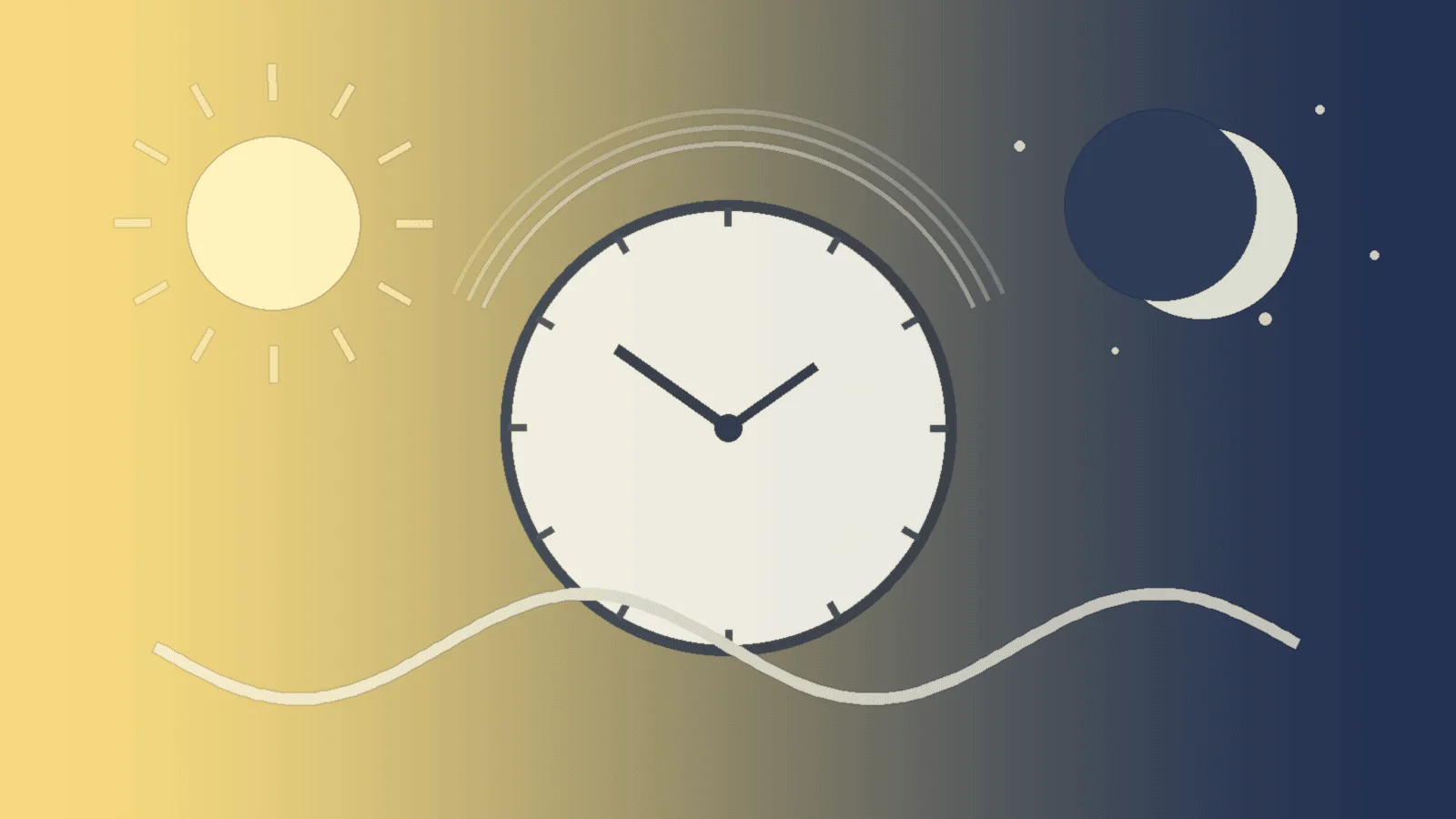
Circadian rhythm, biological clocks and the sleep-wake cycle
Circadian rhythms are self-sustaining biological oscillations that organise physiology and behaviour across the day. NIGMS describes them as physical, mental and behavioural changes occurring over a 24-hour cycle and notes that nearly every human tissue and organ has its own rhythm (NIGMS, 2025). Molecular research shows that a defining feature of circadian organisation is an internally generated oscillator that can continue without an immediate environmental signal while remaining synchronised by external time cues (Takahashi, 2017).
The phrase biological clock is broader. It refers to the cellular timing machinery that generates and coordinates rhythms, including gene-protein feedback loops that continue to cycle without an immediate outside signal. In mammals, CLOCK and BMAL1 help activate Period and Cryptochrome genes, and the resulting PER and CRY proteins feed back to inhibit that activation; this repeating molecular loop is one part of how cells keep time (Takahashi, 2017).
The sleep-wake cycle is an output of this timing system rather than a synonym for it. Human sleep timing reflects an interaction between a circadian signal and homeostatic sleep pressure, which builds with time awake and dissipates during sleep. In a forced-desynchrony study, Dijk and Czeisler separated those influences and showed that the circadian pacemaker independently shapes sleep propensity and sleep structure even when prior wake duration is controlled (Dijk and Czeisler, 1995).
- Circadian rhythm: the recurring biological pattern, such as rhythms in sleepiness, melatonin or temperature.
- Biological clock: the cellular and neural timing machinery that generates and coordinates those rhythms.
- Sleep-wake cycle: the observed pattern of sleeping and waking, influenced by both the clock and accumulated sleep pressure.
- Chronotype: an individual tendency toward earlier or later timing within the normal range of human circadian organisation.
These distinctions matter because a person can be awake while the circadian system is signalling biological night, as happens during night work or rapid travel across time zones. Conversely, someone may be sleepy because of accumulated wakefulness even when the circadian system is still providing a wake-promoting signal. Treating every fluctuation in sleepiness as a direct reading of the body clock therefore oversimplifies the underlying physiology.
How the SCN, light and internal signals keep biological time
The central coordinator of human circadian timing is the suprachiasmatic nucleus, or SCN, a small group of nerve cells in the hypothalamus. NIGMS explains that the SCN acts as a master clock, synchronising rhythms in organs and tissues and adjusting melatonin production in response to light reaching the eyes (NIGMS, 2025). Peripheral tissues also contain clocks, but the SCN helps keep their timing coherent with the environmental day.
The connection between light and biological timing also appears in other animals. An account of seasonal reproductive timing in birds explains how day length and internal timing mechanisms help coordinate hormonal changes. These findings illustrate the broader role of biological clocks, although avian seasonal reproduction is not identical to human circadian regulation.
Light resets the master clock
Human circadian timing is not exactly 24 hours when isolated from ordinary time cues. In tightly controlled conditions, Czeisler and colleagues measured melatonin, core body temperature and cortisol rhythms and found an average intrinsic pacemaker period of 24.18 hours in both young and older adults (Czeisler et al., 1999). Daily entrainment is therefore not simply passive exposure to sunrise and sunset; it is an active correction of an internal oscillator whose natural period is close to, but not identical with, the solar day.
The direction of that correction depends on when light arrives. In 21 healthy participants, Khalsa and colleagues used a 6.7-hour bright-light stimulus at different circadian phases and constructed a human phase-response curve: light presented before the core body temperature minimum tended to delay the clock, whereas light after that region tended to advance it (Khalsa et al., 2003). The result established that timing is central to the biological effect of light, not just brightness alone.
Melatonin and body temperature mark biological night
Melatonin is often described as a sleep hormone, but in circadian research it is also an important marker of biological timing. Controlled laboratory studies track melatonin and core body temperature rhythms to estimate circadian phase and distinguish internal biological time from ordinary clock time (Czeisler et al., 1999). Alertness and performance also vary with circadian phase and are generally better when core body temperature is higher (Wright, Hull and Czeisler, 2002).
Body temperature is not merely a by-product of sleep. Fourteen participants studied under forced desynchrony showed that working memory, subjective alertness, visual attention and several reaction-time measures varied with biological time and were generally better when body temperature was higher (Wright, Hull and Czeisler, 2002). The association does not mean temperature alone controls cognition, but it shows why temperature is both a useful circadian marker and part of the daily pattern of performance.
How circadian timing shapes sleep and alertness across a day
The circadian system helps consolidate wakefulness into the daytime and sleep into the biological night. That sounds straightforward, yet the mechanism is counterintuitive: during the late biological day, the circadian system produces a strong wake-promoting signal even though homeostatic sleep pressure has been rising for many hours. Near the end of the night, the circadian drive for sleep is stronger even as accumulated sleep pressure has fallen, helping maintain a stable block of sleep (Dijk and Czeisler, 1995).
This interaction explains why alertness does not decline in a simple straight line from morning to bedtime. The circadian wake signal can partly counterbalance growing sleep pressure during the day, while a circadian low during the biological night can magnify the effects of prolonged wakefulness. Controlled laboratory work shows that circadian phase and accumulated sleep pressure make independent contributions to sleep propensity, which is why clock time alone does not explain changes in alertness or readiness for sleep (Dijk and Czeisler, 1995).
Selected human studies that separated timing from clock time
Study | n | Protocol or exposure | What was measured | Main finding |
Czeisler et al., 1999 | 24 | Forced desynchrony in controlled light | Melatonin, temperature, cortisol period | Mean intrinsic period 24.18 h |
Dijk & Czeisler, 1995 | 8 | 33–36 days on a 28 h rest-activity cycle | Sleep propensity and sleep structure | Strong independent circadian modulation |
Khalsa et al., 2003 | 21 | 6.7 h bright-light pulse at different circadian phases | Melatonin phase shifts | Light could delay or advance timing depending on phase |
Wright et al., 2013 | 8 | One week constructed environment vs one week natural light | Melatonin timing and sleep timing | Natural light-dark exposure shifted internal timing toward solar time |
Chang et al., 2015 | 12 | Five evenings of light-emitting e-reader vs printed book in crossover design | Melatonin, sleep, circadian timing, morning alertness | E-reader condition delayed timing and reduced next-morning alertness |
The body clock does not simply switch sleep on at night. It continuously changes the probability of sleep and the capacity for alertness, while homeostatic sleep pressure changes in parallel.
Because the two signals overlap in ordinary life, a single bedtime or a single morning alertness score cannot reveal circadian phase precisely. Laboratory protocols use dim light, controlled posture, repeated samples or schedules that deliberately separate behavioural time from internal time. That methodological point is important when interpreting everyday claims about a person's 'body clock': a sleep schedule is visible, but the underlying phase usually has to be inferred from markers such as melatonin or core body temperature.
How circadian timing changes from adolescence to older age
Circadian timing is not fixed for life. Development changes both preferred sleep timing and the relationship between internal rhythms and social schedules. Those shifts are population tendencies rather than a rigid timetable for every individual, because genetics, light exposure, work or school demands and behaviour also influence when sleep occurs.
Adolescence tends to shift timing later
A review of human and animal evidence concluded that puberty is associated with a later phase of sleep and with changes in both circadian and homeostatic regulation (Hagenauer et al., 2009). The biological shift helps explain why many adolescents become sleepy later and prefer later wake times, but the review also stresses that evening light and early school schedules can amplify the mismatch between internal timing and required wake time.
This developmental delay is not evidence that teenagers simply need a different circadian system. The same core clock mechanisms remain, but their phase relationship to the 24-hour day changes. The result is a later window of sleep propensity and alertness relative to local clock time, which can make early-morning performance occur closer to a circadian low than it would for an earlier chronotype.
Ageing often shifts rhythms earlier and weakens sleep consolidation
In a forced-desynchrony experiment comparing young and older people, Dijk and colleagues found age-related differences in the timing and consolidation of sleep, together with earlier timing of melatonin and body-temperature rhythms in older adults (Dijk et al., 1999). Importantly, Czeisler et al. found the average intrinsic circadian period itself was still about 24.18 hours in both age groups (Czeisler et al., 1999), so earlier timing with age cannot be reduced to a simple claim that the clock suddenly runs much faster.
Age-related sleep changes therefore reflect several interacting processes: circadian phase can move earlier, sleep homeostasis changes, and sleep can become more fragmented. The distinction is useful because an earlier wake time is an observed behaviour, whereas the circadian contribution is a physiological timing signal that must be separated from sleep pressure and environmental influences.
Circadian misalignment from jet lag, shift work and night-time light
Circadian misalignment occurs when behavioural schedules and environmental time cues are out of phase with internal biological time. NIGMS lists travel across time zones, shift work and light from electronic devices at night as common ways the sleep-wake cycle can become disconnected from circadian timing (NIGMS, 2025). Short-term effects can include drowsiness, poor coordination and difficulty with learning or focus, but the mechanism is not simply 'too little sleep': the same amount of sleep can occur at a biologically unfavourable phase.
Jet lag and shift work expose the timing mismatch
Jet lag is a temporary mismatch created when the external light-dark cycle changes faster than the internal clock can reset. Shift work can create a repeated version of the same problem because sleep, meals and activity may occur at phases that conflict with the endogenous rhythm. In a 10-day laboratory study of 10 adults, Scheer and colleagues scheduled sleep and meals across a recurring 28-hour day; when behaviour was about 12 hours out of phase with internal time, sleep efficiency fell by 20% and the daily cortisol rhythm was reversed (Scheer et al., 2009).
The same experiment also found changes in glucose, insulin, leptin and blood pressure during misalignment (Scheer et al., 2009). Those findings demonstrate that circadian timing reaches beyond sleep, but they do not establish the long-term health effect of any particular work schedule. The sample was small and the protocol was deliberately extreme to isolate mechanism, so population risk estimates require broader evidence than this laboratory study alone.
Modern light can push timing later
A field experiment illustrates how the lighting environment can alter phase without changing time zones. Eight adults were studied after a week in their normal electric-light environment and after a week camping with natural light only; the natural light-dark cycle shifted internal timing toward solar time and reduced differences between earlier and later chronotypes (Wright et al., 2013). Because the sample was small and the exposure was a specific summer camping condition, the study shows biological responsiveness rather than a universal size of effect.
Evening device light can also influence circadian timing under controlled conditions. In a randomised crossover study of 12 young adults, five evenings of reading on a light-emitting e-reader for about four hours before bedtime suppressed evening melatonin, delayed circadian timing, lengthened sleep onset and reduced next-morning alertness compared with reading a printed book (Chang et al., 2015). The experiment isolated a specific exposure pattern; it does not mean every screen, brightness level or viewing duration produces the same shift.
What is established about circadian rhythm and what remains uncertain
Several conclusions are well supported. Human circadian timing is generated internally, its central coordinator is the SCN, and light is the dominant environmental signal that entrains the system. Controlled studies show an intrinsic period close to 24.2 hours, demonstrate that light can advance or delay phase depending on timing, and show that circadian phase contributes independently to sleep propensity, alertness and performance (Czeisler et al., 1999; Khalsa et al., 2003; Dijk and Czeisler, 1995; Wright, Hull and Czeisler, 2002).
It is also established that circadian organisation extends beyond sleep. NIGMS lists hormone release, appetite, digestion and temperature among circadian-regulated functions (NIGMS, 2025), while molecular work shows that peripheral tissues contain clock machinery coordinated with the central pacemaker (Takahashi, 2017). Age and developmental stage alter the phase and expression of these rhythms, but the direction and size of change vary between individuals and cannot be inferred from age alone (Hagenauer et al., 2009; Dijk et al., 1999).
Circadian timing is only one influence on eating behaviour. Other processes operate within meals, including sensory-specific satiation, in which the appeal of a particular food declines as it is eaten. This mechanism is distinct from the body's circadian clock and should not be mistaken for evidence that daily appetite rhythms determine how much a person eats.
What remains less certain is the size of the effect that a particular modern schedule or light exposure will have in a specific person outside controlled experiments. Chronotype, prior light history, season, latitude, work demands and sleep duration can all modify the observed pattern. Research can therefore explain the mechanisms of circadian alignment and misalignment with high confidence, while prediction of an individual's exact phase from clock time, bedtime or device use alone remains much less precise.
Frequently asked questions
Is circadian rhythm the same as a sleep schedule?
No. A sleep schedule is the observed timing of sleep and wakefulness, whereas a circadian rhythm is an approximately 24-hour biological pattern regulated by internal biological clocks (NIGMS, 2025). Sleep timing can reflect circadian influences, but it is also shaped by behaviour, work schedules, light exposure and accumulated sleep pressure.
Why is the human body clock slightly longer than 24 hours?
Controlled experiments show that the average intrinsic human circadian period is close to 24.2 hours rather than exactly 24 (Czeisler et al., 1999). Environmental time cues, especially the daily light-dark cycle, reset or entrain this internal oscillator so it remains aligned with the 24-hour solar day.
What role does melatonin play in circadian rhythm?
Melatonin is a hormone whose secretion rises during biological night under control of the circadian system. Researchers often use the timing of melatonin onset in dim light as a marker of circadian phase. It signals internal night, but it is only one output of a wider clock network.
Why does jet lag make people sleepy at the wrong time?
Jet lag occurs because local clock time changes immediately after rapid travel, while the internal circadian system shifts more gradually. Sleep, alertness, temperature and melatonin can therefore remain aligned with the previous time zone for a period, creating sleepiness or wakefulness at socially inconvenient local times.
Do circadian rhythms change with age?
Yes, but not in one identical way for everyone. Puberty is commonly associated with later sleep and circadian timing, while older adulthood often shows earlier timing and less consolidated sleep. These patterns reflect interactions among circadian phase, sleep pressure, light exposure, behaviour and individual biology.
Sources
- National Institute of General Medical Sciences. Circadian Rhythms. 20 May 2025. https://www.nigms.nih.gov/education/fact-sheets/Pages/circadian-rhythms
- Takahashi JS. Transcriptional architecture of the mammalian circadian clock. Nature Reviews Genetics. 2017;18(3):164–179. DOI 10.1038/nrg.2016.150.
- Czeisler CA, Duffy JF, Shanahan TL, et al. Stability, precision, and near-24-hour period of the human circadian pacemaker. Science. 1999;284(5423):2177–2181. DOI 10.1126/science.284.5423.2177.
- Dijk DJ, Czeisler CA. Contribution of the circadian pacemaker and the sleep homeostat to sleep propensity, sleep structure, electroencephalographic slow waves, and sleep spindle activity in humans. Journal of Neuroscience. 1995;15(5 Pt 1):3526–3538. DOI 10.1523/JNEUROSCI.15-05-03526.1995.
- Khalsa SBS, Jewett ME, Cajochen C, Czeisler CA. A phase response curve to single bright light pulses in human subjects. Journal of Physiology. 2003;549(Pt 3):945–952. DOI 10.1113/jphysiol.2003.040477.
- Wright KP Jr, Hull JT, Czeisler CA. Relationship between alertness, performance, and body temperature in humans. American Journal of Physiology-Regulatory, Integrative and Comparative Physiology. 2002;283(6):R1370–R1377. DOI 10.1152/ajpregu.00205.2002.
- Wright KP Jr, McHill AW, Birks BR, Griffin BR, Rusterholz T, Chinoy ED. Entrainment of the human circadian clock to the natural light-dark cycle. Current Biology. 2013;23(16):1554–1558. DOI 10.1016/j.cub.2013.06.039.
- Chang AM, Aeschbach D, Duffy JF, Czeisler CA. Evening use of light-emitting eReaders negatively affects sleep, circadian timing, and next-morning alertness. Proceedings of the National Academy of Sciences of the United States of America. 2015;112(4):1232–1237. DOI 10.1073/pnas.1418490112.
- Hagenauer MH, Perryman JI, Lee TM, Carskadon MA. Adolescent changes in the homeostatic and circadian regulation of sleep. Developmental Neuroscience. 2009;31(4):276–284. DOI 10.1159/000216538.
- Dijk DJ, Duffy JF, Riel E, Shanahan TL, Czeisler CA. Ageing and the circadian and homeostatic regulation of human sleep during forced desynchrony of rest, melatonin and temperature rhythms. Journal of Physiology. 1999;516(Pt 2):611–627. DOI 10.1111/j.1469-7793.1999.0611v.x.
- Scheer FAJL, Hilton MF, Mantzoros CS, Shea SA. Adverse metabolic and cardiovascular consequences of circadian misalignment. Proceedings of the National Academy of Sciences of the United States of America. 2009;106(11):4453–4458. DOI 10.1073/pnas.0808180106.

Marcus Reed — author
Marcus Reed writes with an editorial focus on statistics and quantitative research, including effect sizes, regression models, uncertainty, associations and the numerical results reported in scientific studies. At Cabdirect, Marcus covers quantitative findings...
Related

Thermal comfort: temperature, humidity, airflow and clothing

How hormones time seasonal reproduction in temperate-zone birds

How Sensory-Specific Satiation Shapes Appetite and Food Intake
Why we dream and what sleep research says about the purpose of dreams

What déjà vu reveals about how the brain processes memories

What causes hiccups and why your body has this reflex
How long you can survive without food and what happens to your body