How long you can survive without food and what happens to your body
With access to drinking water, a person may survive without food for several weeks, but there is no reliable universal limit, and serious complications can develop much earlier (Gétaz et al., 2012; Faintuch et al., 2000). In a hypothetical calculation for a 70-kilogram man, Faintuch et al. (2000) estimated a survival period of about 72 days based on assumed rates of body protein loss. This estimate illustrates the limits of calculating survival from stored energy, rather than establishing a universal deadline. The arithmetic of energy stores overstates the answer by a wide margin.
This explainer follows the measurements: which fuel the body uses at which point, what the documented extremes actually were, what ends them, why the same deprivation produces very different times in different people, and why the period immediately after food returns carries its own danger. Related work is gathered in the research digest.
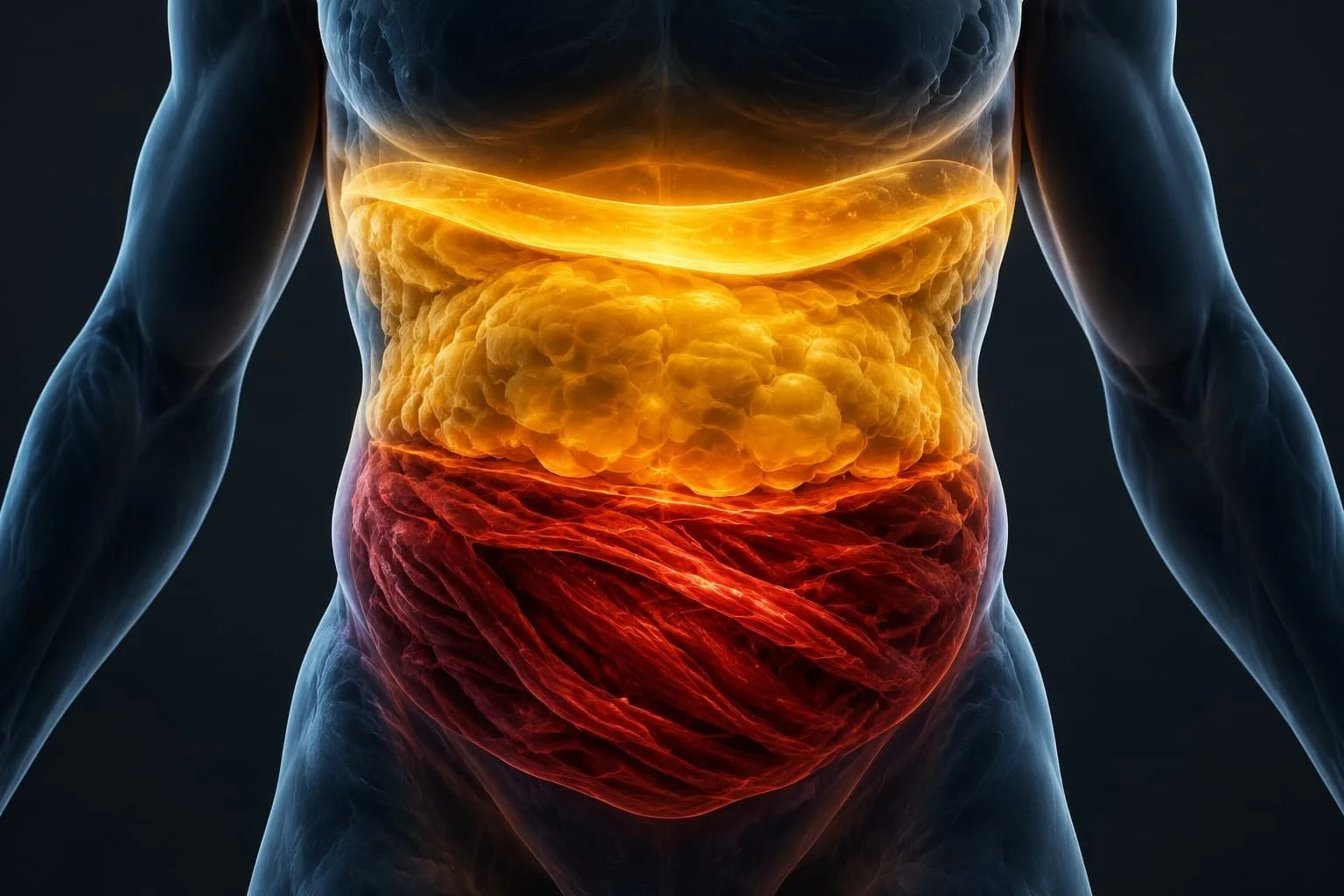
What the body burns, and in what order
The popular account has three tidy stages: glucose, then fat, then muscle. Isotope measurements show the first transition starting far earlier than that. Within the first 22 hours of fasting, gluconeogenesis, the manufacture of new glucose, already accounts for 64% of all glucose production; over the next 14 hours it supplies 82%, and over the 18 hours after that 96%, because liver glycogen is largely gone (Rothman et al., 1991). Nothing waits its turn, the proportions simply shift.
The point at which the body stops running mainly on stored carbohydrate and turns to fat has been placed in a window of 12 to 36 hours, depending on how much glycogen was there to begin with and how active the person is (Anton et al., 2018). By two to three days the glycogen stores are spent and blood glucose settles onto a plateau, with ketone production near its maximum at about 115 grams a day (Gétaz et al., 2012; Rebello et al., 2025). The water bound to those carbohydrate stores is a separate question, traced in how much water glycogen holds.
Measured changes during fasting
Time without food | Reported metabolic change | Source |
Within the first 22 hours | Gluconeogenesis supplies 64% of glucose production. | Rothman et al. (1991) |
About 12–36 hours | The principal fuel supply shifts from stored carbohydrate towards fat. | Anton et al. (2018) |
22–36 hours and later measurements | The reported gluconeogenic share rises to 82%, then 96%. | Rothman et al. (1991) |
By 2–3 days | Glycogen stores are described as depleted. | Gétaz et al. (2012) |
Note: The periods overlap and describe changing fuel contributions, not separate stages or safe durations of fasting. The figures are drawn from the studies already cited in the article.
Then comes the part that makes long survival possible at all. The brain, which cannot burn fatty acids, switches substantially to ketones (Owen et al., 1967). After three to seven days of fasting, ketones contribute about 50–85% of skeletal-muscle oxidative metabolism, but their share falls to around 0–16% after about 24 days as other tissues, including the brain, increasingly use them. Protein breakdown also declines during adaptation, although it remains physiologically important (Rebello et al., 2025).
In measurements of prolonged fasting reviewed by Rebello et al. (2025), glycogen made no significant contribution by week five or six, while estimated glucose production was about 86 grams a day from protein-derived substrates, glycerol, and recycled lactate and pyruvate. The liver and the kidneys split that production roughly evenly, which is not how the textbook division of labour is usually drawn. That pathway was first mapped in animals, as in gluconeogenesis from glycine and serine.
How much is stored, and why the arithmetic misleads
Faintuch et al. (2000) presented a hypothetical calculation for a 70-kilogram man with 13 kilograms of body protein and approximately 160,000 kilocalories stored as fat. Under the assumed daily rates of loss, those reserves corresponded to 217 days for protein and 119 days for fat. Applying a threshold of one-third body protein loss produced a theoretical estimate of about 72 days.
This calculation is not a measured or universal survival limit. Rebello et al. (2025) also describe how limits to protein mobilisation constrain prolonged starvation.
Fat supplies much of the energy during prolonged starvation, but survival cannot be predicted from fat reserves alone. Protein loss and organ complications also matter.
Energy expenditure also falls during prolonged deprivation, which can extend the time over which stored energy is used. Faintuch et al. (2000) studied eight hunger strikers, seven men and one woman, over 43 days of food deprivation. The authors estimated an adapted daily energy expenditure of about 1,500 kilocalories, roughly 25% below that of comparable non-fasting adults.
Indirect calorimetry was performed only once, in one participant on day 17, producing a respiratory quotient of 0.68. The group lost an average of 17.9% of starting body weight, with mean BMI falling from 26.1 to 21.5. No deaths occurred during the observed period.
That reduction has a limit, and it is smaller than the popular idea of a metabolism that shuts down. What changes most is not the rate of burning but the split between fat and protein in what is burned, and that split is governed by the starting body fat together with the size of the usable protein reserve, which the re-analysis found can matter just as much (Dulloo & Jacquet, 1999). A person with large reserves protects their protein for far longer at the same level of deprivation, which is why survival times reported in the literature differ by a factor of several rather than by days.
The documented extremes
The longest recorded case was medically supervised. A 27-year-old man in Dundee completed a 382-day medically supervised fast, receiving water, vitamins and electrolytes while attending outpatient follow-up during part of the period. His weight fell from 456 to 180 pounds, approximately 207 to 81.6 kilograms (Stewart & Fleming, 1973). Fasts of 256, 249 and 210 days were reported in the same era.
Hunger strikes supply the other kind of record, with less favourable starting conditions. In Johannesburg, 33 political prisoners fasted for 6 to 24 days; a third became hyponatraemic and most were dehydrated on admission, not because water was withheld but because the sensation of thirst appeared to fade in that group (Kalk et al., 1993). In Turkey, 41 people who fasted between 130 and 324 days, on average 199, all developed Wernicke-Korsakoff syndrome despite receiving thiamine, with disturbed consciousness lasting from 3 to 31 days (Başoğlu et al., 2006).
The lower boundary of body mass has been revised by famine data rather than by theory. Among 573 patients treated during the Somali famine, a body mass index below 10 was found to be compatible with survival under specialist care, well below the figure previously treated as the limit (Collins, 1995).
What the extremes have in common is supervision and water. The Dundee patient was weighed, bled and examined throughout, and the hunger strikers who survived were hospitalised and monitored; the autopsy series, by contrast, describes men who were not (Stewart & Fleming, 1973; Altun et al., 2004). The absence of fluids introduces a separate and serious risk, but the available evidence does not establish a universal survival period. In a survey of hospice nurses, 85% of terminally ill patients who refused food and fluids died within 15 days, which does not generalise to healthy people (Ganzini et al., 2003).
What actually ends it
Post-mortem examinations of fatal hunger-strike cases found muscle wasting and reduced fat deposits, with reported immediate causes including multi-organ failure, severe sepsis and ventricular fibrillation (Altun et al., 2004). Clinical guidance also identifies slow or irregular heart rhythms and electrolyte disturbances as warning signs, but does not establish that the heart always fails before other organs (Gétaz et al., 2012).
Electrolytes are also harder to read than they look. Serum concentrations reflect total body stores poorly during fasting (Rebello et al., 2025), and phosphate can be depleted inside cells while the blood value stays normal (Gétaz et al., 2012). In the 382-day case, potassium averaged 3.1 over days 80 to 109 and its lowest reading, 2.9, came not during the fast but on the sixth day after eating resumed (Stewart & Fleming, 1973).
Weight loss offers clinical warning signs rather than an exact survival deadline. Guidance for hunger strikers calls for closer monitoring after a loss of about 10% of starting body weight and describes serious clinical risks around an 18% loss (Gétaz et al., 2012). These percentages should be read as warning thresholds, not as a way to calculate how long an individual can live without food.
One cause of death is easy to overlook because it is behavioural rather than metabolic. Reviews of prolonged fasting record deaths occurring when the drive to eat faded and people did not resume eating even though they could have (Rebello et al., 2025). The same literature on very restrictive regimes reports high cardiac morbidity and mortality and the need for repeated electrocardiograms, which is why the long cases that ended well were the ones under daily observation.
Why the same deprivation gives different answers
Two people deprived of food for the same period can be in entirely different danger, and the variable is composition rather than willpower. How the body splits its losses between fat and protein depends on the starting body fat and on the size of the usable protein reserve, which is why two people of different build are not in comparable danger after the same number of days (Dulloo & Jacquet, 1999). The 382-day case is the extreme illustration: that fast was possible because the starting weight was 207 kilograms, and it would have been lethal long before in a lean man.
Energy expenditure can also fall during prolonged deprivation. Faintuch et al. (2000) estimated daily energy expenditure at about 1,500 kilocalories in a group of eight hunger strikers after metabolic adaptation, rather than directly measuring that value in every participant. Dulloo and Jacquet (1999) also described how initial fat reserves influence the balance between fat and protein loss. These adaptations help explain individual differences, but they do not provide a reliable prediction of survival time.
For comparison, energy and fuel use in sport explains how carbohydrate and fat support physical activity. Exercise metabolism differs from prolonged starvation, however, so those findings cannot be used to predict survival without food.
The danger after food returns
Refeeding after prolonged food deprivation carries distinct clinical risks, including refeeding syndrome. When nutritional intake resumes, changes in insulin can drive phosphate, potassium and magnesium into cells. In Rio et al. (2013), only three of 243 adults receiving artificial nutrition developed confirmed refeeding syndrome, whereas Friedli et al. (2020) identified the condition in 141 of 967 malnourished medical inpatients and found an association with increased mortality.
The measured detail from the 382-day fast makes the point concretely: the lowest potassium of the entire episode was recorded during refeeding, not during the year without food (Stewart & Fleming, 1973). Guidance for people on hunger strike treats this phase as requiring the same monitoring as the fast (Gétaz et al., 2012).
Prolonged starvation can also produce severe neurological complications. In a series of 41 Turkish hunger strikers examined for neurological damage after fasting on water, sugar, salt and vitamins, all had received oral thiamine during the strike, yet all showed neurological findings consistent with Wernicke-Korsakoff syndrome (Başoğlu et al., 2006). The study documented serious and sometimes persistent neurological impairment but did not establish that refeeding alone caused these findings.
What the evidence supports and what it does not
Supported: The contributions of glycogen, fat and ketones change during food deprivation, and body composition influences how fat and protein reserves are used (Rothman et al., 1991; Dulloo & Jacquet, 1999). Clinical observations also show that serious complications may arise before energy reserves are fully exhausted and that resuming nutrition introduces distinct risks (Faintuch et al., 2000; Rio et al., 2013).
Not supported: a single number that answers the question. The 382-day case describes one medically supervised person with unusually large initial energy reserves (Stewart & Fleming, 1973). The much shorter durations reported among terminally ill hospice patients refusing both food and fluids cannot be generalised to otherwise healthy people (Ganzini et al., 2003). Clinical guidance also identifies serious risks during prolonged hunger strikes, but these observations do not establish a universal survival limit (Gétaz et al., 2012).
Unsettled: why death occurs when lean tissue is exhausted although fat remains, which has been posed directly as an open question rather than answered; and the thresholds themselves, since the lower limit of body mass compatible with survival has already been revised downward once by famine data (Collins, 1995). The honest summary is that the physiology is well mapped and the end point is not: the sequence of fuels can be timed to the hour, while the moment at which a particular body stops coping is still described case by case.
Frequently asked questions
What is the longest anyone has gone without food?
The longest documented fast lasted 382 days in one medically supervised case, with water, vitamins and electrolytes but no food. Although the patient was initially treated in hospital, he attended regular outpatient appointments for much of the fast. His weight fell from about 207 to 82 kilograms (Stewart & Fleming, 1973).
Does the body really start burning muscle after three days?
Protein breakdown is not a late stage switched on at a fixed moment. Protein breakdown begins early in fasting and gradually declines during metabolic adaptation as ketone use increases, although it remains physiologically important throughout prolonged food deprivation (Rebello et al., 2025).
Why do people on hunger strike become dehydrated?
Because the sensation of thirst faded in the fasting prisoners who were studied. In one series of 33 fasting prisoners most were dehydrated on admission and a third had low blood sodium, although nothing had prevented them from drinking. The sensation that normally regulates intake becomes an unreliable guide. (Kalk et al., 1993).
Is fat the thing that runs out?
No single body reserve determines when starvation becomes fatal. Faintuch et al. (2000) used a hypothetical loss of one-third of body protein to estimate survival, but this was not a measured survival threshold. Fatal hunger-strike cases have also involved severe infections, organ failure and heart rhythm disturbances (Altun et al., 2004).
Why is the first week of eating again risky?
Because restarting food drives phosphate, potassium and magnesium into cells quickly, which can destabilise the heart. In the 382-day case the lowest potassium reading of the whole episode came on the sixth day after eating resumed, not during the fast itself. (Friedli et al., 2020; Stewart and Fleming, 1973).
Sources
- Stewart WK, Fleming LW. Features of a successful therapeutic fast of 382 days' duration. Postgraduate Medical Journal. 1973;49(569):203–209. DOI 10.1136/pgmj.49.569.203.
- Faintuch J, Soriano FG, Ladeira JP, Janiszewski M, Velasco IT, Gama-Rodrigues JJ. Changes in body fluid and energy compartments during prolonged hunger strike. Revista do Hospital das Clinicas. 2000;55(2):47–54. DOI 10.1590/S0041-87812000000200003.
- Rebello CJ, Zhang D, Anderson JC, Bowman RF, Peeke PM, Greenway FL. From starvation to time-restricted eating: a review of fasting physiology. International Journal of Obesity. 2025;49(1):43–48. DOI 10.1038/s41366-024-01641-0.
- Owen OE, Morgan AP, Kemp HG, Sullivan JM, Herrera MG, Cahill GF Jr. Brain metabolism during fasting. Journal of Clinical Investigation. 1967;46(10):1589–1595. DOI 10.1172/JCI105650.
- Rothman DL, Magnusson I, Katz LD, Shulman RG, Shulman GI. Quantitation of hepatic glycogenolysis and gluconeogenesis in fasting humans with 13C NMR. Science. 1991;254(5031):573–576. DOI 10.1126/science.1948033.
- Anton SD, Moehl K, Donahoo WT, et al. Flipping the metabolic switch: understanding and applying the health benefits of fasting. Obesity. 2018;26(2):254–268. DOI 10.1002/oby.22065.
- Gétaz L, Rieder JP, Nyffenegger L, Eytan A, Gaspoz JM, Wolff H. Hunger strike among detainees: guidance for good medical practice. Swiss Medical Weekly. 2012;142:w13675. DOI 10.4414/smw.2012.13675.
- Kalk WJ, Felix M, Snoey ER, Veriawa Y. Voluntary total fasting in political prisoners: clinical and biochemical observations. South African Medical Journal. 1993;83(6):391–394. PMID 8211454.
- Başoğlu M, Yetimalar Y, Gürgör N, et al. Neurological complications of prolonged hunger strike. European Journal of Neurology. 2006;13(10):1089–1097. DOI 10.1111/j.1468-1331.2006.01531.x.
- Altun G, Akansu B, Altun BU, Azmak D, Yilmaz A. Deaths due to hunger strike: post-mortem findings. Forensic Science International. 2004;146(1):35–38. DOI 10.1016/j.forsciint.2004.03.022.
- Collins S. The limit of human adaptation to starvation. Nature Medicine. 1995;1(8):810–814. DOI 10.1038/nm0895-810.
- Ganzini L, Goy ER, Miller LL, Harvath TA, Jackson A, Delorit MA. Nurses' experiences with hospice patients who refuse food and fluids to hasten death. The New England Journal of Medicine. 2003;349(4):359–365. DOI 10.1056/NEJMsa035086.
- Rio A, Whelan K, Goff L, Reidlinger DP, Smeeton N. Occurrence of refeeding syndrome in adults started on artificial nutrition support: prospective cohort study. BMJ Open. 2013;3(1):e002173. DOI 10.1136/bmjopen-2012-002173.
- Friedli N, Baumann J, Hummel R, et al. Refeeding syndrome is associated with increased mortality in malnourished medical inpatients: secondary analysis of a randomised trial. Medicine. 2020;99(1):e18506. DOI 10.1097/MD.0000000000018506.
- Dulloo AG, Jacquet J. The control of partitioning between protein and fat during human starvation: its internal determinants and biological significance. British Journal of Nutrition. 1999;82(5):339–356. DOI 10.1017/S0007114599001580.

Marcus Reed — author
Marcus Reed writes with an editorial focus on statistics and quantitative research, including effect sizes, regression models, uncertainty, associations and the numerical results reported in scientific studies. At Cabdirect, Marcus covers quantitative findings...
Related

Does Glycogen Hold 3 g of Water? What the 1941 Rat Study Found

Gluconeogenesis From Glycine and Serine in the Rat

Sport Nutrition: Energy, Fuel and Athletic Performance

Why we dream and what sleep research says about the purpose of dreams

Circadian rhythm and how your body clock shapes sleep and alertness

What déjà vu reveals about how the brain processes memories

What causes hiccups and why your body has this reflex