















Vitamin A and how it supports vision, skin and immunity
Vitamin A supports vision by forming the light-catching pigment in the retina, keeps skin and the linings of the eyes, lungs and gut renewing themselves properly, and helps the immune system respond to infection. When intake stays too low for months, the first sign is often poor sight in dim light, and in children the shortfall raises the risk of dying from measles and diarrhoeal disease.
This explainer covers the chemical forms of vitamin A, how each of its three best-known roles works at the level of cells, and how widespread deficiency remains in low- and middle-income countries. It also sets out what large supplementation trials have and have not shown, including evidence of harm at high intakes. The account draws on a 2021 review of vitamin A biology, a classic 1994 review of its link with infection, global survey data and a 2024 meta-analysis of 120 randomised trials.

Evidence last checked 20 de nov. 2026 · 12 min
What is vitamin A?
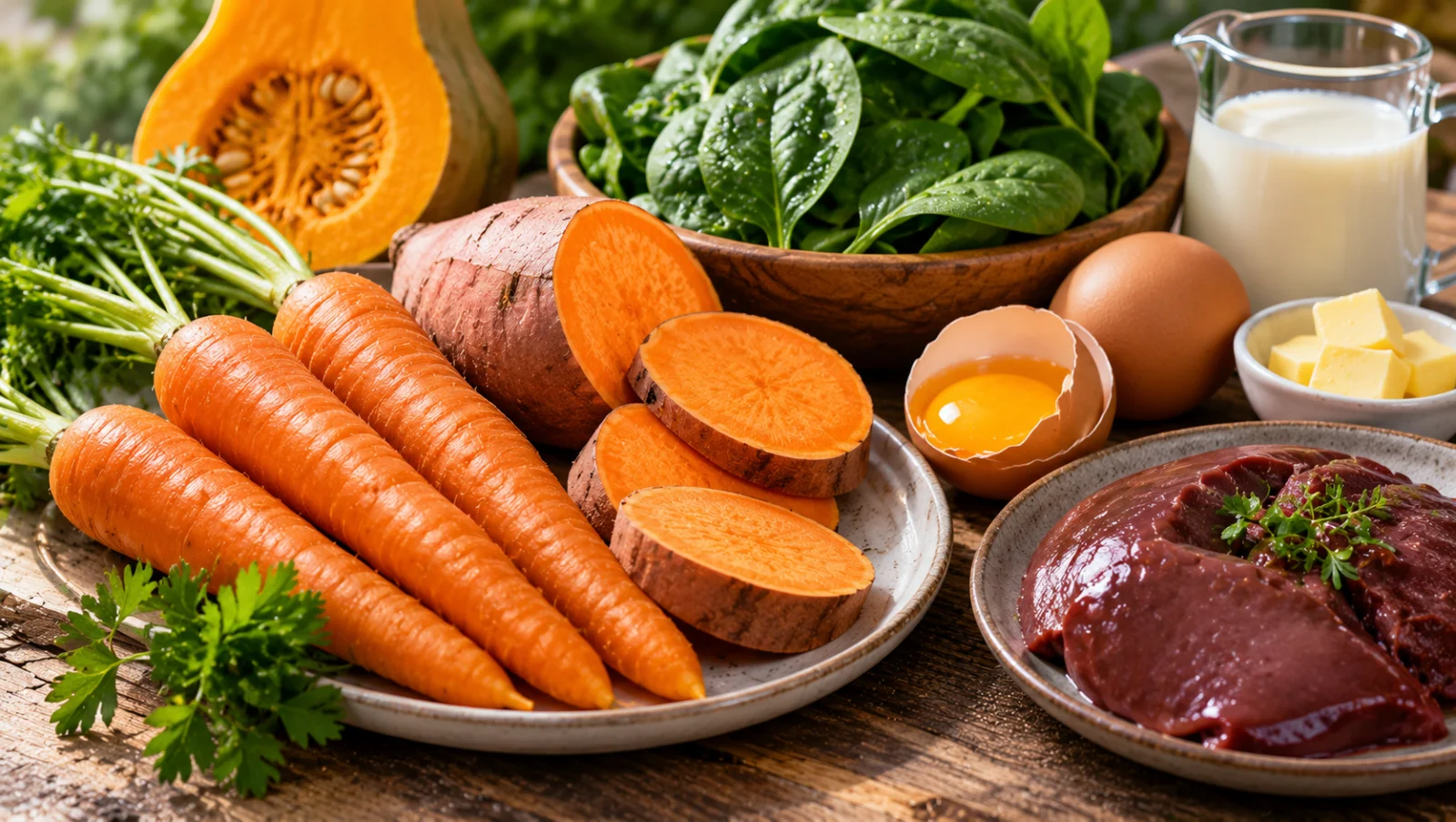
The name covers a family of related compounds rather than one molecule. Foods of animal origin, such as liver, eggs and dairy products, supply preformed vitamin A, mostly as retinyl esters. Plants supply carotenoids, orange and yellow pigments, some of which the gut wall can split into vitamin A and which are therefore called provitamin A (Carazo et al., 2021).
Three active forms
Inside the body, these starting materials are turned into three working forms: retinol, retinal and retinoic acid. Each has its own job. Retinal is the form used in the eye, retinoic acid switches genes on and off through receptors in the cell nucleus, and retinol is mainly the transport form; vitamin A is stored mainly as retinyl esters (Carazo et al., 2021).
Beta-carotene, the best-known provitamin A carotenoid, can be converted into retinal, which the body may then turn into retinol or retinoic acid. Alternative cleavage pathways can also produce other carotenoid metabolites, so not all routes lead to retinoic acid (Carazo et al., 2021). Many other carotenoids in the diet cannot be converted into vitamin A at all.
Storage in the liver
After absorption, vitamin A travels in fat particles through the lymph and reaches the liver, which acts as the body’s main store. From there, retinol is released into the blood bound to a carrier, retinol-binding protein, and target cells take it up through a specific receptor (Carazo et al., 2021).
This storage system explains two features of vitamin A that matter for health. Stores built up over time can cover weeks or months of low intake, so deficiency develops slowly. Blood retinol also stays fairly constant until the liver store runs low, which makes it an imperfect early marker of status.
How does vitamin A support vision?
The best-understood role of vitamin A is in the retina. Rod cells, which handle vision in low light, contain a pigment called rhodopsin, made from a protein, opsin, joined to 11-cis-retinal, a form of vitamin A (Carazo et al., 2021). When light strikes rhodopsin, the retinal changes shape, and that change starts the nerve signal sent to the brain.
After each such event, the retinal has to be recycled back into its light-sensitive shape before the pigment can work again. A steady supply of vitamin A keeps this cycle running. Cone cells, which detect colour in bright light, use a similar mechanism with different opsins.
Night blindness
Because rods are the cells that depend most heavily on rhodopsin, they are the first to struggle when vitamin A runs short. The result is night blindness, difficulty seeing in dim light or adjusting after moving from light into darkness. It is usually the earliest clinical sign of deficiency and is reversible if vitamin A status recovers.
Damage to the front of the eye
Longer and more severe deficiency affects the surface of the eye as well. The conjunctiva and cornea lose their moist, mucus-producing lining and become dry and thickened, a condition called xerophthalmia. In the most serious cases the cornea softens and breaks down, which can cause permanent blindness. Vitamin A deficiency has long been regarded as a leading preventable cause of blindness in children in low-income countries.
A related article on vitamin A deficiency examines how depleted vitamin A stores affect night vision and can progress to xerophthalmia. It also explains why historical estimates of childhood deficiency should not be treated as current prevalence.
Vitamin A and the skin
Skin and the linings of the airways, gut and urinary tract are made of epithelial cells that are constantly replaced. Retinoic acid, acting through nuclear receptors, helps steer these cells as they mature, so that they form a soft, mucus-producing surface where one is needed (Carazo et al., 2021).
When vitamin A is lacking, that control weakens. Epithelial tissues tend to become keratinised, meaning they turn dry, rough and horny, much like the outer layer of the skin (Semba, 1994). On the skin itself, this can appear as rough, raised patches around hair follicles.
Synthetic retinoids
The influence of retinoic acid on skin cells is also the basis for a group of synthetic compounds called retinoids. These are derivatives of the natural vitamin, developed over several generations, and some are used in medicine for skin conditions and certain cancers (Carazo et al., 2021). They share a similar chemical core but can act very differently in the body.
Retinoids are distinct from dietary vitamin A, and their effects in clinical use do not show that eating more vitamin A improves skin in people who are not deficient. Other nutrition-related skin research, including work on stratum corneum moisture, examines different interventions and outcomes. Several retinoid drugs are also known to harm the developing fetus, which links to wider concerns about high intakes in pregnancy discussed below.
How does vitamin A affect immunity?
The link between vitamin A and infection was noticed early in the twentieth century, when deficient animals were seen to die from infections more readily. That observation earned vitamin A the label of an “anti-infective” vitamin, a description that later research partly supported and partly refined.
The 1994 review of immunity and infection
In the review “Vitamin A, immunity, and infection” (1994), Richard Semba drew together laboratory, clinical and community research on how deficiency affects defence against disease. He described two broad routes. The first is physical: keratinised linings in the airways and gut are less able to trap and clear microbes, so pathogens gain entry more easily.
The second route runs through immune cells. Semba (1994) summarised evidence that deficiency alters the behaviour of lymphocytes and weakens antibody responses to some antigens, so the body mounts a poorer defence once an infection has started. Infections themselves lower blood retinol and increase losses of vitamin A, which can set up a cycle in which illness and deficiency feed each other.
Measles and diarrhoeal disease
The clearest clinical effects have been seen with measles. Semba (1994) reviewed hospital studies in which children with measles who received vitamin A died less often than those who did not, and community trials in which supplementation lowered child mortality in areas where deficiency was common. These findings shaped international programmes that distribute vitamin A to young children.
The benefits of vitamin A supplementation have been most clearly demonstrated in populations at risk of deficiency. This does not establish that the effect in every individual can be predicted from their initial vitamin A level. The World Health Organization recommends high-dose supplementation for children aged 6–59 months where vitamin A deficiency is a public health problem (World Health Organization, 2023).
Later reviews reached different conclusions about mortality. Imdad et al. (2022) reported lower all-cause mortality in children aged 6 months to 5 years, whereas Bjelakovic et al. (2024) found no statistically significant mortality reduction in individually randomised trials across age groups.
How common is vitamin A deficiency?
Deficiency is now rare in high-income countries, where diets usually include animal foods, fortified products and vegetables. In many low- and middle-income countries it remains a significant public health problem, especially among young children and pregnant women.
A global assessment by the World Health Organization covering 1995–2005 estimated that about 190 million preschool children, 33.3% of that age group in countries at risk, had low blood retinol, below 0.70 µmol/L (World Health Organization, 2009). The same report estimated that 5.2 million preschool children and 9.8 million pregnant women had night blindness.
Trends over two decades
In the study “Trends and mortality effects of vitamin A deficiency in children in 138 low-income and middle-income countries between 1991 and 2013” (2015), Stevens and colleagues pooled population-based surveys to estimate prevalence among children aged 6–59 months. The estimated prevalence of vitamin A deficiency declined from 39% in 1991 (95% credible interval 27–52%) to 29% in 2013 (95% credible interval 17–42%) across these countries. However, the probability that this represented a genuine decline was estimated at 81%, reflecting uncertainty around the overall trend (Stevens et al., 2015).
Progress was uneven. Prevalence dropped sharply in East and Southeast Asia and Oceania, but remained about 48% in sub-Saharan Africa and 44% in South Asia in 2013 (Stevens et al., 2015). The authors estimated that deficiency accounted for about 105,700 child deaths from diarrhoea and measles in 2013, or 1.7% of all deaths in children under five in these countries.
Source | Population | Measure | Figure |
World Health Organization, 2009 | Preschool children, countries at risk, 1995–2005 | Low blood retinol | 33.3% (about 190 million) |
World Health Organization, 2009 | Preschool children, 1995–2005 | Night blindness | About 5.2 million |
World Health Organization, 2009 | Pregnant women, 1995–2005 | Night blindness | About 9.8 million |
Stevens et al., 2015 | Children 6–59 months, 138 countries, 1991 | Deficiency | 39% |
Stevens et al., 2015 | Children 6–59 months, 138 countries, 2013 | Deficiency | 29% |
Stevens et al., 2015 | Sub-Saharan Africa, 2013 | Deficiency | 48% |
Stevens et al., 2015 | South Asia, 2013 | Deficiency | 44% |
What supplementation trials have shown
Interest in vitamin A as a way to save children’s lives grew from community trials in the 1980s. In the study “Impact of vitamin A supplementation on childhood mortality” (1986), Sommer and colleagues assigned 450 villages in northern Sumatra, Indonesia, to receive a vitamin A distribution programme either immediately or later, covering 25,939 preschool children. Mortality was about 34% lower in the programme villages over the following year (Sommer et al., 1986).
Pooled evidence in young children
Many trials followed, and they have been combined repeatedly. A Cochrane review included 47 studies involving approximately 1.22 million children aged 6 months to 5 years. Its analysis of all-cause mortality drew on 19 trials with 1,202,382 children and found a 12% reduction in mortality among those receiving vitamin A (risk ratio 0.88, 95% confidence interval 0.83–0.93; high-certainty evidence) (Imdad et al., 2022). The same review reported fewer cases of night blindness and xerophthalmia among children who received vitamin A.
A wider and more cautious analysis
A 2024 analysis took a broader view. In the study “Effects of primary or secondary prevention with vitamin A supplementation on clinically important outcomes” (2024), Bjelakovic and colleagues combined 120 randomised trials with 1,671,672 participants of all ages, 92 of them in children and 28 in adults.
The authors separated trials that randomised individuals from those that randomised whole communities. In 105 individually randomised trials with 239,974 participants, no statistically significant difference in mortality was observed (risk ratio 0.99, 95% confidence interval 0.93–1.05; moderate-certainty evidence) (Bjelakovic et al., 2024). Cluster-randomised trials did show lower mortality, with a risk ratio of 0.84, but the certainty of that evidence was rated very low.
Only 14 of the 105 individual trials were judged at low risk of bias (Bjelakovic et al., 2024). In children aged 6–59 months, a subgroup of 29 trials suggested a benefit, but all were at high risk of bias.
The analysis suggested an increased risk of bulging fontanelle in newborns and infants receiving vitamin A (risk ratio 2.03, 95% confidence interval 1.26–3.41, based on nine trials involving 110,774 participants). However, the evidence was rated as low certainty, meaning the true effect remains uncertain (Bjelakovic et al., 2024). Readers interested in why trial design shapes such conclusions can find more in Cabdirect’s section on research methodology.
Harm at high intakes
Because vitamin A is stored in the liver, high intakes can build up to harmful levels, and the review by Carazo and colleagues (2021) covers toxicity alongside deficiency. Two large studies illustrate potential harms associated with high-dose supplementation, although the CARET trial tested beta-carotene and preformed vitamin A together and could not distinguish their individual effects.
In the study “Effects of a combination of beta carotene and vitamin A on lung cancer and cardiovascular disease” (1996), Omenn and colleagues followed 18,314 smokers, former smokers and asbestos-exposed workers. Participants who received beta-carotene with retinyl palmitate had a 28% higher incidence of lung cancer and 17% higher mortality, and the trial was stopped early.
The distinction between a nutrient's essential function and the effects of concentrated supplements is also examined in research on antioxidants. That article explains why antioxidant activity does not guarantee clinical benefit and how some large supplementation trials identified harm.
A study of 22,748 pregnant women found that a high intake of preformed vitamin A from supplements in early pregnancy was associated with more birth defects of structures derived from the cranial neural crest (Rothman et al., 1995). Carotenoids from plant foods are not thought to carry the same risk as high intakes of preformed vitamin A (Carazo et al., 2021). The CARET findings echo those of other antioxidant trials, such as research on selenium and cancer prevention.
What is proven about vitamin A, and what is not
The research described above firmly establishes several points. The clearest conclusions are:
- Vitamin A, as 11-cis-retinal, is part of rhodopsin, and deficiency causes night blindness and, when severe, xerophthalmia (Carazo et al., 2021).
- Retinoic acid regulates genes that control how epithelial cells mature, and deficiency leads to keratinised skin and linings (Semba, 1994).
- Deficiency weakens barriers and immune responses and is linked with more severe infection, particularly measles and diarrhoea (Semba, 1994).
- In 2013, vitamin A deficiency was estimated to affect 29% of children aged 6–59 months across 138 low- and middle-income countries; this historical estimate does not describe current prevalence (Stevens et al., 2015).
- High intakes of preformed vitamin A can be harmful (Omenn et al., 1996; Rothman et al., 1995).
Vitamin A is indispensable for sight and for the body’s defences, but extra vitamin A appears to help mainly where diets fall short, and even there the size of the benefit is still argued over.
Several questions remain open. Evidence on the mortality benefit of vitamin A supplementation differs between systematic reviews. A 2022 Cochrane review found a 12% reduction in all-cause mortality among children aged 6 months to 5 years, based on high-certainty evidence (Imdad et al., 2022). In contrast, a broader 2024 review found no statistically significant reduction in mortality in individually randomised trials across age groups (risk ratio 0.99, 95% confidence interval 0.93–1.05; moderate-certainty evidence), while cluster-randomised trials suggested a benefit based on very-low-certainty evidence (Bjelakovic et al., 2024).
These differences reflect, in part, the populations, trial designs and analytical approaches included in each review. The two reviews therefore provide different estimates of the mortality effect of vitamin A supplementation depending on the populations and trial designs included (Imdad et al., 2022; Bjelakovic et al., 2024).
For readers following research on nutrients and supplements, vitamin A shows how a nutrient with a well-understood biological role can still produce uncertain results in large trials. Its importance for vision, skin and immunity is clear, while the populations that gain from extra intake are narrower than early studies suggested.
Frequently asked questions
Which foods contain vitamin A?
Preformed vitamin A comes from animal foods such as liver, eggs, milk and other dairy products, mainly as retinyl esters. Plant foods, particularly orange and yellow vegetables, some fruits and dark green leaves, supply provitamin A carotenoids such as beta-carotene, which the gut can convert into vitamin A (Carazo et al., 2021).
What is the difference between retinol and beta-carotene?
Retinol is a form of vitamin A itself, found in animal foods and in the blood. Beta-carotene is a plant pigment that the body splits into vitamin A when needed. Large amounts of preformed vitamin A can build up in the liver, whereas carotenoids from ordinary plant foods are not thought to carry the same risk (Carazo et al., 2021).
How is vitamin A status measured?
Studies usually measure retinol in blood, and population surveys often treat values below 0.70 µmol/L as low (World Health Organization, 2009). Because the liver keeps blood retinol steady until its store runs down, and because infection lowers blood levels temporarily, a single result can misjudge how much vitamin A a person actually has.
Can vitamin A turn skin orange?
Eating large amounts of carotene-rich foods, such as carrots, can give the skin a yellow-orange tint known as carotenaemia, most visible on the palms and soles. It reflects carotenoid pigments rather than excess preformed vitamin A, and carotenaemia from carotenoid-rich foods is generally regarded as harmless.
Why is vitamin A given to children in some countries?
In regions where deficiency is a public health problem, vitamin A programmes aim to reduce illness and child mortality. A 2022 Cochrane review reported lower mortality from all causes and diarrhoea in children receiving vitamin A (Imdad et al., 2022). A broader 2024 review found less certain benefits across different trial designs (Bjelakovic et al., 2024).
Sources
- Carazo, A., Macáková, K., Matoušová, K., Krčmová, L.K., Protti, M., Mladěnka, P. Vitamin A update: forms, sources, kinetics, detection, function, deficiency, therapeutic use and toxicity. Nutrients, 2021, 13(5), 1703. DOI 10.3390/nu13051703
- Semba, R.D. Vitamin A, immunity, and infection. Clinical Infectious Diseases, 1994, 19(3), 489–499. DOI 10.1093/clinids/19.3.489
- Bjelakovic, G., Nikolova, D., Bjelakovic, M., Pavlov, C.S., Sethi, N.J., Korang, S.K., Gluud, C. Effects of primary or secondary prevention with vitamin A supplementation on clinically important outcomes: a systematic review of randomised clinical trials with meta-analysis and trial sequential analysis. BMJ Open, 2024, 14(5), e078053. DOI 10.1136/bmjopen-2023-078053
- World Health Organization. Global prevalence of vitamin A deficiency in populations at risk 1995–2005: WHO Global Database on Vitamin A Deficiency. Geneva: World Health Organization, 2009. ISBN 978 92 4 159801 9
- Stevens, G.A., Bennett, J.E., Hennocq, Q., et al. Trends and mortality effects of vitamin A deficiency in children in 138 low-income and middle-income countries between 1991 and 2013: a pooled analysis of population-based surveys. Lancet Global Health, 2015, 3(9), e528–e536. DOI 10.1016/S2214-109X(15)00039-X
- Imdad, A., Mayo-Wilson, E., Haykal, M.R., et al. Vitamin A supplementation for preventing morbidity and mortality in children from six months to five years of age. Cochrane Database of Systematic Reviews, 2022, 3, CD008524. DOI 10.1002/14651858.CD008524.pub4
- Sommer, A., Tarwotjo, I., Djunaedi, E., et al. Impact of vitamin A supplementation on childhood mortality: a randomised controlled community trial. Lancet, 1986, 1(8491), 1169–1173. DOI 10.1016/S0140-6736(86)91157-8
- Omenn, G.S., Goodman, G.E., Thornquist, M.D., et al. Effects of a combination of beta carotene and vitamin A on lung cancer and cardiovascular disease. New England Journal of Medicine, 1996, 334(18), 1150–1155. DOI 10.1056/NEJM199605023341802
- Rothman, K.J., Moore, L.L., Singer, M.R., et al. Teratogenicity of high vitamin A intake. New England Journal of Medicine, 1995, 333(21), 1369–1373. DOI 10.1056/NEJM199511233332101
- World Health Organization. Vitamin A supplementation in infants and children 6–59 months of age. eLENA, 9 August 2023. https://www.who.int/tools/elena/interventions/vitamina-children

Nora Veldin — author
Nora Veldin is a health science writer with academic training in biomedical science and public health. After completing a BSc in Biomedical Science, she undertook an MPH focused on epidemiology, population health and the interpretation of health evidence. Her...
This article is for general information and is not medical advice. It was reviewed for accuracy by a qualified clinician; decisions about your health should be made with your own doctor.
Related
Why vitamin A deficiency remains a leading cause of child blindness
What antioxidants are and why more is not always better

Selenium and cancer prevention: what the evidence shows

Pregnancy-Associated Osteoporosis: Fractures, Causes and Care

Protein and Satiety: How Higher-Protein Meals Affect Appetite

Herbal Medicine Monographs: What Commission E Still Teaches
Vitamin D2 vs D3 and which form works best for you