

















What a normal resting heart rate is and what fitness does to it
MedlinePlus lists a normal resting heart rate of 60 to 100 beats per minute for adults, and 40 to 60 beats per minute for well-trained athletes (MedlinePlus, 2025). Quer et al. reported that, across 92,457 adults, the average daily resting heart rate was 65.5 beats per minute, yet usual values still varied widely between people (Quer et al., 2020).
Resting heart rate matters because it sits at the intersection of measurement, physiology and long-term risk. Meta-analyses by Zhang and colleagues linked higher resting heart rate with worse health outcomes, while training studies by Stratton et al., Bahrainy et al. and Huang et al. showed that fitness often lowers the number, though usually by a modest amount (Zhang et al., 2016; Stratton et al., 1994; Bahrainy et al., 2016; Huang et al., 2005).

Evidence last checked 20 Nov 2026 · 11 min
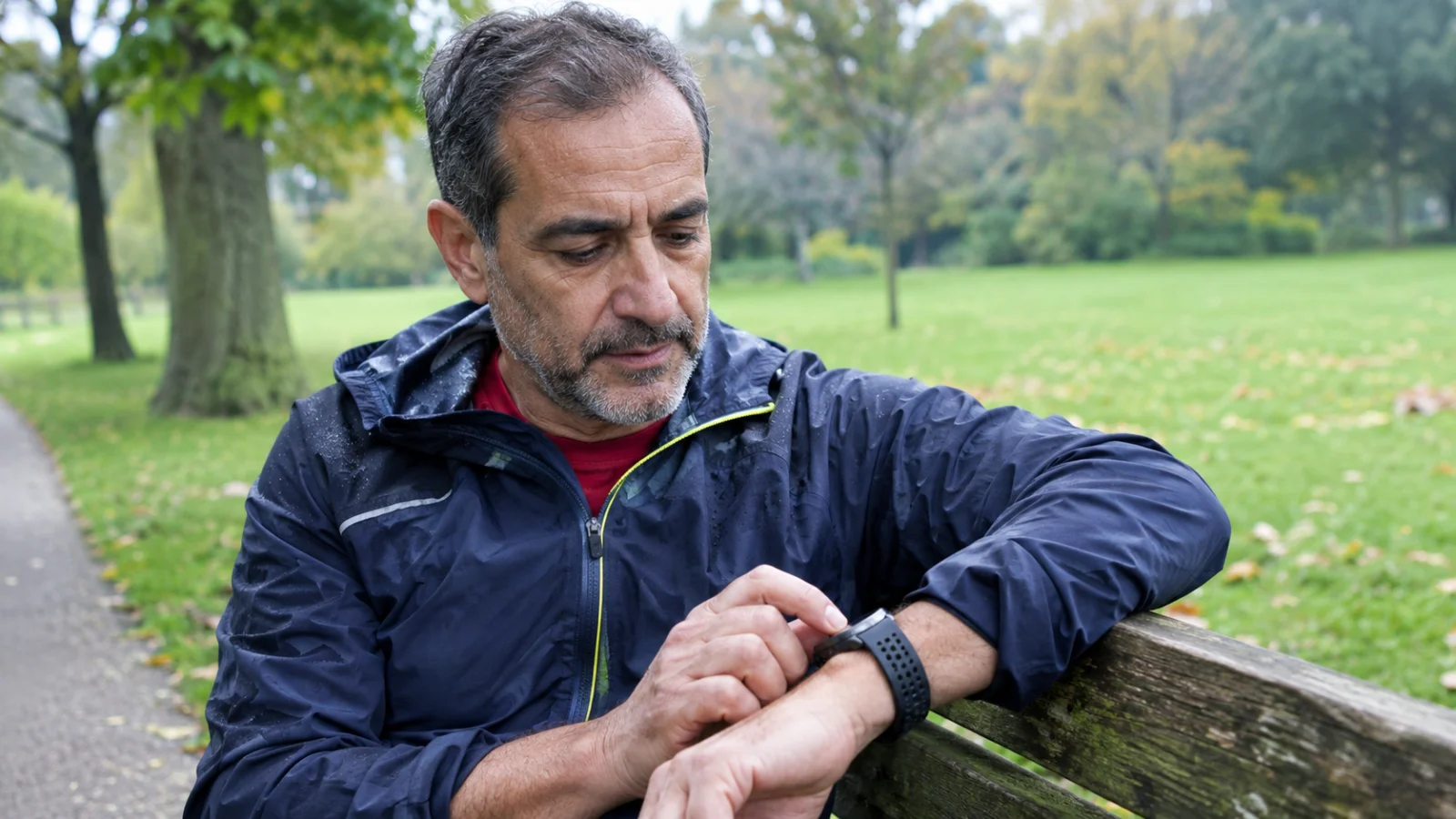
What resting heart rate means and the normal adult range
Heartbeats per minute at rest
The American Heart Association describes resting heart rate as the number of times the heart pumps when exercise is not happening (American Heart Association, 2024). MedlinePlus gives the standard adult reference interval as 60 to 100 beats per minute, and the American Heart Association gives the same range for people who are sitting or lying down, calm and feeling well (MedlinePlus, 2025; American Heart Association, 2024).
Low readings are not automatically abnormal. The American Heart Association notes that trained or physically active adults can have slower resting rates, and MedlinePlus lists 40 to 60 beats per minute for well-trained athletes (American Heart Association, 2024; MedlinePlus, 2025).
Adult ranges and individual variation
Population ranges hide a great deal of spread. In the wearable cohort analysed by Quer et al., the average daily resting heart rate was 65.5 beats per minute, but values ranged from 40 to 109 beats per minute across participants (Quer et al., 2020).
Quer et al. also reported that one person’s usual resting heart rate can differ from another person’s by as much as 70 beats per minute (Quer et al., 2020). That means a value can sit well inside the population range while still being high or low relative to one person’s own baseline.
The adult resting range does not apply unchanged to infants and young children. MedlinePlus (2025) lists 70–190 beats per minute for newborns up to one month, 80–160 at 1–11 months, 80–130 at 1–2 years and 70–110 at 7–9 years. From age 10 onward, it lists 60–100 beats per minute, with lower figures possible in well-trained athletes. The American Heart Association's Target Heart Rates Chart (2024) instead describes exercise-related targets; those age-based exercise figures should not be mistaken for resting pulse ranges.
How resting heart rate is measured and why readings vary
Manual pulse measurement
The American Heart Association says the best places to find a pulse are the wrist, the inside of the elbow, either side of the neck and the top of the foot (American Heart Association, 2024). Those sites are used because the pulse wave is easier to feel where an artery passes close to the skin.
For a manual reading at the wrist, the American Heart Association says to count beats for 60 seconds to get the most accurate number (American Heart Association, 2024). The same organisation also notes that a practical alternative is to count for 30 seconds and multiply by two (American Heart Association, 2024).
Time of day and wearable devices
Repeated readings matter more than isolated ones. Quer et al. found that about 20% of participants had at least one week in which their resting heart rate fluctuated by 10 beats per minute or more within the week (Quer et al., 2020).
Wearables are useful for tracking trends, but they are not perfect substitutes for a reference device. Doherty et al. found that consumer wearables showed a mean heart-rate bias of about plus or minus 3%, while also noting that a clear overall judgement is limited by strong heterogeneity in methods and results across studies (Doherty et al., 2024). That is why changes over time are usually more informative than any single watch-based reading.
The mean bias reported in the umbrella review is an average across evaluations, not a guarantee that each individual watch measurement is within 3% of a reference device. Doherty et al. (2024) found substantial heterogeneity across the systematic reviews and noted the need for consistent validation. Quer et al. (2020) analysed repeated readings from commercial wrist-worn trackers over time, but the study did not establish the clinical cause of every short-term change. Taken together, these findings support treating device data as a description of patterns rather than a diagnosis drawn from one number.
What affects resting heart rate beyond physical fitness
Age, sleep and emotional stress
Fitness is only one influence. Quer et al. reported that mean daily resting heart rate differed by age, sex, body mass index and average sleep duration, which ties the number to broader physiology and recovery rather than to exercise alone (Quer et al., 2020).
The American Heart Association also says that stress, anxiety, happiness, sadness and pain can increase pulse (American Heart Association, 2024). That overlap with arousal is one reason the site’s other coverage of competitive anxiety in sport is relevant when heart-rate readings are discussed outside a laboratory.
Medicines, illness and hydration
Several routine influences can move resting heart rate up or down. The American Heart Association lists temperature, body position and obesity among the factors that can affect pulse, and it also notes that beta blockers, calcium channel blockers and several other medicines can slow heart rate (American Heart Association, 2024).
A faster resting rate is not a fitness verdict by itself. The American Heart Association lists stress, lack of sleep, anaemia and dehydration among the issues that can accompany or trigger tachycardia episodes (American Heart Association, 2024). Similar context matters when people read changes in motivation or exertion during physical activity, which is also reflected in Feeling Fit and Enjoying Exercise: A 2002 Study of Women.
A fast pulse can also occur in clinical circumstances that have little to do with athletic conditioning. The American Heart Association (2024) lists anaemia as one factor that may accompany tachycardia, while an article on iron deficiency explains how depleted iron stores can eventually lead to anaemia. The two terms are not interchangeable: iron deficiency can exist before haemoglobin becomes low. This distinction matters because a pulse recorded alongside illness or fatigue cannot be interpreted in the same way as a training-related change measured in healthy volunteers.
Why resting heart rate is often lower with better fitness
Stroke volume and autonomic regulation
One proposed explanation is that endurance training increases the amount of blood delivered with each beat, allowing a lower heart rate at rest. In healthy men, Stratton et al. (1994) found that resting heart rate fell by 12% while resting stroke volume index increased by 18% after training, although these findings alone do not establish that one change caused the other.
That mechanism is not the whole story, however. Bahrainy et al. reported that six months of supervised training increased VO2 max by 17% and lowered resting heart rate from 62.8 to 57.6 beats per minute, yet they did not find evidence that the reduction was explained by greater parasympathetic tone or reduced beta-adrenergic responsiveness (Bahrainy et al., 2016). The same investigators suggested that the decline was most likely due to a lower intrinsic heart rate (Bahrainy et al., 2016).
A lower resting heart rate often reflects adaptation to training, but it is not a stand-alone score of health or fitness.
Endurance training and individual differences
The average effect of endurance training is meaningful, but it is usually not dramatic. Huang et al. pooled endurance-training trials in older adults and found an average net reduction of 6 beats per minute, with larger and statistically significant decreases in programmes lasting more than 30 weeks (Huang et al., 2005).
That pattern helps explain why fitter adults often trend lower while still overlapping with less-trained adults. A training response is shaped by the starting heart rate, the duration of the programme and the type of adaptation, not by fitness status alone. Broader physical-activity effects on wellbeing are discussed separately in How exercise affects self-concept and well-being in midlife.
What studies show about resting heart rate and health outcomes
Population studies of cardiovascular fitness
Resting heart rate is often treated as a rough signal of cardiovascular fitness because the American Heart Association notes that more active adults may have lower resting values (American Heart Association, 2024). The larger health-outcome literature, though, comes from prospective cohort studies rather than from direct fitness testing.
In one meta-analysis, Zhang, Shen and Qi pooled 46 prospective studies with 1,246,203 participants (Zhang et al., 2016). They reported that each 10 beat per minute increase in resting heart rate corresponded to a relative risk of 1.09 for all-cause mortality and 1.08 for cardiovascular mortality (Zhang et al., 2016).
Long-term risks and study limitations
The same meta-analysis also showed that resting heart rates above 80 beats per minute were associated with a 45% higher risk of all-cause mortality and a 33% higher risk of cardiovascular mortality when compared with the lowest category (Zhang et al., 2016). A second meta-analysis by Zhang, Wang and Li (2016) linked higher resting heart rate with coronary artery disease, stroke, sudden cardiac death and non-cardiovascular disease. The pooled relative risks per 10 beat per minute increase were 1.12 for coronary artery disease, 1.05 for stroke and 1.12 for sudden cardiac death. However, when studies involving patients with hypertension or diabetes were excluded, the association with sudden cardiac death was no longer observed.
These outcome studies are consistent, but they are not free of limits. Zhang, Shen and Qi reported heterogeneity and publication bias, whereas Zhang, Wang and Li found no evidence of publication bias for coronary artery disease, stroke or sudden death (Zhang et al., 2016). That makes the direction of the association more secure than the exact size of the risk estimate.
Both 2016 meta-analyses pooled prospective cohort evidence rather than randomised trials of deliberately changing resting heart rate. Researchers measured participants’ pulses and recorded later outcomes, but characteristics such as illness, medication use or smoking can affect both heart rate and disease risk. Statistical adjustment can reduce some of this confounding without proving that a higher pulse directly caused the outcome. The two analyses also assessed partly different endpoints, so their relative risks should be read as separate association estimates rather than added together or converted into a predicted risk for an individual (Zhang, Shen and Qi, 2016; Zhang, Wang and Li, 2016).
Selected research findings
Study | Design | Main finding | Important limitation |
Zhang, Shen and Qi, 2016 | Meta-analysis of 46 prospective studies, 1,246,203 participants | Every 10 bpm higher resting heart rate was linked with higher all-cause and cardiovascular mortality | Heterogeneity and publication bias were detected |
Zhang, Wang and Li, 2016 | Meta-analysis of 45 prospective cohort studies; coronary artery disease analysis: 30 studies, 1,227,511 participants | Every 10 bpm higher resting heart rate was linked with higher risk of coronary artery disease, stroke and sudden cardiac death | No publication bias detected for these outcomes; the association with sudden death was not found after excluding cohorts with hypertension or diabetes. |
Huang et al., 2005 | Meta-analysis of 13 endurance-training studies in 651 older adults | Endurance training lowered resting heart rate by an average of 6 bpm | Effect size was moderate and depended on programme length |
The table brings the outcome and training evidence into one place. It also shows a key difference between research questions: cohort studies describe long-term associations, whereas training studies test whether exercise can shift the resting number itself.
When a resting heart rate falls outside the typical range
Bradycardia and tachycardia
The American Heart Association defines bradycardia as a heart rate that is usually below 60 beats per minute and tachycardia as a resting heart rate above 100 beats per minute (American Heart Association, 2024). These labels tell what the rate is doing, but they do not explain why it is happening.
Context matters straight away. The American Heart Association notes that rates below 60 can occur during sleep or in physically active adults, and that fast-rate episodes may be linked with exercise, stress, lack of sleep, anaemia, dehydration, excessive caffeine or excessive alcohol (American Heart Association, 2024).
Symptoms and clinical context
Numbers become more meaningful when symptoms are considered alongside them. For bradycardia, the American Heart Association lists fatigue, dizziness, confusion, fainting, shortness of breath and chest pain among the main symptoms (American Heart Association, 2024).
MedlinePlus (2025) notes that a persistently high resting heart rate or a rate below normal values may indicate a problem. The American Heart Association (2024) also identifies dizziness, fainting, chest pain and shortness of breath as symptoms associated with bradycardia, meaning that a low heart rate accompanied by symptoms may require clinical assessment even without a persistent pattern.
What is proven about resting heart rate and fitness
The strongest conclusions are fairly limited and fairly solid. MedlinePlus supports a normal adult range of 60 to 100 beats per minute, and training studies show that endurance exercise can lower resting heart rate by several beats per minute on average (MedlinePlus, 2025; Huang et al., 2005; Stratton et al., 1994).
What is not proven is that the lowest possible number is always the healthiest number, or that resting heart rate works as a complete fitness test on its own. Quer et al. showed large between-person and week-to-week variation, which means an apparently good number can still be uninformative if it is stripped from context (Quer et al., 2020).
The prognosis literature also supports only an association, not a simple mechanism. Zhang, Shen and Qi concluded that elevated resting heart rate was independently associated with increased all-cause and cardiovascular mortality, but that evidence cannot show whether heart rate is the driver, a marker of other physiology, or both (Zhang et al., 2016).
Frequently asked questions
Is a resting heart rate of 50 bpm normal?
It can be normal. MedlinePlus (2025) lists 40 to 60 beats per minute for well-trained athletes, and the American Heart Association (2024) notes that rates below 60 can occur during sleep or in physically active adults. The number becomes more important when it appears together with fatigue, dizziness, fainting or breathlessness.
Does resting heart rate increase with age?
Age influences resting heart rate, but the relationship is not a simple one-way climb. Quer et al. (2020) found that average daily resting heart rate differed by age, while the American Heart Association (2024) also points to sleep, medicines and other influences that can shift the pattern at the same time.
Can anxiety raise resting heart rate?
Yes. The American Heart Association (2024) says stress and anxiety can increase pulse, so a higher reading during emotional strain can reflect arousal rather than a stable baseline. That is one reason repeated calm readings are more informative than measurements taken in the middle of discomfort or tension.
Is a lower resting heart rate always healthier?
No. A lower resting heart rate often accompanies fitness, but it is not automatically better in every situation. The American Heart Association (2024) notes that very low rates may be normal in trained adults, yet the same number can become clinically relevant when it appears with symptoms such as dizziness, fainting, chest pain or shortness of breath.
Why does resting heart rate change from day to day?
Resting heart rate changes because sleep, stress, hydration, medicines, body position and other short-term influences all affect it. Quer et al. (2020) found that about 20% of participants experienced at least one week in which resting heart rate fluctuated by 10 beats per minute or more within that week, illustrating short-term variation.
Sources
- MedlinePlus. Pulse: MedlinePlus Medical Encyclopedia. Reviewed 2025. https://medlineplus.gov/ency/article/003399.htm
- American Heart Association. All About Heart Rate. 2024. https://www.heart.org/en/health-topics/high-blood-pressure/the-facts-about-high-blood-pressure/all-about-heart-rate-pulse
- American Heart Association. Target Heart Rates Chart. 2024. https://www.heart.org/en/healthy-living/exercise-and-physical-activity/fitness-basics/target-heart-rates/
- Quer G, Gouda P, Galarnyk M, Topol EJ, Steinhubl SR. Inter- and intraindividual variability in daily resting heart rate and its associations with age, sex, sleep, BMI, and time of year: retrospective, longitudinal cohort study of 92,457 adults. PLoS One. 2020;15(2):e0227709. DOI 10.1371/journal.pone.0227709.
- Zhang D, Shen X, Qi X. Resting heart rate and all-cause and cardiovascular mortality in the general population: a meta-analysis. CMAJ. 2016;188(3):E53–E63. DOI 10.1503/cmaj.150535.
- Zhang D, Wang W, Li F. Association between resting heart rate and coronary artery disease, stroke, sudden death and noncardiovascular diseases: a meta-analysis. CMAJ. 2016;188(15):E384–E392. DOI 10.1503/cmaj.160050.
- Huang G, Shi X, Davis-Brezette JA, Osness WH. Resting heart rate changes after endurance training in older adults: a meta-analysis. Medicine and Science in Sports and Exercise. 2005;37(8):1381–1386. DOI 10.1249/01.mss.0000174899.35392.0c.
- Bahrainy S, Levy WC, Busey JM, Caldwell JH, Stratton JR. Exercise training bradycardia is largely explained by reduced intrinsic heart rate. International Journal of Cardiology. 2016;222:213–216. DOI 10.1016/j.ijcard.2016.07.203.
- Doherty C, Baldwin M, Keogh A, Caulfield B, Argent R. Keeping Pace with Wearables: A Living Umbrella Review of Systematic Reviews Evaluating the Accuracy of Consumer Wearable Technologies in Health Measurement. Sports Medicine. 2024;54:2907–2926. DOI 10.1007/s40279-024-02077-2.
- American Heart Association. Bradycardia: Slow Heart Rate. 2024. https://www.heart.org/en/health-topics/arrhythmia/about-arrhythmia/bradycardia--slow-heart-rate
- American Heart Association. Tachycardia: Fast Heart Rate. 2024. https://www.heart.org/en/health-topics/arrhythmia/about-arrhythmia/tachycardia--fast-heart-rate
- Stratton JR, Levy WC, Cerqueira MD, Schwartz RS, Abrass IB. Cardiovascular responses to exercise. Effects of aging and exercise training in healthy men. Circulation. 1994;89(4):1648–1655. DOI 10.1161/01.cir.89.4.1648.

Ellen Marsh — author
Ellen writes Health & Medicine explainers for Cabdirect, with a focus on public health, disease prevention and the interpretation of medical research for general readers. Her academic background combines biomedical sciences with postgraduate study in populatio...
This article is for general information and is not medical advice. It was reviewed for accuracy by a qualified clinician; decisions about your health should be made with your own doctor.
Related
How exercise affects self-concept and well-being in midlife

How self-talk patterns relate to competitive anxiety in sport

Feeling Fit and Enjoying Exercise: A 2002 Study of Women
Iron deficiency and how it affects your health

Rotator cuff tears and why shoulder tendons fail with age and overuse
How ligaments tear in a sprained ankle and why ankles re-injure

Visceral fat and why exercise shrinks the fat stored around your organs