Ectopic pregnancy explained, from causes to early warning signs
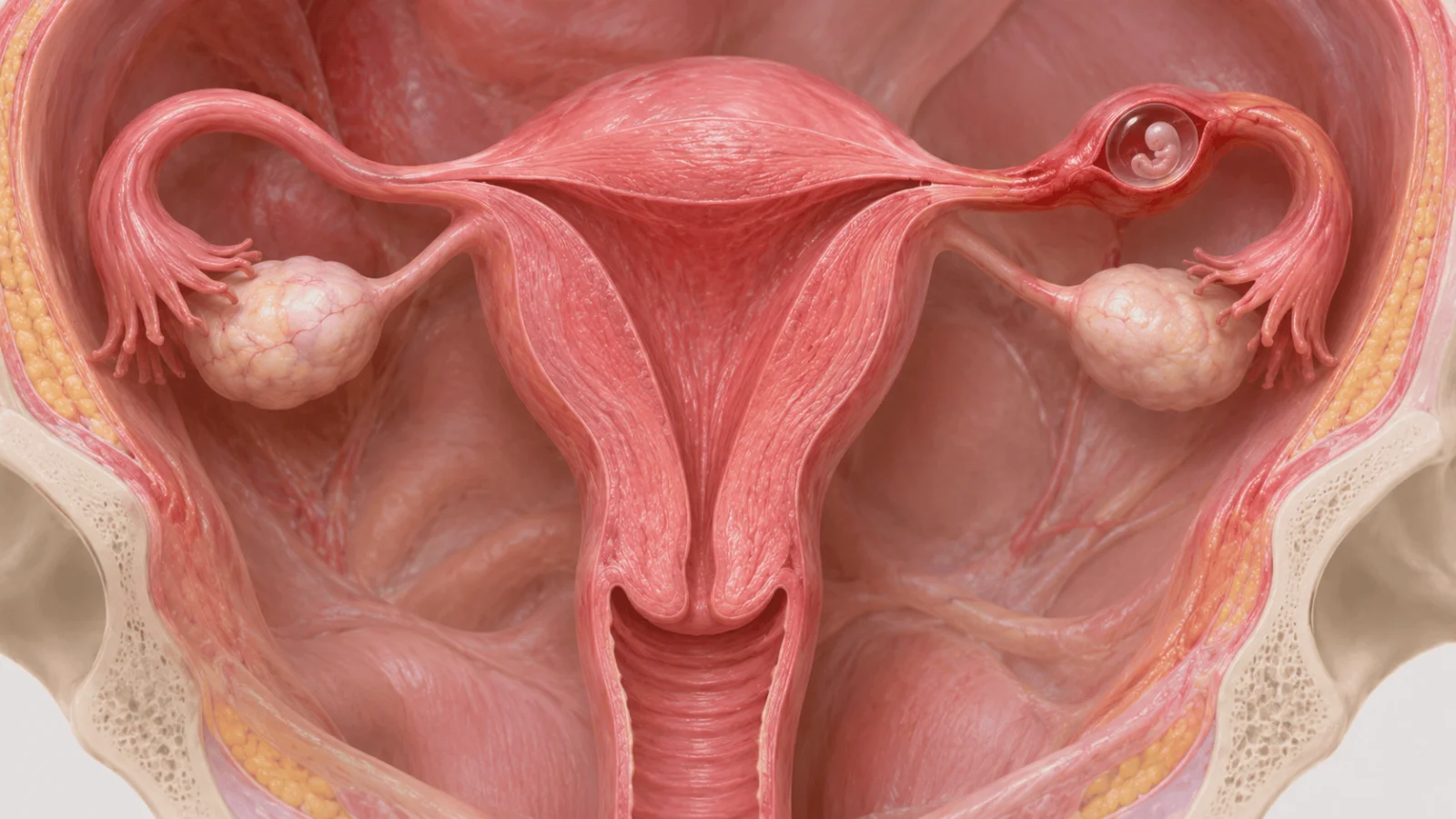
An ectopic pregnancy is one in which the embryo takes root somewhere it was never meant to grow, outside the womb's central chamber. Over nine in ten of these implantations take place in one of the two tubes linking the ovaries to the uterus, a location with no room for an embryo to grow, and a tear in the tube wall can cause heavy, potentially fatal haemorrhage inside the abdomen (Bouyer et al., 2002). In the UK, approximately 1 in 90 pregnancies is ectopic (NHS, 2022). In the United States, historical estimates put the proportion at around 2%, although the CDC has noted that reliable national estimates are difficult to obtain because many cases are managed outside hospitals (CDC, 2012).
This explainer examines the risk factors, early warning signs, diagnosis, treatment options and later fertility after ectopic pregnancy. It draws on NHS and NICE guidance and studies by Bouyer et al. (2003), Kirk et al. (2007) and Mol et al. (2014).

Evidence last checked 9 Nov 2026 · 14 min
What is an ectopic pregnancy and where does it implant?
Fertilisation normally takes place in the outer part of a fallopian tube. During the days after conception, rhythmic squeezing of the tubal wall together with the beating of tiny hair-like cilia move the early embryo towards the womb, where it attaches to the endometrium, a lining built to nourish it. If that journey is slowed or blocked, the embryo can attach to the tube wall instead.
An ectopic pregnancy produces the hormone hCG, so pregnancy tests are usually positive, although very low hormone levels can occasionally result in a negative test. Familiar early pregnancy symptoms, such as a missed period or breast tenderness, may also appear. With each passing week the developing tissue burrows deeper, invading the muscular layer of the tube and the vessels supplying it. Left untreated, the tube may eventually burst, a complication known as rupture, which can lead to heavy bleeding inside the abdomen (NHS, 2022).
Where ectopic pregnancies are found
The Auvergne register in central France recorded 1,800 surgically treated ectopic pregnancies between 1992 and 2001 (Bouyer et al., 2002). The following distribution describes the 1,679 cases with recorded implantation-site data:
- ampulla, the wide middle section of the tube: 70.0%
- isthmus, the narrow section closest to the womb: 12.0%
- fimbriae, the finger-like ends near the ovary: 11.1%
- ovary: 3.2%
- interstitial portion, where the tube passes through the wall of the womb: 2.4%
- abdominal cavity: 1.3%
No cervical pregnancies were seen in that series. The same register showed that complications and treatment varied by implantation site. In their analysis, Bouyer and colleagues (2002) characterised interstitial pregnancies as particularly difficult to manage. Pregnancies outside the tube are rare, but they explain why clinicians look beyond the tubes when a scan is unclear.
What causes an ectopic pregnancy?
Often the precise reason is never pinned down (NHS, 2022). Most explanations, however, point back to a tube that has been injured or has lost part of its normal width. Scar tissue left by infection or earlier operations can constrict the channel and disrupt the cilia, leaving the embryo stranded before it arrives in the womb.
What a large French case-control study found
In the study "Risk factors for ectopic pregnancy: a comprehensive analysis based on a large case-control, population-based study in France" (2003), Bouyer and colleagues set 803 women whose pregnancy had implanted outside the womb alongside 1,683 women who delivered a baby, all drawn from the same regional register between 1993 and 2000. The sample was large enough to weigh many suspected risk factors against each other at once, rather than one at a time as smaller studies had done.
Two factors stood out in the analysis. A history of pelvic infection was associated with more than three times the odds of ectopic pregnancy (adjusted odds ratio 3.4). The researchers estimated a population-attributable fraction of 33% for infectious history and 35% for smoking. These figures represent estimated contributions to ectopic pregnancy risk at the population level, rather than the proportion of affected women exposed to each factor (Bouyer et al., 2003).
Being older, having had several miscarriages, a background of infertility and earlier reliance on an intrauterine device each contributed further. The researchers estimated that the factors they examined together accounted for 76% of ectopic pregnancies in the study population (Bouyer et al., 2003).
Other recognised risk factors
Health services list several further situations linked to a higher risk (NHS, 2022):
- a previous ectopic pregnancy, after which the NHS puts the chance of another at around 10%
- surgery on the fallopian tubes, including a sterilisation procedure that later fails
- fertility treatment such as IVF, and infertility itself
- becoming pregnant with an intrauterine device or intrauterine system in place
- age over 35
The contraception point is often misread. Pregnancy while using an intrauterine device or system is uncommon, and the raised risk applies only to the small number of pregnancies that occur despite the method (NHS, 2022). Pelvic inflammatory disease, the infection most closely tied to tubal damage, is usually caused by sexually transmitted infections, which is why prevention advice from health services focuses on condoms and stopping smoking (NHS, 2022).
What are the early warning signs of an ectopic pregnancy?
Complaints, if any arise, tend to begin somewhere from week 4 to week 12 of gestation, yet a proportion of these pregnancies produce nothing noticeable and come to light only during a scheduled ultrasound (NHS, 2022). NICE recommendations on problems in the first trimester caution doctors that unusual or misleading presentations are frequent, and this partly explains why the diagnosis is so often delayed (NICE, 2019).
Symptoms vary, and some people have none at first. Possible signs include:
- a period that fails to arrive, frequently accompanied by sore breasts or queasiness
- an ache in the lower belly, usually felt more on the left or the right
- spotting or a thin, brownish discharge from the vagina, generally less than usual menstrual flow
- a sharp sensation at the outer edge of the shoulder
- soreness while urinating or having a bowel movement
Of all these, the shoulder symptom is the most puzzling. According to the NHS (2022), the exact reason for shoulder tip pain is not known, but it can be a sign of internal bleeding associated with ectopic pregnancy. No single sign is conclusive, because a miscarriage, a healthy early pregnancy or a gastrointestinal infection may feel much the same (NHS, 2022).
Breast tenderness can accompany early pregnancy, but it cannot establish where a pregnancy is implanted. Separate research on vitamin B6 and mastalgia addresses breast pain rather than diagnosing ectopic pregnancy.
Signs that suggest rupture
NHS information (2022) treats a combination of the following as an emergency that needs an ambulance or an immediate visit to A&E:
- sudden, sharp and intense abdominal pain
- feeling very dizzy or fainting
- feeling sick
- looking very pale
The NHS (2022) describes a rupture as potentially life threatening. The NHS adds that ruptures are uncommon and treatable when dealt with quickly, and that deaths from them are extremely rare in the UK.
Why timing matters
National figures document a substantial decline in ectopic pregnancy mortality over time. A US analysis covering 1980 to 2007 found that the ectopic pregnancy mortality ratio fell by 56.6%, from 1.15 to 0.50 deaths per 100,000 live births. The authors emphasised the importance of timely diagnosis and treatment, although the study did not establish how much of the decline was directly attributable to earlier detection (Creanga et al., 2011). The same study found that in 2003–2007, ectopic pregnancy mortality per 100,000 live births was 6.8 times higher among African American women than among white women, and 3.5 times higher among women older than 35 than among those younger than 25.
Even so, the condition still carries weight out of proportion to its frequency. The Centers for Disease Control and Prevention estimated that ectopic pregnancies make up 1–2% of US pregnancies but 3–4% of pregnancy-related deaths (CDC, 2012), and ACOG (2018) reported that ruptured ectopic pregnancy caused 2.7% of pregnancy-related deaths in 2011–2013 and was the leading cause of deaths from haemorrhage.
How is an ectopic pregnancy diagnosed?
A transvaginal ultrasound scan helps establish where the pregnancy is growing. If the pregnancy test is positive but the scan shows no pregnancy inside or outside the womb, clinicians call this a pregnancy of unknown location. They usually measure blood hCG levels twice, about 48 hours apart, to guide follow-up. The results cannot establish the location on their own.
In the study "The diagnostic effectiveness of an initial transvaginal scan in detecting ectopic pregnancy" (2007), Kirk and colleagues recorded 5,318 consecutive attendees at a UK early pregnancy unit over one year. Outcome data were available for 5,240 women. At the initial examination, the scan detected 73.9% of ectopic pregnancies, with a specificity of 99.9% and a positive predictive value of 96.7% (Kirk et al., 2007).
Most ectopic pregnancies not detected at the initial examination were classified as pregnancies of unknown location. In this specialist early pregnancy unit, overall ultrasound sensitivity increased to 98.3% when follow-up scans were included (Kirk et al., 2007). Serial hCG measurements supported clinical follow-up but could not independently establish the pregnancy's location.
In practical terms, an early ultrasound scan that does not establish the location of a pregnancy cannot reliably exclude an ectopic pregnancy. NICE guidance therefore recommends appropriate follow-up, including repeat assessment when needed, for women with a pregnancy of unknown location (NICE, 2019).
How is an ectopic pregnancy treated?
Medicine currently offers no means of transferring an embryo from the tube to the uterus or of letting it develop where it lies, so the goal of care is to bring the pregnancy to a close without harm, preserving wellbeing and the chance of conceiving again (NHS, 2022). Clinicians select from three options, guided by how unwell the woman is, what her scans and blood results show and what she herself would prefer:
- watchful waiting, where regular checks track whether the tissue is reabsorbed naturally
- a methotrexate injection, a medicine that halts further cell division in the wrongly sited cells
- laparoscopy, a procedure performed via a few tiny cuts in the belly, during which surgeons extract the developing tissue and, in most cases, the tube containing it as well
ACOG (2018) emphasises that heavy internal blood loss with signs of shock demands an immediate operation. For patients diagnosed before rupture, treatment options depend on clinical stability, symptoms, ultrasound findings, hCG concentrations and the ability to attend follow-up appointments. Depending on these factors, clinicians may recommend expectant management, methotrexate or surgery (NICE, 2019).
What the treatment trials measured
Study | Design | Who took part | Main finding |
Barnhart et al., 2003 | Meta-analysis of 26 studies | 1,327 women treated with methotrexate | 89% resolved without surgery; 88.1% with single-dose protocols, 92.7% with multidose protocols |
Alleyassin et al., 2006 | Randomised trial | 108 women with unruptured ectopic pregnancy | 88.9% success with single-dose and 92.6% with multidose treatment; difference not significant |
van Mello et al., 2013 | Randomised trial | 73 stable women with low, plateauing hCG | 76% primary success with methotrexate and 59% with monitoring alone; difference not significant |
Mol et al., 2014 | Randomised trial | 446 women with a healthy opposite tube | Natural ongoing pregnancy within 36 months in 60.7% after tube-sparing surgery and 56.2% after tube removal |
In the meta-analysis, single-dose protocols were far more widely used and caused fewer side effects, while multidose protocols resolved slightly more pregnancies (Barnhart et al., 2003). A smaller randomised trial found the gap between the two approaches too small to be statistically significant (Alleyassin et al., 2006).
The Dutch trial by van Mello and colleagues (2013) examined whether methotrexate was necessary for haemodynamically stable women with confirmed ectopic pregnancy or pregnancy of unknown location and low, plateauing hCG levels. The study included 73 women: those with a visible ectopic pregnancy had hCG levels below 1,500 IU/L, while those with pregnancy of unknown location had levels below 2,000 IU/L.
Nine women in the methotrexate group reported side effects compared with none in the monitoring group, and one woman in the drug group needed surgery compared with four who were being monitored. The authors concluded that, for this specific group, careful monitoring is a reasonable alternative to medical treatment.
Removing the tube or keeping it
In the study "Salpingotomy versus salpingectomy in women with tubal pregnancy (ESEP study)" (2014), Mol and colleagues randomly assigned 446 women with a tubal pregnancy and a healthy opposite tube to one of two operations between 2004 and 2011. Salpingotomy removes the pregnancy and leaves the tube in place; salpingectomy removes the affected tube. Among women with a tubal ectopic pregnancy and a healthy opposite fallopian tube, the cumulative rate of ongoing pregnancy by natural conception over 36 months was 60.7% after salpingotomy and 56.2% after salpingectomy. The difference was not statistically significant (Mol et al., 2014).
Keeping the tube came with trade-offs. Persistent pregnancy tissue needing further treatment occurred in 7% of the salpingotomy group compared with under 1% of the salpingectomy group, and a repeat ectopic pregnancy occurred in 8% and 5% respectively. About a fifth of planned salpingotomies were converted to tube removal during the operation because of bleeding. The trial changed the long-held assumption that saving the tube always improves fertility, at least when the other tube is healthy.
Pregnancy after an ectopic pregnancy: what are the chances?
Most women who have had an ectopic pregnancy are able to conceive again, including those who have lost a tube, although some need fertility treatment such as IVF (NHS, 2022). The ESEP figures above give a concrete sense of scale: well over half of the women in both arms had an ongoing natural pregnancy within three years. The site of the original pregnancy also matters. In the Auvergne register, the two-year rate of a later spontaneous pregnancy in the womb rose progressively from interstitial to ovarian ectopic pregnancies (Bouyer et al., 2002).
The chance of a second ectopic pregnancy is higher than in the general population, at around 10%, but most later pregnancies develop normally (NHS, 2022). NHS information notes that the timing of a new pregnancy after treatment is usually discussed with clinicians, partly because methotrexate can affect a pregnancy conceived soon afterwards. An early scan in the next pregnancy allows its location to be confirmed quickly.
Other complications of pregnancy occur later and have different mechanisms. For example, pregnancy- and lactation-associated osteoporosis is a rare bone-fragility condition reported in late pregnancy and after birth; it is not a recognised consequence of ectopic pregnancy.
The emotional impact is easy to overlook. The NHS (2022) describes grief after an ectopic pregnancy as comparable to other bereavements and notes that it can last several months, and NICE (2019) guidance asks professionals to recognise that early pregnancy loss can cause significant distress and to offer information and support.
What is proven and what remains uncertain
An ectopic pregnancy cannot be saved, and early diagnosis is important for reducing the risk of rupture and serious complications. Evidence from a randomised trial suggests that, among women with a healthy opposite fallopian tube, removing the affected tube does not significantly reduce the likelihood of a subsequent ongoing pregnancy compared with tube-sparing surgery (Mol et al., 2014).
Several points rest on strong, repeated evidence. More than 95% of ectopic pregnancies implant in a fallopian tube (Bouyer et al., 2002). In the French population studied by Bouyer and colleagues, past pelvic infection and smoking had the largest estimated population-attributable fractions among the risk factors examined, at 33% and 35%, respectively (Bouyer et al., 2003).
In a UK specialist early pregnancy unit, the initial transvaginal ultrasound scan detected 73.9% of ectopic pregnancies. Overall ultrasound sensitivity reached 98.3% when follow-up scans were included (Kirk et al., 2007). These findings reflect diagnostic performance in that particular clinical setting rather than a universal detection rate. Methotrexate resolves around 9 in 10 suitable cases without surgery (Barnhart et al., 2003), and in women with a healthy opposite tube, removing the affected tube does not significantly lower later fertility (Mol et al., 2014).
Other questions are less settled. The best methotrexate protocol remains debated, because the meta-analysis favouring the multidose approach relied largely on non-randomised studies while a randomised trial found no significant difference. The evidence for monitoring alone comes from small trials limited to women with low, falling or plateauing hCG levels and cannot be extended to everyone.
The true frequency of ectopic pregnancy is also uncertain: the CDC noted in 2012 that the latest national US estimate, 19.7 per 1,000 pregnancies, dated from 1990–1992 (CDC, 2012). Finally, the French case-control study estimated that the investigated risk factors together accounted for a population-attributable fraction of 76% (Bouyer et al., 2003). This does not mean that the remaining 24% of individual cases had no identifiable risk factor. Meanwhile, the racial and age disparities in ectopic pregnancy mortality documented by Creanga and colleagues (2011) highlight important differences in outcomes during the historical study period, although these findings do not establish the scale of such disparities today.
For readers, the central message is practical rather than technical. The combination of a possible pregnancy with one-sided pain, unusual bleeding or shoulder tip pain is the pattern that health services ask people to have assessed promptly, and sudden severe pain with faintness is treated as an emergency.
Frequently asked questions
Can an ectopic pregnancy be moved into the womb?
No. There is no established procedure for transferring an ectopic pregnancy into the uterus, and the NHS (2022) states that such a pregnancy cannot be saved. The embryo has implanted in tissue that cannot support it, so care focuses on ending the pregnancy safely through monitoring, medicine or surgery while protecting health and future fertility.
Will a pregnancy test be positive with an ectopic pregnancy?
Usually, yes. An ectopic pregnancy produces hCG, the hormone that home tests detect, so the result is normally positive. Levels may rise more slowly than in a healthy pregnancy, which is why clinics compare blood hCG over several days alongside ultrasound. The NHS (2022) recommends seeking advice for typical symptoms even before a positive test.
How early can an ectopic pregnancy be detected?
Symptoms usually appear between weeks 4 and 12 of pregnancy (NHS, 2022). In a study of 5,240 women at a UK specialist early pregnancy unit, the initial transvaginal scan detected 73.9% of ectopic pregnancies. With follow-up scans, ultrasound sensitivity reached 98.3% in that clinical setting (Kirk et al., 2007). An initial scan cannot always exclude ectopic pregnancy.
Can an ectopic pregnancy go away on its own?
Sometimes. Some early ectopic pregnancies resolve without medical treatment. In a Dutch trial involving clinically stable women with ectopic pregnancy or pregnancy of unknown location and low, plateauing hCG levels, expectant management succeeded in 59% of those assigned to monitoring (van Mello et al., 2013). This result does not apply to all cases, and close medical follow-up remains essential.
What does ectopic pregnancy pain feel like?
Pain is usually felt low in the abdomen, often on one side, and can be dull, cramping or sharp. Some women notice pain at the tip of the shoulder or discomfort when opening the bowels (NHS, 2022). Sudden, intense abdominal pain with dizziness, fainting or paleness can signal rupture, which health services treat as an emergency.
Does an IUD increase the risk of ectopic pregnancy?
Pregnancy with an intrauterine device or system in place is rare, but when it happens it is more likely to be ectopic (NHS, 2022). A French study also linked past IUD use to slightly higher risk (Bouyer et al., 2003), while the same research group found that current use was associated with fewer interstitial pregnancies (Bouyer et al., 2002).
Sources
- Alleyassin A, Khademi A, Aghahosseini M, et al. Comparison of success rates in the medical management of ectopic pregnancy with single-dose and multiple-dose administration of methotrexate: a prospective, randomized clinical trial. Fertility and Sterility, 2006; 85(6): 1661–1666. DOI: 10.1016/j.fertnstert.2005.11.055
- American College of Obstetricians and Gynecologists, Committee on Practice Bulletins, Gynecology. ACOG Practice Bulletin No. 193: Tubal ectopic pregnancy. Obstetrics & Gynecology, 2018; 131(3): e91–e103. DOI: 10.1097/AOG.0000000000002560
- Barnhart KT, Gosman G, Ashby R, Sammel M. The medical management of ectopic pregnancy: a meta-analysis comparing "single dose" and "multidose" regimens. Obstetrics & Gynecology, 2003; 101(4): 778–784. DOI: 10.1016/S0029-7844(02)03158-7
- Bouyer J, Coste J, Fernandez H, Pouly JL, Job-Spira N. Sites of ectopic pregnancy: a 10 year population-based study of 1800 cases. Human Reproduction, 2002; 17(12): 3224–3230. DOI: 10.1093/humrep/17.12.3224
- Bouyer J, Coste J, Shojaei T, Pouly JL, Fernandez H, Gerbaud L, Job-Spira N. Risk factors for ectopic pregnancy: a comprehensive analysis based on a large case-control, population-based study in France. American Journal of Epidemiology, 2003; 157(3): 185–194. DOI: 10.1093/aje/kwf190
- Centers for Disease Control and Prevention. Ectopic pregnancy mortality - Florida, 2009–2010. Morbidity and Mortality Weekly Report, 2012; 61(6): 106–109. https://www.cdc.gov/mmwr/preview/mmwrhtml/mm6106a2.htm
- Creanga AA, Shapiro-Mendoza CK, Bish CL, Zane S, Berg CJ, Callaghan WM. Trends in ectopic pregnancy mortality in the United States: 1980–2007. Obstetrics & Gynecology, 2011; 117(4): 837–843. DOI: 10.1097/AOG.0b013e3182113c10
- Kirk E, Papageorghiou AT, Condous G, Tan L, Bora S, Bourne T. The diagnostic effectiveness of an initial transvaginal scan in detecting ectopic pregnancy. Human Reproduction, 2007; 22(11): 2824–2828. DOI: 10.1093/humrep/dem283
- Mol F, van Mello NM, Strandell A, et al. Salpingotomy versus salpingectomy in women with tubal pregnancy (ESEP study): an open-label, multicentre, randomised controlled trial. The Lancet, 2014; 383(9927): 1483–1489. DOI: 10.1016/S0140-6736(14)60123-9
- National Institute for Health and Care Excellence. Ectopic pregnancy and miscarriage: diagnosis and initial management (NG126). 17 April 2019, 17 June 2026. https://www.nice.org.uk/guidance/ng126
- NHS. Ectopic pregnancy. Page last reviewed 23 August 2022. https://www.nhs.uk/conditions/ectopic-pregnancy/
- van Mello NM, Mol F, Verhoeve HR, et al. Methotrexate or expectant management in women with an ectopic pregnancy or pregnancy of unknown location and low serum hCG concentrations? A randomized comparison. Human Reproduction, 2013; 28(1): 60–67. DOI: 10.1093/humrep/des373

Mara Kenwick — author
Mara Kenwick is a health science writer with academic training in biomedical science and public health. She completed a BSc in Biomedical Science before an MPH focused on epidemiology, prevention and the interpretation of population-health evidence. Her early...
This article is for general information and is not medical advice. It was reviewed for accuracy by a qualified clinician; decisions about your health should be made with your own doctor.
Related

Vitamin B6 for mastalgia: what the clinical trial found

Pregnancy-Associated Osteoporosis: Fractures, Causes and Care

Partner Violence and Condom Use in HIV-Discordant Couples

Perimenopause symptoms and the hormone changes behind them

Why Are Children Hit Harder by Pollution? The Evidence Since 2005
How Graves’ disease antibodies push the thyroid into overdrive

How the tetanus shot protects and why boosters are needed