What antioxidants are and why more is not always better
Antioxidants inhibit oxidation, but larger amounts are not always better because high supplemental exposures can disrupt normal cellular functions (Kotha et al., 2022; NCCIH, 2023). The body makes its own antioxidant defences and also obtains compounds with antioxidant properties from food (NCCIH, 2023).
The methods answer different questions. Chemical assays measure reactions under controlled conditions, prospective studies record dietary exposures and health outcomes, and randomised trials compare the effects of assigned supplements with those of control preparations. The evidence includes a defined eye-disease result and prevention trials that reported either no benefit or increased disease incidence.

Evidence last checked 19 Nov 2026 · 14 min
What are antioxidants and where they come from
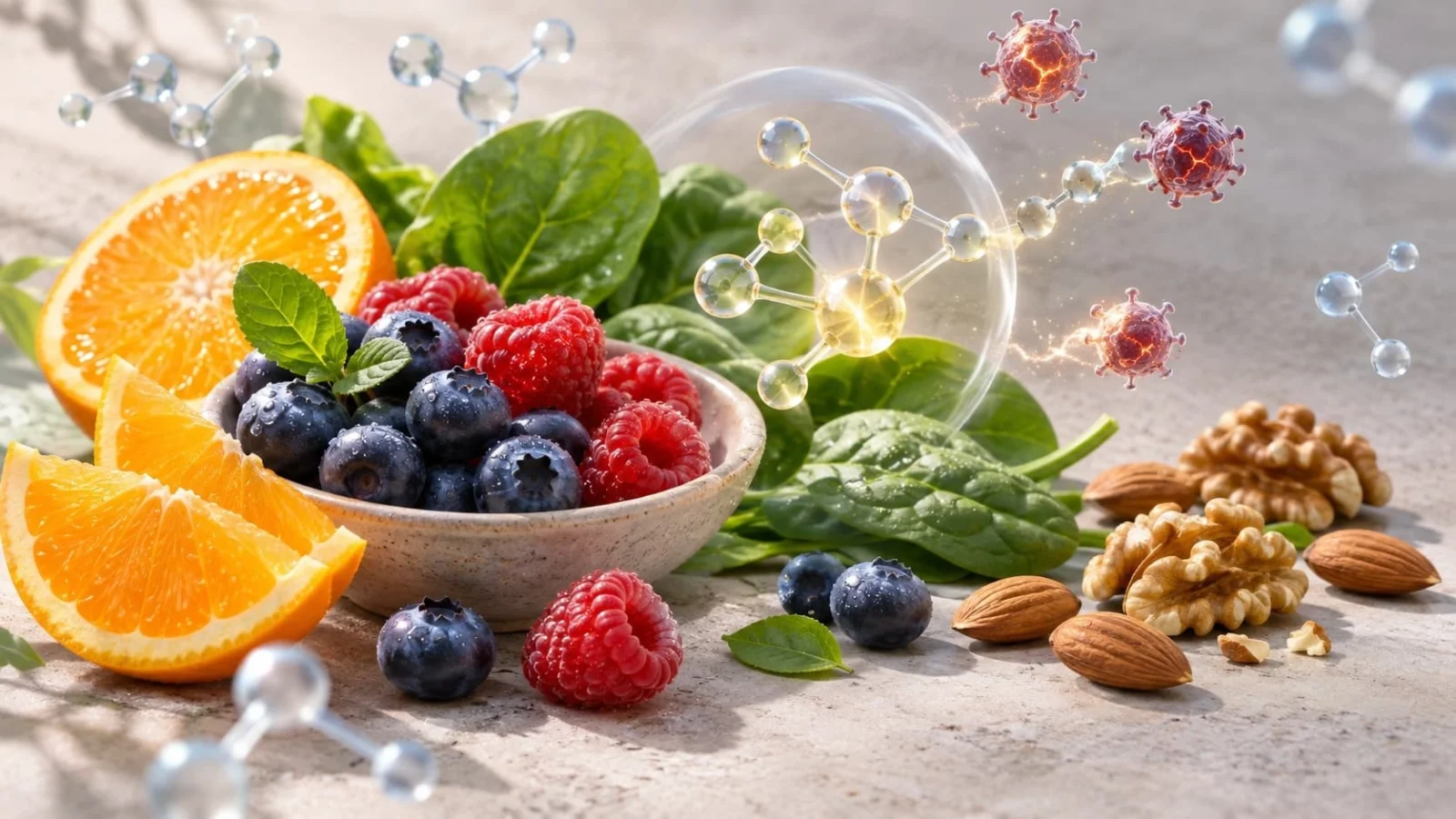
An antioxidant is defined by a reaction it can influence. Kotha and colleagues (2022) describe antioxidants as substances that prevent, inhibit or reduce oxidation. That definition says nothing about whether a particular antioxidant reaches a human tissue or changes the probability of illness. Chemical activity and clinical efficacy are separate measurements (Kotha et al., 2022).
Antioxidants as a chemical property
The label covers chemically diverse compounds. Vitamins, carotenoids and plant polyphenols belong among dietary substances with antioxidant properties, according to Kotha and colleagues (2022). Carlsen and colleagues (2010) also describe many plant phytochemicals as redox-active molecules, meaning that they can participate in electron-transfer reactions. A single label thus gathers compounds with different structures and biological behaviour.
Test conditions alter the readings. Kotha and colleagues (2022) identify extraction-solvent effects, interference from coloured or other reducing plant compounds, reaction timing and a mismatch between assay reagents and physiological reactive species. An assay can still register a chemical response. Health outcomes cannot be inferred from its score (Kotha et al., 2022).
Antioxidant defences made by the body
Human antioxidant protection already operates without dietary supplements. Kotha and colleagues (2022) identify superoxide dismutase, catalase and glutathione-related enzymes among endogenous defences, alongside compounds such as glutathione produced during metabolism. These systems participate in the handling of reactive substances within cells. They are part of normal physiology.
Enzymatic defences operate internally. The National Center for Complementary and Integrative Health (NCCIH, 2023) describes the body's preventive and repair mechanisms, identifying antioxidant enzymes as their most important components, while noting that additional antioxidants come from fruits, vegetables and grains. Supplement compounds belong to a separate source category.
How antioxidants interact with free radicals and oxidative stress
Free radicals are a subset of reactive molecules. Kotha and colleagues (2022) distinguish oxygen-containing radicals, including superoxide, from reactive non-radicals such as hydrogen peroxide. Their properties differ. Chemical reactivity and the ability to move through living cells influence where a molecule may act (Kotha et al., 2022).
Oxidative stress describes an imbalance. Kotha and colleagues (2022) define it as a mismatch between reactive oxygen or nitrogen species and cellular antioxidant defences, including protection from molecules with different reactivities and capacities to diffuse through tissues. The definition contains no measurement of how much dietary antioxidant a person requires.
Free radicals and reactive oxygen species
Reactive oxygen species include molecules with distinct chemical behaviour. A superoxide radical and hydrogen peroxide belong to the same broad family, but Kotha and colleagues (2022) describe different capacities for diffusion and reaction with biological molecules. Their effects also depend on where reactions occur.
At high concentrations, reactive species can damage cellular components. Sies (2017) describes injury to biomolecules at supraphysiological concentrations of hydrogen peroxide, separating that state from physiological redox activity. The concentration and biological setting are integral to that distinction; the presence of a reactive molecule alone is insufficient to classify a process as harmful.
Antioxidant reactions and cellular signalling
Hydrogen peroxide also functions as a messenger. In his 2017 analysis, Sies describes its movement through cells and tissues, where it can initiate changes in cell shape, cell proliferation and recruitment of immune cells. These are signalling functions. Eliminating every reactive oxygen molecule would therefore be incompatible with the physiological roles described in that work (Sies, 2017).
Sies (2017) places hydrogen peroxide within redox sensing and regulation, processes through which cells detect and respond to their chemical environment. Higher concentrations can trigger adaptive responses before damage develops. The relevant biological distinction concerns the nature and intensity of the signal, not a division of all oxidants into harmful substances and all antioxidants into helpful ones.
The NCCIH (2023) cautions that large amounts of antioxidants can interfere with cellular signalling and defence mechanisms. This concern follows from the signalling functions described by Sies (2017), although it does not establish an identical effect for every antioxidant compound. Specific reactions, tissues and exposures determine whether a proposed intervention matches that mechanism.
Which foods contain antioxidants and what types occur naturally
Food provides a chemically mixed source of antioxidants. The NCCIH (2023) identifies fruits, vegetables and grains as dietary sources and notes that vitamin C, vitamin E and beta-carotene also occur in supplement products. Kotha and colleagues (2022) list carotenoids, polyphenols and flavonoids among dietary antioxidant classes. An antioxidant classification therefore covers different chemical substances.
Vitamins C and E and carotenoids
The category extends beyond vitamins. In its 2023 account, the NCCIH names vitamin C, vitamin E and beta-carotene as compounds available in supplements, while also identifying fruits, vegetables and grains as sources of other antioxidants. Different antioxidant types may not be interchangeable (NCCIH, 2023).
Vitamin C illustrates the difference between an essential nutrient's established biological roles and the effects of taking more of it. A related article on vitamin C benefits examines its antioxidant function alongside clinical evidence on the common cold.
Carotenoids also appear as measured blood biomarkers in prospective research. Aune (2019) reports that circulating concentrations of carotenoids, vitamin C and vitamin E had stronger and more linear inverse associations with cardiovascular disease, cancer and all-cause mortality than reported dietary intake. Aune (2019) also identifies lifestyle and dietary differences that can complicate interpretation of such associations.
Polyphenols and dietary plant compounds
Polyphenols and flavonoids are dietary antioxidants (Kotha et al., 2022). Their measured activity can vary with the extraction solvent and with interference from other reducing compounds or coloured phytochemicals, limitations identified in the 2022 critical review of laboratory assays by Kotha and colleagues. The measurement is method-dependent.
Green tea catechins provide another example of this evidence gap. An article on green tea benefits and catechin studies distinguishes antioxidant activity demonstrated in laboratory experiments from clinical outcomes measured in people.
Carlsen and colleagues (2010) tested internationally sourced food samples, recording high laboratory antioxidant values for berries, fruits, nuts, chocolate and vegetables alongside identifying information for individual samples. The research on chocolate polyphenols and LDL oxidation offers another chemical endpoint. Assay scores cannot predict disease prevention (Kotha et al., 2022).
What laboratory antioxidant scores measure
A widely cited food table comes from Carlsen and colleagues (2010), who collected international food samples and measured their total antioxidant content with a modified ferric reducing antioxidant power, or FRAP, assay. They recorded information about individual samples alongside the chemical measurements. The assay measured chemical reducing power in food samples; no clinical disease outcomes were measured in that study (Carlsen et al., 2010).
The values varied substantially between samples. In Carlsen and colleagues' 2010 study, some spices, herbs and supplements had exceptionally high assay values, with several thousand-fold differences across foods. The analysis of date palm seed chemistry and antioxidant activity is another example of research framed around chemical measurements. Neither type of result measures protection from disease in people.
Carlsen and colleagues (2010) explain that antioxidant content in an eaten sample does not necessarily track antioxidant activity in the target cell. Absorption, metabolism and the food matrix can change what becomes biologically available. Those are separate stages from the test-tube reaction. Kotha and colleagues (2022) also warn that in vitro measurements cannot be directly correlated with activity in living systems.
What studies show about antioxidant-rich diets and health
Prospective dietary studies have found associations between antioxidant-related measures and disease outcomes. The 2018 systematic review by Aune and colleagues examined dietary antioxidant intake and blood concentrations in relation to cardiovascular disease, cancer and mortality. A later synthesis by Aune (2019) described inverse associations between fruit, vegetable, whole-grain and nut intake and several chronic disease outcomes.
Food intake and blood biomarkers were measured observationally. Aune (2019) identifies other dietary and lifestyle characteristics as potential confounders.
Associations in prospective dietary studies
Aune and colleagues (2018) reported inverse associations between higher dietary vitamin C intake and coronary heart disease, stroke and cardiovascular disease in prospective datasets. The analysis estimated relationships across observed intake patterns. It did not establish that adding vitamin C alone would cause the observed differences in disease risk.
In a related review, Aune (2019) reported inverse associations for fruits, vegetables, whole grains and nuts with coronary artery disease, stroke, cardiovascular disease, total cancer and all-cause mortality. Blood concentrations of vitamin C, carotenoids and vitamin E showed stronger and more linear inverse associations than self-reported intake in the studies considered. The two kinds of measurement describe different aspects of exposure.
The measures capture different exposures. Reported food intake and measured blood concentrations therefore cannot be assumed to give the same account of antioxidant exposure, while Aune (2019) notes that residual or inadequately controlled confounders may remain in associations with specific causes of death. Neither measure tests randomly assigned supplementation.
Why the complete diet matters
People eating more plant foods may also differ in other ways. Aune (2019) notes lower smoking prevalence, greater physical activity, lower prevalence of overweight or obesity and lower consumption of red and processed meat and fast food among people eating more plant foods. Aune (2019) explicitly identifies those differences as potential confounders.
The NCCIH (2023) likewise states that apparent health advantages associated with fruit- and vegetable-rich diets may arise from other food substances or lifestyle characteristics. Nutritional epidemiology therefore cannot isolate antioxidant chemistry from the food in which compounds occur without stronger experimental comparisons. Aune (2019) explicitly leaves room for unmeasured or incompletely controlled confounding.
Dietary associations and supplement trials consequently answer different questions. Aune and colleagues (2018) drew a distinction between observational findings for antioxidant-rich foods and conclusions about antioxidant supplement use. The direction of a dietary association is insufficient to establish that increasing the amount of one isolated compound prevents disease.
What trials show about antioxidant supplements and disease prevention
Randomised trials have tested antioxidant compounds in settings that differ from observational food studies. Their participants were assigned specified preparations, and investigators measured outcomes such as death or a cancer diagnosis. The outcomes have not supplied a general preventive benefit. The NCCIH (2023) finds no established positive impact from antioxidant supplements across the chronic diseases it discusses, apart from a defined eye-disease context.
Cardiovascular disease and cancer outcomes
The NCCIH (2023) states that current evidence does not support antioxidant supplementation for preventing cardiovascular disease. The same summary flags concern about cardiovascular mortality with high-dose beta-carotene. Those findings cannot be replaced by the favourable dietary associations reviewed by Aune (2019), which also involve other foods and behaviours.
Cancer outcomes vary by trial and population. In the Selenium and Vitamin E Cancer Prevention Trial, known as SELECT, Klein and colleagues (2011) reported a higher observed prostate cancer incidence in the vitamin E arm than with placebo. In a separate trial of smokers and asbestos-exposed people, Omenn and colleagues (1996) found increased lung cancer risk with a combination containing beta-carotene and vitamin A.
Mortality evidence from randomised trials
Bjelakovic and colleagues (2008) reviewed sixty-seven randomised trials involving 232,550 participants. In their random-effects meta-analysis, antioxidant supplements had no statistically significant effect on mortality, with a relative risk of 1.02 and a 95% confidence interval of 0.99–1.06. The conclusion depends on the analysis and trials included rather than on a general claim that every antioxidant changes mortality in the same way.
An analysis restricted to trials at low risk of bias yielded a different result. Bjelakovic and colleagues (2008) reported an increased mortality relative risk of 1.05, with a 95% confidence interval of 1.02–1.08, in that subset. Their review found no evidence supporting antioxidant supplements for primary or secondary prevention. The review also identified possible mortality harm from certain compounds, rather than treating the entire category as harmless.
Disease-specific results and exceptions
A defined exception concerns age-related macular degeneration, or AMD. In the original AREDS trial, antioxidant vitamins combined with zinc and copper reduced the five-year risk of progression to advanced AMD by about 25 per cent among people at high risk (Age-Related Eye Disease Study Research Group, 2001; National Eye Institute, 2025). AREDS2 subsequently tested modifications to the formula; adding lutein/zeaxanthin or omega-3 fatty acids did not provide an additional overall benefit in the primary analysis (National Eye Institute, 2025). The National Eye Institute (2025) reports that these formulations do not prevent AMD onset.
The National Eye Institute (2025) describes the relevant high-risk group as people with intermediate AMD or advanced AMD in one eye, for whom the studied antioxidant and mineral formulation reduced progression risk. The same source states that AREDS and AREDS2 supplements do not prevent the onset of AMD. It also reports no effect on cataracts. The NCCIH (2023) identifies age-related macular degeneration as an exception when describing the absence of positive supplement findings for other chronic diseases.
Selected trials at a glance
Study | Participants or evidence | Outcome measured | Reported finding |
Bjelakovic et al., 2008 | sixty-seven randomised trials; 232,550 participants | Mortality | No statistically significant benefit in random-effects analysis; RR 1.02, 95% CI 0.99–1.06. |
Alpha-Tocopherol group, 1994 | 29,133 Finnish male smokers | Lung cancer incidence | Beta-carotene group had 18 per cent higher incidence than men without beta-carotene. |
Omenn et al., 1996 | 18,314 smokers, former smokers and asbestos-exposed workers | Lung cancer incidence | Beta-carotene plus vitamin A group had RR 1.28 compared with placebo. |
Klein et al., 2011 | 35,533 men in SELECT | Prostate cancer incidence | Vitamin E arm: 620 cases; placebo: 529; HR 1.17. |
Age-Related Eye Disease Study Research Group, 2001 | Participants with intermediate or one-eye advanced AMD | Progression to advanced AMD | The original AREDS formula reduced progression risk by about 25 per cent over five years. |
Why more antioxidants can sometimes cause harm
Amount changes the biological context. Large quantities of antioxidants may interfere with normal cellular signalling and defence according to the NCCIH (2023), while hydrogen peroxide also operates as a messenger capable of initiating cell-shape changes and immune-cell recruitment (Sies, 2017). Reactive molecules can have physiological roles (Sies, 2017).
Beta-carotene trials in smokers
The Alpha-Tocopherol, Beta Carotene Cancer Prevention Study Group (1994) randomly allocated 29,133 male smokers aged 50–69 in southwestern Finland to antioxidant regimens or placebo. Lung cancer incidence was 18 per cent higher among men receiving beta-carotene than among those who did not receive it.
A separate randomised trial, CARET, involved 18,314 smokers, former smokers and asbestos-exposed workers (Omenn et al., 1996). The group receiving a combination of beta-carotene and vitamin A had a lung cancer relative risk of 1.28 compared with placebo. Its all-cause mortality relative risk was 1.17 (Omenn et al., 1996). A harmful result in this trial population cannot quantify the risk of every antioxidant formulation.
The National Eye Institute (2025) reports higher lung cancer incidence among former smokers given beta-carotene in AREDS2, with no statistically significant change in effectiveness after beta-carotene was removed. The trial context matters here because the AMD formulation changed during the research programme. The observed lung cancer signal concerns beta-carotene-containing supplementation in former smokers, not the general antioxidant content of vegetables.
High-dose supplements and unwanted effects
Vitamin E has also produced an adverse finding unrelated to lung cancer. In SELECT, Klein and colleagues (2011) analysed a trial that randomised 35,533 men from sites in the United States, Canada and Puerto Rico. Prostate cancer developed in 620 men in the vitamin E group and 529 in the placebo group, with a hazard ratio of 1.17 and a 99% confidence interval of 1.004–1.36.
The trial did not test whether all forms of vitamin E have identical effects under every exposure condition. Its outcome concerned prostate cancer in the assigned intervention groups. The finding also differs from observational associations involving vitamin E blood concentrations in Aune (2019) in a dietary evidence review. A biomarker association cannot cancel a randomised cancer outcome.
Limits of suppressing oxidative reactions
The biological explanation requires care. Sies (2017) describes hydrogen peroxide as a participant in redox sensing, signalling and metabolic regulation. High concentrations can damage biomolecules, but physiological amounts can act as chemical messages. Cellular protection consequently involves regulation rather than uniform elimination of every oxidant.
The NCCIH (2023) states that large amounts of antioxidants may disrupt cellular defence and signalling, and that antioxidant types are not necessarily interchangeable. Those cautions do not identify a single mechanism responsible for all trial harms. The lung cancer findings in smokers and the prostate cancer finding in SELECT are outcomes measured under distinct trial conditions.
Chemical assays cannot resolve this clinical uncertainty. Kotha and colleagues (2022) explain that test-tube measurements do not directly predict activity in living systems or health outcomes. Carlsen and colleagues (2010) similarly describe absorption and metabolism as barriers between a food's antioxidant assay result and target-cell activity.
What is proven about antioxidants and what is not
Antioxidants inhibit oxidation, and the body maintains endogenous defences against reactive chemical species (Kotha et al., 2022). Some reactive molecules also act as physiological signals (Sies, 2017). The presence of antioxidant activity in a food or supplement therefore cannot establish a beneficial clinical outcome (Kotha et al., 2022).
An antioxidant measurement identifies chemical activity, not a proven health benefit. Large supplemental exposures can interfere with normal cellular functions, while particular clinical trials have recorded harm (Kotha et al., 2022; NCCIH, 2023).
Aune (2019) reported inverse associations between plant-food intake and several chronic disease outcomes in prospective studies. Other dietary and lifestyle characteristics remain possible explanations for part of those associations. Measurements in food or blood cannot identify an effective dose of a specific antioxidant supplement from those observational results.
For supplements, Bjelakovic and colleagues (2008) found no evidence supporting their use for primary or secondary prevention. Specific trials recorded higher lung cancer incidence with beta-carotene in Finnish male smokers and increased prostate cancer incidence in SELECT's vitamin E arm (Alpha-Tocopherol, Beta Carotene Cancer Prevention Study Group, 1994; Klein et al., 2011). These findings concern the assigned products and studied participants.
The AREDS research provides a narrower positive result. The National Eye Institute (2025) reports reduced progression risk in people with intermediate AMD or advanced AMD in one eye, while also stating that the formulations do not prevent AMD onset. Whether other isolated antioxidant compounds benefit different populations or conditions requires trials with defined preparations, prespecified clinical outcomes and appropriate controls.
Frequently asked questions
Can the body produce its own antioxidants?
Yes. The human body produces antioxidant enzymes, including superoxide dismutase and catalase, as well as compounds such as glutathione (Kotha et al., 2022). The NCCIH (2023) describes these enzyme systems as components of cellular protection and repair. Dietary antioxidants are additional substances rather than replacements for those internal systems.
Are antioxidants the same as vitamins?
No. Antioxidant describes chemical activity, whereas vitamins are one group of nutrients that may show such activity (Kotha et al., 2022). The category also includes carotenoids and plant polyphenols. The NCCIH (2023) identifies vitamin C, vitamin E and beta-carotene among antioxidants found in foods and supplements.
Can antioxidants prevent cancer?
Antioxidant supplements have not shown a general preventive benefit in the clinical evidence summarised by the NCCIH (2023). In a trial of Finnish male smokers, beta-carotene supplementation was associated with higher lung cancer incidence (Alpha-Tocopherol, Beta Carotene Cancer Prevention Study Group, 1994). Aune (2019) identified confounding dietary and lifestyle factors that complicate interpretation of observational associations.
Do antioxidant supplements benefit eye health?
The original AREDS trial found that an antioxidant-and-mineral formula reduced the five-year risk of progression to advanced age-related macular degeneration by about 25 per cent in high-risk participants (Age-Related Eye Disease Study Research Group, 2001; National Eye Institute, 2025). AREDS2 tested modifications to that formula. Neither study showed prevention of AMD onset or benefits for cataracts (National Eye Institute, 2025).
Does a high antioxidant score mean a food is healthier?
No clinical conclusion follows directly from an antioxidant assay score. Carlsen and colleagues (2010) measured foods using a laboratory reducing-power method and warned that target-cell activity does not necessarily match the measured food value. Absorption and metabolism can change exposure, while Kotha and colleagues (2022) warn against connecting assay values directly to health outcomes.
Sources
- Kotha RR, Tareq FS, Yildiz E, Luthria DL. Oxidative Stress and Antioxidants: A Critical Review on In Vitro Antioxidant Assays. Antioxidants. 2022;11(12):2388. DOI 10.3390/antiox11122388.
- Sies H. Hydrogen peroxide as a central redox signaling molecule in physiological oxidative stress: Oxidative eustress. Redox Biology. 2017;11:613–619. DOI 10.1016/j.redox.2016.12.035.
- Aune D, Keum N, Giovannucci E, et al. Dietary intake and blood concentrations of antioxidants and the risk of cardiovascular disease, total cancer, and all-cause mortality: a systematic review and dose-response meta-analysis of prospective studies. American Journal of Clinical Nutrition. 2018;108(5):1069–1091. DOI 10.1093/ajcn/nqy097.
- Aune D. Plant Foods, Antioxidant Biomarkers, and the Risk of Cardiovascular Disease, Cancer, and Mortality: A Review of the Evidence. Advances in Nutrition. 2019;10(Suppl 4):S404–S421. DOI 10.1093/advances/nmz042.
- Bjelakovic G, Nikolova D, Gluud LL, Simonetti RG, Gluud C. Antioxidant supplements for prevention of mortality in healthy participants and patients with various diseases. Cochrane Database of Systematic Reviews. 2008;(2):CD007176. DOI 10.1002/14651858.CD007176.
- Alpha-Tocopherol, Beta Carotene Cancer Prevention Study Group. The effect of vitamin E and beta carotene on the incidence of lung cancer and other cancers in male smokers. New England Journal of Medicine. 1994;330(15):1029–1035. DOI 10.1056/NEJM199404143301501.
- Omenn GS, Goodman GE, Thornquist MD, et al. Effects of a combination of beta carotene and vitamin A on lung cancer and cardiovascular disease. New England Journal of Medicine. 1996;334(18):1150–1155. DOI 10.1056/NEJM199605023341802.
- Klein EA, Thompson IM Jr, Tangen CM, et al. Vitamin E and the risk of prostate cancer: the Selenium and Vitamin E Cancer Prevention Trial (SELECT). JAMA. 2011;306(14):1549–1556. DOI 10.1001/jama.2011.1437.
- Carlsen MH, Halvorsen BL, Holte K, et al. The total antioxidant content of more than 3100 foods, beverages, spices, herbs and supplements used worldwide. Nutrition Journal. 2010;9:3. DOI 10.1186/1475-2891-9-3.
- National Eye Institute. AREDS/AREDS2 Clinical Trials. Last updated 22 October 2025. https://www.nei.nih.gov/eye-health-information/clinical-trials/age-related-eye-disease-studies-aredsareds2/about-areds-and-areds2
- National Center for Complementary and Integrative Health. Antioxidant Supplements: What You Need To Know. Last updated July 2023. https://www.nccih.nih.gov/health/antioxidant-supplements-what-you-need-to-know
- Age-Related Eye Disease Study Research Group. A randomized, placebo-controlled, clinical trial of high-dose supplementation with vitamins C and E, beta carotene, and zinc for age-related macular degeneration and vision loss: AREDS report no. 8. Archives of Ophthalmology. 2001;119(10):1417–1436. DOI 10.1001/archopht.119.10.1417. https://pubmed.ncbi.nlm.nih.gov/11594942/

Daniel K. Reynolds — author
Daniel K. Reynolds is an independent nutrition writer with academic training in nutritional sciences and food science. His background combines nutrition research literacy with food-composition analysis and public-facing science communication. He focuses on how...
This article is for general information and is not medical advice. It was reviewed for accuracy by a qualified clinician; decisions about your health should be made with your own doctor.
Related
Chocolate Polyphenols and LDL Oxidation: Antioxidant Effects
How Tunisian Date Palm Seeds Differ in Chemistry and Bioactivity

Selenium and cancer prevention: what the evidence shows

Vitamin C in Peas: Effects of Shipping, Freezing and Canning
Vitamin C benefits and the common cold myth that won't go away
Green tea benefits and which catechin claims hold up in studies

What research shows about whether creatine is bad for your kidneys