Chocolate Polyphenols and LDL Oxidation: Antioxidant Effects
A 2000 study by R. Hirano and colleagues examined whether cacao liquor polyphenols could delay oxidation of low-density lipoprotein (LDL). The researchers tested the effect directly in vitro and then measured LDL oxidizability in 13 male volunteers after they consumed 35 g of delipidated cocoa.
The in-vitro experiment showed a clear dose-dependent prolongation of LDL oxidation lag time across cacao liquor polyphenol concentrations from 0.1 to 0.5 mg/dL. In the volunteer experiment, LDL oxidation lag time increased two hours after cocoa intake and then moved back toward the initial value by four hours.
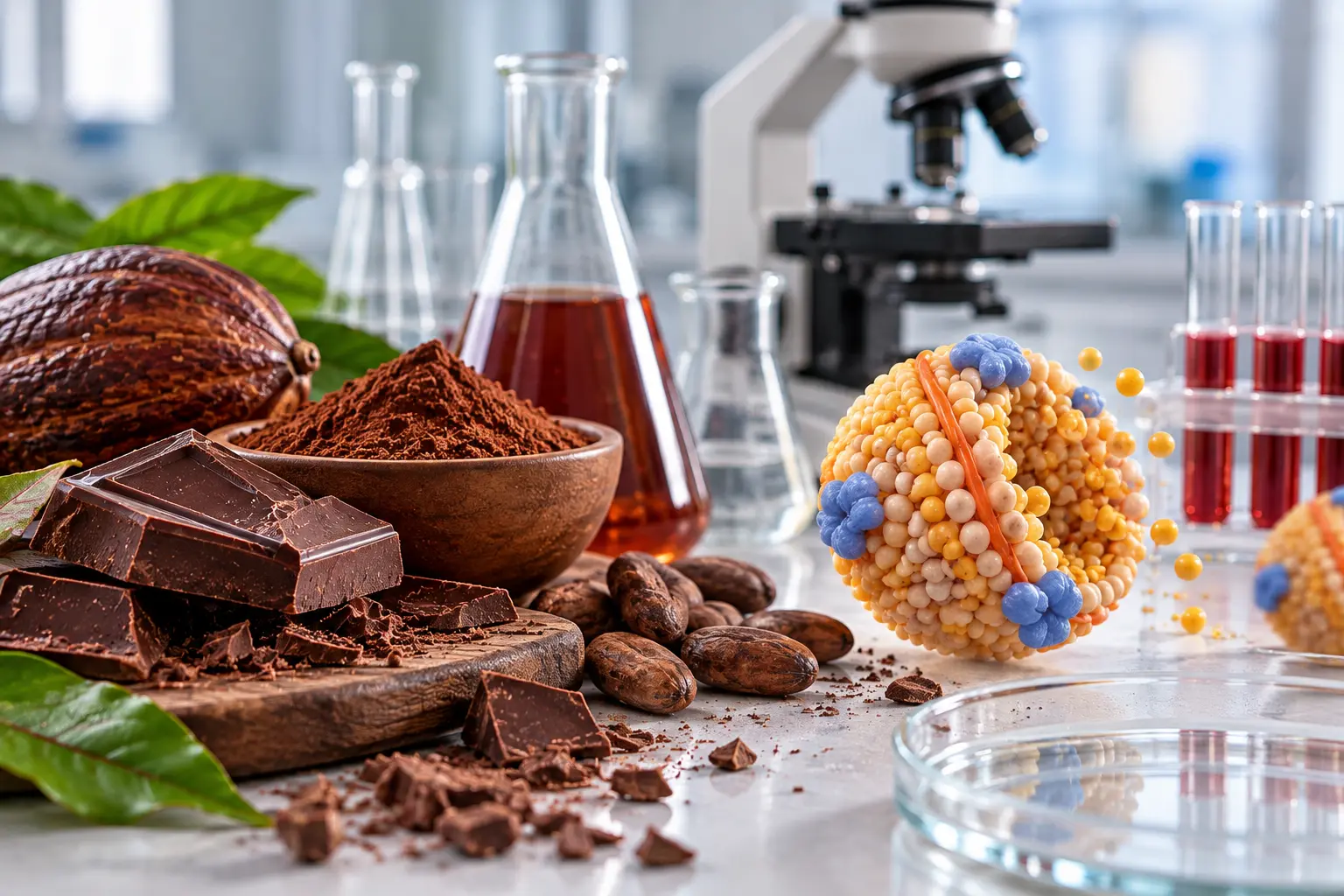
Why Researchers Examined Chocolate Polyphenols and LDL Oxidation
Cacao contains polyphenols, including (-)-epicatechin, and the study describes cacao-red as a polyphenolic coloured component with antioxidant properties. These characteristics led the researchers to ask whether cacao liquor polyphenols could alter the susceptibility of LDL to oxidation. The investigation focused on oxidation lag time rather than on blood LDL concentration. A longer lag time meant that oxidation took longer to begin under the experimental conditions used in the study.
The Study Combined Direct Laboratory Testing With a Volunteer Experiment
The researchers first exposed LDL to increasing concentrations of cacao liquor polyphenols in vitro. They then examined an ex-vivo response by collecting venous blood from volunteers before and after consumption of delipidated cocoa. This two-part design allowed the paper to compare a direct laboratory antioxidant effect with a short-term change observed in LDL isolated after cocoa consumption.
How LDL Oxidation Was Assessed in the Laboratory Experiment
The study used 2,2′-azobis(4-methoxy-2,4-dimethylvaleronitrile), abbreviated AMVN-CH3O, to induce LDL oxidation. Oxidizability was assessed by monitoring absorbance at 234 nm. Cacao liquor polyphenol concentrations ranged from 0.1 to 0.5 mg/dL. Across this range, the oxidation lag time of LDL became progressively longer as the concentration increased.
Increasing CLP Concentrations Produced a Clear Dose-Dependent Pattern
At 0.1 mg/dL CLP, the lag time was 1.7 times that of the control. The reported prolongation increased to 2.9-fold at 0.2 mg/dL and 3.8-fold at 0.3 mg/dL. The effect was larger at the two highest tested concentrations: 5.4-fold at 0.4 mg/dL and 6.4-fold at 0.5 mg/dL. Within this in-vitro system, the dose-response pattern was therefore consistent across all five concentrations.
Table 1. Dose-Dependent Prolongation of LDL Oxidation Lag Time In Vitro
CLP concentration | Lag-time prolongation vs control |
0.1 mg/dL | 1.7-fold |
0.2 mg/dL | 2.9-fold |
0.3 mg/dL | 3.8-fold |
0.4 mg/dL | 5.4-fold |
0.5 mg/dL | 6.4-fold |
Table note: The results show the dose-dependent effects of cacao liquor polyphenols (CLP) on LDL oxidation lag time.
What the In-Vitro Dose Response Shows About CLP Activity
The in-vitro findings show that cacao liquor polyphenols could delay the onset of experimentally induced LDL oxidation under the conditions used. The effect increased at every step from 0.1 to 0.5 mg/dL. The dose-dependent pattern supports an antioxidant effect of cacao liquor polyphenols within the experimental LDL oxidation system used in the study. It does not by itself establish what concentration reaches LDL in the human body after eating cocoa or chocolate.
The Largest Tested Concentration Produced the Longest Relative Delay
The graded response indicates that LDL oxidation lag time increased consistently across the tested concentration range. This relationship is important for interpreting the antioxidant activity observed in vitro, although it does not establish how much cacao polyphenol exposure occurs in human blood after cocoa consumption. The graded response is central to the study because it shows that the measured effect was not limited to a single concentration. Instead, increasing CLP exposure was accompanied by progressively longer oxidation lag times.
How the Human Volunteer Experiment Was Structured
The ex-vivo portion enrolled 13 male volunteers. Each participant consumed 35 g of delipidated cocoa, after which venous blood was collected at defined time points. Samples were taken before cocoa consumption and again at two hours and four hours. LDL from these samples was then evaluated for oxidation lag time.
The Design Focused on Short-Term Changes After a Single Cocoa Intake
The experiment followed the response over only four hours after consumption. It therefore addressed an acute change in LDL oxidizability rather than the effect of habitual cocoa intake over days, weeks or months. The study did not include a reported placebo comparison or randomization procedure, and follow-up lasted only four hours. The findings describe a short-term response in 13 male volunteers.
What Happened to LDL Oxidation Lag Time After Cocoa Intake
Before cocoa consumption, the mean LDL oxidation lag time was 59.0 ± 6.3 minutes. Two hours after the volunteers consumed 35 g of delipidated cocoa, the mean increased to 68.3 ± 6.0 minutes. At four hours, the reported lag time was 61.7 ± 5.7 minutes. This was close to the initial value and indicates that the increase observed at two hours was not maintained at the same magnitude.
The Ex-Vivo Effect Peaked at Two Hours and Then Declined
The post-consumption measurements suggest a short-lived change in LDL oxidizability following cocoa intake. Because the experiment included only three sampling points over four hours, it cannot establish how long the response persisted or whether it would occur after repeated consumption. The abstract therefore supports a temporary short-term effect rather than a sustained change across the full observation period.
Table 2. LDL Oxidation Lag Time Before and After Delipidated Cocoa
Sampling point | Mean oxidation lag time |
Before cocoa | 59.0 ± 6.3 min |
2 h after cocoa | 68.3 ± 6.0 min |
4 h after cocoa | 61.7 ± 5.7 min |
Table note: Thirteen male volunteers consumed 35 g of delipidated cocoa before post-consumption sampling.
How the In-Vitro and Ex-Vivo Findings Fit Together
Both parts of the study pointed in the same general direction: cacao-related polyphenols were associated with delayed LDL oxidation. In vitro, the effect increased with CLP concentration, while ex vivo the lag time increased after cocoa intake. The two experiments nevertheless answer different questions. The laboratory test directly exposed LDL to defined CLP concentrations, whereas the volunteer experiment measured LDL after cocoa had been consumed and processed by the body.
The Two Experimental Settings Should Not Be Treated as Equivalent
The fold changes from the in-vitro experiment cannot be directly transferred to the human ingestion experiment. The exposure conditions, measurement context and available concentration information are different. Taken together, the results support antioxidant activity in the study's laboratory and short-term ex-vivo settings. They do not quantify a long-term clinical benefit or establish that eating chocolate prevents cardiovascular disease.
Table 3. What Each Experimental Part Directly Demonstrated
Experiment | Exposure | Directly reported result |
In vitro | LDL exposed to 0.1–0.5 mg/dL CLP | Dose-dependent prolongation of oxidation lag time |
Ex vivo | 13 men consumed 35 g delipidated cocoa | Lag time increased at 2 h and moved toward baseline by 4 h |
Table note: The two experiments used different exposure settings and should not be interpreted as quantitatively interchangeable.
What the Study Supports and What It Does Not Establish
The study directly supports the conclusion that cacao liquor polyphenols prolonged LDL oxidation lag time in vitro in a dose-dependent manner. It also supports a short-term increase in LDL oxidation lag time two hours after consumption of delipidated cocoa by the study volunteers. The experiment measured LDL oxidation rather than cardiovascular events, progression of atherosclerosis or long-term disease risk. Its findings therefore cannot be used to conclude that cocoa consumption prevents cardiovascular disease. It also does not establish that ordinary chocolate products produce the same exposure as the delipidated cocoa used in the experiment.
LDL Oxidation Is a Laboratory Endpoint Rather Than a Clinical Outcome
A change in oxidation lag time is a biochemical measurement. It can be useful for studying antioxidant effects, but it is not equivalent to demonstrating prevention or treatment of cardiovascular disease. The most precise interpretation is therefore that the paper found antioxidant effects on LDL oxidation both in vitro and ex vivo under its experimental conditions. Broader health claims would require additional clinical evidence, including larger and longer-term human studies.
Why This 2000 Chocolate Polyphenol Study Remains Informative
The paper provides a compact example of how a food-derived polyphenol mixture can be studied across two experimental levels. It begins with a controlled in-vitro oxidation system and then examines whether a related short-term signal can be detected after human consumption. The numerical dose response in vitro is especially clear, while the volunteer data show a time-dependent ex-vivo pattern. These features make the study useful for understanding the distinction between direct antioxidant chemistry and measurements made after ingestion.
Its Main Value Is Mechanistic Rather Than Clinical
The findings help describe how cacao polyphenols may interact with LDL oxidizability. They do not answer whether repeated chocolate or cocoa consumption changes long-term cardiovascular outcomes. That distinction is important when interpreting nutrition research. The study helps explain the laboratory antioxidant behaviour of cacao polyphenols and the short-term changes observed after cocoa intake, while leaving their longer-term cardiovascular significance unresolved.
Practical takeaway: Hirano and colleagues found that cacao liquor polyphenols delayed LDL oxidation in a concentration-dependent manner in vitro, while LDL obtained from 13 men showed a longer oxidation lag time two hours after 35 g of delipidated cocoa. By four hours, the mean lag time had moved back toward its initial value. The study therefore supports a short-term antioxidant effect on LDL oxidizability under its experimental conditions, not a direct conclusion about long-term cardiovascular prevention.
Frequently asked questions
What did the study test in the in-vitro experiment?
The researchers tested cacao liquor polyphenols against experimentally induced LDL oxidation. CLP concentrations ranged from 0.1 to 0.5 mg/dL. LDL oxidation was assessed by monitoring absorbance at 234 nm.
Did cacao liquor polyphenols delay LDL oxidation in vitro?
Yes, oxidation lag time increased at every tested CLP concentration. The effect rose from 1.7-fold at 0.1 mg/dL to 6.4-fold at 0.5 mg/dL. This produced a clear dose-dependent pattern.
How many people took part in the cocoa experiment?
The ex-vivo experiment included 13 male volunteers. Each consumed 35 g of delipidated cocoa. Blood was collected before intake and again two and four hours later.
What happened two hours after the volunteers consumed cocoa?
Mean LDL oxidation lag time increased from 59.0 ± 6.3 to 68.3 ± 6.0 minutes. This was the largest post-consumption change reported in the abstract. It indicates a temporary reduction in LDL oxidizability under the study conditions.
Sources
- Hirano R, Osakabe N, Iwamoto T, et al. Antioxidant effects of polyphenols in chocolate on low-density lipoprotein both in vitro and ex vivo. Journal of Nutritional Science and Vitaminology. 2000;46(4):199–204.
- Wan Y, Vinson JA, Etherton TD, et al. Effects of cocoa powder and dark chocolate on LDL oxidative susceptibility and prostaglandin concentrations in humans. American Journal of Clinical Nutrition. 2001;74(5):596–602.
- Osakabe N, Yasuda A, Natsume M, Takizawa T, Terao J, Kondo K. Catechins and their oligomers linked by C4→C8 bonds are major cacao polyphenols and protect LDL from oxidation in vitro. Experimental Biology and Medicine. 2002;227(1):51–56.
- Baba S, Natsume M, Yasuda A, et al. Plasma LDL and HDL cholesterol and oxidized LDL concentrations are altered after intake of different levels of cocoa powder. Journal of Nutrition. 2007;137(6):1436–1441.
- Baba S, Osakabe N, Kato Y, et al. Continuous intake of polyphenolic compounds containing cocoa powder reduces LDL oxidative susceptibility and has beneficial effects on plasma HDL-cholesterol concentrations in humans. American Journal of Clinical Nutrition. 2007;85(3):709–717.
- Rimbach G, Melchin M, Moehring J, Wagner AE. Polyphenols from cocoa and vascular health—a critical review. International Journal of Molecular Sciences. 2009;10(10):4290–4309.
- Andújar I, Recio MC, Giner RM, Ríos JL. Cocoa polyphenols and their potential benefits for human health. Oxidative Medicine and Cellular Longevity. 2012;2012:906252.

Adrian Foster — author
Adrian Foster writes with an editorial focus on experimental science, laboratory research, controlled comparisons, measurement techniques and the role of replication in evaluating scientific findings. At CAB Direct, Adrian covers experiments, laboratory method...
Related

Chamomile Tea for Primary Dysmenorrhoea: The 2010 Study

Garlic Honey Tea and Blood Pressure: What the Study Found

Mycotoxins in Dried Raisins in Egypt: Fungi and Contamination

Teaching Young Children to Swim: Didactic Approaches in Slovenia

Metofluthrin Mosquito Repellent: Field Efficacy in Outdoor Trials
Capsaicin and Ascorbic Acid Variability in Chilli and Paprika