How to grow tomatoes and what heat, water and light really do
Growing tomatoes depends on temperature, light and water, which affect ripening time, fruit set, yield and flavour in different ways. In controlled conditions, fruit reached ripeness 95 days after the flower opened at 14 degrees Celsius, 65 days at 18, 46 days at 22 and 42 days at 26 (Adams et al., 2001). Almost everything else a grower decides is a smaller adjustment to a schedule that the air temperature has already set.
This explainer follows what the growing trials measured rather than what the advice repeats: where warmth stops helping, what light is worth in kilograms, which two disorders are blamed on watering and what the evidence says about them, the real cost of the flavour trick, and what the fridge does to a tomato. Other crop research is gathered in the plants section.
What the temperature trials measured
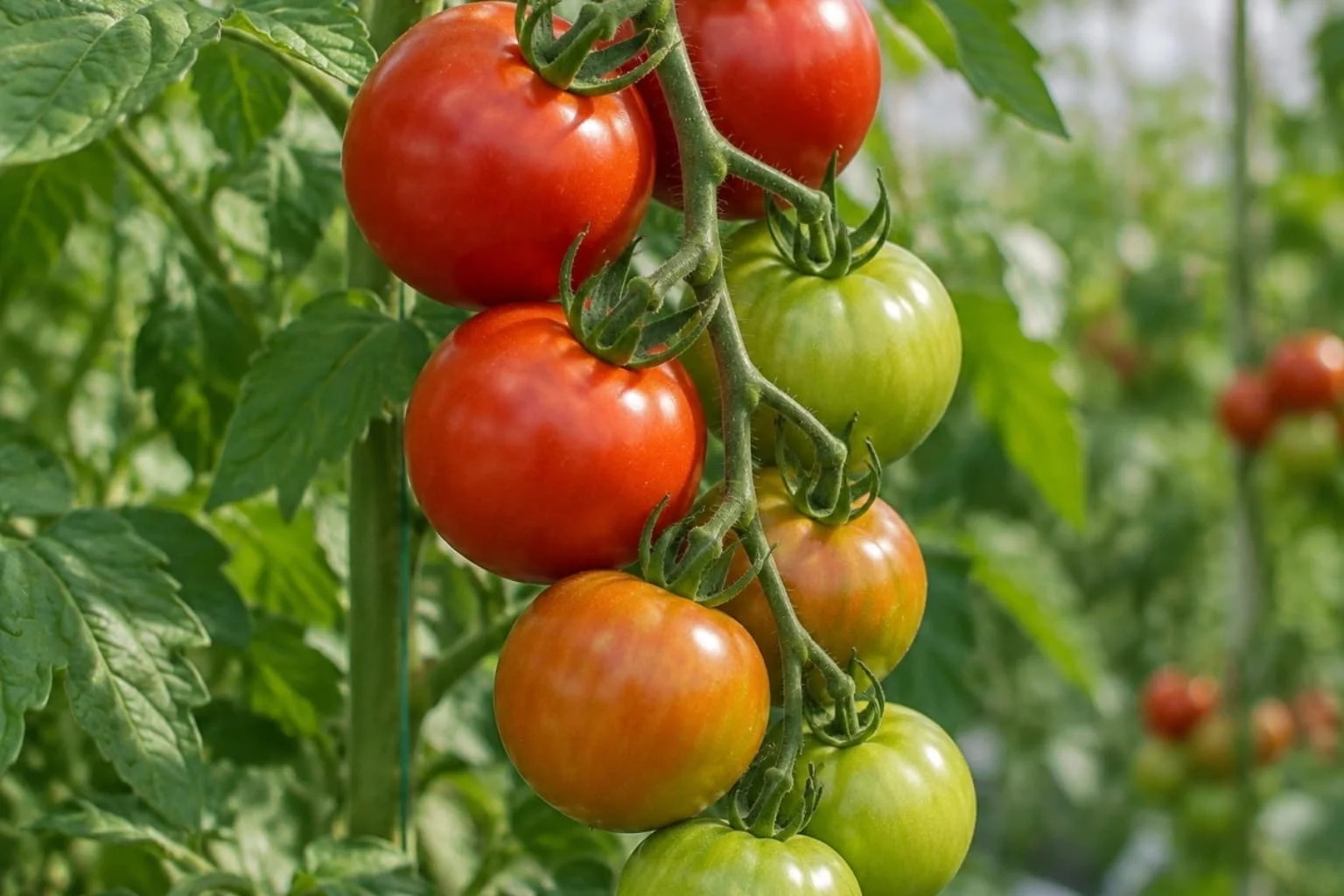
The single most useful number in growing tomatoes is not a watering interval or a feed ratio but the air temperature, because it fixes how long everything takes. Fruit grown at a constant 14 degrees Celsius took 95 days from flower opening to ripeness. At 18 degrees that fell to 65 days, at 22 degrees to 46 and at 26 degrees to 42 (Adams et al., 2001). The gain from warming flattens sharply: the step from 14 to 18 degrees saved a month, the step from 22 to 26 saved four days.
The flattening is not the whole story, because the fruit at the warm end were not simply earlier. In the same experiments both extremes of the range produced small fruit that were frequently parthenocarpic, meaning seedless, and at 26 degrees the plants also carried fewer flowers and set fruit poorly, so the yield was low despite the faster ripening (Adams et al., 2001). Speed and crop are different questions, and the temperature that wins one loses the other.
The same work asked a question that rarely reaches the advice at all. Alongside the whole-plant treatments, the trial varied the temperature of individual trusses on plants held at 20 degrees, which separates the temperature the fruit experiences from the temperature the rest of the plant experiences (Adams et al., 2001). Framing the problem that way matters for anyone deciding whether to warm a glasshouse or simply to stop a cold draught crossing one truss.
This is where a good deal of garden advice goes astray. Warmth is treated as a single good thing to be maximised, with a greenhouse or a sunny wall framed as an unqualified improvement. The measured picture is a plateau with a penalty beyond it, and the position of that penalty, somewhere above the low twenties, is close enough to an ordinary summer in a glasshouse to matter.
Air temperature | Days from flower opening to ripeness | Source |
14 degrees Celsius | 95 | Adams et al. (2001) |
18 degrees Celsius | 65 | Adams et al. (2001) |
22 degrees Celsius | 46 | Adams et al. (2001) |
26 degrees Celsius | 42 | Adams et al. (2001) |
Note: these are controlled-environment measurements of development rate, not a guide to a target temperature. At both ends of the range the fruit were small and often seedless, and at 26 degrees the plants also carried fewer flowers and set fruit poorly, so the fastest treatment was not the most productive one (Adams et al., 2001).
What heat does to fruit set
Above that plateau the failure is specific and it has been traced to one organ. Tomato plants grown at 32 degrees by day and 26 by night were compared with plants at 28 and 22. Of five cultivars, only one achieved meaningful fruit set under the constant heat; two others set barely any, at under 2%.
The number of pollen grains produced did not explain the failure, and neither photosynthesis nor night respiration limited fruit set. What limited it was the release of pollen from the anther and the ability of that pollen to germinate, and the number of grains released correlated with the percentage of fruit set (Sato et al., 2000).
In the heat-stress conditions studied by Sato et al. (2000), reduced pollen release and germination limited fruit set, rather than photosynthesis or respiration.
The timing is narrower than most people expect. Moving plants between the two temperature regimes showed that the sensitive period runs from about 7 to 15 days before the flower opens, which is before the flower is even recognisable as one. Relief from heat after the flower had opened helped much less, although a few hours of it still raised fruit set, and plants grown continuously in heat needed more than five days of relief before anthesis to set fruit at all (Sato et al., 2002). Microscopy showed disrupted development in the pollen, the endothecium, the epidermis and the stomium, the structure that splits to let pollen out.
Variety accounts for much of the rest. Of the five cultivars tested, only one set fruit under the constant 32 and 26 degree regime, yet all five set fruit when the heat was relieved before the flowers opened, and the longer the relief, the higher the percentage of fruit set and the more pollen grains were released (Sato et al., 2000). Heat tolerance in tomato is therefore a property of the cultivar expressed through one narrow process, which is why seed catalogue claims about hot summers are not marketing noise.
The practical consequence is a diagnostic one. Sato et al. (2002) identified a heat-sensitive period approximately 7–15 days before flower opening, but this does not establish that flowers falling in August were necessarily damaged in July.
What the shading trials measured for yield
Light is the one input whose value has been put in weight. Four tomato cultivars were grown under light shade, which cut incoming radiation by 6.4%, and heavy shade, which cut it by 23.4%. Total fresh fruit yield fell by 7.5% and 19.9% respectively, and above-ground dry matter by 6.2% and 16.5%.
Over the first fourteen weeks of harvest in a heated glasshouse, about 2.01 kilograms of fruit were harvested for each 100 megajoules of solar radiation reaching the plants, regardless of the shading treatment (Cockshull et al., 1992). Later in the harvest period the same radiation was used more efficiently, especially under heavy shade, which is why the rule of thumb that a given percentage of lost light costs roughly the same percentage of crop has survived.
That constancy is the useful part. It converts the vague instruction to find a sunny spot into arithmetic: a fence, a hedge or a dirty pane that removes a fifth of the light is removing something close to a fifth of the tomatoes, and no amount of feeding substitutes for it, because the fruit are built from carbon the leaves fixed under that light. What a soil amendment can and cannot change is measured in vermicompost and flowering in Liatris spicata.
More light is not always better, however, and tomato is the species that proves it. Under a continuous 24-hour photoperiod the leaves became chlorotic after about seven weeks, and growth and yield ended up below those under a 14-hour photoperiod, with starch and sugars accumulating in the leaves (Demers et al., 1998). A plant that converts radiation into fruit at a fixed rate still requires the night.
What the evidence says about blossom-end rot and russeting
Irregular watering is the standard explanation for the two faults growers actually see, and in both cases the research is less settled than the advice. Blossom-end rot, the sunken dark patch at the base of the fruit, is usually described as a calcium deficiency caused by erratic water supply.
One influential account proposed a mechanism at the cellular level. During rapid cell expansion in a young fruit, the calcium demand created by vacuolation outruns delivery to the distal tissue, producing aberrant calcium signals, weakened cell walls and cell death, with no single critical fruit calcium concentration separating healthy fruit from affected ones (Ho & White, 2005).
A later reappraisal of the same literature reached the opposite conclusion. It argued that low calcium is a consequence of the disorder rather than its cause, since fruit in the early stages show calcium distribution similar to healthy fruit and depletion appears only once symptoms are visible, and it placed the cause in oxidative stress from salinity, drought, high light, heat or ammonium nutrition, leading to cell death and then to ion leakage (Saure, 2014). The disagreement is unresolved, and it is worth stating plainly because the two accounts imply different responses to the same patch on the same fruit.
Soil amendments are often offered as an answer to both faults, and that class of product has been measured on its own terms in the review of humic substances as plant biostimulants. The evidence there behaves much like the evidence here: narrower than the claims made for it.
The second fault, the fine network of cuticle cracks called russeting, behaves in a way that contradicts a common instruction outright. Across three greenhouse experiments, russeting was governed mostly by the total fruit load on the cluster and very little by the number of leaves between clusters, and decreasing the number of fruit per cluster produced a progressive increase in russeting (Demers et al., 2007). Thinning a truss to grow larger fruit sends more water into fewer fruit, and the skins record it.
The design of that russeting work is worth reading closely, because it is the part that rules out the usual explanation. Leaf-to-fruit ratios from 0.5 to 2.0 were produced in two different ways, by varying the number of fruit per cluster from two to six and the number of leaves between clusters from two to four, and the two routes to the same ratio did not give the same result: fruit number drove russeting and leaf number barely moved it (Demers et al., 2007). The ratio itself was not the operative variable.
What deficit irrigation does to flavour and yield
Withholding water late in the season to concentrate flavour is real, measurable and not free. In drip-irrigated field trials in California run over five seasons, cutting irrigation off 40 to 50 days before harvest, rather than the growers' usual twenty, raised the soluble solids of processing fruit but caused substantial yield loss, enough to reduce the total solids harvested per hectare. Deficit irrigation over the same period, as opposed to a full cutoff, raised soluble solids with no significant loss of solids yield (Johnstone et al., 2005). The distinction between reducing water and stopping it is the whole result.
How far cultivation can shift a crop's chemistry at all is a question other species answer more fully than tomato does. The overview of coffee, cocoa and tea cultivation shows this across much longer runs of management data.
Flavour itself is only partly a growing question. When 398 modern, heirloom and wild accessions were assayed for flavour chemicals and a subset put in front of consumer panels, modern commercial varieties were found to contain significantly lower amounts of many of the chemicals that drove consumer liking (Tieman et al., 2017). A variety that lacks the compounds cannot be irrigated into having them, which places a ceiling on what any watering regime can achieve.
What cold storage does after harvest
The last stage is the one most often undone at home. Flavour-associated volatiles are sensitive to temperatures below 12 degrees Celsius, and chilling reduces the transcripts encoding the enzymes that make them. Some of those genes recover after a return to 20 degrees and some do not, and the transcription factors required for ripening, among them RIPENING INHIBITOR, are themselves reduced by chilling, with transient changes in the methylation of their promoters (Zhang et al., 2016).
That is a sharper statement than the usual advice against the fridge, because it gives a threshold and a mechanism rather than a preference, and because it explains why the damage is not fully reversible on the windowsill. It also marks where the growing ends: the compounds measured in the flavour survey are made during ripening, and they can be lost in a day of storage at the wrong temperature.
What the evidence supports and what it does not
Supported: temperature sets the rate of development and does so with a plateau and a penalty; heat damages fruit set through pollen rather than through the leaves, in a window that closes before the flower opens; light converts to yield at a nearly fixed rate. Cold storage also damages flavour through a described mechanism (Adams et al., 2001; Sato et al., 2000; Cockshull et al., 1992; Zhang et al., 2016).
Not supported: that thinning fruit improves skin quality, which the measurements reverse (Demers et al., 2007). Nor is withholding water a free improvement, since a full cutoff bought concentration at the price of the crop (Johnstone et al., 2005).
Unsettled: the cause of blossom-end rot, where a cellular calcium hypothesis and a reappraisal placing calcium downstream of oxidative stress both rest on the same body of work (Ho & White, 2005; Saure, 2014). The honest summary is that the physical inputs are well quantified and the physiological disorders are not: a grower can predict ripening dates from temperature and yield from radiation with some confidence, while the commonest blemish on the fruit still has two competing explanations.
Frequently asked questions
Why do the flowers drop in hot weather?
Because the pollen fails rather than the plant. Under constant heat the release of grains from the anther and their germination both decline, while photosynthesis and respiration carry on normally. The damage happens roughly a week to a fortnight before the flower opens, so the drop is a delayed signal (Sato et al., 2000).
Does a greenhouse always produce more tomatoes?
Not automatically. Higher temperature speeds ripening with diminishing returns, and in trials the warmest treatment produced small, often seedless fruit with fewer flowers and poor setting. The gain comes from extending the season at the cool end rather than from raising midsummer temperatures further (Adams et al., 2001).
How much does shade from a fence or hedge cost?
Measurably. Cutting radiation by 6.4% lowered fruit yield by 7.5%, and cutting it by 23.4% lowered yield by 19.9%. Harvest tracked radiation at about 2.01 kilograms per 100 megajoules whether plants were shaded or not, so lost light converts almost directly into lost fruit (Cockshull et al., 1992).
Is blossom-end rot definitely a calcium problem?
It is less certain than the advice suggests. One account describes a local calcium shortfall during rapid cell expansion in young fruit. A later reappraisal argues that calcium depletion follows cell death rather than causing it, and places the origin in oxidative stress. Both readings remain in the literature (Ho and White, 2005; Saure, 2014).
Why is refrigerating tomatoes discouraged?
Because flavour volatiles are sensitive below 12 degrees Celsius. Chilling lowers the transcripts for the enzymes that build them and for ripening transcription factors, and only some of those genes recover after a return to room temperature, so part of the loss persists after the fruit warms up (Zhang et al., 2016).
Sources
- Adams SR, Cockshull KE, Cave CRJ. Effect of temperature on the growth and development of tomato fruits. Annals of Botany. 2001;88(5):869–877. DOI 10.1006/anbo.2001.1524.
- Sato S, Peet MM, Thomas JF. Physiological factors limit fruit set of tomato (Lycopersicon esculentum Mill.) under chronic, mild heat stress. Plant, Cell and Environment. 2000;23(7):719–726. DOI 10.1046/j.1365-3040.2000.00589.x.
- Sato S, Peet MM, Thomas JF. Determining critical pre- and post-anthesis periods and physiological processes in Lycopersicon esculentum Mill. exposed to moderately elevated temperatures. Journal of Experimental Botany. 2002;53(371):1187–1195. DOI 10.1093/jexbot/53.371.1187.
- Cockshull KE, Graves CJ, Cave CRJ. The influence of shading on yield of glasshouse tomatoes. Journal of Horticultural Science. 1992;67(1):11–24. DOI 10.1080/00221589.1992.11516215.
- Demers DA, Dorais M, Wien CH, Gosselin A. Effects of supplemental light duration on greenhouse tomato (Lycopersicon esculentum Mill.) plants and fruit yields. Scientia Horticulturae. 1998;74(4):295–306. DOI 10.1016/S0304-4238(98)00097-1.
- Ho LC, White PJ. A cellular hypothesis for the induction of blossom-end rot in tomato fruit. Annals of Botany. 2005;95(4):571–581. DOI 10.1093/aob/mci065.
- Saure MC. Why calcium deficiency is not the cause of blossom-end rot in tomato and pepper fruit, a reappraisal. Scientia Horticulturae. 2014;174:151–154. DOI 10.1016/j.scienta.2014.05.020.
- Demers DA, Dorais M, Papadopoulos AP. Yield and russeting of greenhouse tomato as influenced by leaf-to-fruit ratio and relative humidity. HortScience. 2007;42(3):503–507. DOI 10.21273/hortsci.42.3.503.
- Johnstone PR, Hartz TK, LeStrange M, Nunez JJ, Miyao EM. Managing fruit soluble solids with late-season deficit irrigation in drip-irrigated processing tomato production. HortScience. 2005;40(6):1857–1861. DOI 10.21273/hortsci.40.6.1857.
- Tieman D, Zhu G, Resende MFR Jr, et al. A chemical genetic roadmap to improved tomato flavor. Science. 2017;355(6323):391–394. DOI 10.1126/science.aal1556.
- Zhang B, Tieman DM, Jiao C, et al. Chilling-induced tomato flavor loss is associated with altered volatile synthesis and transient changes in DNA methylation. Proceedings of the National Academy of Sciences. 2016;113(44):12580–12585. DOI 10.1073/pnas.1613910113.

Harriet Colbeck — author
Harriet Colbeck is an agriculture writer with a background in agricultural science and a master’s-level focus on soil science. Her earlier work involved preparing field-trial summaries and farmer-facing guidance on soil management, translating research finding...
Related
Humic Substances as Plant Biostimulants: What They Can Do
Coffee, Cocoa and Tea: Cultivation, Management and Production

How vermicompost affects growth and flowering in Liatris spicata
Nitrogen fixation and how legumes and soil bacteria feed plants
Seed germination and why some seeds fail to sprout
Koshihikari rice: marker-assisted heading-date gene transfer

Wild fruit diversity and the origins of cultivated trees