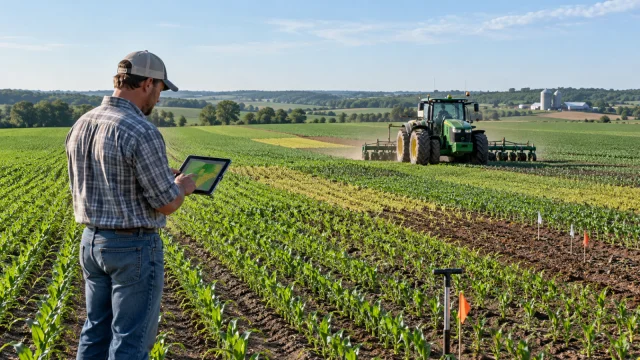
















How crop rotation works and why it improves soil fertility
Crop rotation works by growing crops with different nutrient needs, root systems and pest relationships in a planned sequence on the same land; it can improve soil fertility by diversifying residues, supporting soil organisms and, when suitable legumes are included, adding biologically fixed nitrogen. Changing host crops can also interrupt some pest and disease cycles. Long-term field trials have found yield and drought-resilience benefits in particular diversified systems, but the size and reliability of those benefits depend on crop choice, soil, climate and management.
This explainer covers the soil processes behind crop rotation, the role of legumes in nitrogen cycling, evidence from long-running field experiments, and practical sequences for commercial fields and home gardens. It also explains where rotation is less effective and why it should be planned alongside other soil-health and pest-management practices.
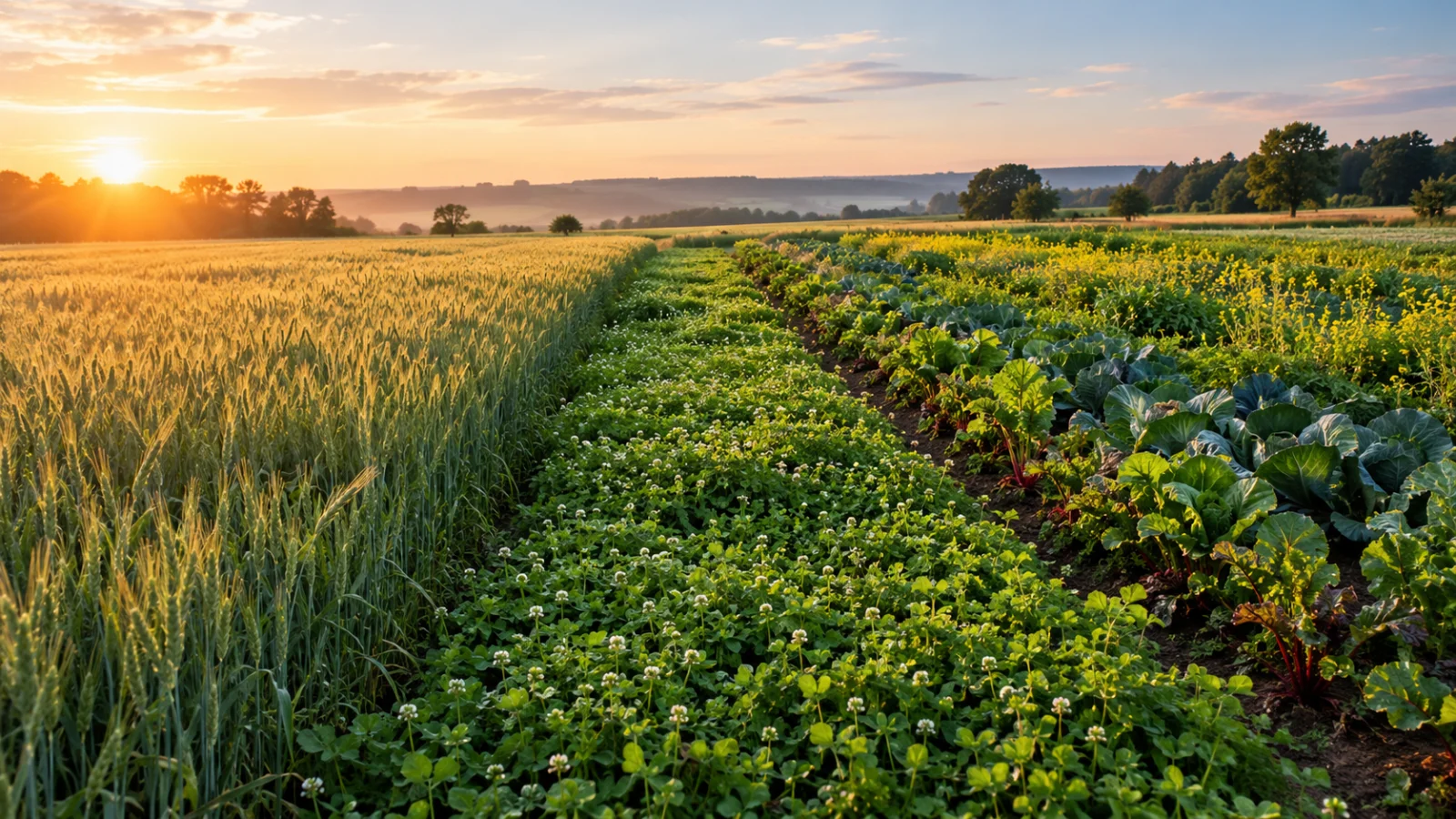
How crop rotation improves soil fertility
Crop rotation is not simply changing a crop name from one year to the next. It is a planned sequence that takes account of botanical family, rooting depth, nutrient demand, residue quality, sowing and harvest dates, and the pests or diseases that can survive between crops. A cereal followed by a legume and then an oilseed or cover crop creates a different pattern of roots and residues from continuous cereal production.
The sequence depends on climate, soil, machinery, markets, livestock needs and weed pressure. A rotation for a temperate maize farm will not automatically suit a dryland wheat farm or a small vegetable plot.
The important unit is the whole sequence, not an isolated crop. For example, a cereal harvested in summer may be followed by a cover crop, a legume or an oilseed, and then another cereal.
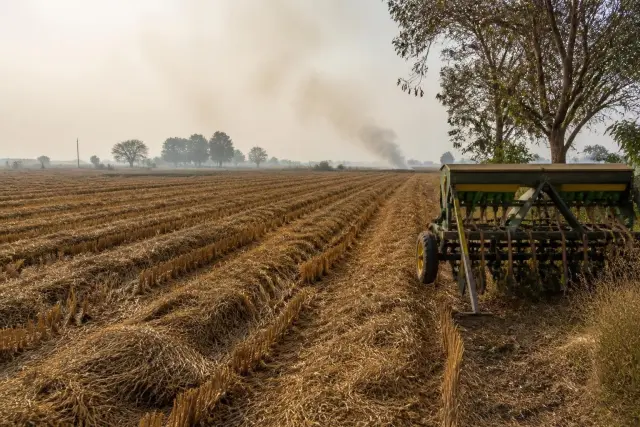
Each phase changes the timing of root growth, soil cover, nutrient uptake and field operations. A sequence can also diversify sowing and harvest dates, which may spread labour demand and create opportunities to manage weeds before the next cash crop. The timing of crop transitions is also important in [research on stubble burning in Punjab](/agriculture/why-punjab-farmers-burn-stubble-agriculture), which explains how a short interval between rice harvest and wheat sowing affects residue-management decisions.
These effects should be evaluated over the full rotation rather than from the yield of one season. A simple alternation between two botanically related crops may provide less of a disease break than a rotation using genuinely different host families. The distinction matters for both commercial fields and vegetable beds.
Nutrient demand and plant residues
Different crops remove nutrients in different amounts and return different residues. Repeating a high-demand crop can draw heavily on the same nutrient pool, while a sequence that includes crops with different rooting patterns can use nutrients from different soil depths. Crop roots, leaves and stems also vary in carbon-to-nitrogen ratio and how quickly they decompose. This variety can feed a wider range of soil organisms and help maintain nutrient cycling over time.
Rotation does not create every nutrient a crop needs. Phosphorus, potassium, sulphur and micronutrients still come from soil reserves, organic amendments or fertilisers. Soil testing and nutrient budgeting remain important where harvests remove substantial nutrients. The interaction between nutrient sources and soil condition is examined further in [research on fertiliser types and rice yields under SRI](/agriculture/fertilizer-types-rice-yield-soil-properties-sri-agriculture), which compares organic and mineral inputs under specific rice-growing conditions.
How legumes contribute nitrogen
Legumes such as peas, beans, clover, vetch and alfalfa form a partnership with rhizobia bacteria living in root nodules. The bacteria convert atmospheric nitrogen into forms the plant can use. This biological nitrogen fixation can reduce a farm’s dependence on manufactured nitrogen fertiliser and can contribute nitrogen to later crops when roots, nodules and plant residues decompose.
The amount left for the next crop depends on species, biomass, growing conditions, harvest and residue management. Grain harvest exports nitrogen; cover crops or forage that leave roots and residues may return more. Timing matters too, because nitrogen may be released before or after the next crop needs it.
A legume is therefore not a fixed substitute for a bag of fertiliser. A harvested soybean or pea crop can remove much of the nitrogen accumulated during growth, whereas a clover green manure incorporated or left as mulch may supply more nitrogen to the following crop. Successful fixation also requires suitable rhizobia, adequate soil conditions and a healthy root system.
A farm nutrient budget distinguishes nitrogen fixed by the plant from nitrogen actually available to the next crop. The nitrogen contribution of a legume phase can vary. Measurements of the following crop’s response and local estimates of the nitrogen supplied by legume residues help inform fertiliser rates.
Soil structure and microbial communities
A more diverse rotation can change the quantity and chemistry of roots and residues entering the soil. Root systems help bind soil particles, while organic inputs provide food for fungi, bacteria and other organisms. These processes are associated with better soil aggregation and changes in soil organic carbon, total nitrogen and microbial activity. In turn, well-aggregated soil can be less vulnerable to crusting and erosion and can provide a more favourable environment for roots.
In a field study, Tiemann and colleagues (2015) compared rotations with one to five crop species. Greater diversity was associated with distinct microbial communities, better soil aggregation, and higher organic carbon, total nitrogen and microbial activity. This does not mean every added crop improves every soil measure at every site.
How rotation breaks pest and disease cycles
Many crop pests and pathogens are adapted to particular host plants or closely related plant families. When the same host is grown repeatedly in the same field or bed, susceptible plants remain available and organisms that survive in soil, crop debris or volunteer plants may build up. Rotating to a non-host crop can interrupt that cycle by removing the food source or changing the conditions needed for the pest or pathogen to reproduce.
This is especially relevant to soil-borne diseases and pests with limited host ranges. In a garden, tomatoes, peppers, aubergines and potatoes all belong to the nightshade family, so changing from tomato to pepper is not a true family-level rotation. The interval needed between susceptible crops depends on the organism and crop.
Rotation can reduce the need for insecticides, fungicides or other controls when it lowers pest pressure, but it is not a guarantee. Some insects move readily between fields, some pathogens persist for years, and some pests have many host species. Effective pest management combines rotation with resistant varieties, monitoring, sanitation, habitat for beneficial organisms and pesticides only when justified by the crop and pest situation.
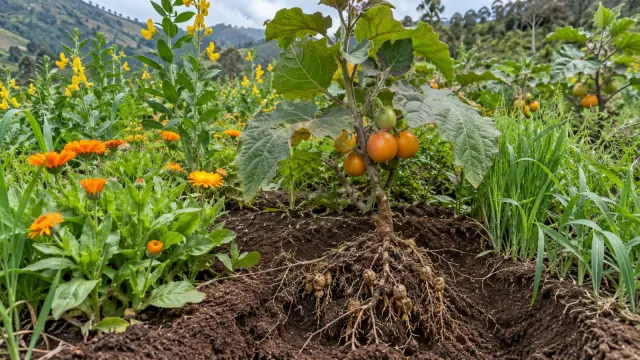
Rotation is one part of integrated pest management, not a stand-alone cure. The importance of selecting crops for a specific pest is illustrated by [research on cover crops and root-knot nematodes](/agriculture/calendula-crotalaria-oats-root-knot-nematodes-naranjilla-agriculture), where calendula, crotalaria and oats reduced some measures of nematode damage without eliminating infection.
The strongest insecticide-saving opportunity occurs when the target insect depends on a particular crop during a vulnerable part of its life cycle and cannot readily survive the non-host phase. A different crop can interrupt local reproduction, but neighbouring fields, volunteer host plants and mobile adult insects may allow reinfestation. This is why scouting remains necessary even in a diverse rotation.
Pest counts and records of crop damage from several seasons help determine whether the pest control programme can be scaled back. When disease is the main problem, the right interval depends on the pathogen: a rotation interval suitable for one soil-borne disease may be too short for another. For a practical home-garden explanation, see West Virginia University Extension’s 2025 guide to crop rotation, which groups vegetables by family and explains why repeated planting of the same family can encourage shared pest and disease problems.
What long-term field trials show
Yield and drought resilience
In Bowles and colleagues’ 2020 synthesis, long-term maize-yield data from 11 North American experiments represented 347 site-years. More diverse rotations increased maize yields by 28.1% on average and by 22.6% in favourable conditions. In drought years, yield losses were 14.0% to 89.9% lower, depending on the comparison.
These results are not a universal yield promise. Outcomes depend on crop sequence, soil, rainfall and input management. The finding is evidence that diversity can improve performance and buffer some weather-related losses, not a guaranteed percentage increase for every grower.
In a drought-manipulation experiment within a 36-year rotation trial in Ontario, Renwick and colleagues (2021) found that diversifying maize-soybean rotations with small grains and cover crops reduced maize yield losses under imposed drought by 17.1 ± 6.1%. Soil organic matter was associated with lower water stress, but the tested mechanisms did not fully explain the relationship.
Productivity, inputs and soil biology
In Iowa, Davis and colleagues (2012) compared a conventional two-year maize-soybean rotation with three- and four-year systems from 2003–2011. The longer sequences included small grains and red clover or alfalfa, with lower synthetic nitrogen and herbicide inputs and periodic cattle manure. Yields and profit were similar or higher, but the effects cannot be attributed to rotation alone because inputs also differed.
Together, these studies suggest that diversification can support productivity and reduce reliance on some inputs, but do not show that every diverse rotation will outperform a simpler one. Factors in selecting an additional crop include its potential to break pest cycles or supply biomass or nitrogen, how well it fits the farm calendar and whether it has a viable use on the farm or a market.
Interpreting field trials also requires attention to the comparison being made. A two-crop system and a four-crop system may differ in planting dates, tillage, fertiliser use, manure additions and the time soil is covered. Those changes can act together. For that reason, a yield difference should not automatically be assigned to crop diversity alone.
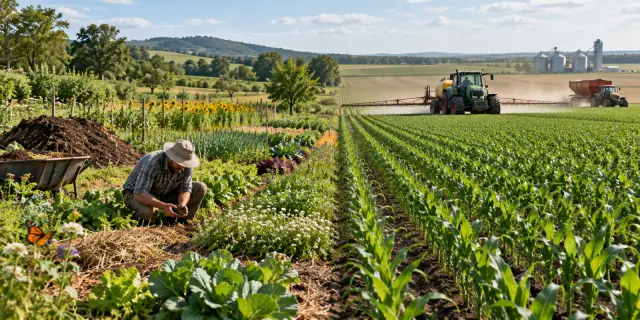
The most useful farm-level comparison tracks the entire sequence, including the value of each harvested crop, the costs of seed and field operations, and any changes in herbicide or fertiliser use. A rotation that improves one maize harvest but loses money over the full cycle may not meet the grower's goals. These whole-system trade-offs are also examined in [research comparing organic and conventional farming](/agriculture/organic-vs-conventional-farming-economics-ecology-agriculture), which considers how diversification, input costs and management practices influence agricultural productivity and profitability.
A well-designed rotation does more than change the crop: it changes the sequence of roots, residues, nutrient demands and host plants that shape the field over time.
Key findings from selected research
Study | Focus | Main finding |
Bowles et al., 2020 | 11 experiments; 347 site-years | More diverse rotations increased maize yields by 28.1% on average; drought-year yield losses were 14.0–89.9% lower. |
Davis et al., 2012 | Iowa field experiment, 2003–2011 | Longer rotations with reduced synthetic inputs maintained or exceeded yields and profit compared with a conventional two-year rotation. |
Tiemann et al., 2015 | Rotation diversity from one to five crop species | Greater diversity was associated with changes in soil microbial communities, aggregation, organic carbon and total nitrogen. |
Crop rotation examples for farms
A useful farm rotation combines cash crops with crops that differ in family, roots, sowing dates and residues. These examples must be adapted to local conditions, machinery, markets and the main pest or nutrient problem.
Rotation aim | Illustrative sequence | Why it may help |
Diversify a grain system | Maize → soybean → small grain with red clover | Adds a crop break, varies residue inputs and includes a legume phase. |
Add a forage phase | Maize → small grain → alfalfa or clover forage | Can provide biomass and biologically fixed nitrogen, depending on harvest and residue management. |
Use a cover crop | Cereal crop → legume cover crop → spring cash crop | Keeps living roots in the system for part of the year and can protect soil between cash crops. |
Cover crops and legumes have different roles. A grass cover crop can capture residual nitrogen and protect soil, while legumes may add biologically fixed nitrogen. Mixtures can combine functions but add management decisions. Crop selection depends on the specific agricultural problem, while results are evaluated across multiple growing seasons.
An illustrative four-year arable sequence consists of winter wheat, spring barley with an undersown legume, a legume-rich forage or green-manure phase, and an oilseed or another locally suitable break crop. The legume phase may supply nitrogen to subsequent crops, while changing sowing dates can provide different opportunities for weed control. However, this is an illustrative design, not a proven prescription for every farm: the choice depends on rainfall, market access, livestock demand and whether a cover crop uses water needed by the following cash crop.
For a maize-based system, adding a small grain and a cover crop may diversify roots and residues, but profitability must be calculated across every phase. Davis and colleagues (2012) measured whole-system outcomes in Iowa; their results should not be assumed to apply unchanged to other rotations.
Crop rotation in a home garden
Crop rotation also works in small vegetable gardens. Crop rotation in vegetable gardens involves moving plant families between beds rather than simply swapping individual vegetables. The University of Wisconsin–Madison Extension (2012) recommends leaving a three- or four-year interval before growing the same plant family in a bed again, where space allows. A garden map helps prevent repetition.
A simple four-group plan might look like this, with the groups moving to a different bed each year:
- Legumes: peas and beans, which can fix nitrogen when nodulated by compatible bacteria.
- Brassicas: cabbage, broccoli, kale and related crops that share some pest and disease risks.
- Root crops: carrots, beetroot and other root vegetables, grouped according to their botanical families when planning the full rotation.
- Nightshades: tomatoes, peppers, aubergines and potatoes, grouped together for rotation purposes because they are in the same family.
This is a planning example, not a strict nutrient prescription: root vegetables do not all belong to one family, and cucumbers, squash and melons are all cucurbits. The University of Wisconsin–Madison Extension (2012) guide and University of Minnesota Extension (reviewed 2024) guidance provide family examples.
Raised beds and small gardens limit movement between beds. Avoiding the same susceptible plant family in consecutive years can help reduce recurring pest and disease pressure.
A garden rotation plan shows which crop family occupied each bed this year and where that family will grow next season. Potatoes and tomatoes belong to the same botanical family and are therefore grouped together in rotation planning. If there are too few beds for a long interval, avoiding back-to-back planting of the same family where possible still matters, particularly for plants that showed disease symptoms.
Compost can replenish organic matter, but it does not replace rotation as a way of interrupting host-specific pest cycles. Records of crop families grown in each bed provide a basis for planning the following year's rotation.
Cornell Cooperative Extension, Chautauqua County (2021), advises gardeners to rotate by plant family rather than by individual vegetable name, because related crops can share diseases; its guidance describes a three-year interval as a common starting point. The University of Saskatchewan (2024) likewise recommends keeping the same vegetable family out of a bed for at least three years, preferably four, where space permits. Both are practical extension recommendations, not evidence that a fixed interval controls every pathogen.
How to plan a rotation that works
Rotation planning starts with the farm or garden problem, not a fixed four-year formula. Records of previous crops, pests, diseases, yields and residue help match the sequence to the goal: a host-specific disease break, a legume phase, better ground cover, more varied residues or a different harvest calendar.
- Annual maps record the botanical family of each crop grown in each field or bed, including cover crops and green manures.
- Local guidance can indicate how long a particular pest or pathogen survives without its host.
- Soil tests and nutrient budgets help assess whether nutrient inputs compensate for nutrient removal through harvests.
- Cover crops and residue management can support soil protection where climate, soil moisture and cropping schedules allow.
- Evaluating rotation performance involves comparing yields, crop quality, input use and costs across multiple seasons.
Rotation may be constrained by contracts, equipment, short seasons, markets, soil moisture or crop-specialisation needs. Some pests have broad host ranges, and some pathogens persist longer than a typical rotation. Diversification also adds planning and labour costs, so biological benefits must fit practical and economic constraints.
Rotation planning considers the sequence of botanical families alongside soil nutrient measurements and pest records from several seasons. Performance is assessed across all harvests in the rotation.
Does crop rotation always improve soil fertility?
The evidence supports crop rotation as a foundational tool in regenerative farming, not a stand-alone solution. Benefits depend on the crops and the wider management system. Crop rotation works alongside soil testing, nutrient management, ground cover and integrated pest management as part of a broader soil-fertility strategy.
A successful rotation is therefore judged by the whole system: the following crop's nutrient supply, pest pressure, soil condition, labour requirements and economic return. Documenting these outcomes over several seasons shows when the sequence needs adjusting because the expected benefits fail to appear. For gardeners, a labelled bed plan and records of plant families offer a practical start. Neither approach removes the need for soil tests, crop monitoring or locally appropriate pest management.
Long-term studies support benefits for soil processes and crop performance in the systems examined. What remains uncertain is how large those benefits will be under different soils, climates, pest pressures and management practices. No single rotation length or crop sequence can guarantee the same outcome everywhere.
Frequently asked questions
How long should tomatoes stay out of the same garden bed?
A three-year gap is a common starting point for moving tomatoes and their relatives, including potatoes, peppers and aubergines, away from the same bed. Cornell Cooperative Extension (2021) and the University of Saskatchewan (2024) provide family-based guidance. A longer interval may be needed for particular persistent diseases.
Do peas and beans remove the need for nitrogen fertiliser?
Not necessarily. Legumes can fix atmospheric nitrogen through their association with rhizobia, but the amount available to a following crop depends on biomass, harvested material, residue management and soil conditions. Harvesting grain exports nitrogen. Local nutrient guidance and soil tests give a better estimate than assigning every legume the same fertiliser credit.
Can rotation control insects that fly between neighbouring fields?
It may reduce local populations of pests closely tied to a host crop, but highly mobile insects can move back into a field from surrounding land. Rotation is therefore one part of integrated pest management, alongside monitoring and other controls when needed. Its effect varies with the pest's life cycle and host range.
What is an example of a three-year rotation on an arable farm?
One illustrative sequence is a cereal, a grain legume and an oilseed, provided the crops suit the local climate and market. A cover crop may be added between harvest and the next sowing. This sequence changes plant families and residues, but its nutrient balance and financial performance still require field-specific assessment.
What if a vegetable garden has only two beds?
A record of crop families allows them to be alternated between beds where possible, even if the ideal interval cannot be achieved. Rotation guidance aims to prevent planting the same family in the same bed in consecutive seasons, particularly after disease problems. Compost, resistant varieties and careful removal of infected material may also be useful.
Sources
- Bowles, T. M., Mooshammer, M., Socolar, Y., et al. (2020). Long-term evidence shows that crop-rotation diversification increases agricultural resilience to adverse growing conditions in North America. One Earth, 2(3), 284–293. doi:10.1016/j.oneear.2020.02.007.
- Davis, A. S., Hill, J. D., Chase, C. A., Johanns, A. M., & Liebman, M. (2012). Increasing cropping system diversity balances productivity, profitability and environmental health. PLoS ONE, 7(10), e47149. doi:10.1371/journal.pone.0047149.
- Tiemann, L. K., Grandy, A. S., Atkinson, E. E., Marin-Spiotta, E., & McDaniel, M. D. (2015). Crop rotational diversity enhances belowground communities and functions in an agroecosystem. Ecology Letters, 18(8), 761–771. doi:10.1111/ele.12453.
- Renwick, L. L. R., Deen, W., Silva, L., Gilbert, M. E., Maxwell, T., Bowles, T. M., & Gaudin, A. C. M. (2021). Long-term crop rotation diversification enhances maize drought resistance through soil organic matter. Environmental Research Letters, 16(8), 084067. doi:10.1088/1748-9326/ac1468.
- West Virginia University Extension. (2025). Crop Rotation in the Garden. WVU Extension, Lawn, Gardening and Pests. https://extension.wvu.edu/lawn-gardening-pests/news/2025/06/01/crop-rotation-in-the-garden
- University of Wisconsin–Madison Division of Extension. (2012). Using Crop Rotation in the Home Vegetable Garden. Wisconsin Horticulture, Garden Facts XHT1210. https://hort.extension.wisc.edu/articles/using-crop-rotation-home-vegetable-garden-0/
- University of Minnesota Extension. (reviewed 2024). Promote healthy soil in your garden. University of Minnesota Extension. https://extension.umn.edu/garden-and-home/yard-and-garden/gardening-in-minnesota/living-soil-healthy-garden
- Cornell Cooperative Extension, Chautauqua County. (2021). Rotating Vegetables by Family. Cornell Cooperative Extension. https://chautauqua.cce.cornell.edu/gardening/food-gardening/rotating-vegetables-by-family
- University of Saskatchewan, College of Agriculture and Bioresources. (2024). Rotating your vegetables. Gardening at USask, February 12, 2024. https://gardening.usask.ca/articles-and-lists/articles-how-to/rotating-your-vegetables.php
Harriet Colbeck — author
Harriet Colbeck is an agriculture writer with a background in agricultural science and a master’s-level focus on soil science. Her earlier work involved preparing field-trial summaries and farmer-facing guidance on soil management, translating research finding...
Related
How fertiliser types affect rice yield and soil under SRI
Organic vs Conventional Farming: Economics and Ecology
Calendula, crotalaria and oats for root-knot nematodes in naranjilla
Why Punjab Farmers Burn Stubble and What Fire Counts Show
What crop rotation is, from the three-field system to today
Why breadfruit mealybug control failed to last on Pacific atolls
How Orchard Age and Herbicides Shift Soil Nitrogen and N2O