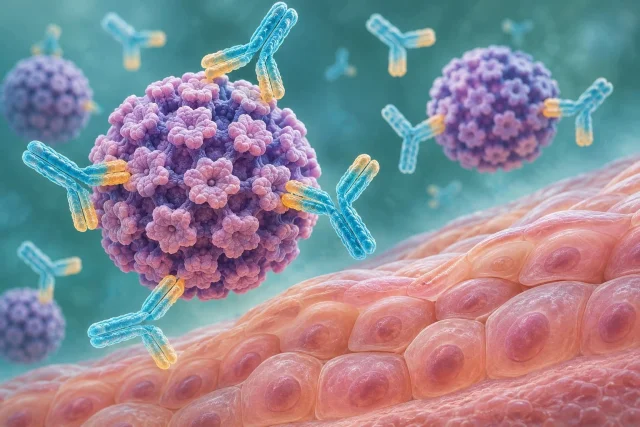

















Why an allergic reaction happens when the immune system overreacts
An allergic reaction is an immune response to a substance that is usually not harmful, and Vitte et al. describe the common immediate form as IgE-mediated type I hypersensitivity (MedlinePlus, 2026; Vitte et al., 2022). Delayed and non-IgE pathways are also recognised, but they are harder to test with the same precision (Meyer et al., 2025; Vitte et al., 2022).
Allergic reactions can be read through symptoms, triggers, sensitisation, testing, anaphylaxis and immunotherapy. The evidence is strongest for the IgE-mast cell pathway and less exact when severity has to be predicted from tests alone (Golden et al., 2024; Santos et al., 2023).

Evidence last checked 19 Nov 2026 · 10 min
What an allergic reaction is and why the body responds
MedlinePlus defines an allergy as an immune response or reaction to substances that are usually not harmful (MedlinePlus, 2026). Vitte et al. add that the immediate form most people mean is IgE-mediated type I hypersensitivity (Vitte et al., 2022).
Vitte et al. say IgE-mediated allergic disease results from a maladaptive type two immune response that promotes synthesis of IgE antibodies to allergens (Vitte et al., 2022). The response is called an overreaction because the stimulus is usually harmless while the immune machinery is fully engaged. A contrasting type of immune error appears in the article on autoimmune disease, where immune responses target the body's own tissues rather than normally harmless external allergens.
The polio vaccines explainer shows the opposite goal of immune training. There the immune response is directed toward protection rather than allergy.
Immediate and delayed hypersensitivity
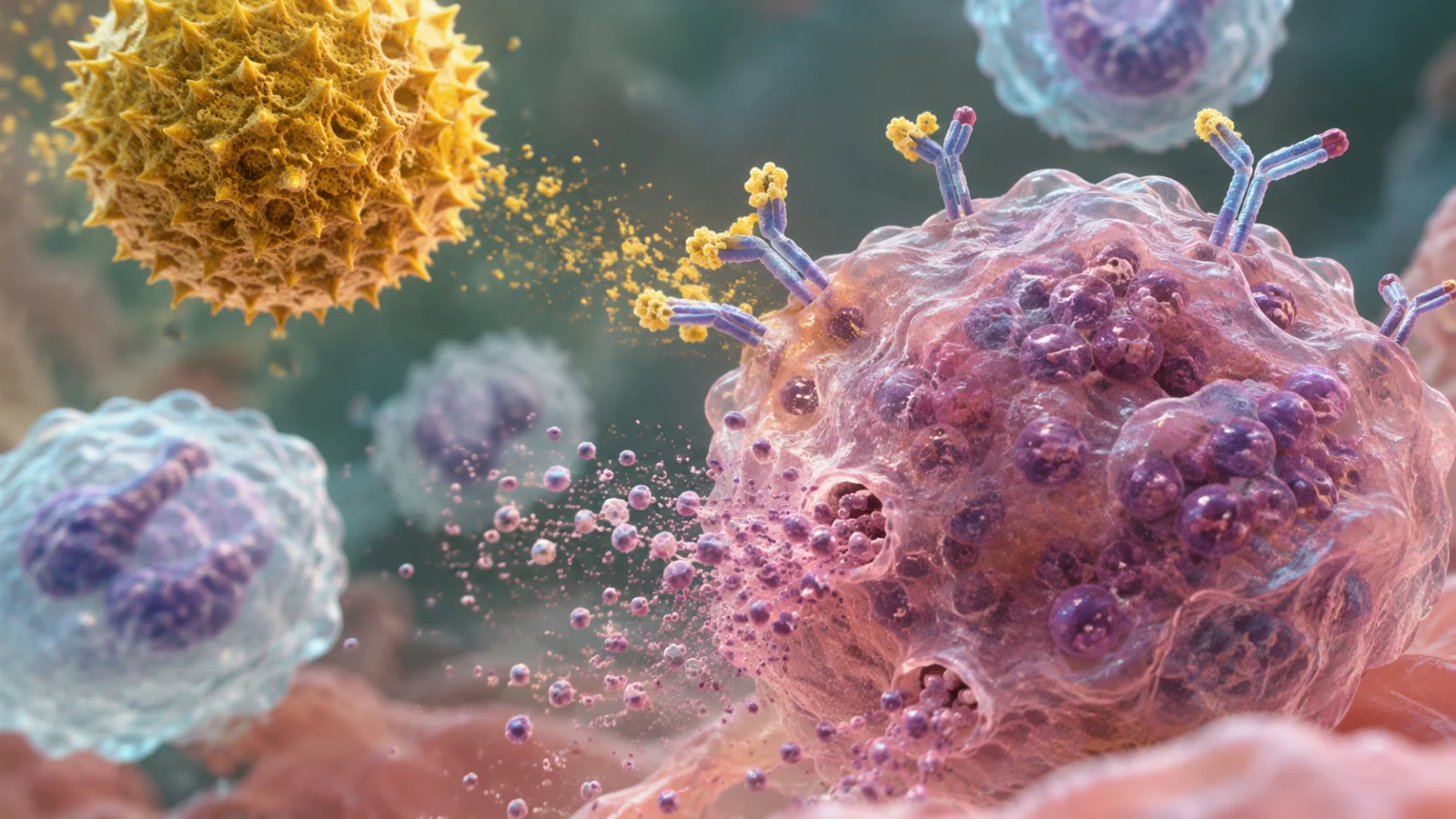
Vitte et al. write that IgE binds FcεRI on mast cells and basophils and sensitises them for a subsequent encounter with the same allergen (Vitte et al., 2022). The same review says that re-exposure then releases mediators including histamine and produces the symptoms of immediate hypersensitivity (Vitte et al., 2022).
Meyer et al. describe non-IgE-mediated food allergies in children as typically delayed, with symptoms beginning hours to days after exposure (Meyer et al., 2025). Santos et al. write that food allergy can be IgE-mediated, non-IgE-mediated or mixed (Santos et al., 2023).
Allergy and non-allergic intolerance
Santos et al. state that an immune-mediated adverse food reaction is a food allergy and a non-immune-mediated one is a food intolerance (Santos et al., 2023). The definition separates the mechanism from the symptom pattern.
Schuler et al. note that the differential diagnosis includes nonimmunologic adverse food reactions as well as immunologic ones (Schuler et al., 2020). The same symptom can therefore sit in different diagnostic categories.
Allergic reaction symptoms from skin irritation to anaphylaxis
MedlinePlus says inhaled allergens often cause an itchy nose or throat, mucus, cough and wheeze, while allergens that touch the eyes or skin may cause redness, watering, rash, hives or blisters (MedlinePlus, 2026). MedlinePlus presents these symptoms by route of contact, which is why airway, eye and skin patterns often look different.
MedlinePlus also states that medicine allergies and food allergies may involve the whole body (MedlinePlus, 2026). The same source therefore separates local exposure symptoms from multisystem reactions.
Skin, eye and airway symptoms
Vitte et al. say immediate hypersensitivity releases inflammatory mediators including histamine (Vitte et al., 2022). MedlinePlus lists skin, eye and airway symptoms that fit that immediate mediator pattern (MedlinePlus, 2026).
Schuler et al. say the characteristic symptom complex and its reproducibility are part of accurate diagnosis (Schuler et al., 2020). Clinicians therefore look for recurring patterns rather than a single isolated symptom.
Signs of a severe systemic reaction
MedlinePlus says that an allergy can at times trigger a response that involves the entire body (MedlinePlus, 2026). Anaphylaxis is primarily diagnosed clinically. Serum tryptase can support the diagnosis and help identify underlying mast cell disorders, but a normal result does not rule out anaphylaxis, and testing must not delay treatment with epinephrine (Golden et al., 2024).
Golden et al. report that infants and toddlers can show age-specific symptoms and that, within this young age group, age does not correlate with reaction severity (Golden et al., 2024). The reaction pattern matters more than age alone.
What causes allergic reactions and who is more susceptible
MedlinePlus lists dust, food, insect venom, medicines, mould, pet dander and pollen among common allergens (MedlinePlus, 2026). Vitte et al. write that the development of type two-driven allergy depends on a complex interplay of genetic and environmental factors at barrier surfaces (Vitte et al., 2022).
Shin et al. report a very large global burden of asthma and atopic dermatitis (Shin et al., 2023). The same analysis found that the incidence of both asthma and atopic dermatitis peaked at ages five to nine years, while prevalence continued to increase in later adulthood (Shin et al., 2023).
Food, pollen, medicines and insect venom
The common allergens listed by MedlinePlus reach the body through different routes. Inhaled allergens often affect the nose and airways, while food and medicine allergies may cause symptoms involving several body systems (MedlinePlus, 2026).
Vitte et al. describe allergy as an inappropriate response to allergens driven by type two immunity (Vitte et al., 2022). Exposure alone is not enough; the immune response has to classify the exposure as an allergen.
Family history, atopy and environmental exposure
MedlinePlus states that both genes and environment play a role in developing allergies and that a child is more likely to have allergies if both parents do (MedlinePlus, 2026). Susceptibility is therefore framed as a mix of inherited tendency and exposure.
Sio and Chew report that family history of asthma was the most frequently reported asthma risk factor and had the highest pooled risk estimate in their meta-analysis of studies from Asia (Sio and Chew, 2021). Their review also reports associations for family history of atopy and other allergic diseases in Asian populations (Sio and Chew, 2021).
Why the immune system overreacts to an allergen
Galli and Tsai write that IgE antibodies and mast cells are convincingly linked to the pathophysiology of anaphylaxis and other acute allergic reactions (Galli and Tsai, 2012). They also say that IgE and mast cells help drive the long-term pathophysiological changes and tissue remodelling associated with chronic allergic inflammation (Galli and Tsai, 2012).
Sensitisation and allergen-specific IgE
Vitte et al. say allergen-specific IgE binds FcεRI on mast cells and basophils and sensitises them for a later encounter with the same allergen (Vitte et al., 2022). Sensitisation therefore comes before the obvious reaction.
A visible reaction can look sudden because the earlier sensitisation phase often passes unnoticed. In classical IgE-mediated allergy, sensitisation precedes the reaction to a subsequent exposure; other hypersensitivity pathways do not necessarily follow this sequence (Vitte et al., 2022).
Mast cells, histamine and inflammatory mediators
Vitte et al. say the reactivated cells release inflammatory mediators including histamine that are responsible for immediate symptoms (Vitte et al., 2022). Histamine is a major mediator, but the response also includes a broader inflammatory programme.
Galli and Tsai add that allergic pathology also includes tissue remodelling (Galli and Tsai, 2012). Acute mediator release and longer-term inflammation are therefore part of the same disease spectrum.
Non-IgE pathways and delayed responses
Vitte et al. write that similar hypersensitivity symptoms can be triggered through IgG- or complement-mediated adaptive responses and through innate triggers acting on mast cells (Vitte et al., 2022). The same review says the classical IgE pathway is still the major mechanism, but not the only one (Vitte et al., 2022).
Meyer et al. report that non-IgE-mediated food allergies in children typically cause delayed symptoms and are diagnosed largely through clinical assessment (Meyer et al., 2025). This pattern does not describe every non-IgE hypersensitivity mechanism.
How an allergic reaction is diagnosed and differentiated
Schuler et al. identify the suspected trigger, temporal associations, duration, characteristic symptom complex and reproducibility as the key elements of clinical history (Schuler et al., 2020). History comes first because later tests are interpreted in that context.
Santos et al. say diagnosis of IgE-mediated food allergy starts with an allergy-focused history followed by tests that determine IgE sensitisation, such as serum allergen-specific IgE and skin prick testing (Santos et al., 2023). Testing is therefore linked to a specific question raised by the history.
Clinical history and timing of symptoms
Meyer et al. report delayed onset over hours to days in non-IgE-mediated food allergies in children (Meyer et al., 2025). Schuler et al. emphasise temporal associations and reproducibility in the history (Schuler et al., 2020).
Schuler et al. also note that the differential diagnosis includes immune reactions, nonimmune reactions and reactions involving nonfood items (Schuler et al., 2020). A careful history helps decide which of those categories is most likely.
Skin testing, specific IgE and diagnostic limitations
Santos et al. say skin prick tests and serum specific IgE support diagnosis well for some foods such as peanut and cashew, but they also say performance is poorer for foods such as wheat and soya (Santos et al., 2023). The value of the test therefore depends on the allergen being assessed.
Santos et al. further state that oral food challenge is the reference standard and should be performed in equivocal cases (Santos et al., 2023). Vitte et al. add that challenge tests are the gold standard but carry a non-negligible risk of severe allergic reactions (Vitte et al., 2022).
Diagnostic element | What it shows |
Clinical history | Schuler et al. say it covers the suspected trigger, timing, duration and reproducibility. |
Skin prick test | Santos et al. use it as a test of IgE sensitisation. |
Serum specific IgE | Santos et al. say it is used to determine IgE sensitisation and performs better for some foods than others. |
Oral food challenge | Santos et al. call it the reference standard in equivocal cases. |
Differential diagnosis | Schuler et al. include immune and nonimmune reactions. |
How allergic reactions are treated and immune responses modified
Golden et al. write that different community settings for anaphylaxis require specific measures for prevention and treatment (Golden et al., 2024). Severe systemic reactions and local allergic complaints are therefore not managed as the same clinical problem.
Sözener et al. describe allergen immunotherapy as a disease-modifying approach that can restore immune tolerance in selected allergic conditions (Sözener et al., 2020). The rabies vaccine explainer shows another attempt to shape immune memory, though for infection control rather than allergy.
Acute treatment and anaphylaxis
Golden et al. focus the practice parameter on diagnosis, patterns, prevention and treatment of anaphylaxis (Golden et al., 2024). The same guideline says infants and toddlers may have age-specific symptoms (Golden et al., 2024).
Golden et al. (2024) identify intramuscular epinephrine (adrenaline) as the first-line treatment for anaphylaxis. Their practice parameter also examines emergency assessment and the possibility of recurrent or persistent symptoms. These findings concern the clinical management of severe systemic reactions rather than the mechanisms underlying every allergic response.
Allergen immunotherapy and tolerance
Sözener et al. say successful allergen immunotherapy induces allergen-specific peripheral tolerance, mainly through generation of allergen-specific regulatory T cells and reduction of Th2 cells (Sözener et al., 2020). The same review treats tolerance induction as the central mechanism.
Sözener et al. also say that early in treatment allergen immunotherapy decreases the activity and degranulation of mast cells and basophils and decreases eosinophilic inflammation in tissues (Sözener et al., 2020). Those cellular changes fit the broader goal of tolerance induction.
What is proven about allergic reactions and what is not
Evidence for immune mechanisms and clinical testing
MedlinePlus defines allergy as an immune response, Vitte et al. describe the common immediate pathway through IgE, mast cells and mediators, and Galli and Tsai place IgE and mast cells at the centre of acute allergic reactions and anaphylaxis (MedlinePlus, 2026; Vitte et al., 2022; Galli and Tsai, 2012). Those mechanisms are the most settled part of the field.
Santos et al. show that testing has real value, but they also show that skin prick tests and serum specific IgE perform better for some foods than for others (Santos et al., 2023). Vitte et al. further note that non-IgE and innate pathways can mimic the classic picture, so one test does not settle every case (Vitte et al., 2022).
Vitte et al. say the classical IgE pathway is still the major mechanism, and Santos et al. show that routine tests perform better for some foods than for others.
Frequently asked questions
How quickly can an allergic reaction start?
Vitte et al. describe immediate hypersensitivity as the classic IgE-mediated pattern in which re-exposure to an allergen releases inflammatory mediators quickly (Vitte et al., 2022). Meyer et al. describe delayed symptom onset, from hours to days, in non-IgE-mediated food allergies in children (Meyer et al., 2025).
How long does an allergic reaction last?
The cited studies do not establish a single duration for all allergic reactions. Vitte et al. describe rapid mediator release in immediate reactions, whereas Meyer et al. discuss the delayed onset of non-IgE-mediated food allergy symptoms in children; the time until symptoms start is not the same as how long they last (Vitte et al., 2022; Meyer et al., 2025).
Can an allergic reaction happen after a first exposure?
In their discussion of infants and toddlers, Golden et al. state that anaphylaxis is unlikely to be the initial reaction to a food or medicine on first exposure (Golden et al., 2024). Vitte et al. describe sensitisation as the stage in which IgE binds mast cells and basophils before a later encounter triggers the visible reaction (Vitte et al., 2022).
What is the difference between food allergy and intolerance?
Santos et al. state that an immune-mediated adverse food reaction is a food allergy, while a non-immune-mediated one is a food intolerance (Santos et al., 2023). Santos et al. also say food allergy may be IgE-mediated, non-IgE-mediated or mixed, and Schuler et al. note that differential diagnosis includes nonimmune reactions (Santos et al., 2023; Schuler et al., 2020).
Can an allergic reaction occur without IgE antibodies?
Yes. Non-IgE immune pathways have been described, including proposed IgG- and complement-related mechanisms, although their clinical importance in human anaphylaxis remains incompletely established. Direct mast-cell activation can produce symptoms but may be classified as nonallergic hypersensitivity (Vitte et al., 2022). Meyer et al. describe non-IgE-mediated food allergies in children that are typically assessed through clinical history (Meyer et al., 2025).
Sources
- MedlinePlus. Allergies. MedlinePlus Medical Encyclopedia. 20 January 2026. https://medlineplus.gov/ency/article/000812.htm
- Galli SJ, Tsai M. IgE and mast cells in allergic disease. Nature Medicine. 2012;18(5):693–704. DOI 10.1038/nm.2755.
- Vitte J, Vibhushan S, Bratti M, Montero-Hernandez JE, Blank U. Allergy, Anaphylaxis, and Nonallergic Hypersensitivity: IgE, Mast Cells, and Beyond. Medical Principles and Practice. 2022;31(6):501–515. DOI 10.1159/000527481.
- Shin YH, Hwang J, Kwon R, Lee SW, Kim MS, et al. Global, regional, and national burden of allergic disorders and their risk factors in 204 countries and territories, from 1990 to 2019: A systematic analysis for the Global Burden of Disease Study 2019. Allergy. 2023;78(8):2232–2254. DOI 10.1111/all.15807.
- Schuler CF 4th, Gupta M, Sanders GM. Immunoglobulin E-mediated food allergy diagnosis and differential diagnosis. Journal of Food Allergy. 2020;2(1):26–30. DOI 10.2500/jfa.2020.2.200019.
- Santos AF, et al. EAACI guidelines on the diagnosis of IgE-mediated food allergy. Allergy. 2023;78(12):3057–3076. DOI 10.1111/all.15902.
- Golden DBK, et al. Anaphylaxis: A 2023 practice parameter update. Annals of Allergy, Asthma & Immunology. 2024;132(2):124–176. DOI 10.1016/j.anai.2023.09.015.
- Sözener ZC, Mungan D, Cevhertas L, Ogulur I, Akdis M, Akdis CA. Tolerance mechanisms in allergen immunotherapy. Current Opinion in Allergy and Clinical Immunology. 2020;20(6):591–601. DOI 10.1097/ACI.0000000000000693.
- Meyer R, Cianferoni A, Vazquez-Ortiz M. An update on the diagnosis and management of non-IgE-mediated food allergies in children. Pediatric Allergy and Immunology. 2025;36(3):e70060. DOI 10.1111/pai.70060.
- Sio YY, Chew FT. Risk factors of asthma in the Asian population: a systematic review and meta-analysis. Journal of Physiological Anthropology. 2021;40:22. DOI 10.1186/s40101-021-00273-x.

Ellen Marsh — author
Ellen writes Health & Medicine explainers for Cabdirect, with a focus on public health, disease prevention and the interpretation of medical research for general readers. Her academic background combines biomedical sciences with postgraduate study in populatio...
This article is for general information and is not medical advice. It was reviewed for accuracy by a qualified clinician; decisions about your health should be made with your own doctor.
Related

Polio vaccines in 1960: what the debate got right and wrong
UV-Inactivated Sheep-Brain Rabies Vaccine: A 1975 Experiment
What autoimmune disease is and why the immune system attacks the body

Hay fever and why pollen triggers sneezing and itchy eyes
Alopecia areata and why the immune system attacks hair follicles

Polymyalgia rheumatica and why shoulders and hips stiffen after 50

How the lymphatic system drains fluid and helps fight infection