Olive oil benefits and why it keeps showing up in heart health studies
The clearest cardiovascular signal for olive oil appears when it is viewed as one part of an overall diet. It is strongest when olive oil takes the place of fats richer in saturated fatty acids.
To show where that signal comes from, this article separates long-running cohort evidence from meta-analyses and the PREDIMED randomised trial. It also examines controlled studies of extra virgin olive oil phenolics, keeping associations, biomarkers and clinical events distinct.

Evidence last checked 19 Nov 2026 · 12 min
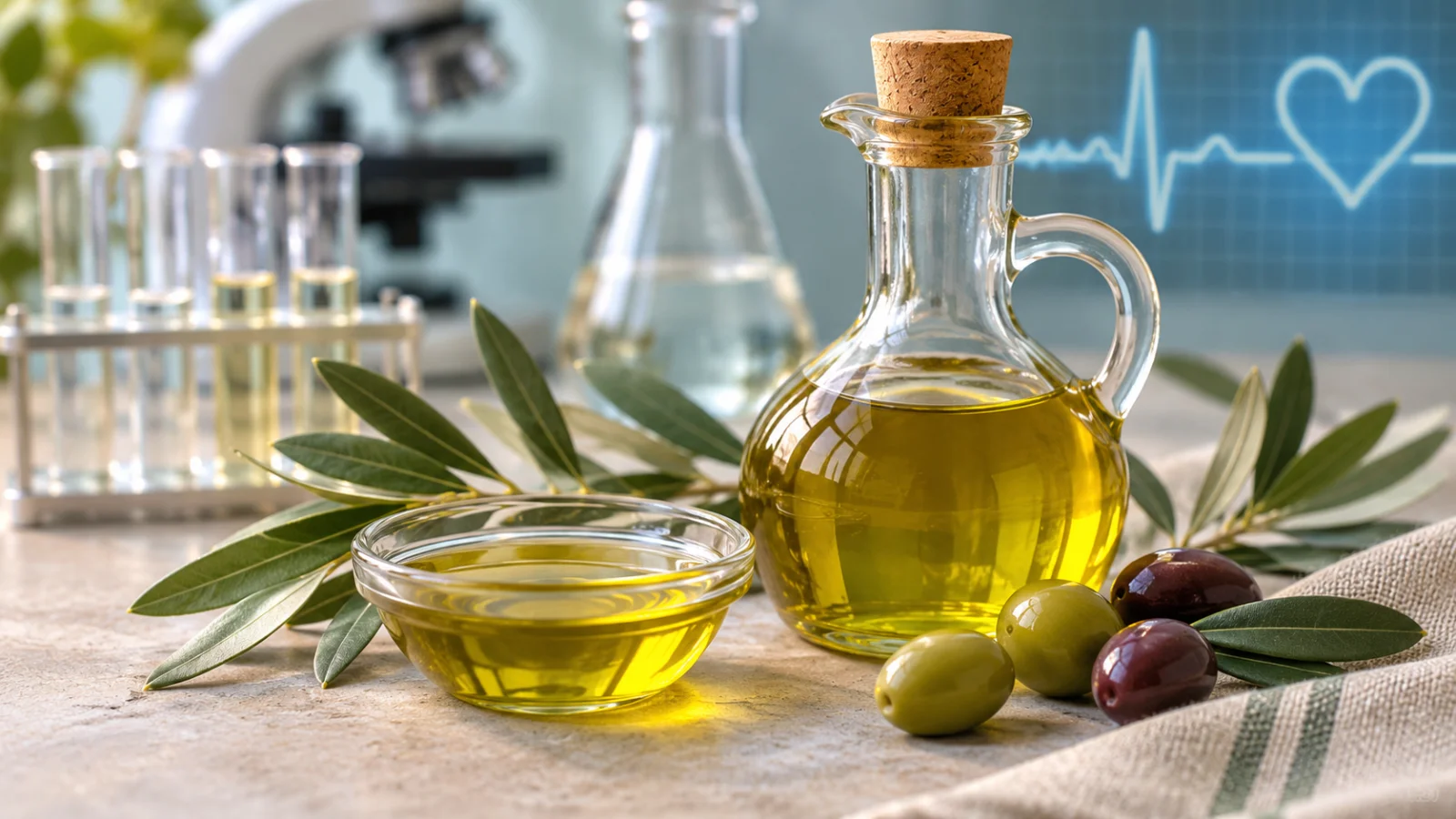
Why extra virgin olive oil is different from refined olive oil
Processing determines more than the label on a bottle of olive oil. Oleic acid remains the dominant fatty acid, but extra virgin olive oil bypasses refining and therefore keeps more of the minor constituents that are stripped out during industrial refining, including phenolic compounds. For that reason, studies often distinguish extra virgin oil from common or refined olive oil instead of assuming that all olive oils provide the same chemical exposure (Guasch-Ferré et al., 2014; Covas et al., 2006).
The research also addresses two different nutritional questions that are easy to merge. One concerns what happens when a predominantly monounsaturated fat replaces a source richer in saturated fatty acids; the other concerns whether olive-oil phenolics alter oxidation, vascular measures or other intermediate outcomes. WHO's 2023 guidance belongs mainly to the first question because it recommends replacing saturated fatty acids with unsaturated fats, including plant-derived monounsaturated fats, rather than assigning a special therapeutic role to olive oil itself (World Health Organization, 2023).
Virgin olive oil is not a standardised dose of phenolics. EFSA's 2025 opinion notes that these compounds can be quantified in olive oil, yet European classification rules do not grade virgin oils according to phenolic concentration. Trials therefore describe the phenolic content of the oils they use, and a result obtained with one study oil cannot be assumed to apply equally to every extra virgin olive oil sold to consumers (EFSA NDA Panel, 2025).
Olive oil polyphenols are not a single proven heart-protection mechanism
Hydroxytyrosol, tyrosol and related phenolic molecules are among the minor compounds investigated in olive oil, but biochemical plausibility does not by itself demonstrate a clinical effect. EUROLIVE tested this question in a randomised crossover design involving 200 healthy men, each exposed for three weeks to oils with low, medium or high phenolic content. HDL cholesterol rose modestly along the phenolic gradient, while oxidised LDL decreased more after the high-phenolic oil, indicating a short-term biomarker response under controlled conditions (Covas et al., 2006).
EUROLIVE therefore supports a limited statement about lipid oxidation rather than a claim that olive-oil polyphenols prevent myocardial infarction. EFSA reached a similarly narrow position in 2011: the panel accepted evidence that olive oil polyphenols help protect blood lipids from oxidative damage, but the same evidence did not substantiate maintenance of normal blood pressure or HDL cholesterol (EFSA NDA Panel, 2011). Those endpoints should remain separate because an oxidation marker, a lipid concentration, blood pressure and a cardiovascular event do not measure the same thing.
Observational studies link higher olive oil intake with lower cardiovascular risk
The long-term observational literature points in a favourable direction, but it cannot completely untangle olive oil from the habits that accompany it. Guasch-Ferré and colleagues analysed two US cohorts comprising 92,383 adults with follow-up extending to 28 years. In their 2022 report, intake above 7 g/day was associated with a 19% lower relative risk of death from any cause compared with never or rare consumption after multivariable adjustment (Guasch-Ferré et al., 2022).
An earlier PREDIMED analysis found a comparable pattern in Spain among people already at high cardiovascular risk. It followed 7,216 participants for a median of 4.8 years and compared cardiovascular outcomes across baseline olive-oil intake categories. Major cardiovascular events were less common in the highest category than in the lowest, with a stronger association for extra virgin olive oil, although the observational design leaves open the possibility of residual confounding (Guasch-Ferré et al., 2014).
Meta-analyses make the association more consistent, not automatically causal
Combining prospective cohorts can reveal whether an association survives across different populations, but pooling does not remove the limitations of non-randomised exposure. Xia and colleagues assembled 13 prospective cohorts in their 2022 meta-analysis. When the highest and lowest intake groups were compared, the pooled relative risk was 0.85 for cardiovascular disease and 0.83 for all-cause mortality (Xia et al., 2022).
A separate 2022 review by Martínez-González and colleagues included 36 studies and produced dose-response estimates rather than only high-versus-low comparisons. For each additional 25 g/day of olive oil, the analysis estimated a 16% lower relative risk of cardiovascular disease and an 11% lower relative risk of all-cause mortality, while also reporting heterogeneity for several outcomes (Martínez-González et al., 2022). These are population associations, not promises of an identical risk reduction for every individual, and estimates from studies with different designs should not be treated as interchangeable.
Study | Design and population | Exposure or intervention | Reported finding |
Guasch-Ferré et al., 2022 | Two prospective US cohorts; 92,383 adults; follow-up up to 28 years | Usual dietary olive-oil intake | All-cause mortality HR 0.81 for >7 g/day versus never/rare |
Guasch-Ferré et al., 2014 | Prospective PREDIMED analysis; 7,216 high-risk adults; median 4.8 years | Baseline total and extra virgin olive-oil intake | Highest versus lowest intake: CVD HR 0.65 for total oil and 0.61 for extra virgin |
Estruch et al., 2018 | PREDIMED randomised trial; 7,447 adults at high cardiovascular risk | Mediterranean diet with extra virgin olive oil | Major cardiovascular events HR 0.69 versus reduced-fat advice |
Covas et al., 2006 | Randomised crossover trial; 200 healthy men; three periods of 3 weeks | Study oils with low, medium or high phenolic content | Modest HDL rise and greater oxidised-LDL reduction with higher phenolic content; no event endpoint |
Schwingshackl et al., 2019 | Systematic review of 13 RCTs with 611 participants; 11 RCTs included in the network meta-analysis | Olive-oil types differing in refinement and phenolic content | Small differences in selected LDL, oxidised-LDL and systolic-pressure outcomes; low-to-moderate certainty |
Controlled trials test dietary patterns and biomarkers rather than olive oil in isolation
PREDIMED provides the main long-duration randomised evidence, although its intervention was a Mediterranean dietary pattern rather than olive oil in isolation. In the corrected 2018 publication, 7,447 Spanish adults at high cardiovascular risk were assigned to one of three strategies: a Mediterranean diet supplemented with extra virgin olive oil, the same dietary pattern supplemented with nuts, or advice aimed at a reduced-fat diet. Major cardiovascular events were less frequent in the extra-virgin-olive-oil arm than in the control arm, corresponding to a hazard ratio of 0.69 (Estruch et al., 2018).
The practical meaning of that finding is narrower than saying that olive oil alone reduced events. Extra virgin olive oil was provided within a broader Mediterranean-diet intervention, so the trial cannot apportion the observed effect among the oil, displacement of other fats, changes in other foods or differences in adherence. The Seven Countries Study offers historical context for Mediterranean dietary patterns, but its ecological comparisons are even less suited to isolating the contribution of a single food.
The corrected PREDIMED report also matters methodologically. Investigators found departures from the intended randomisation procedures at some sites, which led to withdrawal of the original paper and republication with a reanalysis in 2018; the overall cardiovascular result remained after the statistical corrections (Estruch et al., 2018). This history does not invalidate the trial, but it does limit how confidently one can turn a single hazard ratio into an olive-oil-specific effect size.
Shorter trials help separate oil type from the wider diet
Shorter randomised studies answer a different question because they can compare specific oils more directly, even though their outcomes are usually risk markers rather than heart attacks or strokes. Schwingshackl and colleagues identified 13 trials with 611 mostly healthy participants in their 2019 systematic review; 11 trials were included in the network meta-analysis. High-phenolic olive oil produced a small LDL reduction relative to low-phenolic oil and may have improved oxidised LDL relative to refined oil, while both high- and low-phenolic oils lowered systolic blood pressure compared with refined olive oil. Certainty was rated low to moderate, and several other lipid outcomes did not differ clearly (Schwingshackl et al., 2019).
Those results illustrate why the endpoint has to be named precisely. Oxidised LDL speaks to an oxidative pathway, whereas conventional LDL cholesterol and blood pressure represent different cardiovascular risk pathways. Historical work on dietary fat and serum cholesterol helps explain why fat type matters, but controlled feeding experiments of that kind cannot on their own establish whether olive oil changes long-term cardiovascular event rates.
Polyphenol claims need a narrower reading than the overall olive oil evidence
Evidence for the food as part of a dietary pattern is broader than evidence for attributing the benefit to phenolic compounds alone. EFSA revisited this distinction in 2025 while assessing a proposed disease-risk-reduction claim linking naturally occurring olive-oil phenolics with lower LDL cholesterol and systolic blood pressure. The applicant identified seven pertinent human intervention studies reported across 11 articles; EFSA concluded that five of the 11 publications could not support the claim, and ultimately found that a cause-and-effect relationship had not been established for either LDL cholesterol or systolic blood pressure (EFSA NDA Panel, 2025).
That 2025 opinion addresses different endpoints from the accepted 2011 claim on protection of blood lipids against oxidative damage, so the two conclusions are not contradictory. EFSA noted an LDL decrease after three weeks in one small study of people with raised cholesterol, but larger studies in healthy participants did not reproduce the effect, and evidence that any reduction persisted over longer periods was lacking (EFSA NDA Panel, 2025). A demonstrated effect on one biomarker therefore cannot simply be extended to another biomarker or to disease risk.
Why observational and trial findings can point in the same direction for different reasons
Olive oil is rarely consumed in isolation from the rest of a person's diet. Higher intake often occurs within patterns that include vegetables, pulses, nuts, fish and whole grains, and these patterns may also coincide with differences in smoking, physical activity, socioeconomic circumstances and other behaviours that statistical adjustment cannot capture perfectly. Randomised Mediterranean-diet trials reduce that confounding by assigning a dietary strategy, but because several foods change at once they make food-specific attribution more difficult.
The different study designs are therefore complementary rather than directly competing. Cohorts ask whether habitual intake predicts later outcomes, randomised trials test assigned dietary patterns, and mechanistic studies look at specific biological pathways. The same interpretive problem appears in whole-grain evidence and cardiovascular outcomes: an association can be consistent while the size of the effect and the mechanism still depend on the foods displaced and on the wider diet.
The evidence does not support treating olive oil as a heart medicine. Its strongest case is as an unsaturated plant fat used within a broader dietary pattern, while claims about individual polyphenols have a much narrower evidential base.
Olive oil benefits make most sense as part of fat replacement and dietary pattern
Substitution is central to interpreting olive-oil research. Pouring additional oil onto an unchanged diet is not nutritionally equivalent to replacing butter, lard or another saturated-fat-rich food with it. WHO's 2023 guideline frames the issue in those terms by recommending that saturated fatty acids be replaced with unsaturated fats or fibre-rich carbohydrate sources; olive oil is relevant here as a plant source rich in monounsaturated fat (World Health Organization, 2023).
Extra virgin olive oil can also supply phenolic compounds that refined oils contain in smaller amounts, and controlled trials show effects on selected oxidation-related outcomes. Even so, the 2019 network meta-analysis and EFSA's 2025 assessment show that proposed effects on LDL cholesterol and blood pressure are not uniformly reproduced across studies (Schwingshackl et al., 2019; EFSA NDA Panel, 2025). The evidence is consequently more coherent at the level of an overall heart-health dietary pattern than at the level of one isolated molecule.
What the evidence does not establish
No study base reviewed here establishes that olive oil prevents cardiovascular disease independently of the rest of the diet, and none defines a single intake that delivers the same effect across populations. The large US studies observed rather than assigned consumption, PREDIMED enrolled older adults with elevated cardiovascular risk, and many phenolic-oil trials were short and comparatively small. A percentage reported in one of these settings therefore should not be transplanted directly into another.
Antioxidant terminology also needs restraint. Oxidised LDL is an intermediate outcome, so a statistically significant change in that measure is not equivalent to evidence of fewer myocardial infarctions or strokes. Taken together, the studies support extra virgin olive oil as a plausible component of dietary patterns associated with lower cardiovascular risk, while the independent contribution of specific phenolic compounds remains less certain.
What is established and what remains uncertain
Across study types, several findings line up without being identical. Prospective cohorts report lower cardiovascular risk or mortality among people with greater olive-oil intake, meta-analyses reproduce the same direction of association, and PREDIMED recorded fewer major cardiovascular events for a Mediterranean diet that included extra virgin olive oil than for reduced-fat advice (Guasch-Ferré et al., 2022; Xia et al., 2022; Estruch et al., 2018). Controlled oil-comparison studies additionally show that phenolic content can alter selected oxidative and lipid-related biomarkers (Covas et al., 2006).
What remains unresolved is how much of the observed benefit belongs to olive oil itself. Confounding cannot be fully removed from long-term cohorts, PREDIMED changed an entire dietary pattern, and shorter trials comparing oils have not produced consistently lower LDL cholesterol or systolic blood pressure. EFSA's 2025 finding that causality was not established for those specific endpoints therefore fits within, rather than negates, the broader cardiovascular evidence (EFSA NDA Panel, 2025).
A moderate evidence rating is appropriate because several independent research designs point in the same general direction, yet none isolates a universal effect attributable solely to olive oil and none shows that polyphenols account for the clinical outcomes. The most supportable interpretation is that olive oil, particularly extra virgin olive oil, functions as an unsaturated plant fat within a wider eating pattern rather than as a stand-alone cardiovascular intervention.
Frequently asked questions
Is extra virgin olive oil better for heart health than regular olive oil?
Compared with refined olive oil, extra virgin olive oil preserves more phenolic compounds, and Covas et al. (2006) detected differences in selected oxidation-related biomarkers. Long-term event trials, however, rarely isolate one olive-oil grade from another. The best-known cardiovascular trial tested a Mediterranean diet including extra virgin olive oil, not extra virgin oil directly against regular olive oil.
Do olive oil polyphenols lower LDL cholesterol?
The evidence is inconsistent. Some short trials report favourable LDL-related changes, but EFSA's 2025 assessment found that an LDL-lowering effect was not reproduced across the human intervention studies it considered and had not been shown to persist over longer periods. Evidence is stronger for protecting blood lipids from oxidative damage than for lowering LDL concentration itself.
Can olive oil reduce the risk of a heart attack or stroke?
Estruch et al. (2018) found fewer events in PREDIMED’s combined outcome of myocardial infarction, stroke and cardiovascular death with a Mediterranean diet plus extra virgin olive oil than with reduced-fat advice. Observational cohorts also link higher olive-oil intake with lower cardiovascular risk, but neither line of evidence proves that olive oil alone produces the same effect in every population.
Is olive oil healthy because of oleic acid or because of polyphenols?
They contribute to different parts of the evidence. Oleic acid makes olive oil a predominantly monounsaturated fat that can displace more saturated sources of fat, whereas phenolic compounds have been tested mainly against short-term oxidative and related biomarkers. Current research does not demonstrate that polyphenols by themselves account for the lower cardiovascular event rates observed in Mediterranean dietary patterns.
Does heating olive oil remove all of its cardiovascular value?
Normal cooking does not remove olive oil's basic fatty-acid composition, although processing, storage and heating can reduce some minor phenolic constituents. The cardiovascular studies summarised here mostly examine habitual intake or specified study oils rather than one cooking technique. They therefore do not support the claim that heating olive oil removes all of its potential cardiovascular relevance.
Sources
- Guasch-Ferré M, Li Y, Willett WC, et al. Consumption of Olive Oil and Risk of Total and Cause-Specific Mortality Among U.S. Adults. Journal of the American College of Cardiology. 2022;79(2):101–112. DOI 10.1016/j.jacc.2021.10.041.
- Xia M, Zhong Y, Peng Y, Qian C. Olive oil consumption and risk of cardiovascular disease and all-cause mortality: A meta-analysis of prospective cohort studies. Frontiers in Nutrition. 2022;9:1041203. DOI 10.3389/fnut.2022.1041203.
- Martínez-González MA, Sayón-Orea C, Bullón-Vela V, Bes-Rastrollo M, Rodríguez-Artalejo F, Yusta-Boyo MJ, García-Solano M. Effect of olive oil consumption on cardiovascular disease, cancer, type 2 diabetes, and all-cause mortality: A systematic review and meta-analysis. Clinical Nutrition. 2022;41(12):2659–2682. DOI 10.1016/j.clnu.2022.10.001.
- Guasch-Ferré M, Hu FB, Martínez-González MA, et al. Olive oil intake and risk of cardiovascular disease and mortality in the PREDIMED Study. BMC Medicine. 2014;12:78. DOI 10.1186/1741-7015-12-78.
- Estruch R, Ros E, Salas-Salvadó J, et al. Primary Prevention of Cardiovascular Disease with a Mediterranean Diet Supplemented with Extra-Virgin Olive Oil or Nuts. New England Journal of Medicine. 2018;378(25):e34. DOI 10.1056/NEJMoa1800389.
- Covas MI, Nyyssönen K, Poulsen HE, et al.; EUROLIVE Study Group. The effect of polyphenols in olive oil on heart disease risk factors: a randomized trial. Annals of Internal Medicine. 2006;145(5):333–341. DOI 10.7326/0003-4819-145-5-200609050-00006.
- Schwingshackl L, Krause M, Schmucker C, Hoffmann G, Rücker G, Meerpohl JJ. Impact of different types of olive oil on cardiovascular risk factors: A systematic review and network meta-analysis. Nutrition, Metabolism and Cardiovascular Diseases. 2019;29(10):1030–1039. DOI 10.1016/j.numecd.2019.07.001.
- EFSA Panel on Dietetic Products, Nutrition and Allergies. Scientific Opinion on the substantiation of health claims related to polyphenols in olive and protection of LDL particles from oxidative damage (ID 1333, 1638, 1639, 1696, 2865), maintenance of normal blood HDL cholesterol concentrations (ID 1639), maintenance of normal blood pressure (ID 3781), “anti-inflammatory properties” (ID 1882), “contributes to the upper respiratory tract health” (ID 3468), “can help to maintain a normal function of gastrointestinal tract” (3779), and “contributes to body defences against external agents” (ID 3467) pursuant to Article 13(1) of Regulation (EC) No 1924/2006. EFSA Journal. 2011;9(4):2033. DOI 10.2903/j.efsa.2011.2033.
- EFSA Panel on Nutrition, Novel Foods and Food Allergens. Phenolic compounds naturally present in olive oil and lowering of blood LDL-cholesterol and systolic blood pressure, therefore reducing the risk of coronary heart disease: Evaluation of a health claim pursuant to Article 14 of Regulation (EC) No 1924/2006. EFSA Journal. 2025;23(5):e9470. DOI 10.2903/j.efsa.2025.9470.
- World Health Organization. Saturated fatty acid and trans-fatty acid intake for adults and children: WHO guideline. 17 July 2023. https://www.who.int/publications/i/item/9789240073630

Daniel K. Reynolds — author
Daniel K. Reynolds is an independent nutrition writer with academic training in nutritional sciences and food science. His background combines nutrition research literacy with food-composition analysis and public-facing science communication. He focuses on how...
This article is for general information and is not medical advice. It was reviewed for accuracy by a qualified clinician; decisions about your health should be made with your own doctor.
Related
The Seven Countries Study: Diet and Heart Deaths in 1980
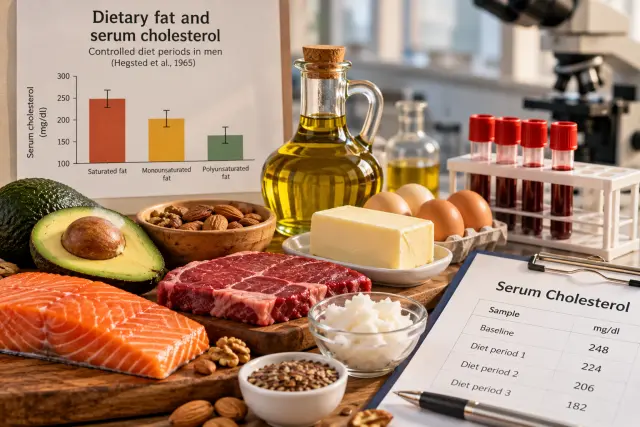
Dietary Fat and Serum Cholesterol: Hegsted Study Findings
Whole grains and what the bran and germ add that refined flour loses
Whether Greek yogurt is good for you and how straining changes it

What kombucha is and what is actually in the fizzy fermented tea

Green tea benefits and which catechin claims hold up in studies
Probiotic foods and which fermented foods still carry live cultures