


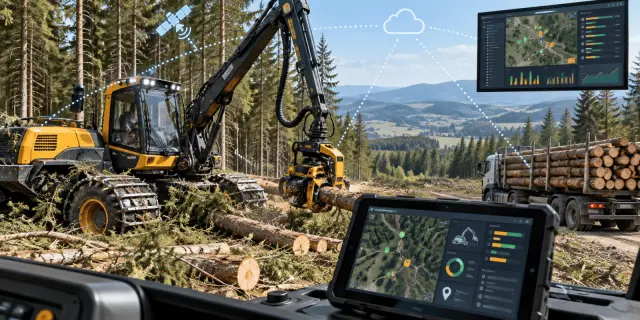



Harmonizing Measurements from Wood Harvesting Machines to Support Near Real Time Spatio-Temporally Enabled Dashboards for Process Control
A 2015 FORMEC conference paper examined how harmonized sensor measurements from wood-harvesting machines could be shared across the forest supply chain to support near-real-time, spatially enabled dashboards and better process control.
What the study did and found
The 2015 conference paper “Harmonizing measurements from wood harvesting machines to support near real time spatio-temporally enabled dashboards for process control” by M. Mittlboeck, R. Jank and J. Scholz described work within the EU-funded FOCUS project. The authors addressed a coordination problem in forest-based supply chains: production and sensor data were generated by different actors, including forest enterprises, harvesting contractors, haulage companies and wood-processing firms, but were not necessarily shared in a common technical and semantic form. Their proposed approach was to harmonize measurements from harvesting machines and exchange them between stakeholders so that near-real-time, spatially and temporally enabled dashboards could improve situational awareness and process control. The paper presented this as an interoperability and monitoring concept rather than a controlled trial demonstrating a quantified economic effect.
Why it is cited
The paper remains relevant as an example of efforts to connect forest-machine measurements with broader digital supply-chain management. Its focus on interoperability, standardized data exchange and shared operational visibility anticipated themes that continue in precision forestry and digital timber logistics.
Subsequent developments support the general technical direction described in the paper. StanForD, maintained by Skogforsk, remains a widely used standard for communication and data exchange with forest machines and continues to evolve, including XML-based structures and specifications for production monitoring and geographical reporting. The completed FOCUS project also reported integration of data from multiple sensors, harmonized data models and dashboard-style mobile tools. These developments show that standardized machine data and interoperable monitoring remain practical priorities. They do not, however, by themselves verify every proposed benefit or cost-saving expectation in the 2015 paper.
The topic today
Forest operations now make increasing use of connected machine data for production follow-up, logistics, equipment monitoring and maintenance. The central issue identified in 2015 therefore remains current: useful dashboards depend not only on collecting data, but on making measurements technically compatible, semantically interpretable and shareable between organizations. Modern implementations use more mature standards, APIs and digital platforms, while data governance, interoperability and consistent definitions remain important challenges.