What causes hiccups and why your body has this reflex
Hiccups are caused by a reflex that suddenly contracts the diaphragm and closes the glottis, while why the body retains this reflex remains uncertain. Common triggers include stomach distension from food, drink or swallowed air, and the leading hypotheses link the reflex to clearing air during suckling, an ancient amphibian breathing pattern or early brain development.
The sections below describe what happens in the chest and throat during a hiccup, which everyday triggers and medical conditions set the reflex off and how researchers explain its purpose. The account draws on reviews of hiccups in adults and children, a classic experiment that provoked hiccups by inflating a balloon in the oesophagus, two evolutionary hypotheses and a brain recording study in newborn babies.
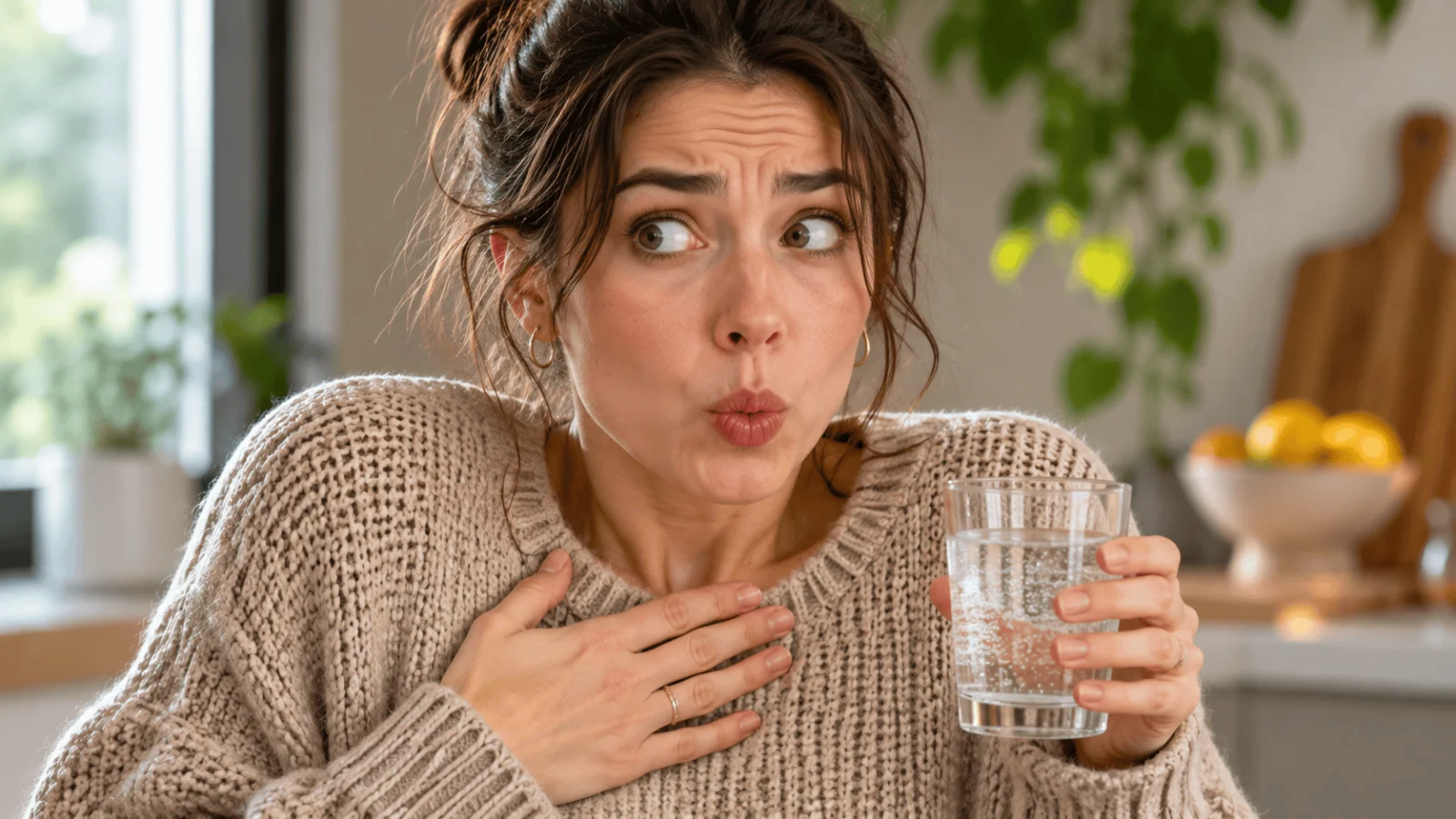
What actually happens during a hiccup?
A hiccup is a twitch, not a breath. The diaphragm, the dome of muscle under the lungs, contracts suddenly and involuntarily, often together with the muscles between the ribs that help draw air in. Air begins to move inward, but almost immediately the glottis, the opening between the vocal cords, closes abruptly and interrupts inspiration, producing the characteristic “hic” sound (Rajagopalan et al., 2021; Howes, 2012).
The timing is tight. In an experimental study, Newsom Davis (1970) observed that glottal closure occurred approximately 35 ms after the onset of inspiratory airflow. This helps explain why a hiccup moves so little air: inspiration is interrupted almost as soon as it begins.
Hiccups usually arrive in runs, each spasm spaced out at a rhythm that can approach the pace of ordinary breathing (Straus et al., 2003). Medical writers sort episodes by how long they last. A bout of up to 48 hours counts as acute, one that goes beyond 48 hours as persistent, and one lasting longer than a month as intractable (Rajagopalan et al., 2021). Hiccups are universal and turn up at every age, from the womb onwards.
What causes hiccups?
The hiccup reflex is commonly described as an arc with afferent, central and efferent components. Sensory signals are thought to travel through vagal, phrenic and sympathetic pathways. Several CNS regions, including the upper cervical cord, medulla, reticular formation and hypothalamus, have been implicated, but the precise central hiccup generator has not been identified. Efferent signals travel mainly through the phrenic nerve to the diaphragm, with additional pathways involved in movements of the rib and laryngeal muscles (Rajagopalan et al., 2021).
Anything that irritates one of these pathways can, in principle, set off hiccups. In practice, the stomach and gullet are the commonest culprits.
The stomach and oesophagus
In a review of hiccups in children, Leung and colleagues (2020) named an overstretched stomach as the most common identifiable cause of short-lived hiccups, followed by acid reflux and inflammation of the stomach lining. Everyday triggers listed in a 2021 review of hiccups in hospital patients follow the same theme: large meals, fizzy drinks, hot and spicy food, alcohol and smoking, as well as [anxiety](/health/how-self-talk-patterns-relate-to-competitive-anxiety-in-sport-health) with fast breathing or gulping of air (Rajagopalan et al., 2021).
A neat experiment showed that the oesophagus itself can start the reflex. In the study “Stimulus and site specific induction of hiccups in the oesophagus of normal subjects” (1997), Fass and colleagues placed a small balloon in the oesophagus of 10 healthy volunteers and inflated it in different ways. Rapid inflation in the upper part of the oesophagus reliably brought on hiccups in four of them, while inflation lower down did not.
The hiccups began during rapid inflation and stopped the moment the balloon was deflated. In a commentary on the work, Kahrilas and Shi (1997) concluded that stretch sensors in the oesophageal wall are likely to form part of the incoming side of the hiccup reflex.
Emotions as a trigger
Not every bout has an obvious mechanical cause. Stress, fear, excitement and other strong emotions are recognised psychogenic triggers (Rajagopalan et al., 2021), and Straus and colleagues (2003) listed emotional factors alongside a full stomach as the usual sources of brief bouts. How emotion reaches the reflex loop is not well understood, although the involvement of the hypothalamus in the central part of the loop offers one possible route.
Why do some hiccups last for days?
Long-running hiccups are a different matter from the after-dinner kind. Leung and colleagues (2020) noted that persistent or intractable hiccups can stem from disorders of the digestive tract, the nervous system, the heart, [the lungs](/health/chest-disease-diagnosis-radiologic-signs-differential-health), infections or psychological conditions, and can be a sign of an underlying disease.
Conditions linked to persistent hiccups
Data gathered in the 2021 review give a sense of how common the problem is in particular groups. Recurrent hiccups have been reported in about 3% of healthy people, about 10% of people with gastro-oesophageal reflux disease and about 20% of people with Parkinson’s disease, and figures of 3.9–4.8% have been reported in advanced cancer (Rajagopalan et al., 2021).
Damage in the brain can drive the reflex directly. Hiccups have been reported in approximately 12–36% of patients with lateral medullary infarction, a type of brainstem stroke (Park et al., 2005). Disorders of the upper digestive tract are also frequently associated with chronic hiccups. In a prospective study of 184 patients, upper digestive abnormalities were identified in 80% of cases, although their presence did not establish that they caused every episode of hiccups (Cabane et al., 2010).
Group or cause | Reported figure | What the figure measures | Source |
Healthy people | About 3% | Share with recurrent hiccups | Rajagopalan et al., 2021 |
Gastro-oesophageal reflux disease | About 10% | Share with recurrent hiccups | Rajagopalan et al., 2021 |
Parkinson’s disease | About 20% | Share with recurrent hiccups | Rajagopalan et al., 2021 |
Advanced cancer | 3.9–4.8% | Reported prevalence of hiccups | Rajagopalan et al., 2021 |
Lateral medullary infarction | 12–36% | Share of patients with lateral medullary infarction reported to develop hiccups | Park et al., 2005 |
Upper digestive tract abnormalities | 80% | Share of 184 patients with chronic hiccups in whom upper digestive abnormalities were identified | Cabane et al., 2010 |
Medicines as triggers
Some medicines can also bring on hiccups. Steroids, dopamine agonists, certain antibiotics and some psychiatric drugs have been implicated. In cancer patients, hiccups have been reported during cisplatin-based chemotherapy, although accompanying medicines, particularly the antiemetic steroid dexamethasone, may also contribute, making it difficult to attribute the symptom to cisplatin alone (Rajagopalan et al., 2021; Liaw et al., 2005).
Why does the body have a hiccup reflex?
Most reflexes have an obvious job. Coughing clears the airway, and sneezing clears the nose. A hiccup, which draws in a sliver of air and then blocks it, has no clear benefit for adults, so researchers have looked for its purpose earlier in life and further back in evolution.
Hiccups start before birth
Hiccuping begins remarkably early in life. Fetal hiccups can be seen on ultrasound from about nine weeks of pregnancy, and in babies born early they are a dominant motor pattern, estimated to take up about 1% of the day (Whitehead et al., 2019). That early start, well before lungs are used for breathing, suggests the reflex matters for development.
A brain-training hypothesis
In the study “Event-related potentials following contraction of respiratory muscles in pre-term and full-term infants” (2019), Whitehead and colleagues at University College London looked at the brain’s response to hiccups in newborns. Out of 217 brain recordings from babies, they found hiccups in 13 infants whose corrected gestational ages ranged from 30 to 42 weeks. Movement sensors on the trunk marked each diaphragm contraction, and EEG electrodes on the scalp recorded what followed across 1,316 hiccups.
Each hiccup produced a sequence of three distinct brain responses. Their strength did not change with age across the range studied, and hiccups were more common when babies were awake. The authors found that diaphragm contractions produced measurable brain responses from as early as 30 weeks of corrected gestational age, approximately ten weeks before a typical birth. They proposed that this sensory feedback might contribute to the development of the brain's representation of the chest and respiratory muscles, although the study did not establish a direct developmental benefit (Whitehead et al., 2019).
An echo of amphibian breathing
A bolder idea looks back hundreds of millions of years. In the study “A phylogenetic hypothesis for the origin of hiccough” (2003), Straus and colleagues pointed out that hiccups share several features with the way tadpoles and some frogs pump water over their gills. In both cases, a breath-like inward movement is paired with closure of the glottis, which keeps water out of the lungs.
Hiccups are inhibited when inhaled carbon dioxide rises and can be suppressed by baclofen, a GABA-B receptor agonist, features the authors compared with lower-vertebrate ventilatory patterns (Straus et al., 2003). They suggested that the circuit for hiccups is an ancient motor pattern that survived in mammals because it later served other functions, such as suckling or normal breathing, while acknowledging that neither of their models had been tested experimentally.
A tool for clearing air from a milk-filled stomach
A third explanation focuses on feeding. In “Hiccups: a new explanation for the mysterious reflex” (2012), Howes proposed that hiccups evolved in mammals to remove air swallowed during suckling. The sharp pull of the diaphragm against a closed glottis lowers pressure in the chest, which could draw a pocket of air from the stomach up into the oesophagus to be burped out.
On this view, getting rid of trapped air would leave more room for milk and help young mammals feed. The idea fits the observation that a full or distended stomach is the most common trigger (Leung et al., 2020), but it rests on reasoning rather than direct measurement.
Hypothesis | Core idea | Main support | Source |
Brain mapping | Hiccups send feedback that helps the newborn brain map breathing muscles | Distinct brain responses to each hiccup from about 30 weeks | Whitehead et al., 2019 |
Amphibian legacy | Hiccups are a leftover of gill ventilation in frogs and tadpoles | Shared features, including glottis closure and suppression by carbon dioxide | Straus et al., 2003 |
Air removal | Hiccups pull swallowed air out of the stomach in suckling mammals | Fits the link with stomach distension; not yet directly tested | Howes, 2012 |
Do hiccup remedies work?
Popular remedies range from holding the breath to sipping water upside down, and most people have a favourite. The evidence behind them is thin. Leung and colleagues (2020) concluded that no formal guidelines exist for treating hiccups and that most proposed methods rest on case reports and personal accounts. Because ordinary bouts usually stop on their own within minutes, it is hard to tell whether a remedy worked or the hiccups simply ended.
Research on long-lasting hiccups has the same weakness. In the study “Systemic review: the pathogenesis and pharmacological treatment of hiccups” (2015), Steger, Schneemann and Fox found reports of 341 patients with persistent or intractable hiccups across 15 published studies. They identified no adequately powered, well-designed treatment trials, and concluded that the available data did not support firm recommendations. Management was most effective when directed at an identifiable underlying condition, but persistent or intractable hiccups may also require symptomatic treatment when the cause cannot be found or treated (Steger et al., 2015).
What is proven about hiccups, and what is not
Several features of the hiccup reflex are well documented across experimental studies and clinical reviews. The evidence is strongest for its mechanism, common triggers and occurrence before birth. The main findings are:
- A hiccup involves an involuntary contraction of the diaphragm and inspiratory muscles, with glottal closure occurring approximately 35 ms after the onset of inspiratory airflow in experimental measurements (Newsom Davis, 1970).
- The proposed reflex arc includes vagal, phrenic and sympathetic pathways, while several CNS regions in the upper cervical cord, medulla, reticular formation and hypothalamus have been implicated; the precise central generator remains unknown (Rajagopalan et al., 2021).
- Stretching of the stomach or upper oesophagus can trigger it, as balloon experiments show (Fass et al., 1997; Leung et al., 2020).
- Hiccups begin before birth and produce measurable brain responses in newborns (Whitehead et al., 2019).
- Persistent hiccups can be linked to brainstem strokes, oesophageal disease, other illnesses and some medicines (Rajagopalan et al., 2021).
Hiccups can be triggered by irritation of the reflex pathways associated with the stomach and oesophagus, as well as by neurological conditions, medications and other factors. The reflex may have been retained through evolution because of a role in feeding, breathing or early development, although none of these proposed functions has been conclusively established.
The purpose of the reflex remains open. The amphibian and suckling hypotheses are both plausible, but neither has been tested directly, and the brain-mapping idea rests on one study of 13 babies (Whitehead et al., 2019). How emotions trigger the reflex is unclear.
For treatment, evidence remains limited. Although small randomised, placebo-controlled trials have provided some support for baclofen and metoclopramide, there is still insufficient high-quality evidence to make firm recommendations for most treatments, particularly household remedies (Steger et al., 2015; Leung et al., 2020).
Hiccups are a reminder that some familiar experiences in the body remain incompletely explained. A 1997 balloon experiment and a 2019 study of newborn brain activity have both helped researchers investigate this everyday reflex (Fass et al., 1997; Whitehead et al., 2019). Other unresolved scientific questions are explored in the site's [scientific curiosities](/research?sub=curiosities) section.
Frequently asked questions
Are hiccups dangerous?
Ordinary hiccups are harmless and usually stop on their own within minutes (Leung et al., 2020). Persistent or intractable hiccups are rare, but they can lead to insomnia, exhaustion and weight loss (Kahrilas and Shi, 1997), and they may point to an underlying disorder, which is why long bouts are investigated rather than ignored.
Why do babies hiccup so often?
Hiccups are a dominant movement in babies born early, taking up an estimated 1% of the day, and fetuses hiccup from about nine weeks of pregnancy (Whitehead et al., 2019). Researchers think the reflex may help the developing brain map the breathing muscles, or help clear swallowed air during feeding (Howes, 2012).
Are hiccups more common in men?
In healthy people, studies have found no clear difference between men and women. Among people with persistent hiccups, those caused by problems outside the brain and spinal cord appear to be more common in men than those of central nervous system origin (Rajagopalan et al., 2021).
Do animals get hiccups?
Hiccup-like spasms have been described in other mammals, which led Howes (2012) to link the reflex with suckling. Straus and colleagues (2003) went further back in evolution, comparing hiccups with the way frogs and tadpoles pump water over their gills while keeping the glottis shut to protect the lungs.
Sources
- Rajagopalan, V., Sengupta, D., Goyal, K., Dube, S.K., Bindra, A., Kedia, S. Hiccups in neurocritical care. Journal of Neurocritical Care, 2021, 14(1), 18–28. DOI 10.18700/jnc.200018
- Leung, A.K.C., Leung, A.A.M., Wong, A.H.C., Hon, K.L. Hiccups: a non-systematic review. Current Pediatric Reviews, 2020, 16(4), 277–284. DOI 10.2174/1573396316666200508112951
- Steger, M., Schneemann, M., Fox, M. Systemic review: the pathogenesis and pharmacological treatment of hiccups. Alimentary Pharmacology and Therapeutics, 2015, 42(9), 1037–1050. DOI 10.1111/apt.13374
- Howes, D. Hiccups: a new explanation for the mysterious reflex. BioEssays, 2012, 34(6), 451–453. DOI 10.1002/bies.201100194
- Straus, C., Vasilakos, K., Wilson, R.J.A., Oshima, T., Zelter, M., Derenne, J.Ph., Similowski, T., Whitelaw, W.A. A phylogenetic hypothesis for the origin of hiccough. BioEssays, 2003, 25(2), 182–188. DOI 10.1002/bies.10224
- Whitehead, K., Jones, L., Laudiano-Dray, M.P., Meek, J., Fabrizi, L. Event-related potentials following contraction of respiratory muscles in pre-term and full-term infants. Clinical Neurophysiology, 2019, 130(12), 2216–2221. DOI 10.1016/j.clinph.2019.09.008
- Fass, R., Higa, L., Kodner, A., Mayer, E.A. Stimulus and site specific induction of hiccups in the oesophagus of normal subjects. Gut, 1997, 41(5), 590–593. DOI 10.1136/gut.41.5.590
- Kahrilas, P.J., Shi, G. Why do we hiccup? Gut, 1997, 41(5), 712–713. DOI 10.1136/gut.41.5.712
- Liaw CC, Wang CH, Chang HK, et al. Cisplatin-related hiccups: male predominance, induction by dexamethasone, and protection against nausea and vomiting. Journal of Pain and Symptom Management, 2005; 30(4): 359–366. DOI 10.1016/j.jpainsymman.2005.08.008.
- Newsom Davis, J. An experimental study of hiccup. Brain, 1970, 93(4), 851–872. DOI 10.1093/brain/93.4.851.
- Cabane, J., Bizec, J.L., Derenne, J.P. Le hoquet chronique est souvent une maladie œsophagienne. Une étude prospective de 184 cas. La Presse Médicale, 2010, 39(6), e141–e146. DOI 10.1016/j.lpm.2010.01.006.
- Park, M.H., Kim, B.J., Koh, S.B., Park, M.K., Park, K.W., Lee, D.H. Lesional location of lateral medullary infarction presenting hiccups (singultus). Journal of Neurology, Neurosurgery & Psychiatry, 2005, 76(1), 95–98. DOI 10.1136/jnnp.2004.039362.

Eleanor Hayes — author
Eleanor Hayes writes with an editorial focus on research methodology and study design, including experimental and observational studies, controls, sampling, measurement and the methodological choices that shape scientific conclusions. At Cabdirect, Eleanor cov...
Related
Chest disease diagnosis: radiologic signs and differentials

How Sensory-Specific Satiation Shapes Appetite and Food Intake

How self-talk patterns relate to competitive anxiety in sport

Why we dream and what sleep research says about the purpose of dreams
Circadian rhythm and how your body clock shapes sleep and alertness

What déjà vu reveals about how the brain processes memories
How long you can survive without food and what happens to your body