Gestational diabetes and why pregnancy changes how the body uses insulin
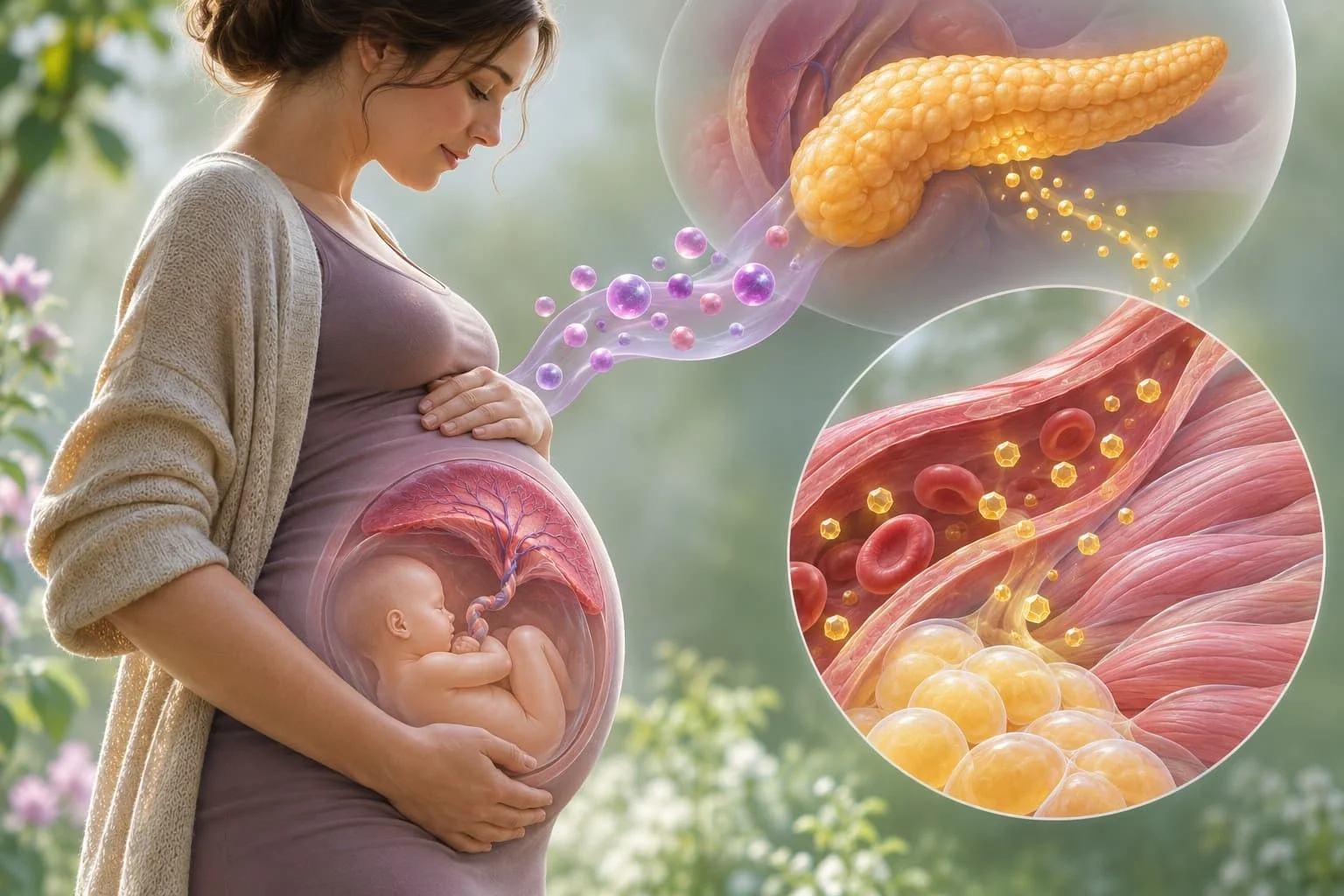
Hormonal changes alter insulin action throughout pregnancy, and maternal insulin sensitivity usually falls as gestation progresses. If the pancreas cannot supply enough additional insulin to meet that demand, blood glucose can rise to the level classified as gestational diabetes. Plows et al. (2018) discuss this process and cite a worldwide prevalence estimate of about 14% derived from data available at the time.
The crucial distinction is between an expected pregnancy adaptation and glucose regulation that no longer compensates adequately. Drawing on official guidance, physiological reviews, cohort evidence and randomised trials, this article considers how the condition is recognised, which pregnancy outcomes change with treatment and what research can say about risks after delivery.

Evidence last checked 17 Nov 2026 · 13 min
What gestational diabetes is and when it develops
A diagnosis made during pregnancy does not necessarily establish when the underlying glucose disturbance first began. Gestational diabetes is distinguished from diabetes known to have been present before conception, even though both can be identified while someone is pregnant (NIDDK, 2017; Plows et al., 2018).
That distinction influences who enters a study's GDM category. It also helps explain why two apparently comparable groups may produce different prevalence estimates: the diagnostic rules applied to their glucose results are not necessarily identical (Mittal et al., 2025; Plows et al., 2018).
For a historical estimate of its scale, the International Diabetes Federation (2017) reported that approximately 18.4 million live births worldwide were affected by gestational diabetes in 2017, equivalent to about 14% of live births among women aged 20–49. The estimate was derived from 2017 data and should not be interpreted as the current global prevalence.
Gestational diabetes and pre-existing diabetes
Plows et al. (2018) quote the ADA definition in which GDM is identified during the second or third trimester and is not clearly pre-existing diabetes. The result of a pregnancy glucose test is therefore only part of the classification; evidence of diabetes before pregnancy matters as well.
NIDDK uses a simpler patient-facing description, referring to diabetes that develops during pregnancy. Researchers tend to state the exclusion of pre-existing disease explicitly, because that distinction affects interpretation of both pregnancy outcomes and the need for later follow-up (NIDDK, 2017; Plows et al., 2018).
Timing during pregnancy
Although GDM is diagnosed most frequently in later gestation, it is not confined to a single week of pregnancy. NHS guidance acknowledges that it may arise earlier, whereas NIDDK describes routine testing in the 24–28-week window (NHS, 2022; NIDDK, 2017).
The increasing demand for insulin offers a physiological explanation for this pattern. Placental and maternal hormonal shifts progressively reduce insulin responsiveness, so a degree of pancreatic compensation that was sufficient earlier may no longer maintain glucose regulation later (Mittal et al., 2025; Plows et al., 2018).
Gestational diabetes symptoms and risk factors
Many cases would be missed if detection relied on noticeable physical changes. NIDDK (2017) reports that symptoms are often absent; even when increased thirst or urination occurs, those changes may be subtle and indistinguishable from other experiences of pregnancy.
Risk characteristics provide additional information where symptoms offer little guidance. NHS recommendations and the reviews by Plows et al. (2018) and Torres-Torres et al. (2024) identify broadly overlapping groups, although they differ in emphasis and do not establish one universally applicable ranking of risk.
Symptoms and symptom-free cases
Thirst and urinary frequency are poor discriminators because they can occur in uncomplicated pregnancy. Equally, a woman with GDM may notice nothing out of the ordinary. NIDDK (2017) therefore describes a condition whose recognition depends much more on testing than on a distinct symptom profile.
The absence of discomfort does not guarantee that glucose exposure is low. HAPO linked measured maternal glycaemia with several pregnancy outcomes, which helps explain why the clinical assessment uses laboratory results even for women who feel well (HAPO Study Cooperative Research Group, 2008; NIDDK, 2017).
Maternal and pregnancy-related risk factors
NHS (2022) identifies several circumstances associated with GDM: age over 40, BMI above 30, a previous infant weighing at least 4.5 kg, or GDM in an earlier pregnancy. Its list also includes diabetes in a parent or sibling and South Asian, Black, African-Caribbean or Middle Eastern family background. A previous GDM diagnosis is specifically relevant to the timing of testing during a subsequent pregnancy.
The research reviews place these clinical risk factors in a wider context. Plows et al. (2018) repeatedly identify higher body weight, older maternal age and a family history of diabetes, while Torres-Torres et al. (2024) also discuss differences associated with ethnicity. None of these characteristics alone determines whether GDM will occur.
Why pregnancy changes insulin sensitivity in gestational diabetes
Insulin resistance changes as part of normal pregnancy physiology. Rather than indicating GDM by itself, the gradual fall in maternal insulin sensitivity helps redirect nutrient availability during foetal development (Plows et al., 2018; Torres-Torres et al., 2024).
Whether glucose remains regulated depends partly on the pancreatic response to that change. In most pregnancies, insulin production rises sufficiently; GDM emerges in those where extra secretion fails to offset resistance (Mittal et al., 2025; Plows et al., 2018).
Placental hormones and inflammatory signalling
Insulin sensitivity follows a changing course rather than declining uniformly from the first weeks. Plows et al. (2018) report an initial rise followed by a decline later in pregnancy, against a hormonal background involving oestrogen, progesterone, leptin, cortisol, placental lactogen and placental growth hormone.
Placental signalling provides one explanation for reduced maternal glucose uptake. In their mechanistic review, Torres-Torres et al. (2024) describe effects of human placental lactogen on insulin action alongside alterations to IRS and PI3K signalling involving hormones and cytokines.
Those hormonal pathways do not operate in isolation. The review by Torres-Torres et al. (2024) also discusses low-grade inflammatory signalling, including TNF-α and IL-6, as a possible contributor to reduced insulin responsiveness, particularly when obesity coexists with GDM.
Pancreatic beta-cell compensation
Pancreatic beta cells also adapt during pregnancy to meet increased insulin demand. Plows et al. (2018) describe changes in beta-cell mass and insulin secretion, although much of the mechanistic evidence comes from animal studies. Human research also indicates adaptive changes in beta-cell numbers, but the underlying mechanisms may differ from those observed in rodents (Butler et al., 2010). Mittal et al. (2025) connect pancreatic adaptation with the maintenance of glucose regulation despite rising insulin resistance.
A limited ability to increase secretion can leave circulating glucose elevated. Mittal et al. (2025) discuss several possible contributors to this shortfall, including pre-existing beta-cell difficulties, age-related changes, prolonged inflammation and insulin resistance that persists despite compensatory responses.
Molecular mechanisms and unresolved pathways
The overall sequence of increased resistance and variable pancreatic adaptation is clearer than its full molecular explanation. Plows et al. (2018) cautioned that the signalling events responsible for GDM had not been completely resolved, even though its central physiological features were recognised.
More recent work adds candidate pathways without reducing GDM to a single cause. Torres-Torres et al. (2024) examine placental hormones, cytokines and intracellular insulin signalling, while the uncertainties described by Plows et al. (2018) remain relevant to interpreting such mechanisms.
Pregnancy also changes calcium and bone handling through different mechanisms, which is one reason another maternal adaptation appears in pregnancy-associated osteoporosis. The two conditions do not share a cause, but they do show how pregnancy can expose hidden limits in maternal physiology.
How gestational diabetes screening and diagnosis work
Because symptoms may be absent, blood glucose results are central to identifying GDM. NIDDK (2017) describes testing at 24–28 weeks, with some testing pathways starting with a glucose challenge and proceeding to an oral glucose tolerance test, or OGTT.
There is, however, more than one accepted sequence of tests. Plows et al. (2018) discuss the IADPSG single-step strategy, whereas Mittal et al. (2025) note the continued use of both single-step and two-step approaches in the United States.
Glucose challenge and tolerance testing
Under a two-step protocol, an initial glucose challenge is used to decide who requires a further assessment. An elevated screening result leads to an OGTT rather than automatically establishing GDM from the first measurement alone (NIDDK, 2017).
The earlier IADPSG proposal described by Plows et al. (2018) used fasting glucose at the first prenatal visit, with a 75 g OGTT at 24–28 weeks for women whose fasting result was below 92 mg/dL. ADA (2026) distinguishes earlier identification of previously unrecognised diabetes or abnormal glucose metabolism from standard later-pregnancy GDM testing; thresholds derived for later gestation have not been validated for early use.
Diagnostic thresholds and differing criteria
A major source for threshold-setting was the HAPO investigation. Researchers tested 25,505 pregnant women across 15 centres in nine countries, using a 75 g oral glucose tolerance test between gestational weeks 24 and 32 (HAPO Study Cooperative Research Group, 2008).
The relationship HAPO observed was gradual: adverse outcomes became more frequent as measured maternal glucose rose. It did not reveal a single biological boundary separating wholly safe values from harmful ones, including at glucose concentrations below overt diabetes thresholds (HAPO Study Cooperative Research Group, 2008; Plows et al., 2018).
Diagnostic cut-offs are consequently decisions about where to draw a line on a continuous risk curve. The IADPSG approach uses lower thresholds and can classify GDM after one abnormal result, contributing to differences in recorded prevalence and the resources required for care (Plows et al., 2018; Mittal et al., 2025).
Study | Size and duration | What it measured | Main finding |
HAPO Study Cooperative Research Group, 2008 | 25,505 women at 15 centres in nine countries; OGTT at 24–32 weeks | Maternal glucose against pregnancy outcomes | Risk rose continuously as maternal glycaemia increased. |
Crowther et al., 2005 | 490 intervention-group women and 510 routine-care women | Treatment versus routine care in gestational diabetes | Serious perinatal complications fell from 4% to 1%, but induction of labour rose from 29% to 39%. |
Landon et al., 2009 | 958 women, with 485 assigned to treatment and 473 to control | Treatment for mild gestational diabetes | The primary composite outcome was not significantly different, but several secondary outcomes improved. |
Bellamy et al., 2009 | 20 studies, 675,455 women and 10,859 type 2 diabetes events | Later maternal diabetes after gestational diabetes | The pooled relative risk for later type 2 diabetes was 7.43. |
How gestational diabetes is managed during pregnancy
Dietary measures and activity are among the approaches NIDDK (2017) describes for managing blood glucose after a GDM diagnosis. Where glucose remains above the intended range, insulin can form part of treatment. The objective of these measures is glucose control during pregnancy, not reversal of pregnancy's hormonal changes.
The trials should be read by their individual outcomes rather than as a simple verdict that every complication is prevented. Crowther et al. (2005) and Landon et al. (2009) found benefits on some measures but did not obtain the same result for each endpoint.
Glucose monitoring and dietary management
Glucose monitoring provides information that symptoms cannot reliably supply. NIDDK (2017) discusses dietary changes and activity in GDM management, while NHS (2022) describes home glucose measurements and closer observation through pregnancy and birth.
These steps aim to limit elevated glucose while pregnancy-related insulin resistance remains present. Neither monitoring nor dietary management removes placental hormone production; their role is to manage its metabolic consequences during gestation (NIDDK, 2017; Torres-Torres et al., 2024).
Evidence from general nutrition studies cannot simply be imported into pregnancy care. That is why broader food claims, including those discussed in pistachios and diabetes, do not answer pregnancy-specific questions by themselves.
Insulin and other treatments in clinical studies
Medication is considered in some pregnancies when diet and movement do not achieve the glucose targets used in care. NIDDK (2017) identifies insulin for that situation. Mittal et al. (2025) review metformin and other agents but describe insulin as the established pharmacological treatment when non-drug measures are inadequate.
In the ACHOIS randomised comparison, 490 women received a treatment programme and 510 received routine care. Crowther et al. (2005) reported serious perinatal complications in approximately 1% and 4% of these groups, respectively. Caesarean delivery rates were much closer, at 31% versus 32%, illustrating that the treatment effects differed by outcome.
Research findings on pregnancy outcomes
For milder GDM, Landon et al. (2009) randomised 958 women: 485 to treatment and 473 to the comparison group. The primary combined outcome occurred in 32.4% versus 37.0% and was not significantly different. However, treatment improved certain secondary outcomes involving birth weight, large-for-gestational-age infants, shoulder dystocia and caesarean birth.
The two trials should therefore not be compressed into a claim that treatment improves every maternal or infant outcome. Taken together, their evidence is more specific: interventions affected some measures of excessive foetal growth and serious perinatal morbidity, while other comparisons showed little or no difference (Crowther et al., 2005; Landon et al., 2009).
How gestational diabetes affects birth and later health
The outcomes associated with GDM span different stages of life. Research near delivery focuses on foetal growth, complications in newborns and obstetric procedures; follow-up work considers later maternal glycaemia and metabolic outcomes in offspring (Bellamy et al., 2009; Plows et al., 2018).
Delivery does not erase the longer-term significance of a GDM history. NHS guidance includes postpartum glucose testing, while Mittal et al. (2025) discuss a continuing predisposition to metabolic problems even when pregnancy-associated hyperglycaemia improves.
Maternal and newborn outcomes
Excess maternal glucose can cross the placenta and prompt the foetal pancreas to release additional insulin, contributing to increased growth. Plows et al. (2018) relate GDM to macrosomia and more complicated births, as well as higher subsequent risks of type 2 diabetes and cardiovascular disease in the mother.
The treatment trials offer evidence that some pregnancy complications can be reduced. Crowther et al. (2005) recorded serious perinatal complications of 1% with intervention compared with 4% in routine care. Landon et al. (2009) found advantages for selected secondary outcomes, including large-for-gestational-age birth and shoulder dystocia.
Glucose regulation after delivery
The fall in pregnancy-associated hormonal demand after birth changes insulin responsiveness rapidly. Plows et al. (2018) describe insulin sensitivity returning towards its earlier level over the following days, which is consistent with the improvement in glucose concentrations often seen postpartum.
An early improvement does not remove the need to assess later risk. NHS guidance describes a blood test 6–13 weeks after delivery and annual testing thereafter when the result is normal, since diabetes may develop after the pregnancy has ended (NHS, 2022).
Later maternal and childhood associations
Bellamy et al. (2009) examined the scale of later maternal diabetes by pooling 20 studies with 675,455 women and 10,859 events. Compared with women whose pregnancies were normoglycaemic, those with a GDM history had a pooled relative risk of 7.43 for later type 2 diabetes. This population comparison does not predict any one person's future.
A systematic review and meta-analysis by Li et al. (2020), including 170,139 women with previous GDM, estimated the risk of developing type 2 diabetes at 19.72% after 10 years and 29.36% after 20 years. These estimates vary across populations and depend on follow-up duration and diagnostic criteria. In Peters et al. (1996), one later pregnancy among Latina women with a GDM history was linked to a higher subsequent diabetes rate than having no later pregnancy (adjusted rate ratio 3.34, 95% CI 1.80–6.19).
Offspring outcomes require a distinction between observed associations and individual predictions. Plows et al. (2018) report an almost twofold association with childhood obesity after maternal GDM, and NHS guidance notes research linking maternal GDM with later obesity or diabetes in children. Neither source identifies which individual children will be affected.
What is proven about gestational diabetes and what is not
Two findings are particularly well established: insulin responsiveness normally changes as pregnancy progresses, and some women cannot compensate adequately through increased pancreatic secretion. The trials by Crowther et al. (2005) and Landon et al. (2009) further demonstrate reductions in selected, rather than all, maternal and infant complications (Mittal et al., 2025; Plows et al., 2018).
Pregnancy creates a changing demand for insulin, while gestational diabetes describes a failure to compensate sufficiently. The point at which that change is labelled a diagnosis is determined by clinical glucose thresholds, not by a sudden biological switch.
What remains less clear-cut is the border between normal maternal adaptation and GDM. HAPO found that risk increased progressively with glucose concentration, and the account by Plows et al. (2018) shows why choosing lower IADPSG cut-offs brings more pregnancies within the diagnostic category.
Not every biochemical step in GDM has been established. Plows et al. (2018) identify gaps in the mechanistic explanation; Mittal et al. (2025) also note that proposed treatments, including GLP-1 receptor agonists, require stronger pregnancy-specific evidence on efficacy and safety across diverse populations.
The findings therefore support a conditional conclusion rather than a single rule for every pregnancy. Insulin resistance and the benefits of treating some hyperglycaemic pregnancies are supported by multiple studies, but test thresholds and newer medicines raise distinct questions. Neither the results of Crowther et al. (2005) and Landon et al. (2009) nor the review by Mittal et al. (2025) justify assuming uniform outcomes.
Frequently asked questions
Can gestational diabetes occur without symptoms?
Yes. NIDDK (2017) states that gestational diabetes often has no symptoms, and when symptoms occur they may be mild, such as thirst or more frequent urination. That is why screening at 24–28 weeks is described in its guidance, rather than waiting for a clear symptom pattern.
Is gestational diabetes the same as type 2 diabetes?
No. Plows et al. (2018) describe gestational diabetes as diabetes first diagnosed in the second or third trimester when it is not clearly pre-existing type 1 or type 2 diabetes. Bellamy et al. (2009) found a pooled relative risk of 7.43 for later type 2 diabetes after a pregnancy affected by gestational diabetes.
Does gestational diabetes always disappear after birth?
No. Plows et al. (2018) describe insulin sensitivity returning towards pre-pregnancy levels within days of delivery, so glucose regulation often improves quickly. However, NHS (2022) recommends a blood test 6–13 weeks after birth and annually thereafter if normal, because the later risk of diabetes remains elevated.
Can gestational diabetes recur in a later pregnancy?
Yes. NHS (2022) states that women who have had gestational diabetes are more likely to have it again in future pregnancies. When tests after birth are normal, NHS guidance provides for earlier screening after the first midwife appointment in the next pregnancy and repeat testing at 24–28 weeks.
Can gestational diabetes be diagnosed early in pregnancy?
Early testing may identify previously unrecognised diabetes or abnormal glucose metabolism, especially in higher-risk pregnancies. ADA (2026) notes that standard gestational diabetes thresholds have not been validated for early use. NHS (2022) describes earlier screening after previous gestational diabetes, with repeat testing at 24–28 weeks when the first result is normal.
Sources
- Plows JF, Stanley JL, Baker PN, Reynolds CM, Vickers MH. The pathophysiology of gestational diabetes mellitus. International Journal of Molecular Sciences. 2018;19(11):3342. DOI 10.3390/ijms19113342.
- Torres-Torres J, Monroy-Muñoz IE, Perez-Duran J, et al. Cellular and molecular pathophysiology of gestational diabetes. International Journal of Molecular Sciences. 2024;25(21):11641. DOI 10.3390/ijms252111641.
- Mittal R, Prasad K, Lemos JRN, et al. Unveiling gestational diabetes: an overview of pathophysiology and management. International Journal of Molecular Sciences. 2025;26(5):2320. DOI 10.3390/ijms26052320.
- National Institute of Diabetes and Digestive and Kidney Diseases. Gestational Diabetes. Last reviewed May 2017. https://www.niddk.nih.gov/health-information/diabetes/overview/what-is-diabetes/gestational
- NHS. Gestational diabetes. Page last reviewed 08 December 2022. https://www.nhs.uk/conditions/gestational-diabetes/
- HAPO Study Cooperative Research Group. Hyperglycemia and adverse pregnancy outcomes. The New England Journal of Medicine. 2008;358(19):1991–2002. DOI 10.1056/NEJMoa0707943.
- Landon MB, Spong CY, Thom E, et al. A multicenter, randomized trial of treatment for mild gestational diabetes. The New England Journal of Medicine. 2009;361(14):1339–1348. DOI 10.1056/NEJMoa0902430.
- Crowther CA, Hiller JE, Moss JR, McPhee AJ, Jeffries WS, Robinson JS, for the Australian Carbohydrate Intolerance Study in Pregnant Women Trial Group. Effect of treatment of gestational diabetes mellitus on pregnancy outcomes. The New England Journal of Medicine. 2005;352(24):2477–2486. DOI 10.1056/NEJMoa042973.
- Bellamy L, Casas JP, Hingorani AD, Williams D. Type 2 diabetes mellitus after gestational diabetes: a systematic review and meta-analysis. The Lancet. 2009;373(9677):1773–1779. DOI 10.1016/S0140-6736(09)60731-5.
- Peters RK, Kjos SL, Xiang A, Buchanan TA. Long-term diabetogenic effect of single pregnancy in women with previous gestational diabetes mellitus. The Lancet. 1996;347(8996):227–230. DOI 10.1016/S0140-6736(96)90405-5.
- American Diabetes Association Professional Practice Committee for Diabetes. 2. Diagnosis and Classification of Diabetes: Standards of Care in Diabetes-2026. Diabetes Care. 2026;49(Suppl 1):S27–S49. DOI 10.2337/dc26-S002.
- Butler AE, Cao-Minh L, Galasso R, et al. Adaptive changes in pancreatic beta cell fractional area and beta cell turnover in human pregnancy. Diabetologia. 2010;53:2167–2176. DOI: 10.1007/s00125-010-1809-6. https://pubmed.ncbi.nlm.nih.gov/20523966/
- Li Z, Cheng Y, Wang D, et al. Incidence Rate of Type 2 Diabetes Mellitus after Gestational Diabetes Mellitus: A Systematic Review and Meta-Analysis of 170,139 Women. Journal of Diabetes Research. 2020;2020:3076463. DOI: 10.1155/2020/3076463. https://pubmed.ncbi.nlm.nih.gov/32405502/
- International Diabetes Federation. IDF Diabetes Atlas. 8th edition. Brussels: International Diabetes Federation; 2017. https://diabetesatlas.org/media/uploads/sites/3/2025/02/IDF-Atlas-8th-Edition-EN.pdf

Ellen Marsh — author
Ellen writes Health & Medicine explainers for Cabdirect, with a focus on public health, disease prevention and the interpretation of medical research for general readers. Her academic background combines biomedical sciences with postgraduate study in populatio...
This article is for general information and is not medical advice. It was reviewed for accuracy by a qualified clinician; decisions about your health should be made with your own doctor.
Related

Pregnancy-Associated Osteoporosis: Fractures, Causes and Care

Can Pistachios Help With Diabetes? What a 2009 Rat Study Found

WHO 2010 Physical Activity Recommendations by Age Group
Ectopic pregnancy explained, from causes to early warning signs

Perimenopause symptoms and the hormone changes behind them

Vitamin B6 for mastalgia: what the clinical trial found

Why Are Children Hit Harder by Pollution? The Evidence Since 2005