
















Visceral fat and why exercise shrinks the fat stored around your organs
Exercise can reduce visceral fat stored around the abdominal organs by increasing energy use and changing fat metabolism, including in some trials without major weight loss (Ross et al., 2004; Ross et al., 2000). Prospective cohort evidence links higher visceral adiposity indices with cardiometabolic disease risk (He et al., 2024; Liu et al., 2025).
This explainer looks at what visceral fat is, why it is associated with higher metabolic risk and what studies show about exercise as a way to reduce it. The evidence is strongest for regular exercise reducing visceral adipose tissue in people with overweight or obesity, but the exact size of the effect, the best training format and the role of concurrent weight loss still vary across studies.

Evidence last checked 17 Nov 2026 · 10 min
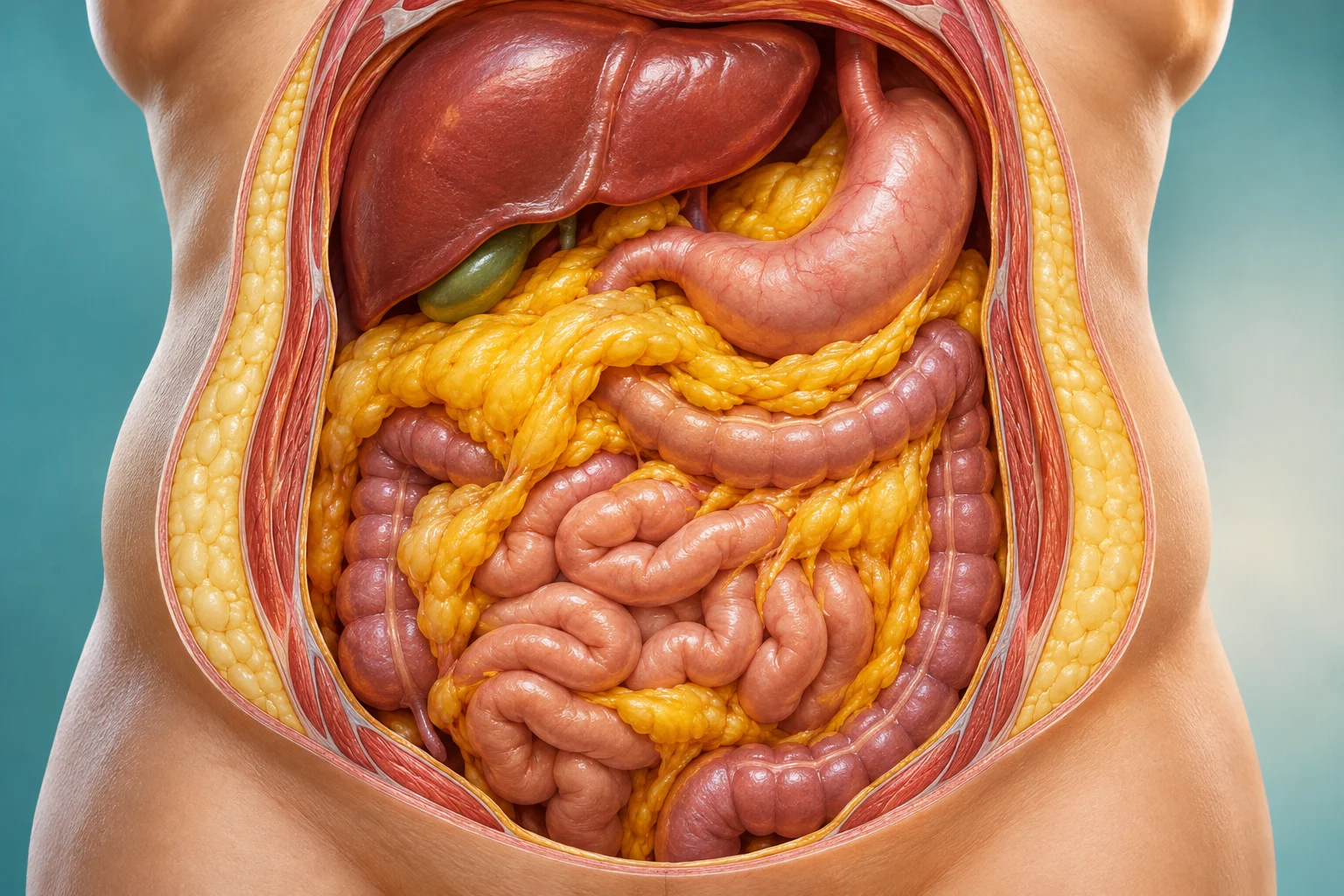
What visceral fat is and where it is stored
Visceral fat refers to one specific fat compartment, not a vague idea of “belly fat”. In research papers it is usually called visceral adipose tissue, or VAT, and it is discussed separately from subcutaneous adipose tissue, or SAT.
Around the abdominal organs
The key anatomical point is location. Visceral fat lies within the abdominal cavity and surrounds or sits next to organs rather than forming the soft layer that can be pinched at the waist. LiuLi et al. (2026) describe VAT as a group of fat depots, including omental, mesenteric and retroperitoneal fat, which helps explain why it is often discussed in relation to organ function and metabolic traffic between the gut, liver and circulation.
Because VAT sits deep in the abdomen, it is not directly visible in the same way as subcutaneous fat. Someone can have a similar body weight or even a similar waistline to another person yet differ in how much fat is stored viscerally versus under the skin. That is one reason body-mass index alone cannot fully describe metabolic risk.
How it differs from subcutaneous fat
Subcutaneous fat and visceral fat both store triglycerides, but they do not behave in the same way biologically. Reviews consistently describe visceral fat as more lipolytically active and more closely tied to inflammatory signalling than SAT (LiuLi et al., 2026; Maeyens et al., 2026). Lower-body subcutaneous fat, by contrast, is often described as a relatively safer lipid-storage reservoir.
This does not mean that visceral fat is “toxic” in every circumstance or that all subcutaneous fat is harmless. The more accurate message is that fat distribution matters. A person’s health profile depends not just on how much fat is present overall, but also on whether excess energy is being stored in relatively safer depots or in metabolically riskier visceral and ectopic depots.
Why visceral fat is linked to cardiometabolic disease
The main reason visceral fat attracts so much attention is that it is associated with metabolic and cardiovascular risk more strongly than total body weight alone. Researchers see it as part of a broader pattern of central and ectopic fat accumulation. Saad and colleagues (2022) reviewed the association between abdominal visceral adipose tissue and all-cause mortality.
Insulin resistance, lipids and inflammation
Visceral adipose tissue is increasingly described as metabolically active tissue rather than passive storage. Reviews link excess visceral fat with insulin resistance, dyslipidaemia, metabolic syndrome, type 2 diabetes and cardiovascular disease (LiuLi et al., 2026; Maeyens et al., 2026). Proposed mechanisms include greater release of free fatty acids, inflammatory mediators and adipokines, together with impaired lipid buffering elsewhere.
Large cohort studies support that general picture. In a UK Biobank analysis of 423,934 participants, He et al. (2024) found that a higher visceral adiposity index was associated with progression from a healthy state to a first cardiometabolic disease and from a first disease to cardiometabolic multimorbidity. In a separate prospective cohort of 41,756 participants, Liu et al. (2025) found that higher cumulative exposure to a metabolic score for visceral fat was associated with increased cardiovascular disease risk and all-cause mortality.
These findings are still observational, so they do not prove that visceral fat alone causes every downstream outcome. Even so, they support the broader idea that central fat patterning carries information that total body weight or BMI can miss.
Waist size and imaging measures
Researchers usually measure visceral fat directly with CT or MRI, while some studies use DXA-based estimates or validated surrogate indices. In everyday clinical settings, however, direct imaging is not routine, so waist-based measures are widely used as practical markers of central adiposity.
The 2026 obesity standards from the American Diabetes Association note that waist circumference may be used as an alternative to waist-to-height ratio when differentiating overweight from obesity. Those standards also give waist cut-offs for different population groups, showing how simple body measures are used as risk markers even though they cannot directly visualise visceral fat.
That distinction matters. A larger waist can be a useful clue that abdominal fat has accumulated, but waist circumference is still a proxy rather than a direct scan of intra-abdominal fat. In article terms, waist size helps estimate risk; it does not by itself diagnose the exact amount of visceral fat around the organs.
Why visceral fat accumulates
Visceral fat accumulation is shaped by biology and behaviour together. Modern reviews describe fat distribution as a dynamic phenotype influenced by developmental, endocrine, genetic and environmental factors.
Age, hormones and energy balance
Ageing is one of the clearest recurring themes in the literature. Lin and Sul (2026) describe age-related changes in adipose tissue, including differences in the development and maintenance of visceral and subcutaneous fat depots. Hormonal changes, impaired adipose expansion in safer depots and shifts in whole-body energy handling appear to contribute to that redistribution.
Energy surplus still matters, but the destination of stored energy matters too. When lipid storage capacity is stressed or poorly regulated, some of that burden appears to shift toward visceral and ectopic depots. This helps explain why two people with the same body weight can show different metabolic profiles.
Physical inactivity, sleep and stress
LiuLi et al. (2026) identify physical activity, sleep and stress as factors that can modify regional fat distribution. The evidence base is not equally strong for every factor in every population, but the general model is clear: fat distribution is responsive to lifestyle exposures, not fixed once adulthood is reached.
Physical inactivity is especially relevant to this article because the intervention evidence runs in the opposite direction: when people become more active, visceral fat often declines. Adherence, compensation and the broader energy balance still matter, yet the fact that exercise repeatedly affects VAT in trials suggests that inactivity is part of the accumulation story as well. For a broader overview of how public-health bodies frame movement, WHO 2010 physical activity recommendations by age group summarise how regular activity is positioned within general health guidance.
How exercise reduces visceral fat
Exercise does not “melt” abdominal fat in a single local spot, but it does shift the body toward higher energy use and altered substrate handling. In that setting, visceral fat often shrinks along with other adipose depots.
Energy expenditure and fat oxidation
At a basic physiological level, increased energy demand promotes lipolysis, releasing fatty acids from stored triglycerides. This is not unique to visceral fat, but trials show that VAT is responsive to exercise interventions. In a randomised trial involving women with abdominal obesity, Ross et al. (2004) found that visceral fat decreased across all treatment groups, including the exercise-without-weight-loss group.
In a comparable randomised trial involving men, Ross and colleagues (2000) examined diet-induced weight loss, exercise-induced weight loss and exercise without weight loss as separate conditions. Together, those trials helped establish an important point that still appears in modern discussions: exercise can reduce visceral fat even when the scale moves less than expected, and the metabolic effect of training is not perfectly captured by total body weight.
Changes that can appear without large weight loss
This is one of the most useful findings for readers. Several intervention studies show that body composition and fat distribution can improve without dramatic overall weight loss. In the trial by Ross and colleagues (2004), daily exercise without caloric restriction was associated with substantial reductions in total fat, abdominal fat, visceral fat and insulin resistance in women.
That does not mean weight change is irrelevant. Some trials show larger visceral-fat reductions when substantial total fat loss occurs, while Christiansen et al. (2009), in a 12-week randomised study, reported that exercise alone had relatively limited effects compared with the major effect of a hypocaloric diet. Still, the broader evidence shows why researchers often look beyond the scale: exercise can change where fat is stored and how the body handles energy, not just how much a person weighs.
This is also why “spot reduction” claims are misleading. Crunches or other local exercises do not selectively strip fat from one body region on demand. The studies that show VAT reductions are studying whole-body training exposure, not a local abdominal trick.
What studies show about exercise and visceral fat loss
The strongest evidence comes from systematic reviews and meta-analyses that pool randomised controlled trials. Those syntheses make it possible to compare exercise types more fairly than relying on one isolated intervention.
Aerobic training
Chen et al. (2024), in a network meta-analysis of 84 randomised controlled trials involving 4,836 participants, found that moderate-to-vigorous aerobic exercise, resistance training, combined aerobic plus resistance training and HIIT were all beneficial for reducing visceral adipose tissue. In its ranking analysis, vigorous aerobic exercise and HIIT had the highest probability of being the best interventions for improving VAT.
Deng et al. (2026), in a dose-response network meta-analysis including 78 reports and 4,930 participants, reached a similar overall conclusion. It found the largest estimated effects versus control for vigorous aerobic exercise and HIIT, and suggested that the overall exercise-dose relationship with VAT improvement was U-shaped rather than infinitely linear. Igarashi et al. (2025), in a meta-analysis of 12 studies, also found significant reductions in both visceral fat area and subcutaneous fat area, with some indication that increasing exercise intensity may favour visceral-fat reduction slightly more.
Resistance and interval training
Resistance training is not absent from the evidence. In the 84-RCT network meta-analysis, resistance training improved VAT even though it did not significantly improve body weight to the same extent as some other interventions. That makes resistance training relevant when the outcome of interest is abdominal fat distribution rather than scale change alone.
At the same time, comparative evidence does not show one universal winner in every setting. Lehmann et al. (2024), in the 24-month randomised STEN trial involving 239 participants with abdominal obesity, found no difference between strength and endurance training in visceral-fat dynamics after 12 and 24 months. That finding is a useful reminder that adherence, programme design and overall energy balance can be as important as neat labels such as “cardio” versus “weights”.
Exercise modalities at a glance
Two network meta-analyses compared exercise modalities for reducing visceral fat, with different numbers of studies and participants. Chen et al. (2024) examined 84 RCTs, while Deng et al. (2026) examined 78 reports.
Study | Studies / reports | Participants | Main finding |
Chen et al., 2024 | 84 RCTs | 4,836 | Vigorous aerobic exercise and HIIT ranked among the strongest interventions for VAT reduction. |
Deng et al., 2026 | 78 reports | 4,930 | Vigorous aerobic exercise and HIIT showed the largest estimated effects versus control. |
Readers interested in the behavioural side of sticking with exercise may also find Feeling Fit and Enjoying Exercise relevant, because adherence helps determine whether a theoretically effective exercise plan produces a real-world result. The linked article discusses exercise enjoyment and motivation rather than direct measurements of visceral fat.
What is proven about exercise and visceral fat and what is not
The evidence is now strong enough to say that exercise can reduce visceral fat. It is also fair to say that the effect is not uniform, and that strong claims still need boundaries.
First, what seems well supported: multiple systematic reviews and randomised trials show that exercise interventions reduce VAT, especially in people with overweight or obesity. Aerobic exercise, HIIT, combined training and resistance training can all contribute, and some reductions appear even when overall body-weight change is modest.
Second, what remains uncertain: no single exercise mode is guaranteed to be best for every person, and the optimal dose is still being modelled rather than established as one universal prescription. The 2026 dose-response meta-analysis suggests that clinically meaningful VAT improvement begins well below extreme training volumes, but such model-based estimates should not be mistaken for one exact threshold that fits every body.
Third, some people compensate. In an analysis of exercise-induced changes in central adiposity, Dorling et al. (2024) found that most exercisers lost less weight than predicted, while those who compensated showed less favourable changes in waist circumference and VAT than those who did not. That finding does not refute exercise; it shows that behavioural and physiological compensation can blunt the visible effect.
Finally, not every decrease in visceral fat should be interpreted as proof of a fully solved metabolic problem. VAT is important, but it is part of a larger pattern involving total adiposity, ectopic fat, muscle, diet, sleep, stress and cardiometabolic status. Exercise helps, yet it acts within that larger system. For a broader perspective on how exercise affects well-being beyond body composition, see How exercise affects self-concept and well-being in midlife.
Frequently asked questions
Is visceral fat the same as belly fat?
Not exactly. “Belly fat” is a broad everyday term that can include both subcutaneous fat under the skin and visceral fat inside the abdominal cavity. Visceral fat is the deeper compartment stored around the organs, which is why it is not identical to everything that shows up around the waist.
Can exercise reduce visceral fat without major weight loss?
Yes, at least in some studies. Randomised trials and meta-analyses show that exercise can reduce visceral fat even when overall body-weight change is modest (Ross et al., 2004; Chen et al., 2024). This is one reason researchers often assess body composition and waist-based measures rather than relying on the scale alone.
How is visceral fat measured?
The most direct research methods are imaging tests such as CT and MRI. In routine care, waist circumference and waist-to-height ratio are commonly used as practical proxies because they are simpler and cheaper, though they do not directly show intra-abdominal fat.
Does resistance training reduce visceral fat?
Yes, pooled trial evidence suggests that it can. Resistance training usually does not rank as the single strongest option in every analysis, but systematic reviews show that it can reduce visceral adipose tissue, especially when considered as part of an overall exercise programme (Chen et al., 2024; Deng et al., 2026).
Is waist circumference a good proxy for visceral fat?
It is a useful proxy, but not a direct substitute for imaging. A larger waist often signals greater central adiposity and can help estimate metabolic risk, yet two people with the same waist circumference may still differ in their exact amount of visceral fat.
Sources
- Lin F, Sul HS. Distinct precursor landscape of subcutaneous and visceral fat in development and aging. Cell Reports. 27 January 2026;45(1):116706. DOI: 10.1016/j.celrep.2025.116706.
- LiuLi A, Zhang T, Feng Z. Adipose tissue distribution in metabolic disease: depot-specific biology, clinical assessment, and therapeutic remodeling. Frontiers in Endocrinology. 24 June 2026;17:1822659. DOI: 10.3389/fendo.2026.1822659.
- Maeyens LT, Nelson JF, Zhao S. Visceral adiposity, metabolic health and aging. Nature Aging. 19 February 2026;6(3):506–519. DOI: 10.1038/s43587-026-01076-4.
- American Diabetes Association Professional Practice Committee for Obesity. Screening, Diagnosis, Evaluation, and Staging of Obesity in Adults: Standards of Care in Overweight and Obesity-2026. Diabetes, Obesity, and CardioMetabolic CARE. 2026;1(4):536–571. DOI: 10.2337/doci26-0003.
- Chen X, He H, Xie K, Zhang L, Cao C. Effects of various exercise types on visceral adipose tissue in individuals with overweight and obesity: A systematic review and network meta-analysis of 84 randomized controlled trials. Obesity Reviews. March 2024;25(3):e13666. DOI: 10.1111/obr.13666.
- Igarashi Y, Akazawa N, Maeda S. An exercise program to reduce abdominal visceral and subcutaneous fat in adults with overweight and obesity: A systematic review and meta-analysis of randomized controlled trials. Obesity Research & Clinical Practice. 2025;19(5):388–393. DOI: 10.1016/j.orcp.2025.10.004. PMID: 41109785.
- Deng Y, Wang X, Li D, et al. Optimal Dose and Modality of Exercise for Reducing Visceral Adipose Tissue in Individuals with Overweight or Obesity: A Systematic Review and Dose-Response Network Meta-Analysis. Obesity Reviews. 2026;e70253. DOI: 10.1111/obr.70253.
- Ross R, Janssen I, Dawson J, et al. Exercise-induced reduction in obesity and insulin resistance in women: a randomized controlled trial. Obesity Research. 2004;12(5):789–798. DOI 10.1038/oby.2004.95.
- Ross R, Dagnone D, Jones PJH, et al. Reduction in obesity and related comorbid conditions after diet-induced weight loss or exercise-induced weight loss in men. A randomized, controlled trial. Annals of Internal Medicine. 2000;133(2):92–103. DOI: 10.7326/0003-4819-133-2-200007180-00008.
- Christiansen T, Paulsen SK, Bruun JM, et al. Comparable reduction of the visceral adipose tissue depot after a diet-induced weight loss with or without aerobic exercise in obese subjects: a 12-week randomized intervention study. European Journal of Endocrinology. 2009;160(5):759–767. DOI: 10.1530/EJE-08-1009. PMID: 19211707.
- Lehmann S, Retschlag U, Oberbach A, et al. Visceral fat mass dynamics in a 2-year randomized STrength versus ENdurance training trial in people with obesity. Diabetes, Obesity and Metabolism. 2024;26(9):4087–4099. DOI: 10.1111/dom.15767.
- Dorling JL, Apolzan JW, Johannsen NM, et al. Exercise-induced Changes in Central Adiposity During an RCT: Effect of Exercise Dose and Associations With Compensation. The Journal of Clinical Endocrinology & Metabolism. 2024;109(3):e997–e1005. DOI: 10.1210/clinem/dgad696.
- Saad RK, Ghezzawi M, Horanieh R, Khamis AM, Saunders KH, Batsis JA, Chakhtoura M. Abdominal Visceral Adipose Tissue and All-Cause Mortality: A Systematic Review. Frontiers in Endocrinology. 22 August 2022;13:922931. DOI: 10.3389/fendo.2022.922931.
- He Q, Wang Y, Feng Z, et al. Visceral adiposity associated with incidence and development trajectory of cardiometabolic diseases: A prospective cohort study. Nutrition, Metabolism and Cardiovascular Diseases. May 2024;34(5):1235–1244. DOI: 10.1016/j.numecd.2023.12.024.
- Liu Q, Cui H, Si F, Wu Y, Yu J, et al. Association of Cumulative Exposure to Metabolic Score for Visceral Fat With the Risk of Cardiovascular Disease and All-Cause Mortality: A Prospective Cohort Study. Journal of Cachexia, Sarcopenia and Muscle. February 2025;16(1):e13702. DOI: 10.1002/jcsm.13702.

Mara Kenwick — author
Mara Kenwick is a health science writer with academic training in biomedical science and public health. She completed a BSc in Biomedical Science before an MPH focused on epidemiology, prevention and the interpretation of population-health evidence. Her early...
This article is for general information and is not medical advice. It was reviewed for accuracy by a qualified clinician; decisions about your health should be made with your own doctor.
Related

WHO 2010 Physical Activity Recommendations by Age Group

Feeling Fit and Enjoying Exercise: A 2002 Study of Women
How exercise affects self-concept and well-being in midlife
How ligaments tear in a sprained ankle and why ankles re-injure

Dehydration symptoms and how fluid loss during exercise affects the body

Piriformis syndrome and how a hip muscle irritates the sciatic nerve

How self-talk patterns relate to competitive anxiety in sport
