






Alkaline Water and Blood Lipids: What a 2009 Rat Study Tested
Evidence that alkaline water improves blood lipids in people is limited: the closest human data, a 2026 meta-analysis of 13 hydrogen-rich water trials in 757 adults, found total cholesterol only 6.71 mg/dL lower (Ye et al., 2026). Its authors judged that change too small to matter for cardiovascular risk (Ye et al., 2026). The 2009 Taiwanese study often listed as evidence tested alkaline reduced water in spontaneously hypertensive rats (Chao & Chiang, 2009). No full text or author abstract of the two-page item is openly available, so its results cannot be checked (Chao & Chiang, 2009).
Below, we explain what the 2009 study could and could not show, what alkaline reduced water is and why drinking it barely touches blood pH. We then set out what human trials, WHO and UK regulators say, and which measures guidelines recommend for cholesterol and blood pressure. We do not review alkaline diets or cancer claims. The original study is summarised in Cabdirect archive record 20093203049.

Evidence last checked 2 Jun 2026 · 9 min
What Did the 2009 Rat Study Test?
The 2009 study set out to test whether alkaline reduced water changes oxidative status in red blood cells and plasma lipids in spontaneously hypertensive rats. Chao and Chiang published it on pages 71–72 of the Taiwanese Journal of Agricultural Chemistry and Food Science (Chao & Chiang, 2009). At two pages, it is probably a short communication or meeting abstract rather than a full paper, although its type is unconfirmed (Chao & Chiang, 2009).
Beyond the title, little can be verified: the item has no DOI or PubMed record, and its dose, water pH, treatment length, number of rats, controls and direction of any effect are unknown (Chao & Chiang, 2009).
A rat strain bred for high blood pressure
Spontaneously hypertensive rats were bred in Kyoto from outbred Wistar rats, starting from a male with a blood pressure of 150–170 mmHg and a female at 130–140 mmHg (Doris, 2017). A 2017 review calls the strain a useful model of inherited, apparently polygenic high blood pressure, but judges genetic progress with it limited (Doris, 2017).
What the same laboratory did later
The same two authors appear on a 2024 paper from the Department of Food Science at National Taiwan Ocean University (Huang et al., 2024). It gave alkaline reduced water for six weeks to male Wistar rats, with and without induced diabetes, in groups of 10 (Huang et al., 2024). The water had a pH of about 10.0–10.5 and an oxidation-reduction potential of −250 to −400 mV (Huang et al., 2024).
Those authors suggest the water enhanced glucose and lipid metabolism and antioxidant activity in their rats (Huang et al., 2024). That was a different strain, design and decade, so none of its figures can be carried over to the 2009 item.
What Is Alkaline Reduced Water?
Alkaline reduced water, also called electrolysed reduced water, is drinking water made alkaline by electrolysis; in Japan it is known as alkaline ionised water (LeBaron et al., 2022; Hotta & Saihara, 2017). Its properties vary widely. According to a 2022 review, its pH runs from slightly alkaline to 11.5 and its oxidation-reduction potential from −300 mV to below −800 mV (LeBaron et al., 2022). Its dissolved hydrogen ranges from under 0.1 to about 1.6 mg/L (LeBaron et al., 2022).
A strongly negative potential says little about hydrogen content: the reading is dominated by pH, so water at pH 10.5 can show −580 to −730 mV with less than 0.1 mg/L of hydrogen (LeBaron et al., 2022).
How Japan approved home ionisers
Japan approved alkaline ionised water in 1965 for digestive complaints such as indigestion, excess stomach acid and chronic diarrhoea, and licensed home ionisers in 1966 (Hotta & Saihara, 2017). A 2017 review from a foundation that works with the ioniser industry council gives the drinking specification as pH 9–10 and states that water above pH 10 is not for drinking (Hotta & Saihara, 2017). None of the approved uses concerns blood lipids (Hotta & Saihara, 2017).
The water in the laboratory’s 2024 rat study, at pH 10.0–10.5, therefore sat at or above that drinking limit (Huang et al., 2024; Hotta & Saihara, 2017). LeBaron and colleagues set the bar lower still and say this water should not exceed pH 9.8 (LeBaron et al., 2022).
Can Drinking Alkaline Water Change Your Blood pH?
No: in healthy people blood pH stays at about 7.35–7.45, and drinking alkaline water does not shift it in any clinically meaningful way (Alebrahim et al., 2026). The kidneys excrete surplus acid, so a rise in urine pH does not mean the blood has become more alkaline (Fenton & Huang, 2016). Urine pH is simply not a measure of the body’s overall acid-base balance (Fenton & Huang, 2016).
A 2016 systematic review of dietary acid load, alkaline water and cancer screened 8,278 citations, included one study and found no randomised trials (Fenton & Huang, 2016). Its authors wrote that almost no research either supports or disproves these ideas (Fenton & Huang, 2016).
What WHO says about pH in drinking water
WHO sets no health-based guideline value for the pH of drinking water (World Health Organization, 2007; World Health Organization, 2022). Its current guidelines treat pH as one of the most important operational measures of water quality, usually best kept at 6.5–8.5, and note that it usually has no direct impact on consumers (World Health Organization, 2022). That range guides water treatment and pipe corrosion control, not health.
WHO’s background review judged a direct link between drinking-water pH and human health impossible to establish, and saw any effect as indirect, through metals dissolving from pipes or poorer disinfection (World Health Organization, 2007).
What Do Human Trials Show for Cholesterol?
Human trials show at most small changes in blood lipids, too small to matter for heart health (Alebrahim et al., 2026; Ye et al., 2026). The largest pooled analysis, published in 2026, combined 13 randomised trials of hydrogen-rich water in 757 adults with overweight or obesity, with searches up to November 2025 (Ye et al., 2026). Participants had a mean body mass index of 25 or more (Ye et al., 2026). Total cholesterol fell by 6.71 mg/dL and LDL cholesterol by 3.21 mg/dL, while HDL cholesterol fell slightly and triglycerides showed no significant change (Ye et al., 2026).
The LDL result was borderline, and the authors advised against routine use of hydrogen-rich water to lower lipids outside research (Ye et al., 2026). A fall of 6.71 mg/dL in total cholesterol is about 0.17 mmol/L.
Trials of electrolysed water
Only a few trials have used electrolysed hydrogen water from ionisers, and two are among the 13 pooled above (Ye et al., 2026). The larger, a three-month trial in 181 people with metabolic or pre-metabolic syndrome run jointly with the device maker Nihon Trim, found no significant difference in its main comparison (Moribe et al., 2024).
A 2026 narrative review reached a similar verdict for alkaline water as a whole. It found the evidence for metabolic, antioxidant and immune benefits inconsistent and drawn largely from small or preclinical studies (Alebrahim et al., 2026). Its authors concluded that alkaline water should not be routinely recommended in primary care (Alebrahim et al., 2026).
Table 1. Studies of alkaline, electrolysed or hydrogen-rich water and blood lipids or metabolism
Study | Design and subjects | Main lipid or metabolic result |
Ye et al. 2026 (Ye et al., 2026) | Meta-analysis of 13 RCTs of hydrogen-rich water; 757 adults with overweight or obesity | Total cholesterol −6.71 mg/dL; LDL −3.21 mg/dL (borderline); HDL −1.16 mg/dL; triglycerides no significant change |
Moribe et al. 2024 (Moribe et al., 2024) | 3-month RCT of electrolysed hydrogen water; 181 people with metabolic or pre-metabolic syndrome | No significant difference in the main comparison; smaller waist only in a high-activity subgroup |
Alebrahim et al. 2026 (Alebrahim et al., 2026) | Narrative review of alkaline water | Metabolic and antioxidant evidence inconsistent, mostly small or preclinical |
Chao & Chiang 2009 (Chao & Chiang, 2009) | Spontaneously hypertensive rats; dose and design unknown | Not openly available |
Huang et al. 2024 (Huang et al., 2024) | Male Wistar rats, 10 per group, 6 weeks, water at pH 10.0–10.5 | Authors report better glucose and lipid metabolism in rats |
Is Alkaline Water Safe, and What Can Sellers Claim?
Few harms have been documented in people drinking alkaline water at the usual pH, and the most discussed risk is high potassium in people with weak kidneys (LeBaron et al., 2022; Hotta & Saihara, 2017). LeBaron and colleagues report that some people develop dangerous hyperkalaemia when this water exceeds pH 9.8 (LeBaron et al., 2022). They advise people with impaired kidney function to avoid it without medical supervision (LeBaron et al., 2022). The references they give for human cases, however, are an electrochemistry paper and a 1996 symposium abstract, so that evidence is thin (LeBaron et al., 2022).
In a Japanese double-blind trial of 163 cases, potassium rose in one person drinking alkaline water and two on placebo, all back in the normal range on retesting (Hotta & Saihara, 2017). The 2026 review urges caution in chronic kidney disease, with acid-suppressing drugs, in pregnancy and in children (Alebrahim et al., 2026).
What sellers may claim
Great Britain’s retained list of authorised health claims allows water just two, both about hydration: that it helps maintain normal physical and cognitive functions and normal thermoregulation (Commission Regulation (EU) No 432/2012, 2012). Each requires telling consumers to drink at least 2 litres a day from all sources (Commission Regulation (EU) No 432/2012, 2012). The list has no entry for alkaline, ionised or hydrogen water (Commission Regulation (EU) No 432/2012, 2012).
The UK Advertising Standards Authority also demands strong evidence for health claims. In 2022 it upheld a complaint about an alkaline filter pack advertised as helping acid reflux, rejecting a laboratory study, an unblinded study of 184 patients and customer reviews as support (Advertising Standards Authority, 2022).
How Strong Is the Evidence?
The evidence that alkaline water improves blood lipids or oxidative status in people is weak. The 2009 study was done in rats bred for high blood pressure, runs to two pages and has no open results (Chao & Chiang, 2009; Doris, 2017). The human trials pooled or reviewed here test hydrogen-rich or electrolysed water, find small or null effects and are sometimes run with device makers (Ye et al., 2026; Moribe et al., 2024). For these reasons the evidence on the article’s central question, whether alkaline water improves blood lipids in people, is rated limited.
The sources also differ in independence. The first author of the review behind the pH 9.8 advice is affiliated with the Molecular Hydrogen Institute, and the Japanese safety data come from a committee commissioned by the ioniser industry council (LeBaron et al., 2022; Hotta & Saihara, 2017). The 2026 narrative review declared no commercial relationships (Alebrahim et al., 2026).
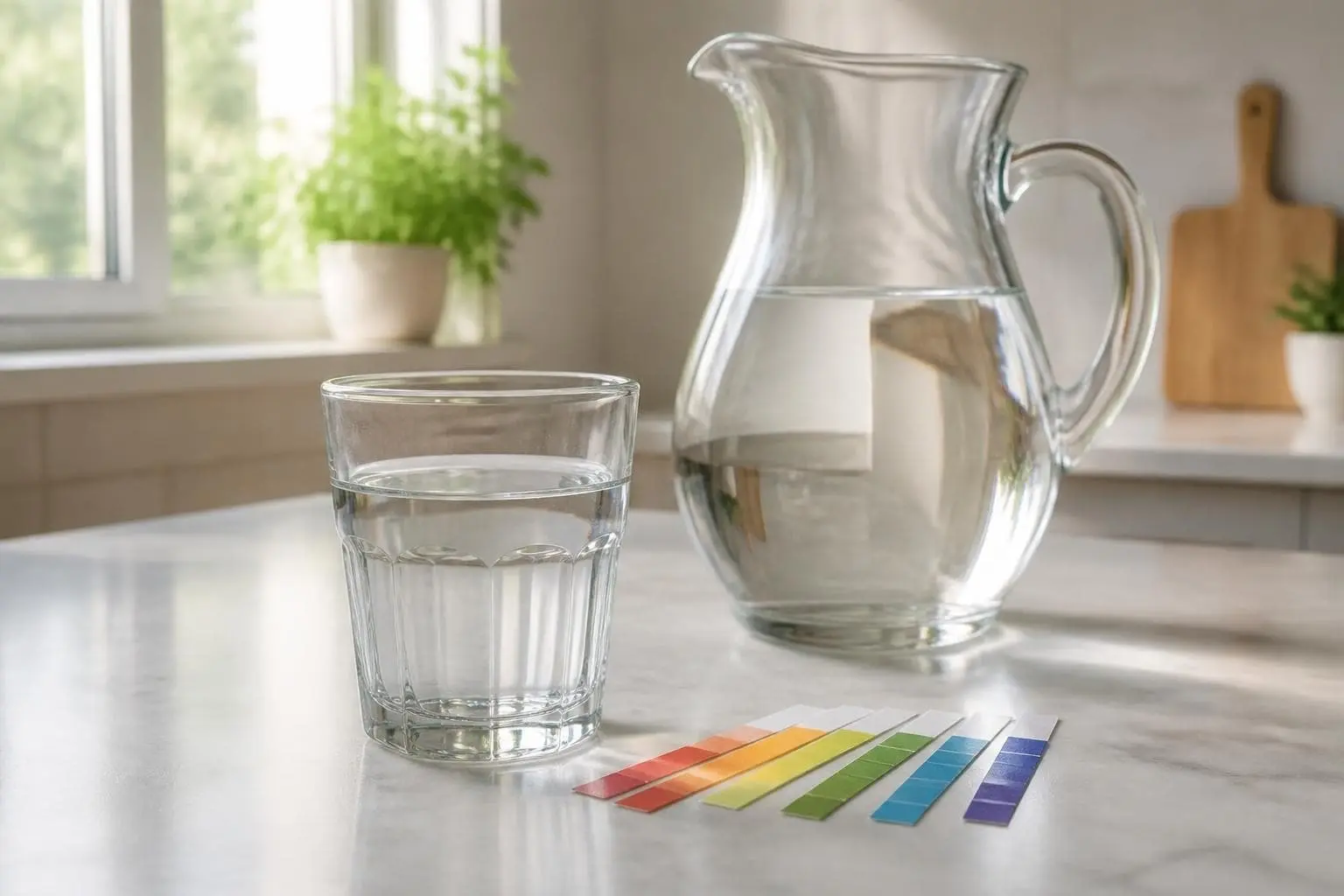
A strip of paper can show that water is alkaline. It cannot show that the water does the body any good.
Measures with evidence behind them
Guidelines for raised blood pressure and cholesterol rely on diet, lifestyle and medicines where needed, not special waters (National Institute for Health and Care Excellence, 2019; National Institute for Health and Care Excellence, 2023). NICE’s hypertension guideline covers diet, exercise, alcohol, caffeine, low sodium intake and stopping smoking, and advises against calcium, magnesium or potassium supplements to lower blood pressure (National Institute for Health and Care Excellence, 2019).
For people at high risk of cardiovascular disease, NICE advises total fat at 30% or less of energy and saturated fat at 7% or less, with physical activity, limits on alcohol and stopping smoking (National Institute for Health and Care Excellence, 2023). Neither guideline mentions alkaline water (National Institute for Health and Care Excellence, 2019; National Institute for Health and Care Excellence, 2023).
Frequently asked questions
Does alkaline water lower cholesterol?
Not by an amount that matters, on current evidence. Pooled trials of hydrogen-rich water, two of them using ionised (electrolysed) water, in 757 adults with overweight or obesity showed total cholesterol about 0.17 mmol/L lower. The authors judged this below meaningful thresholds for heart risk and advised against routine lipid-lowering use outside research (Ye et al., 2026).
Can alkaline water make your blood less acidic?
No. Healthy blood stays at a pH of about 7.35–7.45 whatever you drink, and alkaline water does not move it in a clinically meaningful way (Alebrahim et al., 2026). The kidneys remove surplus acid, which is why a change in urine pH says nothing reliable about the pH of the blood itself (Fenton & Huang, 2016).
What did the 2009 study of alkaline water in rats find?
Its results cannot be checked. The two-page item by Y. C. Chao and M. T. Chiang tested alkaline reduced water in spontaneously hypertensive rats, measuring red-cell oxidative status and plasma lipids. Without an open text, its dose, design and results are unknown, and rat results would not show an effect in people (Chao & Chiang, 2009).
Is it safe to drink water above pH 10?
It is not advised. A Japanese specification for drinking alkaline ionised water sets pH 9–10 and says water above pH 10 is not for drinking (Hotta & Saihara, 2017). Reviewers linked to the hydrogen-water field suggest staying at or below pH 9.8, and people with kidney disease face potassium concerns (LeBaron et al., 2022; Alebrahim et al., 2026).
Does WHO recommend a pH for drinking water?
WHO gives no health-based value for pH. Its guidelines treat pH as an operational measure for water supplies, usually best kept between 6.5 and 8.5 (World Health Organization, 2022). They note that pH usually has no direct effect on the people who drink the water, so the range serves water treatment rather than health (World Health Organization, 2022).
Sources
- Chao, Y. C., & Chiang, M. T. (2009). Effect of alkaline reduced water on erythrocyte oxidative status and plasma lipids of spontaneously hypertensive rats. Taiwanese Journal of Agricultural Chemistry and Food Science, 47(2), 71–72. – Cabdirect archive record 20093203049
- Doris, P. A. (2017). Genetics of hypertension: an assessment of progress in the spontaneously hypertensive rat. Physiological Genomics, 49(11), 601–617.
- Huang, C.-H., Chao, Y.-C., & Chiang, M.-T. (2024). Influence of Alkaline Reduced Water Supplementation on Glucose and Lipid Metabolism in Non-Diabetic and Diabetic Rats. Nutrients, 16(23), 4082.
- LeBaron, T. W., Sharpe, R., & Ohno, K. (2022). Electrolyzed-Reduced Water: Review II: Safety Concerns and Effectiveness as a Source of Hydrogen Water. International Journal of Molecular Sciences, 23(23), 14508.
- Hotta, K., & Saihara, Y. (2017). アルカリイオン水(飲用アルカリ性電解水)の基礎知識 -科学的検証と社会的基盤および展望- [Basic knowledge of alkaline ionised water (drinking alkaline electrolysed water): scientific verification, social basis and outlook]. 機能水研究 (Functional Water Research), 12(2), 35–44.
- Fenton, T. R., & Huang, T. (2016). Systematic review of the association between dietary acid load, alkaline water and cancer. BMJ Open, 6(6), e010438.
- World Health Organization. (2007). pH in Drinking-water: Revised background document for development of WHO Guidelines for Drinking-water Quality (WHO/SDE/WSH/07.01/1).
- World Health Organization. (2022). Guidelines for drinking-water quality: fourth edition incorporating the first and second addenda.
- Alebrahim, H., Alsaei, A., Sefen, P., Hasan, M., Ramadhan, A., & Deen, G. R. (2026). The health benefits of alkaline water: is it a fact or marketing myth? Frontiers in Medicine, 13, 1849818.
- Ye, H., Fang, J., Safargar, M., Fareed, H., Prabahar, K., & Jin, P. (2026). The effect of hydrogen-rich water interventions on lipid profiles in adults with overweight or obesity and associated metabolic disorders: a systematic review and meta-analysis of randomized controlled trials. Diabetology & Metabolic Syndrome, 18, 114.
- Moribe, R., et al. (2024). Health Effects of Electrolyzed Hydrogen Water for the Metabolic Syndrome and Pre-Metabolic Syndrome: A 3-Month Randomized Controlled Trial and Subsequent Analyses. Antioxidants, 13(2), 145.
- Advertising Standards Authority. (2022). ASA Ruling on Phox Water Ltd (A22-1157562).
- Commission Regulation (EU) No 432/2012. (2012). Annex: list of permitted health claims, as retained in the law of Great Britain. legislation.gov.uk.
- National Institute for Health and Care Excellence. (2019, updated 2026). Hypertension in adults: diagnosis and management (NG136).
- National Institute for Health and Care Excellence. (2023). Cardiovascular disease: risk assessment and reduction, including lipid modification (NG238).

Sophie Bennett — author
Sophie writes the health and nutrition explainers. Her editorial focus includes nutrients, dietary patterns, energy metabolism, hydration, supplements, sports nutrition and the interpretation of health research for general readers. She approaches health conten...
This article is for general information and is not medical advice. It was reviewed for accuracy by a qualified clinician; decisions about your health should be made with your own doctor.
Related

Can Pistachios Help With Diabetes? What a 2009 Rat Study Found

Mainly fruit diet study: biochemical effects in 1971

Does Glycogen Hold 3 g of Water? What the 1941 Rat Study Found

Sport Nutrition: Energy, Fuel and Athletic Performance

Vitamin C in Peas: Effects of Shipping, Freezing and Canning

How Sensory-Specific Satiation Shapes Appetite and Food Intake
