What potassium does for the body, from heartbeat to blood pressure
Potassium helps the body transmit nerve impulses, contract muscles and maintain the electrical conditions on which a normal heartbeat depends. It also contributes to fluid regulation and kidney function (NIH ODS, 2022). Blood pressure studies support a benefit from higher potassium intake in people with hypertension, although the response depends on the population and intervention (Aburto et al., 2013).
Potassium's relationship with sodium connects physiology to clinical research. Evidence from controlled trials, reviews and an official nutrient assessment distinguishes effects on measured blood pressure from the outcomes of replacing ordinary salt. The same evidence provides the context for food sources, blood tests and the consequences of abnormal potassium levels.

Evidence last checked 19 Nov 2026 · 12 min
What potassium does for the body and why it is essential
Potassium exists in tissues as a positively charged ion, or cation. Its distribution across the cell membrane allows cells to maintain internal fluid volume and an electrical difference between their interior and surroundings (NIH ODS, 2022). These properties underpin processes in excitable tissues, including nerves and muscle, and they require active regulation rather than a constant supply of potassium entering the bloodstream.
Potassium as an electrolyte
Electrolytes carry charge in solution. Potassium is the principal cation inside cells; sodium is more closely associated with the fluid outside them (NIH ODS, 2022). This arrangement creates the conditions for movement of charged particles across cell membranes. The difference is maintained by a transporter known as sodium-potassium ATPase (NIH ODS, 2022).
The NIH Office of Dietary Supplements (2022) reports that intracellular potassium concentration is about 30 times extracellular concentration. This gradient is regulated. Blood concentrations are separately regulated (NIH ODS, 2022).
Fluid balance inside and outside cells
Potassium helps regulate the amount of fluid inside cells, whereas sodium is the main regulator of extracellular fluid, including blood plasma (NIH ODS, 2022). The two ions therefore influence different sides of a biological membrane. Changes in either compartment can affect the conditions under which nerve and muscle cells function, while the kidneys continually adjust the amount of potassium eliminated.
Potassium arrives through food and is eliminated mainly through urine, with healthy kidneys adapting the amount they excrete as intake changes and as the body maintains concentrations inside and outside cells (NIH ODS, 2022). Kidney impairment changes that relationship, which helps explain why the safety of greater potassium exposure cannot be judged solely from the amount eaten.
How potassium supports heartbeat, nerves and muscle contraction
Electrical signalling requires ion gradients. The NIH nutrient assessment connects the potassium gradient directly with nerve transmission, muscle contraction and kidney function (NIH ODS, 2022). These functions depend on the distribution of potassium, so a blood concentration outside the normal range has consequences beyond nutrition.
Electrical signals and muscle contraction
Nerve and muscle membranes function within a regulated electrochemical gradient. The sodium-potassium transporter maintains a large difference between intracellular and extracellular potassium (NIH ODS, 2022). This difference makes controlled electrical changes possible when cells are activated. Muscle contraction depends on those changes, which helps explain why abnormal potassium balance can be accompanied by weakness or impaired movement.
Clinical reports of low potassium include fatigue and muscle weakness. In severe cases, the same condition can be associated with paralysis or impaired respiration (NIH ODS, 2022). The symptoms do not measure a person's dietary potassium intake directly. They concern potassium in the blood and the conditions that change it, including losses through the kidneys or gastrointestinal tract (Kim et al., 2023).
Cardiac rhythm and kidney regulation
The heart is a muscle whose rhythm depends on electrical activity. Disturbances of potassium balance can be associated with cardiac arrhythmias, and the NIH describes severe abnormalities as potentially life-threatening (NIH ODS, 2022). This makes the regulated blood concentration different from the total amount stored in tissues. A normal electrical environment depends on the kidney's ability to handle potassium and on shifts between cells and plasma.
Potassium leaves through urine (NIH ODS, 2022). Medicines that change renal potassium handling can push blood concentrations in opposite directions. The clinical distinction concerns urinary losses and retention (Kim et al., 2023; NIH ODS, 2022).
How potassium affects blood pressure and sodium balance
Potassium has been studied for its ability to influence blood pressure through several pathways. The NIH identifies increased sodium excretion in urine and widening of blood vessels as possible contributors, with a reduction in plasma volume also involved (NIH ODS, 2022). The blood pressure response also depends on sodium exposure (Filippini et al., 2020).
Sodium excretion and blood vessels
Kidneys handle both ions. Increasing potassium intake may stimulate urinary sodium loss, which can alter circulating fluid volume (NIH ODS, 2022). Blood vessels can also dilate. The magnitude varies across groups studied by Granal and colleagues (2025).
Dietary effects cannot be isolated. Stone and colleagues (2016) describe how the DASH dietary pattern changes several nutritional factors at once. Dietary comparisons may therefore show a favourable blood pressure response without demonstrating the contribution of one mineral. Filippini and colleagues (2020) assessed changes in blood pressure in potassium supplementation trials.
Salt sensitivity and dietary sodium
Filippini and colleagues (2020) found stronger blood pressure responses to potassium supplementation in participants with hypertension and in those consuming more sodium. These are study-level observations about the populations included. They help explain why average results from different trials can vary even when both studies manipulate potassium intake.
Salt substitutes introduce another complication. They commonly replace a portion of sodium chloride with potassium chloride, so the intervention changes two exposures together. Granal and colleagues (2025) explicitly distinguish the trials of potassium alone from those combining sodium reduction with potassium enrichment. A lower stroke rate after salt replacement cannot therefore reveal which of those changes contributed most to the outcome.
What studies show about potassium, blood pressure and stroke
Trials measure changes in blood pressure. Stroke studies instead count events occurring during follow-up, and their conclusions depend on the precise intervention being tested. Potassium-only trials and salt-replacement trials answer different questions (Granal et al., 2025; Neal et al., 2021). Observational stroke associations were also examined by Aburto et al. (2013).
Blood pressure trials and systematic reviews
Aburto and colleagues (2013) combined evidence from 22 randomised trials involving 1,606 participants and 11 cohort studies involving 127,038 adults. In the randomised evidence, greater potassium intake was associated with reductions of 3.49 mm Hg in systolic and 1.96 mm Hg in diastolic blood pressure, with a detectable benefit among people with hypertension rather than those without it. The cohort component considered clinical events, so its stroke results should not be mistaken for a randomised prevention trial.
In the later synthesis by Granal and colleagues (2025), the authors selected 10 randomised trials that used urinary potassium excretion to assess change in exposure. Four concerned participants without hypertension and six concerned those with hypertension. Their model estimated systolic reductions of 5.3 mm Hg in the hypertensive group and 0.5 mm Hg in the group without hypertension for an increase of 50 mmol/day in urinary potassium excretion. That is a modelled relationship within the trials, not an individual prediction.
Filippini and colleagues (2020) found that baseline sodium intake and existing hypertension altered the observed blood pressure response, with larger reductions recorded in participants who had hypertension or consumed more sodium. Differences between trial populations are therefore relevant when interpreting a pooled effect. Granal and colleagues (2025) acknowledged that the small collection of trials restricted their analysis.
Salt Substitute and Stroke Study
Neal and colleagues (2021) conducted an open-label, cluster-randomised trial in rural Chinese villages. Sodium chloride was partly replaced. The outcome was stroke occurrence, a clinical event rather than a change on a blood pressure monitor. The combined intervention prevents attribution to potassium alone (Granal et al., 2025).
Stroke occurred at 29.14 events per 1,000 person-years in the salt-substitute group, against 33.65 events per 1,000 person-years with regular salt (Neal et al., 2021). The trial's rate ratio was 0.86, with a reported 95% confidence interval of 0.77 to 0.96. The comparison concerns salt replacement, which also reduces sodium (Granal et al., 2025).
Shimamura and colleagues (2022) placed the trial within earlier evidence on sodium reduction, which had already shown lower blood pressure following reduced sodium exposure in randomised comparisons. The distinction is material because sodium reduction had independently been investigated for effects on blood pressure, whereas the salt substitute modified both ions. The clinical outcome remains a result of the combined salt intervention (Neal et al., 2021).
Selected clinical findings
Research | Population and comparison | Outcome | Interpretation |
Aburto et al., 2013 | 22 randomised trials, 1,606 participants | Systolic blood pressure lower by 3.49 mm Hg | Reduction found in participants with hypertension. |
Granal et al., 2025 | 10 randomised trials | Modelled systolic change of 5.3 mm Hg in hypertensive participants | Depended on a specified difference in urinary potassium excretion. |
Neal et al., 2021 | Rural Chinese cluster trial, salt replacement versus regular salt | Stroke: 29.14 versus 33.65 events per 1,000 person-years | Combined sodium reduction and potassium enrichment. |
Lai et al., 2026 | 34 randomised trials, 37,063 participants | Cardiovascular and blood pressure outcomes | Mortality evidence relied heavily on the largest Chinese trial. |
The 2026 analysis covered many trials: Lai and colleagues included 34 randomised comparisons with 37,063 participants across 15 countries, allowing an examination of several blood pressure and cardiovascular outcomes. The largest Chinese trial dominated mortality estimates (Lai et al., 2026). Removing that trial eliminated the statistical significance of the pooled all-cause mortality finding. This restricts the confidence with which the mortality result can be extended to other countries or food settings.
Which foods contain potassium and how dietary intake is assessed
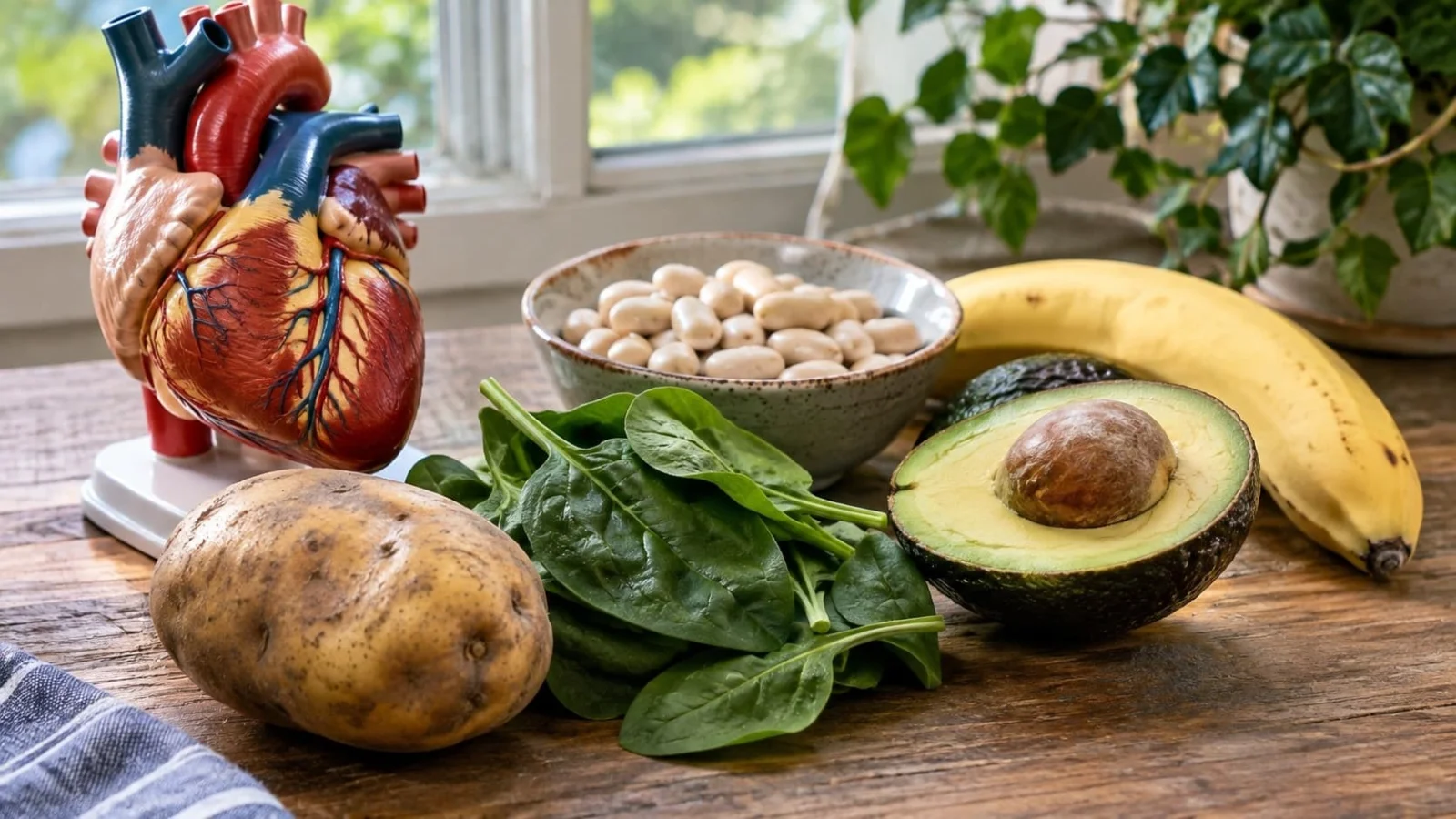
Potassium occurs in many ordinary foods rather than in a single characteristic food group. The NIH lists legumes, potatoes, fruit and vegetables alongside fish, meat, milk and nuts (NIH ODS, 2022). The quantity in a meal depends on its ingredients and serving size, while population surveys estimate reported dietary consumption and clinical blood tests measure the regulated concentration of potassium circulating in plasma rather than the total amount eaten (NIH ODS, 2022).
Food sources beyond bananas
A medium baked potato, flesh only, contains 610 mg of potassium in the NIH comparison table; a medium banana contains 422 mg (NIH ODS, 2022). These figures describe different specified servings and do not establish that every potato preparation contains more potassium than every banana. Lentils, beans, dried fruit and vegetables also appear among the assessed sources.
Potassium from food is part of a broader dietary pattern. Research on a mainly fruit diet separately examined blood biomarkers in a small dietary experiment. Stone and colleagues (2016) found that evidence for blood pressure reduction after potassium supplementation was clearer than the independent effect of increasing potassium from foods. Changes to food composition frequently change other nutrients and sodium intake at the same time.
The distinction resembles the interpretation of a small human study of garlic honey tea and blood pressure, where the intervention has to be distinguished from the effects attributed to individual components. Different nutritional exposures were measured in these two research settings.
Dietary intake versus blood potassium
In US adults, average daily potassium intake from food was 3,016 mg for men and 2,320 mg for women in the survey figures reported by NIH ODS (2022). These are dietary intake estimates, rather than measurements of potassium concentration in plasma. Blood concentrations are regulated within a narrow range by kidney excretion and redistribution between tissue compartments.
Research also uses urinary excretion to estimate intake. Granal and colleagues (2025) required trials to quantify changes using urine collected across 24 hours. The authors described urinary potassium as an imperfect indicator because it does not capture every route of elimination. Dietary estimates and serum measurements represent different quantities (NIH ODS, 2022; Granal et al., 2025).
What happens when potassium levels are too low or too high
The amount of potassium circulating in the blood is regulated separately from dietary intake. According to NIH ODS (2022), the normal serum concentration is approximately 3.6 to 5.0 mmol/L, with hypokalaemia and hyperkalaemia representing opposite departures from that range under conditions involving excretion or transcellular movement. Kim and colleagues (2023) describe gastrointestinal and kidney losses among the possible causes.
Hypokalaemia and symptoms
Hypokalaemia is the term for a low blood potassium concentration. The NIH lists fatigue, constipation and muscle weakness among manifestations of mild cases, with more severe disturbances associated with paralysis and cardiac arrhythmias (NIH ODS, 2022). These findings relate to blood chemistry rather than to a single low-potassium meal. The severity of symptoms varies with the underlying disturbance and clinical context.
Kim and colleagues (2023) describe potassium loss through the kidneys or digestive tract, insufficient intake and movement of potassium into cells as different pathways to hypokalaemia. A diuretic-related loss therefore differs from a redistribution of potassium between tissues. The possibility of changing both the total amount and its location explains why interpreting a low blood measurement requires more than identifying dietary sources.
Hyperkalaemia, kidneys and medicines
Hyperkalaemia denotes excess potassium in the blood. Severe cases may produce muscle weakness, palpitations or dangerous disturbances in cardiac rhythm, although some individuals have no obvious symptoms (NIH ODS, 2022). The kidney's capacity to remove potassium is central to this risk. Blood potassium can rise when excretion is impaired, even when intake is not exceptionally high.
Chronic kidney disease and certain medicines, including potassium-sparing diuretics and ACE inhibitors, can reduce potassium excretion (NIH ODS, 2022). This changes the safety interpretation of potassium-enriched salt or supplements. In people with normal kidney function, NIH found no evidence that usual high dietary potassium intake alone causes hyperkalaemia (NIH ODS, 2022). The risk assessment therefore depends on physiological handling, not on a universal label attached to potassium-rich foods.
What is proven about potassium benefits and what is not
Potassium supports the electrical and fluid conditions required for normal nerve, muscle and kidney function (NIH ODS, 2022). Randomised evidence also supports reductions in blood pressure from increased potassium exposure among adults with hypertension, although responses vary with sodium intake and baseline pressure (Aburto et al., 2013; Filippini et al., 2020).
Potassium is required for normal electrical signalling, while the measured blood pressure response to greater intake depends on hypertension status and the intervention studied.
Neal and colleagues (2021) compared a salt substitute with regular salt. The intervention altered both ions (Granal et al., 2025). A reduction in strokes in that trial cannot isolate potassium's contribution. The 2026 network review found that mortality evidence remained concentrated in one Chinese trial (Lai et al., 2026).
Several limits are visible across the studies. Granal and colleagues (2025) identified a restricted number of eligible randomised comparisons for modelling potassium's relationship with blood pressure. Aburto and colleagues (2013) found an observational association with incident stroke but no statistically significant association with coronary heart disease. Such results do not demonstrate a consistent preventive effect across cardiovascular outcomes.
Normal potassium physiology also depends on the kidneys. Dietary potassium was not found to cause hyperkalaemia in healthy adults with normal kidney function in the NIH assessment, whereas impaired excretion changes the risk (NIH ODS, 2022). A complete account of potassium benefits therefore needs both the pressure-related evidence and the consequences of blood concentrations outside their regulated range.
Frequently asked questions
Is potassium the same as an electrolyte?
Potassium is a charged electrolyte. It is concentrated inside cells and contributes to the difference in electrical conditions across cell membranes. That gradient supports nerve impulses and muscle contraction. Sodium is another electrolyte, but its distribution is different (NIH ODS, 2022).
Can potassium affect an irregular heartbeat?
Yes. Abnormal blood potassium concentrations can interfere with cardiac electrical activity, and severe disturbances may be associated with dangerous arrhythmias. The NIH describes rhythm problems in both severe potassium deficiency and excess. An irregular heartbeat has many possible causes, so potassium intake alone cannot explain an individual's rhythm disturbance (NIH ODS, 2022).
Does a banana contain more potassium than a potato?
Not in the serving comparison provided by the NIH. Its table lists 610 mg for the flesh of a medium baked potato and 422 mg for a medium banana (NIH ODS, 2022). These values apply to the stated foods and portions. Cooking method, size and the part consumed affect other comparisons.
Can blood potassium be normal when dietary intake is low?
Yes. Healthy kidneys adjust how much potassium leaves the body, and most potassium is located within cells rather than circulating in blood (NIH ODS, 2022). A normal serum value therefore measures a regulated concentration, not total dietary intake. Research may use food surveys or urinary excretion to assess consumption (Granal et al., 2025).
Does more potassium always mean lower blood pressure?
No. Controlled trials have found stronger reductions in participants who already have hypertension, while effects in people without hypertension have been smaller or uncertain (Aburto et al., 2013; Granal et al., 2025). Salt replacement changes sodium and potassium together, and impaired kidney function changes the safety context (NIH ODS, 2022).
Sources
- National Institutes of Health, Office of Dietary Supplements. Potassium: Fact Sheet for Health Professionals. 2 June 2022 https://ods.od.nih.gov/factsheets/Potassium-HealthProfessional/
- Aburto NJ, Hanson S, Gutierrez H, et al. Effect of increased potassium intake on cardiovascular risk factors and disease: systematic review and meta-analyses. BMJ. 2013;346:f1378. DOI 10.1136/bmj.f1378.
- Neal B, Wu Y, Feng X, et al. Effect of Salt Substitution on Cardiovascular Events and Death. New England Journal of Medicine. 2021;385(12):1067–1077. DOI 10.1056/NEJMoa2105675.
- Granal M, Sourd V, et al. Effect of changes in potassium intake on blood pressure: a dose-response meta-analysis of randomized clinical trials (2000–2024). Clinical Kidney Journal. 2025;18(7):sfaf173. DOI 10.1093/ckj/sfaf173.
- Kim MJ, Valerio C, Knobloch GK. Potassium Disorders: Hypokalemia and Hyperkalemia. American Family Physician. 2023;107(1):59–70.
- Filippini T, Naska A, Kasdagli MI, et al. Potassium Intake and Blood Pressure: A Dose-Response Meta-Analysis of Randomized Controlled Trials. Journal of the American Heart Association. 2020;9(12):e015719. DOI 10.1161/JAHA.119.015719.
- Stone MS, Martyn L, Weaver CM. Potassium Intake, Bioavailability, Hypertension, and Glucose Control. Nutrients. 2016;8(7):444. DOI 10.3390/nu8070444.
- Shimamura Y, Turk M, Qader MA, et al. Potassium-Enriched Salt to Lower Stroke Risk: A #NephJC Editorial on the SSaSS Study. Kidney Medicine. 2022;4(7):100489. DOI 10.1016/j.xkme.2022.100489.
- Lai H, Nesrallah G, Guyatt GH, et al. Comparative effects of salt substitutes on blood pressure, cardiovascular events and mortality: a systematic review and network meta-analysis. BMC Medicine. 2026;24:106. DOI 10.1186/s12916-026-04635-z.

Daniel K. Reynolds — author
Daniel K. Reynolds is an independent nutrition writer with academic training in nutritional sciences and food science. His background combines nutrition research literacy with food-composition analysis and public-facing science communication. He focuses on how...
This article is for general information and is not medical advice. It was reviewed for accuracy by a qualified clinician; decisions about your health should be made with your own doctor.
Related

Mainly fruit diet study: biochemical effects in 1971
Dietary Fat and Serum Cholesterol: Hegsted Study Findings

Garlic Honey Tea and Blood Pressure: What the Study Found
Vitamin B12 deficiency and the signs you should know

Vitamin K deficiency and why newborns get a vitamin K shot at birth

What research shows about whether creatine is bad for your kidneys

Magnesium for anxiety and what the clinical trials actually found