Dietary Iron and Hair Growth - Cunningham’s 1932 Rat Study
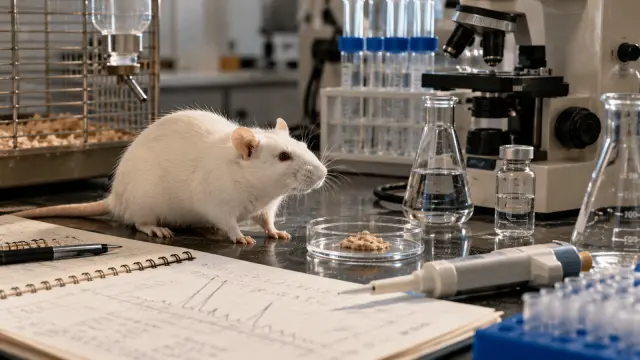
I. J. Cunningham’s 1932 study examined whether dietary iron influenced hair growth in young rats. Rats given an iron-deficient ration after weaning developed severe hair loss, while a small daily amount of limonite, a hydrated iron oxide, prevented the condition or supported hair regrowth.
The experiment was conducted in the context of New Zealand agricultural research, where mineral deficiencies in grazing livestock were an important practical concern. Cunningham proposed that the rat findings justified investigating whether iron availability could also affect wool production in sheep grazing iron-deficient pastures, but the published abstract does not report a sheep wool-growth experiment.
How Did Dietary Iron Affect Hair Growth in Young Rats
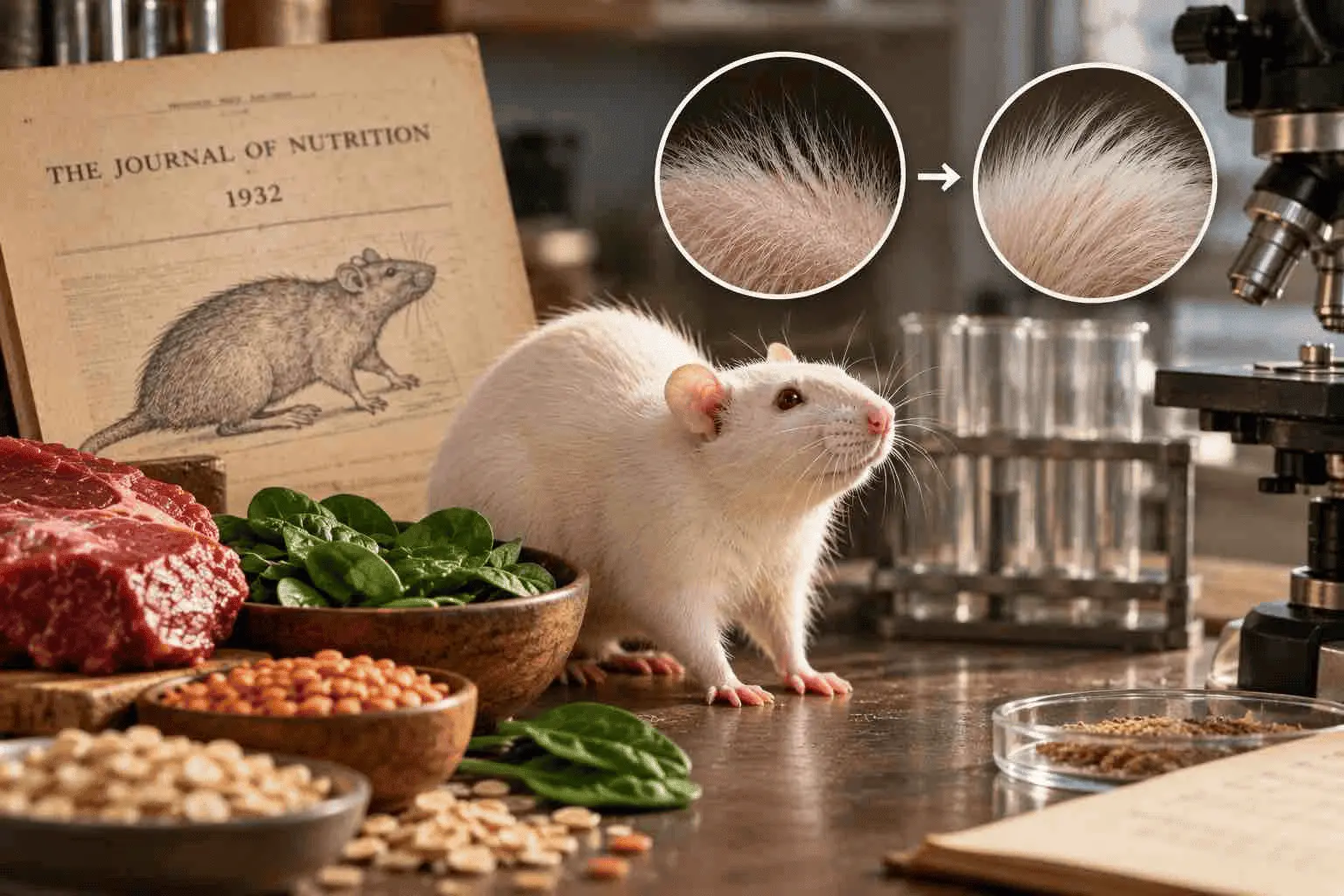
The central observation was straightforward: young rats maintained for one to two months on a ration containing very little iron, but described as adequate in other respects, became practically hairless. New Zealand Department of Agriculture reporting from the same period described a marked response in hair growth after iron was administered and stated that iron present in the ration from the beginning protected the animals from hairlessness.
The result linked an experimentally controlled dietary deficiency with a visible change in the coat. This contrast between deficient animals and animals receiving iron was central to the experiment’s interpretation. It indicated that the observed hairlessness was responsive to the nutritional conditions rather than being an irreversible characteristic of the animals. It did not, however, establish that every form of hair loss is caused by iron deficiency or that the same response necessarily occurs in other species.
What Was Limonite and Why Was It Used
Cunningham used limonite, a hydrated iron oxide, as the source of dietary iron administered to young rats after weaning. A small daily quantity either prevented the hairless condition or helped reverse it in the deficient rats. Contemporary New Zealand agricultural reports also describe limonite as an iron-containing material being used in livestock mineral licks in districts affected by mineral-related unthriftiness.
Iron supplementation in its historical setting
This agricultural context matters because the study was not framed only as laboratory nutrition research. At the time, researchers were seeking connections between pasture composition and livestock condition. A finding that could be observed directly in growing animals offered a starting point for asking whether mineral availability influenced other types of animal fibre. New Zealand investigators were actively examining mineral availability in soils, pastures and livestock, and iron-containing licks were part of that wider programme. Cunningham’s rat experiment therefore raised an applied question about whether a similar nutritional factor might influence wool production.
What Did the Experiment Actually Demonstrate
Cunningham's experiment demonstrated a relationship between severe dietary iron restriction and hair loss in young rats under the conditions investigated. It also supports a protective or restorative response when iron was supplied as limonite. The Department of Agriculture’s annual report independently summarizes the same pattern: very low dietary iron produced near hairlessness, iron administration was followed by renewed growth, and dietary iron from the start was protective.
Key observations from the 1932 report
The study can be reduced to three experimentally relevant observations. They describe the rat model only and should not be extended directly to sheep or people.
Experimental condition | Reported observation | Interpretation within the study |
Very low-iron ration | Young rats became practically hairless | Severe iron restriction was associated with impaired hair growth |
Iron supplied after deficiency | Marked hair growth followed iron administration | The coat change was responsive to iron replacement |
Iron present from the beginning | Hairlessness was prevented | Adequate dietary iron was protective in the rat model |
Why Did Cunningham Connect Rat Hair With Sheep Wool
Hair and wool are both keratinized fibres produced by follicles, so a nutritional effect on rat hair raised an obvious agricultural question. Cunningham suggested that the findings could be important for wool production on iron-deficient pastures and that observations on iron feeding and wool growth in sheep were needed.
The rat experiment generated a hypothesis about sheep. Cunningham did not measure wool growth or fleece weights in a controlled sheep supplementation trial, so the findings cannot establish that iron supplementation increases wool production.
What Was Happening in New Zealand Pasture Research
The study appeared during intensive New Zealand work on mineral-related livestock disorders. Contemporary reports described the use of iron-containing limonite licks in some districts and investigations into how soil and pasture conditions influenced mineral nutrition. A 1932 discussion in Nature likewise described New Zealand research that had linked ‘bush sickness’ with mineral conditions and iron availability, illustrating the scientific setting in which Cunningham’s work was interpreted.
Pasture iron and wool growth were separate questions
Evidence that an iron-containing supplement benefited livestock affected by a mineral disorder did not by itself prove an effect on wool growth. Cunningham’s article is valuable precisely because it shows how a laboratory observation in rats was used to identify a new livestock research question rather than to claim a completed sheep experiment.
How Does Later Rat Research Fit the 1932 Observation
Later experimental work confirmed that iron deficiency can produce broad physiological changes in rats. A 1965 study reported altered coat appearance along with changes in body and organ physiology in iron-deficient animals. These findings support the wider physiological importance of adequate iron nutrition without reproducing Cunningham’s 1932 experiment.
These later findings provide context rather than a replication of Cunningham’s exact experiment. They do not establish that the specific hairless phenotype, limonite dose or experimental ration used in 1932 would produce identical results under modern protocols.
What Does Later Sheep Research Show About Iron
Later sheep studies confirm that iron status can matter for animal health, particularly under controlled or housed conditions. Research in growing lambs found poor performance at very low dietary iron levels, while later work on housed lambs documented iron-associated anaemia and hematological responses to supplementation.
However, these studies do not demonstrate that additional iron increases wool growth. Findings on iron requirements, anaemia and clinical responses in lambs cannot establish the wool-production hypothesis raised by Cunningham’s rat experiment.
How Should the 1932 Results Be Interpreted Today
The strongest conclusion remains narrow: under Cunningham’s experimental conditions, severe dietary iron deficiency impaired normal hair maintenance or growth in young rats, and supplying iron reversed or prevented the visible coat effect. The proposed connection with wool was a research hypothesis. A direct investigation of sheep would have needed to separate deficiency correction from any claim of improved wool production. Such an investigation would also have required wool-specific outcomes, rather than relying on changes in rat coats.
Modern readers should distinguish correction of iron deficiency from supplementation above nutritional requirements. Later lamb studies investigated iron status and clinical outcomes, not the effect of routine iron supplementation on wool yield.
What Are the Main Limitations of the Historical Evidence
The published account does not establish the full ration composition, number of animals, precise limonite dose, quantitative hair-growth measurements, statistical analysis or detailed experimental design. These gaps limit how precisely the original experiment can be evaluated.
The work also used rats as the experimental model. Its proposed importance for wool production was therefore prospective rather than demonstrated, and the results should not be treated as evidence for current livestock supplementation practices or as a direct model of human hair loss.
Why Does This Study Still Matter
Cunningham’s experiment is an early example of nutritional research linking a trace mineral deficiency with a visible change in hair growth. Contemporary agricultural reporting supports the core observation that severe iron restriction produced hair loss in young rats and that iron administration was followed by regrowth.
Its agricultural significance lies in the question it generated rather than in a proven wool-production effect. The distinction matters because the biological consequences of severe deficiency are not equivalent to the benefits of adding a nutrient to an otherwise adequate diet. The study remains informative when its direct observations and wider agricultural implications are considered separately. The study helped direct attention toward testing mineral nutrition in sheep while leaving the wool hypothesis open for further investigation.
Practical takeaway: The 1932 evidence supports a role for adequate dietary iron in normal hair growth in young rats, but it does not show that routine iron supplementation increases wool production in sheep.
Frequently asked questions
Can dietary iron deficiency cause hair loss in rats?
Young rats fed a ration containing very little iron became practically hairless after one to two months. The ration was described as otherwise adequate, making iron restriction the central dietary factor under investigation. The observation linked severe iron deficiency with visible coat changes in this experimental model, not with all causes of hair loss.
What effect did limonite have on hair growth in rats?
Limonite was used as a source of iron after weaning. A small daily amount was reported to prevent the hairless condition or support recovery of hair growth. The historical account does not establish a precise dose, and the observation is not a modern supplementation recommendation.
Did Cunningham test wool growth in sheep?
Cunningham experimented with young rats rather than conducting a controlled wool-growth trial in sheep. He suggested that iron availability might influence wool production on deficient pastures. This was an agricultural hypothesis that required direct testing of fleece growth in sheep before any practical conclusion could be drawn.
Does iron supplementation increase wool production in sheep?
No. Cunningham’s experiment supports a relationship between severe iron deficiency and impaired hair growth in young rats. It did not measure sheep fleece weight or wool yield. Later investigations of iron status in lambs concern nutritional requirements and health outcomes, which cannot establish that extra iron increases wool production in adequately nourished sheep.
Why is Cunningham’s 1932 dietary iron research historically important?
Cunningham’s work connected trace-mineral nutrition with a visible hair-growth response during an early period of experimental animal nutrition research. It also linked laboratory observations to questions about New Zealand livestock production. Its historical significance lies in showing how an experiment in one species could generate testable agricultural hypotheses without proving the same effect in another.
Can the results be applied to human hair loss?
Cunningham’s 1932 experiment involved young rats and was not a human clinical study. It cannot identify the cause of hair loss in an individual person or establish a human treatment. Human hair loss has several potential causes, and interpreting iron status requires evidence from human research and appropriate clinical evaluation rather than extrapolation from this rat experiment.
Sources
- Cunningham, I. J. (1932). Influence of dietary iron on hair and wool growth. New Zealand Journal of Agriculture, 44, 335–337.
- New Zealand Department of Agriculture. (1932). Annual Report: experimental work on iron absorption and hair growth in rats. Appendix to the Journals of the House of Representatives, 1932.
- New Zealand Journal of Agriculture. (1932). “Bush Sickness and Dopiness”: discussion of limonite and iron-containing livestock licks in New Zealand.
- King, A. T. (1932). Sulphur Assimilation in Wool Growth. Nature, 129, 938.
- Cusack, R. P., & Brown, W. D. (1965). Iron Deficiency in Rats: Changes in Body and Organ Weights, Plasma Proteins, Hemoglobins, Myoglobins, and Catalase. Journal of Nutrition, 86(4), 383–393.
- Lawlor, M. J., Smith, W. H., & Beeson, W. M. (1965). Iron Requirement of the Growing Lamb. Journal of Animal Science, 24(3), 742–747.
- Green, L. E., Berriatua, E., & Morgan, K. L. (1993). Anaemia in housed lambs. Research in Veterinary Science, 54(3), 306–311.
- Vatn, S., & Framstad, T. (2000). Anaemia in housed lambs: effects of oral iron on clinical pathology and performance. Acta Veterinaria Scandinavica, 41(3), 273–281.

Eleanor Hayes — author
Eleanor Hayes writes with an editorial focus on research methodology and study design, including experimental and observational studies, controls, sampling, measurement and the methodological choices that shape scientific conclusions. At CAB Direct, Eleanor co...
Related
The 1989 Molecular Cloning Manual: Why Labs Still Cite It

The Seven Countries Study: Diet and Heart Deaths in 1980
Animals, Fungi and Protozoa: How a 1998 Idea Held Up

Why Homes Get Cheaper Further Out: Alonso’s 1964 Model

Conservation Biology: Ecological Principles and Insularization
Gluconeogenesis From Glycine and Serine in the Rat