





Vacationscape: Designing Tourist Regions for Visitors and Place
Clare A. Gunn's Vacationscape argued that successful tourist regions must be designed around both visitor satisfaction and the integrity of the places people come to experience. The 1988 second edition used land-use principles and site examples to show how commercial attractions, natural resources, transport, services and public spaces could be planned as parts of a coherent destination rather than as isolated projects.
This explainer places Gunn's book in the wider evolution of tourism planning, from destination life-cycle thinking and community approaches to current visitor-management and sustainability standards. It treats Vacationscape as a design and planning classic: influential for its systems perspective, but not a modern impact assessment or a current regulatory manual.
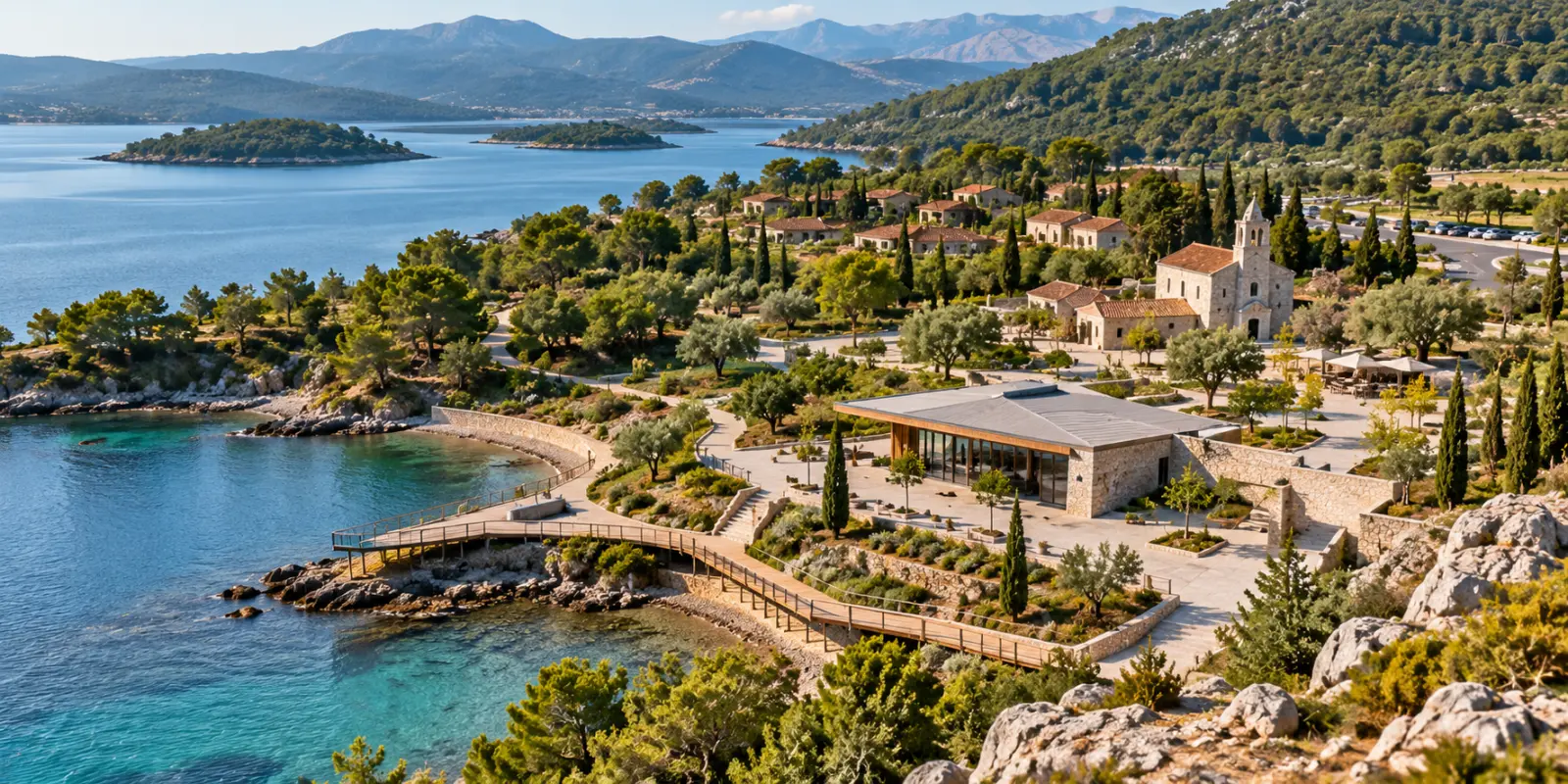
Vacationscape treated tourism as a design problem at regional scale
The book's central concern is the design of tourist attractions that encourage return visits while respecting the natural integrity of the surrounding environment. Gunn did not limit tourism planning to hotels or individual attractions. The book addressed land use and site design across a wide range of settings, including campgrounds, cultural attractions, entertainment facilities, historic sites, shopping areas, convention centres, sports arenas, theme parks and holiday homes.
That breadth reflected a regional view of tourism. A visitor experiences not one building but a sequence of places: arrival routes, attractions, landscapes, services, public spaces and the connections among them. The quality of the destination therefore depends on how those elements fit together, not simply on the commercial performance of one property.
The book linked visitor satisfaction with environmental fit
The 1988 edition is notable for treating visitor needs and environmental surroundings as parts of the same design question. The book argues that development schemes should satisfy tourists while remaining compatible with protection of the environment. This was not the same as today's sustainability frameworks, but it moved tourism design beyond the idea that more facilities automatically create a better destination.
Gunn's emphasis was practical. Site layout, land-use relationships and the character of attractions influence whether visitors can move comfortably, understand a place and experience it without the destination destroying the qualities that made it attractive in the first place.
A tourist region works as a system: the quality of the experience depends on how attractions, access, services and place fit together.
Destination design sits between architecture and regional planning
Vacationscape is difficult to place in a single discipline because it bridges landscape architecture, recreation planning, tourism economics and regional development. Library records classify the 1988 second edition under tourism, recreation areas and architectural design, while the book's own chapter headings include travellers, public involvement and tourism destinations.
This mixed perspective was one of its strengths. Tourism changes land, traffic, public space and patterns of investment, so destination design cannot be reduced to visual appearance. A well-designed attraction still depends on transport, service infrastructure, neighbouring land uses, local communities and the capacity of the wider region to absorb visitors.
Gunn's thinking developed alongside systems-based tourism planning
Tourism planning scholarship in the 1980s was increasingly concerned with how many interacting parts of a destination could be planned together. Donald Getz's 1986 review of tourism-planning models argued for stronger integration between theory and practice and presented a systems-based approach to area tourism planning.
Vacationscape belongs to that same intellectual shift. Its design examples show that an attraction is not isolated from transportation, accommodation, commercial services or environmental resources. Planning therefore becomes a coordination problem: decisions about one part of the destination alter the functioning and experience of the rest.
The tourist-area life cycle added a time dimension
R. W. Butler's 1980 tourist-area life-cycle model proposed that destinations can pass through stages of exploration, involvement, development, consolidation and stagnation, followed by possible decline or rejuvenation. The model was not a design manual, but it added an important temporal question to the spatial issues Gunn addressed.
A destination that works well at low visitor volumes may function differently after large-scale development. Roads, beaches, historic centres and public spaces can become crowded; original attractions can be altered; and infrastructure can fall behind demand. Design decisions therefore need to consider how a destination may change as visitation grows.
Planning for growth is different from reacting to growth
The life-cycle idea and Gunn's regional design perspective point to the same practical lesson: tourism development creates path dependence. Once hotels, roads and attraction zones are fixed in place, later corrections can be expensive. Early decisions about access, land use, public space and environmental protection can therefore shape decades of destination performance.
Community interests became a stronger part of destination planning
Peter Murphy's 1985 Tourism: A Community Approach argued that long-term tourism development should be evaluated from the viewpoint of destination areas and host communities, not only visitors and investors. Murphy emphasised local initiative, local benefits and development compatible with the physical and social environment.
This complements Vacationscape rather than replacing it. Gunn focused strongly on the physical organisation of tourist regions, while community-based planning broadened the question to who participates, who benefits and how residents experience development. Modern destination planning usually needs both: spatial design and stakeholder governance.
Integrated planning made sustainability more explicit
Edward Inskeep's 1991 Tourism Planning: An Integrated and Sustainable Development Approach developed a comprehensive planning framework for attractions, transport, accommodation, infrastructure, environmental factors and socioeconomic impacts. Its scope shows how quickly tourism planning moved from site design toward formal sustainable-development language.
The difference is useful historically. Vacationscape anticipated many sustainability concerns through environmental fit and land-use design, but later planning literature developed more explicit methods for impact assessment, carrying capacity, community participation and implementation.
How tourism-planning frameworks expanded after Vacationscape
Framework | Primary scale | Main planning question | Contribution to current destination thinking |
Gunn, Vacationscape, 1988 | Site to tourist region | How should attractions, access, services and landscape be designed together? | Spatial coherence, visitor experience and environmental fit |
Butler, 1980 | Destination over time | How does tourism change as visitor numbers and development intensify? | Lifecycle, capacity and need for renewal or management |
Murphy, 1985 | Host community | How can tourism serve local needs and remain socially compatible? | Community participation and local benefit |
Getz, 1986 | Planning system | How can tourism theory and planning practice be integrated? | Systems-based destination planning |
Inskeep, 1991 | Regional / national planning | How can tourism development integrate environment, infrastructure and socioeconomic goals? | Formal sustainable and integrated planning |
GSTC Destination Standard | Contemporary destination management | How can destinations manage sustainability, visitor pressure and stakeholder responsibilities? | Operational criteria, monitoring and accountability |
Modern destination management measures what older design texts described qualitatively
The World Tourism Organization's 2004 guidebook on sustainable-tourism indicators formalised destination monitoring across issues such as water, waste, seasonality, visitor and resident satisfaction, cultural heritage and environmental pressures. It proposed destination-specific indicators rather than relying only on visual design or general planning intentions.
That shift from design principles to measurable indicators is one of the biggest changes since Gunn's era. A destination can now track whether visitor growth is increasing congestion, resource use, pressure on sensitive sites or dissatisfaction among residents and visitors.
Visitor satisfaction remains important, but it is no longer the only success measure
Gunn's abstract explicitly frames repeat visitation and visitor satisfaction as design goals. Contemporary standards still retain that concern. The Global Sustainable Tourism Council's Destination Standard calls for monitoring visitor satisfaction and taking action in response to feedback.
However, current destination standards balance the visitor experience against community, cultural and environmental outcomes. The GSTC also requires destination strategies, stakeholder coordination, management of visitor volumes and activities, and protection of sensitive natural and cultural sites.
Managing visitor flows has become central in high-pressure destinations
One of the clearest modern extensions of Gunn's design logic is visitor-flow management. Attractions are connected by roads, pedestrian routes, transit, public spaces and information systems; when those connections fail, overcrowding can concentrate even when the wider region has unused capacity.
The current GSTC Destination Standard explicitly calls for systems to monitor and manage visitor volumes and activities, including action to spread visitation across places and times where appropriate. This turns a spatial design issue into an ongoing management responsibility.
Design can spread pressure rather than simply add capacity
Adding parking, hotel rooms or larger attractions can increase peak demand instead of solving crowding. An alternative is to diversify attractions, strengthen public transport, improve walking routes, shift events across seasons or guide visitors toward less sensitive locations. These measures use design and management together rather than assuming that capacity expansion is always the answer.
Environmental protection now includes climate resilience
The environmental concerns in Vacationscape focused on preserving the natural integrity of tourism settings. Modern destination planning adds climate risk. Heatwaves, wildfires, floods, coastal erosion and water scarcity can directly affect attractions, infrastructure and visitor safety.
OECD Tourism Trends and Policies 2024 argues that destinations need more coordinated, forward-looking strategies to manage environmental and community pressures while adapting tourism infrastructure and business models to climate-related risks. This extends Gunn's environment-tourism relationship from site compatibility to resilience at destination and regional scale.
Tourism planning is also about governance
A beautiful masterplan cannot coordinate public transport, conservation agencies, private attractions, accommodation providers and local residents by itself. Current destination standards therefore place responsibility, funding, stakeholder engagement and implementation capacity at the centre of destination management.
This is another important evolution from classic design texts. Gunn showed how physical components should relate spatially; contemporary governance frameworks ask who maintains those relationships, how conflicts are resolved and how outcomes are measured over time.
What remains valuable in Vacationscape
Vacationscape remains useful because it treats tourist regions as designed environments rather than accidental collections of businesses. Its central insights are still recognisable: visitors experience linked places, attractions depend on their surroundings, land-use choices shape destination quality and environmental character is part of the tourism product.
What has changed is the level of accountability. Modern planners are expected to measure environmental and social impacts, involve communities, manage visitor pressure, plan for climate risk and document progress. Gunn's book is therefore best read as a design foundation that anticipated later destination-management practice, not as a complete contemporary sustainability framework.
A modern reading of Vacationscape asks planners to connect:
- visitor needs with the physical character and limits of the destination;
- individual attractions with transport, services, public space and surrounding land uses;
- site design with the wider region and with future growth over time;
- visitor satisfaction with resident experience and environmental protection;
- masterplans with monitoring, stakeholder governance and adaptive management.
Taken together, Vacationscape remains valuable as a historical foundation for regional tourism design, while contemporary destination planning extends its approach through measurable sustainability, governance and climate-resilience requirements.
Frequently asked questions
What did Gunn mean by designing a tourist region?
Gunn treated a destination as more than a collection of separate attractions. Tourist experiences depend on the spatial relationship among attractions, access routes, services, landscapes and public spaces. Designing the region therefore means coordinating land use and site design so the destination functions coherently for visitors while protecting the qualities of place.
Is Vacationscape a sustainable-tourism book?
It predates today's formal sustainable-tourism standards, but it contains important precursor ideas. The 1988 edition emphasised environmental integrity, land-use compatibility and visitor satisfaction. Modern sustainability frameworks add explicit community participation, measurable indicators, climate resilience, visitor-pressure management and governance requirements that were less developed in classic design texts.
How does Butler's tourism-area life cycle relate to Gunn's work?
Butler focused on how destinations change over time as tourism develops, while Gunn concentrated on how tourist regions are spatially designed. Together, the ideas highlight two planning dimensions: where attractions and services are placed, and how those arrangements may perform differently as visitation, investment and congestion increase.
Why is visitor-flow management important in tourist regions?
Visitor pressure is rarely distributed evenly. Popular attractions, roads, historic centres and viewpoints can become crowded while nearby areas remain underused. Destination planning can spread demand through transport, route design, timed access, alternative attractions and seasonal programming, helping protect sensitive sites while maintaining a better visitor experience.
Why classify Vacationscape as a science classic rather than a current planning manual?
The book remains influential for its regional design perspective, but it was published in 1988 and predates contemporary sustainability standards, climate-risk planning and modern monitoring tools. Reading it as a classic preserves its historical contribution while allowing newer evidence and destination-management frameworks to supply current practice.
Sources
- Gunn CA. Vacationscape: Designing Tourist Regions. 2nd ed. New York: Van Nostrand Reinhold; 1988. 208 pp. ISBN 978-0-442-22679-4.
- Goodrich JN. Book Reviews: Vacationscape: Designing Tourist Regions, by Clare A. Gunn. Journal of Travel Research. 1988;27(2):59–60.
- Butler RW. The Concept of a Tourist Area Cycle of Evolution: Implications for Management of Resources. The Canadian Geographer. 1980;24(1):5–12. doi:10.1111/j.1541-0064.1980.tb00970.x.
- Murphy PE. Tourism: A Community Approach. New York: Methuen; 1985.
- Getz D. Models in tourism planning: Towards integration of theory and practice. Tourism Management. 1986;7(1):21–32. doi:10.1016/0261-5177(86)90054-3.
- Inskeep E. Tourism Planning: An Integrated and Sustainable Development Approach. New York: Van Nostrand Reinhold; 1991.
- World Tourism Organization. Indicators of Sustainable Development for Tourism Destinations: A Guidebook. Madrid: World Tourism Organization; 2004. ISBN 978-92-844-0726-2.
- Global Sustainable Tourism Council. GSTC Destination Standard. Version 2.0.
- OECD. OECD Tourism Trends and Policies 2024. Paris: OECD Publishing; 2024.

Eleanor Hayes — author
Eleanor Hayes writes with an editorial focus on research methodology and study design, including experimental and observational studies, controls, sampling, measurement and the methodological choices that shape scientific conclusions. At CAB Direct, Eleanor co...
Related

Seven Countries Study: Coronary Heart Disease Across Populations

Heinrich and the Origins of Modern Industrial Accident Prevention

Garlic Honey Tea and Blood Pressure: What the Study Found

Mycotoxins in Dried Raisins in Egypt: Fungi and Contamination

Teaching Young Children to Swim: Didactic Approaches in Slovenia
Metofluthrin Mosquito Repellent: Field Efficacy in Outdoor Trials